Links
- CV
- Titles
- Topics
- Tickets
- Science
- About Eric
- Book Reviews
- Country Profile
- Modern China
- Contact Eric
- Podcast
- Vision
- Sekai
- John
Archives
RSS

Reflections on a Wandering Life.....
Wednesday, December 29, 2010
A Hole to Bury You
Very interesting couple of articles in the Asia Wall Street Journal. They aren't in the same part of the paper, and the fact that they both occurred in the same issue may be coincidence, but I thought it was interesting.
The first concerns a professor in China who was roughed up by police after trying to visit a dissident. His report on the incident is very well written, and convincingly condemning of the Chinese approach to law enforcement (putting human rights safeguard into law and then dutifully ignoring those safeguards). The other article is about a young Black kid with no money who was accused of a murder he did not commit.
It's interesting. When you read the story by the Chinese professor, you get a picture of China's cops as goons and thugs who have no respect for law. But the professor was free after a very short period of time. This does not justify what they did to him, of course, but what he suffered at the hands of the Chinese legal system is nothing compared to what the Black kid went through in the American system. He was not roughed up at all. But he did spend 15 years in prison for a crime he did not commit, and ended up getting out because, and only because he acted as his own lawyer, and would not let the case die.
The second story does not mitigate the first. But what it does point out is that, while the legal system in China certainly needs reform, if China ever has a mind to reform the legal system, China must not follow the American model. Both legal systems are seriously in need of reform. Both systems have deep flaws built into the standard procedure that almost guarantee injustice.
The first concerns a professor in China who was roughed up by police after trying to visit a dissident. His report on the incident is very well written, and convincingly condemning of the Chinese approach to law enforcement (putting human rights safeguard into law and then dutifully ignoring those safeguards). The other article is about a young Black kid with no money who was accused of a murder he did not commit.
It's interesting. When you read the story by the Chinese professor, you get a picture of China's cops as goons and thugs who have no respect for law. But the professor was free after a very short period of time. This does not justify what they did to him, of course, but what he suffered at the hands of the Chinese legal system is nothing compared to what the Black kid went through in the American system. He was not roughed up at all. But he did spend 15 years in prison for a crime he did not commit, and ended up getting out because, and only because he acted as his own lawyer, and would not let the case die.
The second story does not mitigate the first. But what it does point out is that, while the legal system in China certainly needs reform, if China ever has a mind to reform the legal system, China must not follow the American model. Both legal systems are seriously in need of reform. Both systems have deep flaws built into the standard procedure that almost guarantee injustice.
Sunday, December 26, 2010
China, the New Black Hole
I grew up in a boarding school in Northern Japan. It was an isolated environment in many ways, but I had a connection to the world that predated computers by a generation. It was my short wave radio. I used to tune in the Voice of America from the States, the Far East Network (American Armed Forces Radio) from Tokyo, and Radio Moscow from the Soviet Union. But from China, nothing. China in those days was the "black hole."
China's "reform and opening up" has changed that situation dramatically, but the vestiges of China's historical antipathy toward outsiders does have modern manifestations. A fascinating map put together by a Facebook Intern shows a light for every Facebook connection in the world.
Click picture for high resolution image.
 Most interesting is the big blank spot where China is supposed to be. Facebook is blocked in China. But the map is misleading. I am in China, and I use Facebook regularly. The blocking of Facebook started a revolution among young people who suddenly had a reason to break through the GFW (Great Firewall of China). VPN (Virtual Private Networks) are fast becoming a standard accessory for young people who want to be involved internationally. When you use a VPN, it effectively takes you "out" of China. The other day, I was trying to view a video on Youku (Chinese Youtube copycat site) that I sometimes use for language practice. Since I was going to a site inside of China, I didn't need my VPN, but I had been using it for something else, and had forgotten to turn it off. When I tried to access the Youku video, I got a message that said, "Sorry, but this video is currerntly available to be streamed within China only (China blocks some content going out as well as some content coming in)." Obviously, I was coming at it with an IP address outside of China. So when you look at the lights in this Facebook map, many of them do in fact show connections with Chinese users, but they show up as connections to locations (wherever the VPN server happens to be) outside of China.
The blocking of Facebook was frustrating at first, but in many ways, it is one of the best things that has happened to the Internet in China, because it has motivated young Chinese engineers to conquer the GFW like nothing else could have.
China's "reform and opening up" has changed that situation dramatically, but the vestiges of China's historical antipathy toward outsiders does have modern manifestations. A fascinating map put together by a Facebook Intern shows a light for every Facebook connection in the world.
Click picture for high resolution image.
 Most interesting is the big blank spot where China is supposed to be. Facebook is blocked in China. But the map is misleading. I am in China, and I use Facebook regularly. The blocking of Facebook started a revolution among young people who suddenly had a reason to break through the GFW (Great Firewall of China). VPN (Virtual Private Networks) are fast becoming a standard accessory for young people who want to be involved internationally. When you use a VPN, it effectively takes you "out" of China. The other day, I was trying to view a video on Youku (Chinese Youtube copycat site) that I sometimes use for language practice. Since I was going to a site inside of China, I didn't need my VPN, but I had been using it for something else, and had forgotten to turn it off. When I tried to access the Youku video, I got a message that said, "Sorry, but this video is currerntly available to be streamed within China only (China blocks some content going out as well as some content coming in)." Obviously, I was coming at it with an IP address outside of China. So when you look at the lights in this Facebook map, many of them do in fact show connections with Chinese users, but they show up as connections to locations (wherever the VPN server happens to be) outside of China.
 The blocking of Facebook was frustrating at first, but in many ways, it is one of the best things that has happened to the Internet in China, because it has motivated young Chinese engineers to conquer the GFW like nothing else could have.
Saturday, December 25, 2010
Christmas in China
Last night I went to the Bridge Cafe for a Christmas dinner. I don't generally go to this dinner, because it is quite expensive. It's not that easy for a restaurant in China to provide a traditional American Christmas dinner, so the cost is quite a bit more than the same meal would be in the States, and about ten times as much as a reasonably similar meal in China. Sorta like trying to get Chinese food in the US. This year, however, Nell decided to invite me because I have been a customer of the coffee bar for so long. I have been in China nearly seven years now, and I have been studying at the Bridge Cafe for almost that long.

 After the dinner, Jacky and Melissa and Betsy wanted to stop by and visit me. Their small house church had a Christmas party, and they came by after that was finished. Christmas Eve in China is very much a church thing rather than a family thing. When I was a kid, Christmas Eve was for family, and then Christmas Day there was often a church service. Since China is not a Christian country, families don't really celebrate Christmas. But Christmas has gradually become an international festival, so it exists in come form in practically ever society. In China, Christmas Eve is called 平安夜 (ping an ye), which means, literally, "peaceful evening." For most people, it's considered an excuse to go out to dinner at a nice restaurant. So restaurants are open a little later then usual, and there is a more or less festive atmosphere.
Christmas Day. Most years I have had a Christmas party in my apartment on Christmas Day, but this year I moved out to Fragrant Hills, and the tiny place I rented is not really big enough for that sort of thing. I had thought of holding it in a coffee bar or something, because I have done that before. But I found out that Rosie had organized a cooperative Christmas party in her office building. It was a joint party for several Bible study groups, and she invited us to join, so I decided it would be a good idea. It turned out really well. She had contracted with the cafeteria in the basement of her building to prepare a dinner for us, and then we each bought dinner tickets for 30 RMB. It's a lot of work to set something like that up, and I was quite impressed with how well it went.
After the dinner, Jacky and Melissa and Betsy wanted to stop by and visit me. Their small house church had a Christmas party, and they came by after that was finished. Christmas Eve in China is very much a church thing rather than a family thing. When I was a kid, Christmas Eve was for family, and then Christmas Day there was often a church service. Since China is not a Christian country, families don't really celebrate Christmas. But Christmas has gradually become an international festival, so it exists in come form in practically ever society. In China, Christmas Eve is called 平安夜 (ping an ye), which means, literally, "peaceful evening." For most people, it's considered an excuse to go out to dinner at a nice restaurant. So restaurants are open a little later then usual, and there is a more or less festive atmosphere. Christmas Day. Most years I have had a Christmas party in my apartment on Christmas Day, but this year I moved out to Fragrant Hills, and the tiny place I rented is not really big enough for that sort of thing. I had thought of holding it in a coffee bar or something, because I have done that before. But I found out that Rosie had organized a cooperative Christmas party in her office building. It was a joint party for several Bible study groups, and she invited us to join, so I decided it would be a good idea. It turned out really well. She had contracted with the cafeteria in the basement of her building to prepare a dinner for us, and then we each bought dinner tickets for 30 RMB. It's a lot of work to set something like that up, and I was quite impressed with how well it went.
Tuesday, December 14, 2010
Most nations oppose peace prize to Liu?
I have never seen China so angry. This time they have abandoned all attempts at even a pretense of integrity. Sixty-five nations were invited to Oslo for the awarding of the Nobel Prize for Peace. About 19 or 20 declined. I suppose you could say that some of them would agree with China. Russia, for example, has had it's own issues with the peace prize. They don't respect it. But countries like the Philippines have said privately that they were afraid of angering China. But to read the headlines in the China Daily, you would think support for China was all but unanimous.
What would you be led to believe if the only information you had about the peace prize controversy came from headlines like, "'Most nations' oppose peace prize to Liu," or "100-plus nations, organizations back Beijing's peace prize stance?"
Whatever you think about Liu Xiaobo, there is absolutely no integrity in China's position relative to this issue, and that is why China is losing the propaganda war, at least internationally. Within China, it is a different matter, because Chinese people have learned from painful experience that their lives will be much less complicated if they stay out of politics. And in today's China, you are allowed to be apolitical. It wasn't that way during the Cultural Revolution. During those days, if you weren't saying, "Long live Chairman Mao" every other sentence, you could be accused of being "counter revolutionary." But in today's China, the neutral option is allowed. So to people in China, Liu Xiaobo's decision not to be neutral is viewed as prima facie evidence that he is a troublemaker. That is, if they have heard of him. Most have not. Which again points to China's sense of desperation in responding to this issue. A Global Times editorial said, "The Nobel committee has no reason to believe their political judgment is better than that of 1.3 billion people. The West has no authority to overrule Chinese people's values and judgment." The statement is disingenuous. Their own research shows that well over 70 percent of the public doesn't even know who Liu Xiaobo is. And you wouldn't need the research. The person who wrote that editorial knows very well that information about this issue is strictly controlled in China. Trust me, this one is not about how the Chinese people feel. It is about how the Communist Party feels about their image before the watching world. In their desperation to counter the negative image and downplay the Nobel ceremony, China quickly invented their own
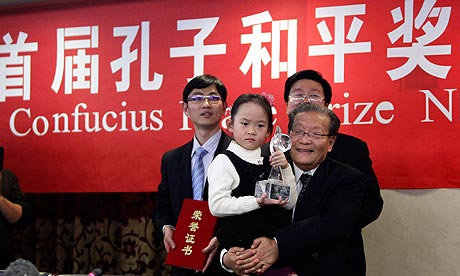 "Confucius Peace Prize," giving the award to Lien Chan. Lien Chan is a former KMT leader from Taiwan who supports reunification with China (which is the official KMT position) and has visited China and met with mainland leaders.
 Unfortunately, in the rush to throw the whole fiasco together, somebody forgot to tell Lien himself about the "award." He only heard about it when the media called to ask him what he thought. In his absence, they grabbed a little girl who happened to be handy, and gave the "award" to her. Poor kid looks like she's trying to figure out what the whole thing is all about. She and a lot of other people. I guess her parents can't be too disappointed with the 100,000 RMB in prize money. But what a farce!
China really doesn't get diplomacy. Every time they do something like this, they end up looking stupid. It's as if they had gone out and hired a western ad agency and said, "Money is no object; just help us to look as ridiculous as possible."
As I have said before, I do not agree with Liu Xiaobo's idea that American style democracy is the cure for China's ills. China is not a Christian country. Democracy requires a strong, underlying moral foundation, and this China does not have. I believe American style democracy would be a disaster in China at this point. But Liu Xiaobo does have some good ideas that ought to be discussed. Cantankerous? Perhaps. Controversial? Certainly. But criminal? No. That isn't working.
What is his crime? China says that he is guilty of "subverting state power." But what does that mean? What, exactly, did Liu Xiaobo do that constituted "subverting state power?" Answer: He advocated implementation of a multi-party democracy. He wrote this proposal (along with several others) in a charter, and put it on the Internet. It was signed by 10,000 people, including several top Communist Party members. So you can see why the CCP considers Liu Xiaobo a criminal. This is China's conundrum. China holds out the irrational hope that she will be able to convince western countries that Liu Xiaobo should be considered a criminal deserving an 11 year prison sentence just because he has called for an end to one party rule. It's a vain hope. Western countries worship multi-party democracy.
But even though I don't agree with China's assessment of Liu Xiaobo, once they decided not to participate, they should have just ignored it. That's what a confident, self-assured nation would have done. And that's what the largest number of respondents in their own survey advised. China chose to ignore that wise counsel, which shows that they don't really care what their own people think. But they are hopelessly obsessed with what the rest of the world thinks. This is one propaganda war China is going to lose. Most people are impressed with the tremendous economic progress China has made, beginning with Deng Xiaoping's economic reforms, which have lifted some 400 million people out of poverty. But when it comes to human rights, China is not respected. You can fake a peace prize, but you can't fake human rights.

Saturday, December 11, 2010
Fragrant Hills Fellowship
 This evening Mellissa (she spells it with two l's) invited the Fragrant Hills Fellowship to her place for a Chongqing hotpot. Mellissa's village is three bus stops from Fragrant Hills. It is not that often that I have Chongqing hotpot in Beijing. What is much more common in North China is the Beijing hotpot, which is actually the old Mongolian hotpot.
 The Mongolian hotpot generally focuses on mutton, but also often includes beef and pork, and uses a water based soup. The Chongqing hotpot uses an oil base, and in it's purest form, employs the stuff that used to be considered garbage. This is because the Chongqing hotpot was invented by longshoreman working on the docks in Chongqing in the first half of the 20th century. They were very poor, so they gathered the scraps discarded by the meat processing plants, and spiced it up to obscure the original flavor. So now, when you have an original Chongqing hotpot in Chongqing or Chengdu, the stuff on the menu will be the same old garbage, now regarded as delicacy.
If you have a Chongqing hotpot in Beijing, it may have the same base as the hotpot in Chongqing, but you will more likely be eating the razor thin sheets of mutton, beef, or pork that are more commonly associated with traditional Beijing (Mongolian) hotpot.
Sunday, December 05, 2010
Shawarmas and Tea
 Charley and James and Shasha and I went to a new Palestinian restaurant this evening that Jordan told me about. These guys are Palestinians from Jordan (the country) and Jerusalem. The food is really, really delicious, and quite reasonable. Maybe not every day reasonable, but not expensive at all. Fifteen kuai for a Shawarma, and boy, are they good!. Hard to predict what the future of this place will be, because Wudaokou is a changing community--businesses come and go pretty fast. And the place is not located right on the corner. It is down on the south end of the strip. But it really doesn't take more than a few minutes to walk down there. It's not exactly a study bar, so it is not the kind of place where I would be inclined to spend a lot of time. But the food is exceptional. Really tasty. I think it's going to be a success.
Wednesday, December 01, 2010
Nationalism
Nell has started to hold lectures at the Bridge Cafe on Tuesdays. Last night's subject was "Nationalism and Politics in China." I was a little surprised by the title, because I thought the question of Chinese nationalism would be a little sensitive. In fact, the lecture was not about Chinese nationalism vis-a-vis the rest of the world, but about "nationalism" among minorities in China. That being said, the professor (from Peking University) was quite open and straightforward. I had met him before because I was on a panel with him last year when we did a presentation on the development of religious freedom in China.
He said that when he talked about Chinese nationality, he was referring to Zhongguo (the country) Nationality, not Han (the main "Chinese" ethnic group) nationality, but I said to him that in my experience, Zhongguo nationality becomes Han nationality, because the Han people have the power. I still think that is largely true, but he did tell me that his research showed that 40 per cent of Uighurs identify themselves as Chinese first and Uighur second. That is higher than I would have expected. But it still shows, I think, that most Uighur do not think of themselves as Chinese. That's a problem for the country as a whole. But the larger problem, in my opinion, is that when most Chinese people express their feelings about how China is viewed in the world, they don't always see that it is not a reaction to China as such, but to the Han people themselves, and their treatment of minority people in China. The government seems to think that what they are doing is good, because they are taking care of minorities, and to a certain degree, that is a valid point. Minorities in China get special preferences in China just like they do in America. But the problem with that is that human beings do not like to be taken care of. Dogs like to be taken care of. But human beings prefer to take care of themselves. It is just a fact that minorities in China are not treated like normal Chinese citizens.
Several times on CCTV, I have heard the statement that China (under the New China government post 1949) entering Tibet constituted a freedom for the Tibetan people from the serfdom of the monks. There is considerable truth to this. Life for the common people was not better under the monks. Many of them were taken advantage of. But the statement (on CCTV) that follows always irks me: "This was the beginning of Tibet's democratic reform." This in nonsense. Yes, the Tibetans as a whole probably have a better life under the current Chinese government than under the monks. But no, they most certainly do not have democracy or anything like it. This is the paradox of Tibet. American idealists, like actor Richard Geer (a Buddhist), seem to think that Tibet given back to the monks would be Heaven on Earth. I do not concur. Life for the common people was oppressive under the monks (I mean when the monks were political leaders, not just religious leaders). But the Chinese position seems to be that the Tibetan people should be thankful to be taken care of. But the Tibetan people and the Uighurs and others don't just want to be taken care of. They want to be treated like human beings. And all the propaganda notwithstanding, minorities in China do not have the same freedoms as Han people. For example, any Uighur will tell you that it is much harder for a Uighur to get a passport than for a Han person to get a passport.
He said that when he talked about Chinese nationality, he was referring to Zhongguo (the country) Nationality, not Han (the main "Chinese" ethnic group) nationality, but I said to him that in my experience, Zhongguo nationality becomes Han nationality, because the Han people have the power. I still think that is largely true, but he did tell me that his research showed that 40 per cent of Uighurs identify themselves as Chinese first and Uighur second. That is higher than I would have expected. But it still shows, I think, that most Uighur do not think of themselves as Chinese. That's a problem for the country as a whole. But the larger problem, in my opinion, is that when most Chinese people express their feelings about how China is viewed in the world, they don't always see that it is not a reaction to China as such, but to the Han people themselves, and their treatment of minority people in China. The government seems to think that what they are doing is good, because they are taking care of minorities, and to a certain degree, that is a valid point. Minorities in China get special preferences in China just like they do in America. But the problem with that is that human beings do not like to be taken care of. Dogs like to be taken care of. But human beings prefer to take care of themselves. It is just a fact that minorities in China are not treated like normal Chinese citizens.
Several times on CCTV, I have heard the statement that China (under the New China government post 1949) entering Tibet constituted a freedom for the Tibetan people from the serfdom of the monks. There is considerable truth to this. Life for the common people was not better under the monks. Many of them were taken advantage of. But the statement (on CCTV) that follows always irks me: "This was the beginning of Tibet's democratic reform." This in nonsense. Yes, the Tibetans as a whole probably have a better life under the current Chinese government than under the monks. But no, they most certainly do not have democracy or anything like it. This is the paradox of Tibet. American idealists, like actor Richard Geer (a Buddhist), seem to think that Tibet given back to the monks would be Heaven on Earth. I do not concur. Life for the common people was oppressive under the monks (I mean when the monks were political leaders, not just religious leaders). But the Chinese position seems to be that the Tibetan people should be thankful to be taken care of. But the Tibetan people and the Uighurs and others don't just want to be taken care of. They want to be treated like human beings. And all the propaganda notwithstanding, minorities in China do not have the same freedoms as Han people. For example, any Uighur will tell you that it is much harder for a Uighur to get a passport than for a Han person to get a passport.
