Links
- CV
- Titles
- Topics
- Tickets
- Science
- About Eric
- Book Reviews
- Country Profile
- Modern China
- Contact Eric
- Podcast
- Vision
- Sekai
- John
Archives
RSS

Reflections on a Wandering Life.....
Wednesday, May 31, 2006
Went with Raymond and his girlfriend to a restaurant near the West Gate of Renmin University. That place has the best kao ya west of the Mississippi. Way west of the Mississippi. There is a Peking Duck restaurant down by Tiananmen that is a lot more famous (and about five times as expensive), but I don't believe that the quality is better. I have often wondered if this stuff would be legal in the United States, because of the force-feeding procedure that is used to fatten the birds.
There's a certain technique to eating Peking Duck. I don't know how or when the standard was developed, but somehow it did, and it's probably going to be a standard for some time, because it seems to work pretty well. What you do is to grab a piece of the roast duck with your chopsticks, and dip it in the meat sauce. Then you lay it on a flat flowered shell like a soft tortilla shell. You do this a few times, then grab some sticks of cucumber and do the same with them. Then you roll the whole business up in the tortilla shell, and shovel it in. I generally like Peking duck, but I will say that it varies somewhat, depending on where you get it. The stuff at this particular place is very tender. And cheap. Only 38 RMB for an order. It's a good idea to get a vegetable with it or something, but not too much, because a few mouthfuls of that juicy roast duck will really fill you up. One order easily takes care of three people. It probably would not be a good idea to eat this stuff every day, because it is certainly designed for flavor. But if you're hungry, this meal will definitely satisfy you.
There's a certain technique to eating Peking Duck. I don't know how or when the standard was developed, but somehow it did, and it's probably going to be a standard for some time, because it seems to work pretty well. What you do is to grab a piece of the roast duck with your chopsticks, and dip it in the meat sauce. Then you lay it on a flat flowered shell like a soft tortilla shell. You do this a few times, then grab some sticks of cucumber and do the same with them. Then you roll the whole business up in the tortilla shell, and shovel it in. I generally like Peking duck, but I will say that it varies somewhat, depending on where you get it. The stuff at this particular place is very tender. And cheap. Only 38 RMB for an order. It's a good idea to get a vegetable with it or something, but not too much, because a few mouthfuls of that juicy roast duck will really fill you up. One order easily takes care of three people. It probably would not be a good idea to eat this stuff every day, because it is certainly designed for flavor. But if you're hungry, this meal will definitely satisfy you.
Thursday, May 25, 2006
 Last night I was standing at "Junction #5" (Wudaokou), waiting for the night train from Inner Mongolia to pass so that I could cross and go to the coffee bar to study. Very different from a railroad crossing in America. This one is manned full time by at least one, but usually two guys. When a train is coming, instead of the bar coming down automatically, the guy starts to lower it, then yells over the address system, "Hurry, the train is coming!" in order to get as many people through at the last minute before the train actually gets there. The predominate traffic is pedestrian. Actually, I guess I would have to call it a toss-up between bicycle and pedestrian. Today's China brings a new dynamic, because there are many more cars than before, and yet all the other elements remain, except that there are probably slightly fewer bikes (although still quite a few of them), because some folks have graduated to motorcycles, and eventually, cars. Also, a certain contingent of the population prefers bus transportation.
 Local delivery is done primarily with carts pulled by bicycles--basically a bicycle richshaw. Different from when I was a kid. In Japan, there were many more pushcarts. I have not seen pushcarts in Beijing. I think I have seen something similar in some parts of China, but in Beijing, stuff is delivered with bicycle rickshaws. Beer, fresh meat for local restaurants, drinking water, garbage collection--basically anything that you can imagine being delivered to local markets is handled more often than not by bicycle rickshaw carts. Put them all together--bicycles, pedestrians, motorcycles, richshaws, taxis, busses, and you have quite a varied traffic.
Monday, May 22, 2006
Sitting here in the Waterstone Cafe. Kind of a dungeon of a place near the South Gate, but the wireless connection here is tops, and it is usually quiet. Not tonight. They're showing a movie called, "Scent of a Woman." It's not what you think--it's actually a good movie--about how attitude overcomes handicap, etc. Saw it in a truck stop once. Only then the preppies weren't speaking perfect Mandarin.
Went to McDonald's after church yesterday with some nice folks from Miami. David and his wife are originally from India, but now live in Florida. David is a professor at the University of Miami. He shares my interest in the problem of rural education in China. I am have been looking for a way to do something about this problem, and I am going to be taking a trip to Gansu Province this summer to see what can be done in that area. David and his wife are currently building a school in India. David and I talked about his interest in doing the same kind of thing in China. He is here to speak at a conference, but his interests go deeper--like me, he really wants to get his arms around the problem of rural education. Grandiose to even think about it, but every worthy mission starts with a dream. Funny how people of like mind cross your path just when you're wondering if anyone else feels the way you do.
Went to McDonald's after church yesterday with some nice folks from Miami. David and his wife are originally from India, but now live in Florida. David is a professor at the University of Miami. He shares my interest in the problem of rural education in China. I am have been looking for a way to do something about this problem, and I am going to be taking a trip to Gansu Province this summer to see what can be done in that area. David and his wife are currently building a school in India. David and I talked about his interest in doing the same kind of thing in China. He is here to speak at a conference, but his interests go deeper--like me, he really wants to get his arms around the problem of rural education. Grandiose to even think about it, but every worthy mission starts with a dream. Funny how people of like mind cross your path just when you're wondering if anyone else feels the way you do.
Sunday, May 21, 2006
WHIZZ KID MEMORIZES DICTIONARY
(China Daily)
A 6-year-old boy from Zibo of Shandong Province can give the meaning to any given character and can recall their exact locations in a Chinese dictionary.
Jun started memorizing the Xinhua Dictionary at the age of 4. It took him 11 months to remember all of the characters in the dictionary.
Just the encouragement I need. I recently installed a homemade flashcard program I got from an English teacher on the Teaching in China Yahoo group. My language skill is still quite limited, but for me, it is really a matter of priority. What I mean by that is that my current situation doesn't allow me to study language full time. So that's one thing. I have a job, and I have to give a certain measure of attention to it. But I also have other things to study. For me, the process of "learning" China involves much more than just language. The research says that for Missionary Kids, knowledge of country and culture tends to exceed language proficiency. That is certainly true for me, except for the United States, where I was a native speaker. But even in that case, my interest in the history and culture of the US tended to be significantly above average. I have traveled in every one of the 50 states, and spent a good deal of time talking with local people everywhere I went. Understanding the culture in which I live has always been a high priority for me. I said all that to say this: It is not enough for me to learn the Chinese language. I need to spend a considerable amount of time studying the history and culture of this country. And beyond that, I have a personal need to be involved in some sort of systematic study of the Scriptures. That's just something that's always been part of my life.
How to combine all these. Throughout my adult life, I have expended considerable effort in developing self-teaching methods. When I began to study Chinese, I ran into a roadblock. Every self-teaching method I have developed is based primarily on reading. I diverged from that when I decided to become a technical trainer, because I felt that I would never really have any measure of proficiency if I did not work with the systems I was teaching. So I put a fair amount of emphasis on lab work. Even so, I still spent hundreds of hours reading tens of thousands of pages of documentation. But when I began to study Mandarin, as I said, I hit a brick wall. I didn't know how to read Chinese. So it has taken me quite awhile to develop enough reading proficiency for self-teaching. I am certainly not where I would like to be, but I have managed to get to a point where I can basically make out a sentence, if I have a dictionary available to look up the characters with which I am not familiar.
I started in the spring of 2002 with a tutor about 1-2 hours a week. My first tutor returned to China with her family in August of 2002. Fortunately, I was introduced to Ina at about this time. What a Godsend! Ina was born in Changchun, and lived there until she was 11 years old. At that point, her father moved the family to Japan, where they took out Japanese citizenship. He teaches Chinese at a Japanese university, and she used his textbook to teach me. I will never forget her kind patience as I stumbled through the lessons she gave me. Part of each lesson was a scrambled sentence. I had to arrange the words correctly, using the rules of Mandarin grammar I was learning. Sometimes I frustrated and went to a Chinese restaurant so I could ask a waitress to help me (usually took her about ten seconds). But I really was able to teach myself through my homework most of the time.
When I got to China, I started with a couple tutors here, and then began to take classes at a local language school. The language school really helped my listening comprehension, but it was frustrating, because it is pretty tough to do the exercises in the book if you can't read. So after a year of that, I dropped out and started studying on my own, determined to learn how to read. I bought a book at the level that I thought would fit me, and began to go through the dialogues, looking up one character at a time. The book had forty chapters, so I figured if I could go through one chapter a week, I could finish the book before the end of the year, and go back to the language school. Best laid plans. Took me four months to get through the first two chapters. Pathetically slow, but I do know how to look up a character using the radical chart, now, so the time was well spent. Another thing I did during that time was to develop a self-teaching modus operandi that accommodates my study of the Scriptures. I download sermons from the Internet, and load them in my mp3 player. Every day, as much as possible, I go to the coffee bar with my mp3 player, my Chinese dictionary, and some dialogues and study my Chinese while I am going through the lectures on the Bible. The benefit of a theological lecture as background is that I am guided to keep at my study for a predetermined amount of time.
Just recently, I have started using Chinesepod. This is very helpful, because I can carry the audio with me (the podcast part is free), and read through the dialogues while I am listening to the audio. A little bit of this and a little bit of that and I am somehow slowly getting the job done. But eleven months? That's a little ambitious. Good target, though. If a 4-year-old can do it, I can at least give it a try.
Saturday, May 20, 2006
Read a disturbing piece in the Wall Street Journal about the plight of North Korean refugees. Close to home, 'cause some of them are moving through Beijing. The Americans aren't saying too much, because they have their own illegal alien problem. There are differences, of course, but this just doesn't seem to be a very open-hearted age.
Tuesday, May 16, 2006
Two lecture nights in one week. That's a lot of time on the subway. But I didn't want to miss this one, because the speaker, Andy McEwan, and his partner hiked the route of the Long March. The main feature of the presentation was a series of about 100 slides of the countryside people and places of Western China. That alone would have made the trip to Dongsishitiao worth the trouble. But I was interested in something else. I have been reading Jung Chang's new biography of Mao, where she and her husband argue that Mao, to satisfy his own political ends, deliberately led the people on a longer, more arduous route than would have been necessary.
I asked Andy if he had an opinion about this. It turns out that Andy and Ed (his partner, who is out in Western China doing the Long March again) finished their book just as Jung Chang's book hit the press. They were able to hold publication long enough to respond to some of Jung Chang's points. This is fortunate for me, of course, because I have been looking for something to balance some of Jung Chang's more daring statements, such as the idea that Chiang Kai-shek allowed the Reds to get away because he was trying to palliate the Soviets, who were basically holding his son hostage. Andy and his partner, who happens to have a PhD in History, have reacted quite strongly to Jung Chang's book. I think Jung Chang and Jon Halliday (her husband) have perhaps precipitated some of this by their statement that the Long March is one of the "biggest myths of the twentieth century." But if you read their book (I'm almost half-way through), they aren't really saying that the Long March didn't happen. They are saying that the story of the Long March bears little resemblance to what actually happened, and disguises some of the more malicious aspects (such as the idea previously mentioned, that Mao deliberately led the people on a longer march than was necessary). Anyway, more on that after I have had a chance to read their book, which should be interesting, since they reference both Jung Chang's book and Edgar Snow's classic, as well as Philip Short's book, which is perhaps the definitive biography of Mao.
I asked Andy if he had an opinion about this. It turns out that Andy and Ed (his partner, who is out in Western China doing the Long March again) finished their book just as Jung Chang's book hit the press. They were able to hold publication long enough to respond to some of Jung Chang's points. This is fortunate for me, of course, because I have been looking for something to balance some of Jung Chang's more daring statements, such as the idea that Chiang Kai-shek allowed the Reds to get away because he was trying to palliate the Soviets, who were basically holding his son hostage. Andy and his partner, who happens to have a PhD in History, have reacted quite strongly to Jung Chang's book. I think Jung Chang and Jon Halliday (her husband) have perhaps precipitated some of this by their statement that the Long March is one of the "biggest myths of the twentieth century." But if you read their book (I'm almost half-way through), they aren't really saying that the Long March didn't happen. They are saying that the story of the Long March bears little resemblance to what actually happened, and disguises some of the more malicious aspects (such as the idea previously mentioned, that Mao deliberately led the people on a longer march than was necessary). Anyway, more on that after I have had a chance to read their book, which should be interesting, since they reference both Jung Chang's book and Edgar Snow's classic, as well as Philip Short's book, which is perhaps the definitive biography of Mao.
Monday, May 15, 2006
This evening, I had a chance to listen to Sirin Phathanothai. Her father was a government official in Thailand, and he sent her to China as an eight-year-old girl with her twelve-year-old brother. They came to China as guests of the Chinese government, and eventually ended up living more or less as adopted children of Zhou En-lai.
Sirin's book looks like it will be interesting, not so much in terms of the historical details, because they are so well known, but in terms of very personal insights into personalities. For example, she tells of coming home from school one day carrying an ugly piece of crudely made steel from one of the many neighborhood smelters which sprang up during the Great Leap Forward. When Zhou saw it he was very angry. He told her to go back to school and not have any part in such foolishness. It's an interesting insight, because it demonstrates that support for Mao's Great Leap Forward was far from universal among party leadership.
I have considerable sympathy for Sirin as a child living away from home, because I went to a boarding school during my elementary school years. I asked her where she felt the most at home today, Thailand or China. Her answer was interesting. She said, "I love China, but I can never feel at home here, because for me, China was always a country of obligation." But she told me that while Thailand is her home country, she doesn't really feel at home there either. She said she feels the most comfortable when she is neither in Thailand or China (she lives in Paris). Interesting. It reminds me of something Roger Olson told me one time. He said he felt the most at home when he was on the plane between Japan and America. It's a strange things with third culture kids, you know. I am a U.S. citizen, and I lived in America for forty years, but I cannot recall ever feeling at home there.
Sirin's book looks like it will be interesting, not so much in terms of the historical details, because they are so well known, but in terms of very personal insights into personalities. For example, she tells of coming home from school one day carrying an ugly piece of crudely made steel from one of the many neighborhood smelters which sprang up during the Great Leap Forward. When Zhou saw it he was very angry. He told her to go back to school and not have any part in such foolishness. It's an interesting insight, because it demonstrates that support for Mao's Great Leap Forward was far from universal among party leadership.
I have considerable sympathy for Sirin as a child living away from home, because I went to a boarding school during my elementary school years. I asked her where she felt the most at home today, Thailand or China. Her answer was interesting. She said, "I love China, but I can never feel at home here, because for me, China was always a country of obligation." But she told me that while Thailand is her home country, she doesn't really feel at home there either. She said she feels the most comfortable when she is neither in Thailand or China (she lives in Paris). Interesting. It reminds me of something Roger Olson told me one time. He said he felt the most at home when he was on the plane between Japan and America. It's a strange things with third culture kids, you know. I am a U.S. citizen, and I lived in America for forty years, but I cannot recall ever feeling at home there.
Saturday, May 13, 2006
Click for larger image.
 Rode my bike to Houhai park today. Beautiful day for a bike ride. And Beijing is the best town in the world for riding bikes. Almost every street has a special bicycle lane. And the town is basically flat, so a casual pace can get you just about anywhere before too long. Before sitting down and having a latte at a lakeside cafe, I stopped at a small Muslim (Xinjiang) restaurant and got a couple skewers of barbequed lamb. Really delicious stuff. Problem is, there was a guy in there who was putting away baijiu like it was water. Baijiu is not water. A word to the wise, folks. If you're traveling in China, and someone asks, "Would you like some wine?" make sure it is really wine they're talking about. Baijiu is definitely not wine. It is a distilled beverage--basically a whiskey, made from sorghum. Now, I would not call myself a teetotaler, but I do have a philosophical problem with distilled spirits, because in the distillation process, the alcohol content is artificially elevated far beyond what would occur, unassisted, in nature. Baijiu is not a natural beverage. But the guy was friendly, so I politely took a little sip. That didn't satisfy him. He kept trying to get me to drink more. I have become accustomed to this subtile (in this case not so subtile) pressure in China. I have heard people say that in some situations, they will "force" you to drink alcohol. That isn't true. I have never been forced. Nevertheless, sometimes folks (especially men, and especially drunk men) can be quite pushy. If they want you to drink more, and you politely excuse yourself, they really do get kinda sore at you.
 Rode my bike to Houhai park today. Beautiful day for a bike ride. And Beijing is the best town in the world for riding bikes. Almost every street has a special bicycle lane. And the town is basically flat, so a casual pace can get you just about anywhere before too long. Before sitting down and having a latte at a lakeside cafe, I stopped at a small Muslim (Xinjiang) restaurant and got a couple skewers of barbequed lamb. Really delicious stuff. Problem is, there was a guy in there who was putting away baijiu like it was water. Baijiu is not water. A word to the wise, folks. If you're traveling in China, and someone asks, "Would you like some wine?" make sure it is really wine they're talking about. Baijiu is definitely not wine. It is a distilled beverage--basically a whiskey, made from sorghum. Now, I would not call myself a teetotaler, but I do have a philosophical problem with distilled spirits, because in the distillation process, the alcohol content is artificially elevated far beyond what would occur, unassisted, in nature. Baijiu is not a natural beverage. But the guy was friendly, so I politely took a little sip. That didn't satisfy him. He kept trying to get me to drink more. I have become accustomed to this subtile (in this case not so subtile) pressure in China. I have heard people say that in some situations, they will "force" you to drink alcohol. That isn't true. I have never been forced. Nevertheless, sometimes folks (especially men, and especially drunk men) can be quite pushy. If they want you to drink more, and you politely excuse yourself, they really do get kinda sore at you.
Wednesday, May 10, 2006
I took a cab to the Beijing Exhibition Hall this evening. I was there for the last showing of West Side Story. The cab driver dropped me off in front of the Hall, and the actual ticket sales office was some distance away. I was hounded by ticket scalpers, but it was clear from their tickets that they were trying to sell me tickets for the earlier performance that was almost over. A kind lady finally helped me to find the ticket office. The lowest price ticket they had left was 28O RMB about $35. Too rich for my blood. It's kinda awkward in China. Because China is a cash oriented society, the only way to get advance tickets is to make an advance trip to the theater or music hall. There are a few exceptions to this. Sometimes they do offer a delivery service to your place of business. In those situations, it is cash on delivery. Oh, well. The show probably wasn't that good, and I'd rather go to the coffee bar and read anyway.
I don't go down to the Sanlitun bar street very much, because, well, I'm just not into that sort of thing. Every once in awhile, though, they have an interesting lecture night at the Bookworm, and then I will take the subway to Dongsishitiao, and catch a bus over to Sanlitun.
They guy they had tonight was Sir Joseph Nombri, who grew up in a small village in New Guinea. He left his village to go to school, and eventually became ambassador to Japan. He told of stepping into an elevator in Japan once and meeting a young lady. She fainted. This guy really is pretty bushy. He makes me look mild, folks. I should have had my camera.
He talked about the first white men who came to his village. He saw them reading from a book (evidently the Bible). He was struck by the fact that this thing they were reading from contained ideas and thoughts from some other place. I asked what he thought was the primary contribution of these foreigners who came to his home village. He said, "They disrupted our lives." Disruption. That is the key word. But it was interesting--he seemed a bit conflicted in answering my question. Part of him seemed to be viewing the interruption negatively. At the same time, though, it was quite obvious that everything he had become really derived from this "unwanted" disruption.
They guy they had tonight was Sir Joseph Nombri, who grew up in a small village in New Guinea. He left his village to go to school, and eventually became ambassador to Japan. He told of stepping into an elevator in Japan once and meeting a young lady. She fainted. This guy really is pretty bushy. He makes me look mild, folks. I should have had my camera.
He talked about the first white men who came to his village. He saw them reading from a book (evidently the Bible). He was struck by the fact that this thing they were reading from contained ideas and thoughts from some other place. I asked what he thought was the primary contribution of these foreigners who came to his home village. He said, "They disrupted our lives." Disruption. That is the key word. But it was interesting--he seemed a bit conflicted in answering my question. Part of him seemed to be viewing the interruption negatively. At the same time, though, it was quite obvious that everything he had become really derived from this "unwanted" disruption.
Sunday, May 07, 2006
This evening I was flipping through gobs of headlines that had accumulated in my newsreader the past few days while I was out of town, when I noticed that Louis Rukeyser had passed away. A moment of silence would be in order. Louis Rukeyser represented the best of the best of old fashioned American optimism. When it came to optimism, he was the FDR of finance. Although he was sometimes criticized for being too bullish, his simple advice to get out of debt and save for the future was good for average middle class people. And his sense of humor helped to make his advice palatable to viewers for whom the whole world of finance seemed forbidding. Answering a question from a viewer who was investing in a hairpiece company, he said, "If all your money seems to be hair today and gone tomorrow, we'll try to make it grow by giving you the bald facts on how to get your investments toupee." When the market took a dive, he joked about changing the name of the show to "Wall Street Wake." But again, his defining quality was his eternal optimism. It is really what made him an American institution.
Friday, May 05, 2006
Just got back from Chengde tonight in time for a pizza party that I had put together back last week when I thought I was going to be in Chengde the beginning of the week. Since I was not able to buy a ticket right away, things got a little rushed. Anyway, I got back just in time for the party.
 Yesterday we went to visit the Imperial Summer Villa. I was interested in this place, because it is the site of the MacArtney mission, where Lord MacArtney met the emperor Qian Long in September of 1793, in an attempt to establish formal trade relations between England and China. The palace itself did not seem that impressive to me, but the grounds are quite expansive, and have been turned into a park area that is pretty nice. I doubt that most people who go there really understand the significance of the historical events that took place there, but they seem to like the pedal boats on the lake. I didn't see any reference to the MacArtney mission, which is probably an oversight, but an unfortunate one, I think, because the MacArtney mission really marks the beginning of China's opening to the West, even though MacArtney was rather firmly rebuffed.
Other than the Summer Villa, the main attraction of Chengde is the statue of Guanyin at the Puning Temple. I didn't see it, because Claire refused to take me.
"God doesn't want us to worship this."
"I don't want to worship it. I just want to see what it looks like."
"No."
"It's okay. It's not important. I was just curious."
"In the beginning, the Israelites were just curious."
Some other time, I guess. Today, Claire and I biked around her hometown. I was riding a bicycle her grandfather purchased in 1967. It has been in the family for almost 40 years. Incredible. So bicycles don't get stolen in Chengde?
"My hometown is not like Beijing."
I guess not. Chengde is much smaller, and more isolated. Pretty tough to steal a bike from one guy and sell it to his next door neighbor. It would be tough for professional thieves to make a living stealing bikes in this town. To make a living stealing bikes, you have to be able to turn them around quickly. That's the main problem in Beijing. The main It's easy to steal bikes in Beijing is because it is so easy to sell them.
 Yesterday we went to visit the Imperial Summer Villa. I was interested in this place, because it is the site of the MacArtney mission, where Lord MacArtney met the emperor Qian Long in September of 1793, in an attempt to establish formal trade relations between England and China. The palace itself did not seem that impressive to me, but the grounds are quite expansive, and have been turned into a park area that is pretty nice. I doubt that most people who go there really understand the significance of the historical events that took place there, but they seem to like the pedal boats on the lake. I didn't see any reference to the MacArtney mission, which is probably an oversight, but an unfortunate one, I think, because the MacArtney mission really marks the beginning of China's opening to the West, even though MacArtney was rather firmly rebuffed.
 Other than the Summer Villa, the main attraction of Chengde is the statue of Guanyin at the Puning Temple. I didn't see it, because Claire refused to take me.
"God doesn't want us to worship this."
"I don't want to worship it. I just want to see what it looks like."
"No."
"It's okay. It's not important. I was just curious."
"In the beginning, the Israelites were just curious."
Some other time, I guess. Today, Claire and I biked around her hometown. I was riding a bicycle her grandfather purchased in 1967. It has been in the family for almost 40 years. Incredible. So bicycles don't get stolen in Chengde?
"My hometown is not like Beijing."
I guess not. Chengde is much smaller, and more isolated. Pretty tough to steal a bike from one guy and sell it to his next door neighbor. It would be tough for professional thieves to make a living stealing bikes in this town. To make a living stealing bikes, you have to be able to turn them around quickly. That's the main problem in Beijing. The main It's easy to steal bikes in Beijing is because it is so easy to sell them.
Wednesday, May 03, 2006
Sitting here at KFC in Chengde scribbling on a placemat. The Muzak, some new rising star singing the Mandarin version of "Lemon Tree," has been serenading me as I finish the day by reading The Life and Adventures of Morrison of Peking. Morrison, the swashbuckling adventurer, doctor, journalist, and finally consultant to the government of Yuan Shikai, writes of the few days he spent as a guest in the China Inland Mission House in the autumn of 1893 (there were no youth hostels in those days):
It's perhaps unfair to judge the whole British Empire by the words of one man, but Morrson's description seems so typical of the superior attitude toward the laobaixing that seemed to prevail amoung westerners doing business in China.
Yesterday, I went to the ticket office outside the East Gate to try to buy a ticket for today. Meiyou. Not surprised, of course. This is the May holiday. I went to Pizza Hut to do some studying, and finally decided to try and get a ticket for the following day, even though i didn't want to leave that late in the week. To my surprise, when I got to the ticket office, they had the ticket I had asked them for previously. Mysterious. Not sure if they goofed the first time, or if the tickets suddenly became available. And if so, how could that have happened? Have to think about that one for awhile.
I left Beijing this morning on the 11:15 train. Claire met me at the train station here in Chengde. Her father had arranged for me to stay at a small, private hotel for 50 RMB per night. I have wanted, for some time, to visit the Imperial Summer Villa. But Chengde, like other places in this part of the country, is not easy for a foreigner to visit. Not like Western China. If I had come on my own, I would probably have had to pay 8 to 10 times that much. There are no youth hostels in Chengde. It really makes a difference. When I was first told that there were no tickets to Chengde, I called the Youth Hostel in Suzhou. I thought I might go there instead. The guy at the youth hostel told me they were booked up. Of course I was not surprised. Then he asked me if I had a sleeping bag, and offered find a place for me on the floor. That's the way with youth hostels. They are just much more flexible. In the Summer of 1988, I traveled throughout the United States and Canada, and stayed at many youth hostels. I never made advance reservations, and was never turned away, in spite of the fact that I was traveling with three children. Heather was 7 (she had her 8th birthday on our trip), Juliana was 6. And Melissa was 3. Not luxury accommodations, by any means, but comfortable. In Thunder Bay, Ontario, we stayed in an off-beat rural hostel and slept in an old school bus. In Ottawa, we stayed in the old jail hostel. In Philadelphia, we stayed at the Chamounix Mansion hostel, a home that was built when Jefferson was President. There are lots of youth hostels in Canada, and also quite a few on the East Coast of the United States. Youth hostels in China pretty much follow the international standard. They are clean, neat and provide needed travel services. They usually have a travel desk, where you can get information and purchase tickets. And there is another thing about youth hostels in China that is not commonly known. Although most backpackers prefer the low cost, dormitory style accommodations, every youth hostel I have stayed at in China, also has a few private family rooms for those who want to pay for them. And the price is not high by American standards, perhaps 20-40 US dollars a night. I have never stayed in them, because, as a single person, I prefer the dormitory--the low cost gives me much more schedule flexibility, since I day more or less involves a cost difference of only a few dollars.
As soon as I got off the train, I went to the ticket window to purchase a return ticket to Beijing. No luck. That's one of the hazards of traveling during "Golden Week." Even if you are able to get a ticket to your chosen destination, you may have trouble getting back. We walked outside and were immediately confronted by a husband-wife team of ticket scalpers. They had a whole pocketful of tickets for the date I needed, and were selling them for a price about 20 RMB (two-and-a-half dollars) over the face value. I hate doing business with ticket scalpers, and there are a number of busses going to Beijing from Chengde, so I decided to postpone the decision. In the end though, I ended up going back later in the evening and buying a ticket. I guess I can't really complain if an enterprising soul wants to buy a bunch of tickets on speculation, as long as he or she assumes all the risk. But if someone is being given money under the table to cancel out the tickets that don't sell, then this would definitely not be good. I can't tell for sure which was the case in this instance, but I sure wish I knew, because there is a lot of this kind of thing going on in China these days.
You will be delighted to hear what a blessed time I have been having with the Missionaries. Today, for instance. Called 7. Breakfast 7:30. Prodigiously long grace then prayers, including Psalms, Bible-reading and prayer for 20 minutes. Then to hospital. Address by Doctor to outpatients kneeling down in outpatients' room among a lot of dirty Chinamen. Then lunch with grace and then a special prayer for one of the seven missionary divisions of China. Then afternoon tea with grace and special prayer for the conversion of all Unitarians. Then to dinner with Doctor--grace, and in the evening, music, hymns, etc., a most blessed conversation concerning the conversion of a sea captain by the Doctor's sister and then family prayers. Then home or would have had more. Total 10 hours, having sung 26 hymns, 25 being out of tune, have had prayers 17 times and have put in gracious word for Heathen of all lands and of every color. I am making up for lost time with a vengeance.
It's perhaps unfair to judge the whole British Empire by the words of one man, but Morrson's description seems so typical of the superior attitude toward the laobaixing that seemed to prevail amoung westerners doing business in China.
Yesterday, I went to the ticket office outside the East Gate to try to buy a ticket for today. Meiyou. Not surprised, of course. This is the May holiday. I went to Pizza Hut to do some studying, and finally decided to try and get a ticket for the following day, even though i didn't want to leave that late in the week. To my surprise, when I got to the ticket office, they had the ticket I had asked them for previously. Mysterious. Not sure if they goofed the first time, or if the tickets suddenly became available. And if so, how could that have happened? Have to think about that one for awhile.
I left Beijing this morning on the 11:15 train. Claire met me at the train station here in Chengde. Her father had arranged for me to stay at a small, private hotel for 50 RMB per night. I have wanted, for some time, to visit the Imperial Summer Villa. But Chengde, like other places in this part of the country, is not easy for a foreigner to visit. Not like Western China. If I had come on my own, I would probably have had to pay 8 to 10 times that much. There are no youth hostels in Chengde. It really makes a difference. When I was first told that there were no tickets to Chengde, I called the Youth Hostel in Suzhou. I thought I might go there instead. The guy at the youth hostel told me they were booked up. Of course I was not surprised. Then he asked me if I had a sleeping bag, and offered find a place for me on the floor. That's the way with youth hostels. They are just much more flexible. In the Summer of 1988, I traveled throughout the United States and Canada, and stayed at many youth hostels. I never made advance reservations, and was never turned away, in spite of the fact that I was traveling with three children. Heather was 7 (she had her 8th birthday on our trip), Juliana was 6. And Melissa was 3. Not luxury accommodations, by any means, but comfortable. In Thunder Bay, Ontario, we stayed in an off-beat rural hostel and slept in an old school bus. In Ottawa, we stayed in the old jail hostel. In Philadelphia, we stayed at the Chamounix Mansion hostel, a home that was built when Jefferson was President. There are lots of youth hostels in Canada, and also quite a few on the East Coast of the United States. Youth hostels in China pretty much follow the international standard. They are clean, neat and provide needed travel services. They usually have a travel desk, where you can get information and purchase tickets. And there is another thing about youth hostels in China that is not commonly known. Although most backpackers prefer the low cost, dormitory style accommodations, every youth hostel I have stayed at in China, also has a few private family rooms for those who want to pay for them. And the price is not high by American standards, perhaps 20-40 US dollars a night. I have never stayed in them, because, as a single person, I prefer the dormitory--the low cost gives me much more schedule flexibility, since I day more or less involves a cost difference of only a few dollars.
As soon as I got off the train, I went to the ticket window to purchase a return ticket to Beijing. No luck. That's one of the hazards of traveling during "Golden Week." Even if you are able to get a ticket to your chosen destination, you may have trouble getting back. We walked outside and were immediately confronted by a husband-wife team of ticket scalpers. They had a whole pocketful of tickets for the date I needed, and were selling them for a price about 20 RMB (two-and-a-half dollars) over the face value. I hate doing business with ticket scalpers, and there are a number of busses going to Beijing from Chengde, so I decided to postpone the decision. In the end though, I ended up going back later in the evening and buying a ticket. I guess I can't really complain if an enterprising soul wants to buy a bunch of tickets on speculation, as long as he or she assumes all the risk. But if someone is being given money under the table to cancel out the tickets that don't sell, then this would definitely not be good. I can't tell for sure which was the case in this instance, but I sure wish I knew, because there is a lot of this kind of thing going on in China these days.
Tuesday, May 02, 2006
Well, I bought bicycle number four today. Walking around the campus last night, I spotted an old, old bike in the yard of one of the bicycle mechanics who works near the West Gate. I don't think this bike was stolen. It has obviously been sitting here for a long, long time. I suppose there is no way to be positive, but it doesn't seem like something he was frantic to get rid of. Besides, he is not a bicycle salesman. He's a mechanic. The tires were flat. Hmmm... I don't know, but I don't think this guy is handling stolen stuff. He must have guessed my situation, because he was driving a hard bargain. He insisted on having 100 RMB for the bike, plus extras. My students would tell me that I was being ripped off, and that did seem like a lot of money for such an old, old bike, but the thing looked so terrible I just had to buy it.
It is easy to become cynical about this, but even though I am very suspicious of people who sell used bikes, the fact is that there are many, many used bikes in China, and certainly they are not all stolen. It's hard to explain if you have never been to Asia, but I have seen bicycle parking lots with hundreds of old bikes that have been there for nobody knows how long. Every once once in awhile, they will put up a sign announcing that the bikes are going to be removed by a certain date. When that date comes, the bikes that have not been removed by their owners are gathered up and junked. What happens to these bikes? I suppose some of them would be sold for scrap iron, but certainly many of them would be sold wholesale to dealers. These are not stolen bikes. They are abandoned. I have no problem with abandoned bikes being recycled through the market. That's why I always try to buy a used bike from a legitimate business. After my first bike was stolen, I decided that the best way to be sure a bike was not stolen was to buy a new one. But that isn't always a guarantee, either. And it doesn't work to buy a new bicycle if I cannot even park it at the Foreign Teacher's dormitory. Guess I could take it up in the elevator every night like some folks do. I hate to start doing that, though, because it is kinda large, and...well, I don't know...I hate to alter my life because of criminals.
 Here it is, folks. My "new" fourth bicycle. If this thing ever turns up in your neighborhood, it's mine. I hope I'm not getting cynical. Anne Marie sent me an email today, and said that all of her kids have had a bicyle stolen at some time or another. She is right, and the point is well taken. Bicycle theives are certainly not limited to China. Kaori, my Japanese daughter, had her bike stolen in the parking lot of the Japanese International Baptist Church in Tempe. She had run a cable lock through the front tire. The theives just unbolted the tire and took the bike. There are two reasons that this kind of theivery is out of control in China. First, there are just so many, many people who depend on bicycles as their primary means of transportation. And second, related to the first, is that there is a market for used bicycles. These two factors make enforcement a very, very difficult task. Many people speak of the police with a certain measure of dispair and almost contempt on this issue. But I would hate be responsible for law enforcement on something like this. It's a huge problem, simply because there are so many, many people in China.
It is easy to become cynical about this, but even though I am very suspicious of people who sell used bikes, the fact is that there are many, many used bikes in China, and certainly they are not all stolen. It's hard to explain if you have never been to Asia, but I have seen bicycle parking lots with hundreds of old bikes that have been there for nobody knows how long. Every once once in awhile, they will put up a sign announcing that the bikes are going to be removed by a certain date. When that date comes, the bikes that have not been removed by their owners are gathered up and junked. What happens to these bikes? I suppose some of them would be sold for scrap iron, but certainly many of them would be sold wholesale to dealers. These are not stolen bikes. They are abandoned. I have no problem with abandoned bikes being recycled through the market. That's why I always try to buy a used bike from a legitimate business. After my first bike was stolen, I decided that the best way to be sure a bike was not stolen was to buy a new one. But that isn't always a guarantee, either. And it doesn't work to buy a new bicycle if I cannot even park it at the Foreign Teacher's dormitory. Guess I could take it up in the elevator every night like some folks do. I hate to start doing that, though, because it is kinda large, and...well, I don't know...I hate to alter my life because of criminals.
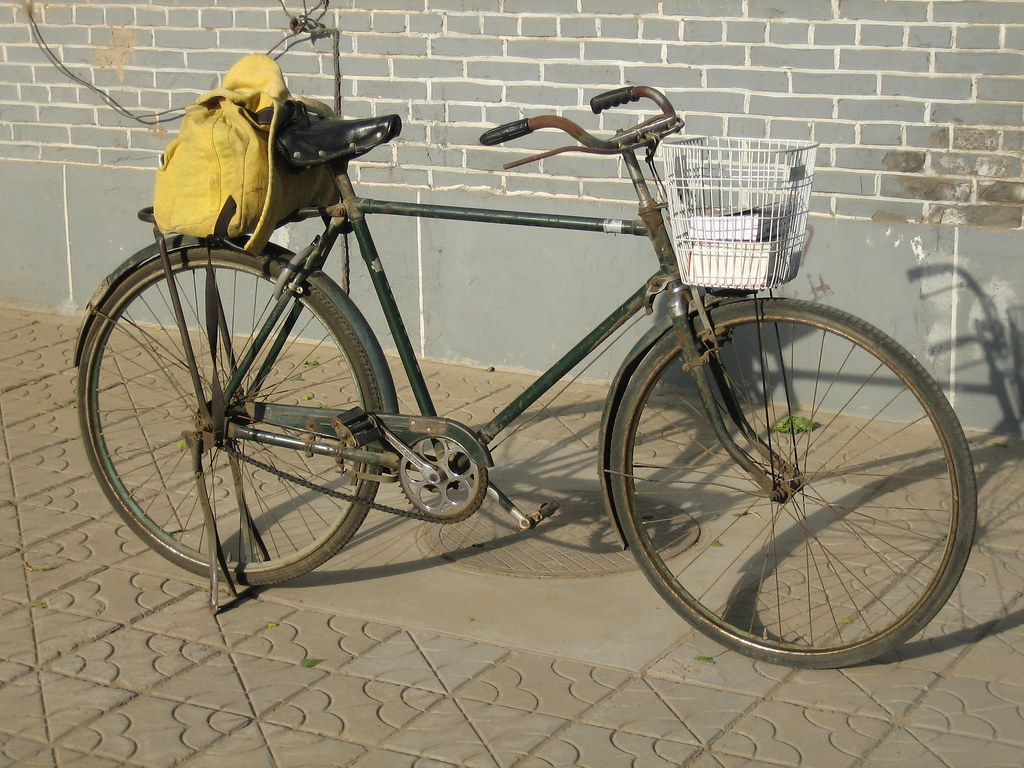 Here it is, folks. My "new" fourth bicycle. If this thing ever turns up in your neighborhood, it's mine. I hope I'm not getting cynical. Anne Marie sent me an email today, and said that all of her kids have had a bicyle stolen at some time or another. She is right, and the point is well taken. Bicycle theives are certainly not limited to China. Kaori, my Japanese daughter, had her bike stolen in the parking lot of the Japanese International Baptist Church in Tempe. She had run a cable lock through the front tire. The theives just unbolted the tire and took the bike. There are two reasons that this kind of theivery is out of control in China. First, there are just so many, many people who depend on bicycles as their primary means of transportation. And second, related to the first, is that there is a market for used bicycles. These two factors make enforcement a very, very difficult task. Many people speak of the police with a certain measure of dispair and almost contempt on this issue. But I would hate be responsible for law enforcement on something like this. It's a huge problem, simply because there are so many, many people in China.
Monday, May 01, 2006
Today was what the expats call a "bad China day." Yesterday, bicycle number 3 was stolen. Particularly troubling this time, because it was stolen from right in front of the teacher's dormitory. This gives me cause to believe that someone was tipping off the thief as to when I would be there.
Last night, I walked to the coffee bar. At the coffee bar I ran into Raymond and a classmate of his from the Geosciences University. Leave it to Raymond, the music lover--he had a tune for the occasion. "Always Look on the Bright Side of Life." It's a gig by Monty Python. The song is actually a bit cynical--about what you'd expect from Monty Python. But, oh well, it's the idea, you know. Raymond's classmate told me about a place over in the Chaoyang District that sells used bicycles.
This morning, I hailed a taxi and headed over there. Fortunately, the lady cab driver was very friendly, and she tried her best to help me find the place, but to no avail. Finally, we pulled over, and she talked to a motorcycle cab driver. He said he knew where it was. I was skeptical, because those guys always say they know...they want your business. But I decided to go with him. He took me to a street corner where there were a few guys standing around. They immediately showed me a new bike. This was definitely not a bicycle shop, and the bike they showed me was almost certainly stolen. I started walking away. Another guy saw me and motioned for me to follow. He led me through a bunch of narrow alleys and finally stopped in front of an old shed. He unlocked it and showed me a bike very much like the one that had just been stolen from me. It was in mint condition. The price he quoted was half what my bike cost me new. I turned and walked away. As I was walking away, he yelled after me...the price dropped quickly. He really wanted to unload that thing. I didn't turn back. I felt like spitting in his face. Sorry, I'm not in a good mood right now. Minimum wage workers in Beijing make 500 to 600 RMB a month. A bicycle like that costs more than half a month's wages. That's not easy to save for. And just to have it taken from them by the growing criminal element that preys on these people, and will continue to prey on them because of middlemen like this who do their dirty work for them.
I walked across to a gas station and asked them if they knew of a shop locally that sold used bikes. A lady heard me and started offering me prices. I walked away. Miserable. Everybody is into the racket. I hailed a cab and told the driver I wanted to go back to Wudaokou. I mentioned something about buying a used bike and he told me he knew the place where they were sold. I asked him if there were many bikes there. I didn't want a repeat of what I had just seen. I wanted to go to a legitimate business. He told me there were many bikes there. He was lying. He dropped me off in a neighborhood where there were a couple guys sitting on new looking bicycles. They immediately started bargaining with me. Disgusting. I noticed we were right across the street from a bus yard, so I walked across the street and caught the 802 to Xidan.
To some, it would seem that I am drawing a false distinction, and they may be right. I was looking for a legitimate shop that sold used bikes. But what guarantee would I have that those bikes weren't stolen? I suppose there is no way to know for sure, but at least they have a fixed location, and the police can stop anytime and demand a bill of sale to prove that the bikes there were obtained legally. But I am quite sure the four different parties I was introduced to today (all in the space of about an hour) were dealing in stolen bikes. I wish I had remembered to bring my camera with me. I wonder what they would have done if I had started taking pictures.
Last night, I walked to the coffee bar. At the coffee bar I ran into Raymond and a classmate of his from the Geosciences University. Leave it to Raymond, the music lover--he had a tune for the occasion. "Always Look on the Bright Side of Life." It's a gig by Monty Python. The song is actually a bit cynical--about what you'd expect from Monty Python. But, oh well, it's the idea, you know. Raymond's classmate told me about a place over in the Chaoyang District that sells used bicycles.
This morning, I hailed a taxi and headed over there. Fortunately, the lady cab driver was very friendly, and she tried her best to help me find the place, but to no avail. Finally, we pulled over, and she talked to a motorcycle cab driver. He said he knew where it was. I was skeptical, because those guys always say they know...they want your business. But I decided to go with him. He took me to a street corner where there were a few guys standing around. They immediately showed me a new bike. This was definitely not a bicycle shop, and the bike they showed me was almost certainly stolen. I started walking away. Another guy saw me and motioned for me to follow. He led me through a bunch of narrow alleys and finally stopped in front of an old shed. He unlocked it and showed me a bike very much like the one that had just been stolen from me. It was in mint condition. The price he quoted was half what my bike cost me new. I turned and walked away. As I was walking away, he yelled after me...the price dropped quickly. He really wanted to unload that thing. I didn't turn back. I felt like spitting in his face. Sorry, I'm not in a good mood right now. Minimum wage workers in Beijing make 500 to 600 RMB a month. A bicycle like that costs more than half a month's wages. That's not easy to save for. And just to have it taken from them by the growing criminal element that preys on these people, and will continue to prey on them because of middlemen like this who do their dirty work for them.
I walked across to a gas station and asked them if they knew of a shop locally that sold used bikes. A lady heard me and started offering me prices. I walked away. Miserable. Everybody is into the racket. I hailed a cab and told the driver I wanted to go back to Wudaokou. I mentioned something about buying a used bike and he told me he knew the place where they were sold. I asked him if there were many bikes there. I didn't want a repeat of what I had just seen. I wanted to go to a legitimate business. He told me there were many bikes there. He was lying. He dropped me off in a neighborhood where there were a couple guys sitting on new looking bicycles. They immediately started bargaining with me. Disgusting. I noticed we were right across the street from a bus yard, so I walked across the street and caught the 802 to Xidan.
To some, it would seem that I am drawing a false distinction, and they may be right. I was looking for a legitimate shop that sold used bikes. But what guarantee would I have that those bikes weren't stolen? I suppose there is no way to know for sure, but at least they have a fixed location, and the police can stop anytime and demand a bill of sale to prove that the bikes there were obtained legally. But I am quite sure the four different parties I was introduced to today (all in the space of about an hour) were dealing in stolen bikes. I wish I had remembered to bring my camera with me. I wonder what they would have done if I had started taking pictures.

