Links
- CV
- Titles
- Topics
- Tickets
- Science
- About Eric
- Book Reviews
- Country Profile
- Modern China
- Contact Eric
- Podcast
- Vision
- Sekai
- John
Archives
RSS

Reflections on a Wandering Life.....
Wednesday, July 04, 2018
China's Infrastructure Development
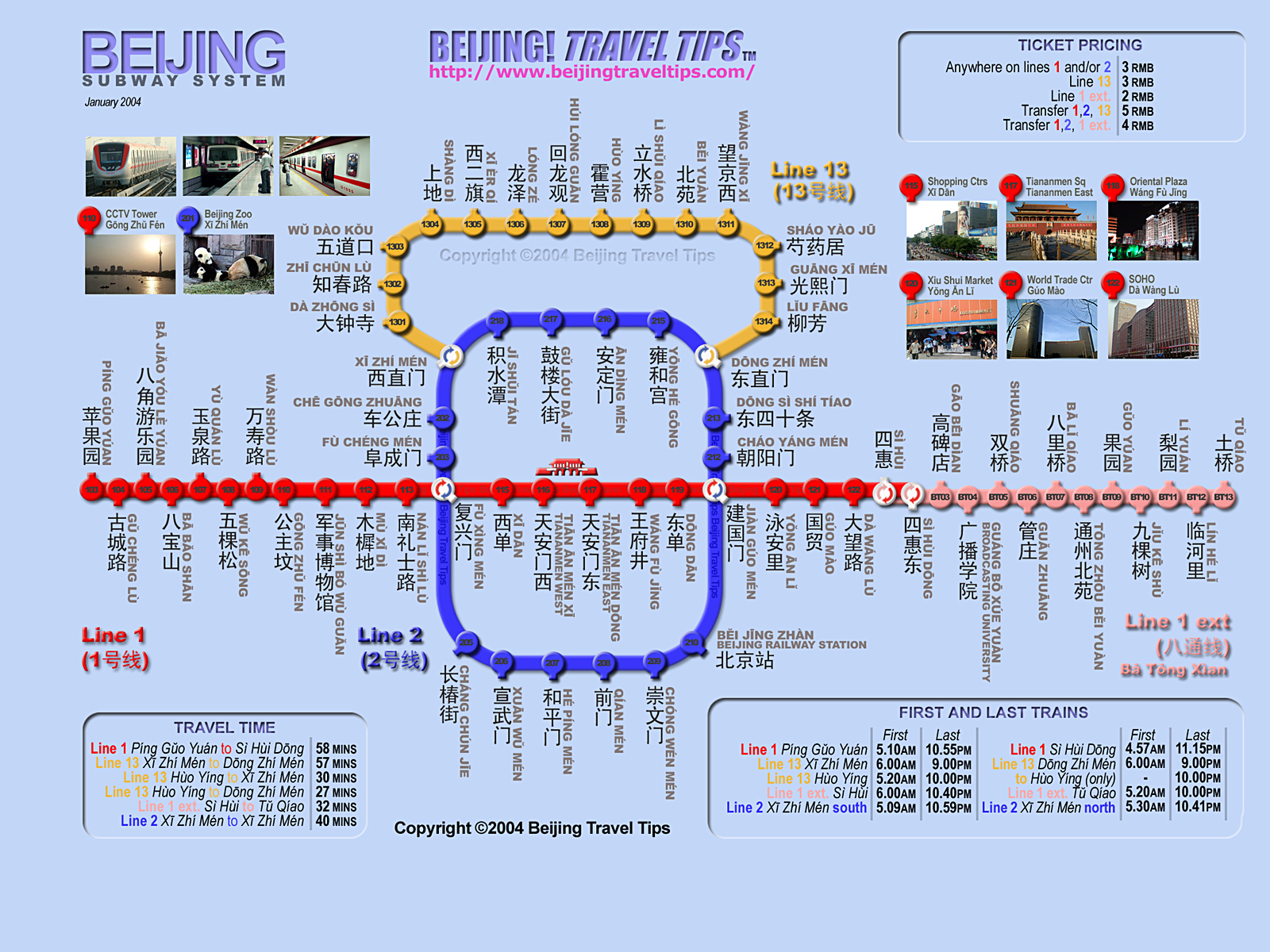 This is the subway map that was current when I moved to Beijing in January of 2004. The red line is Line 1. It goes right by Tiananmen Square. The pink line to the right (east) is the extension, apparently added later. The blue line is Line 2. Line 2 follows pretty closely the perimeter of the old city wall. The old city wall has mostly been torn down, but some of the gates remain, and where even the gates are gone, the names remain. So many of the the names of the stops on Line 2 are the names of the old city gate that once stood at that place ("men" means gate). In the summer of 2005 I stopped in Xi'an on my way back from Xinjiang. In Xi'an you can go up on top of the old city wall, rent a bicycle, and ride around the city on the old city wall. It took me an hour and a half. But as far as I know, Beijing is the only city in China where you can ride around the city underneath the old city wall. That's Line 2. The horseshoe is Line 13. Line 13 is an extension that was added later, so it is mostly an elevated train rather than a subway. It's part of the subway system, but I guess you could call it a subway up in the air. It was really important for me when I first came to China, because I was living and teaching at Beihang University, which is very near to Wudaokou on Line 13.
 Click for larger image.
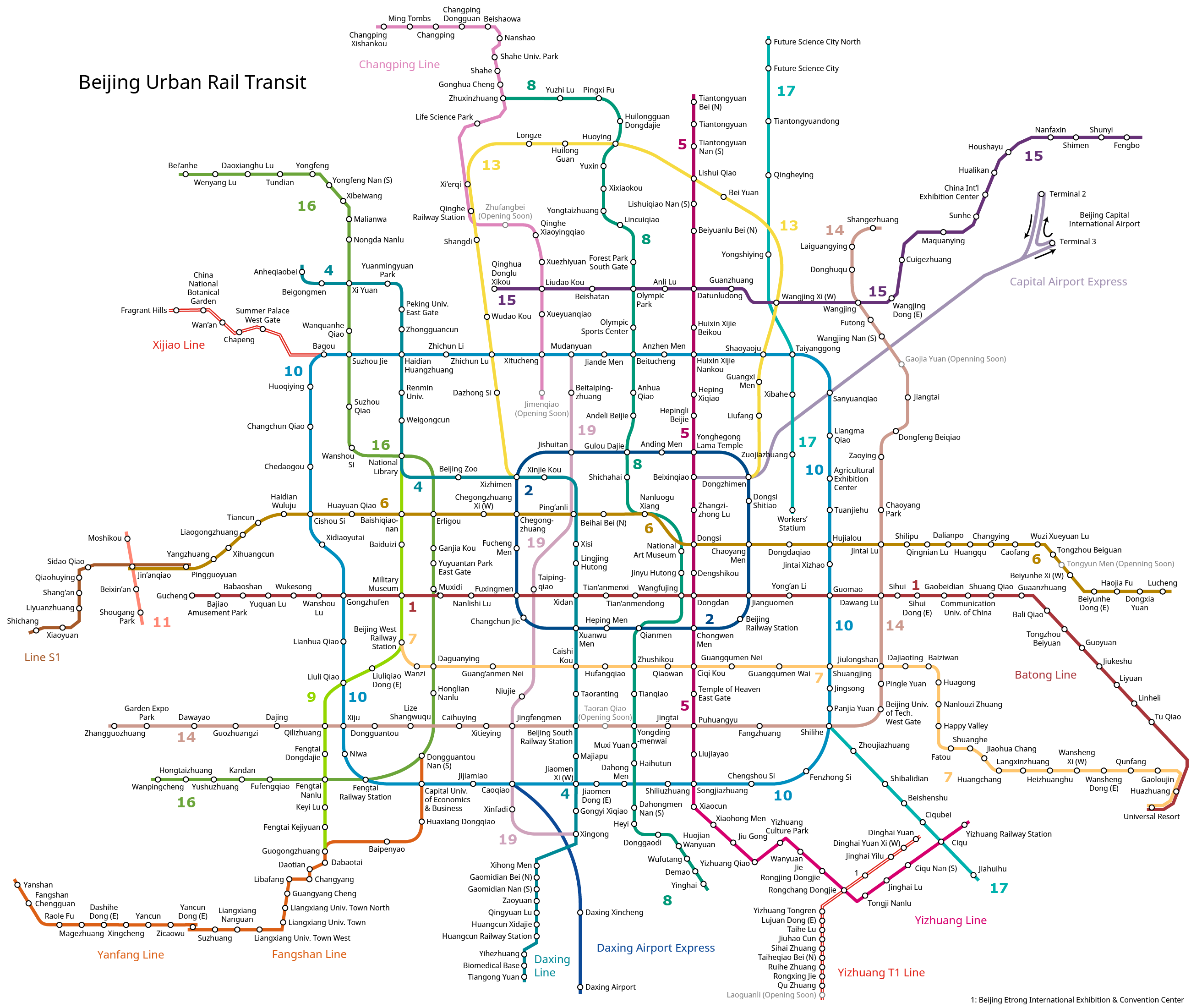 This is the subway map of Beijing today. This is just one example of the massive infrastructure development that goes on all the time all over China. And it goes on at a very rapid pace. During those years, we would occasionally read an article in the China Daily about a street caving in or something. Oh, well. Fix it and go on. The government seemed in a mad rush to get the subway system modernized. On this map you can see Line 2 as the small circle in the center of the map. Line 1 runs east and west across the bottom section of that circle. And Line 13 is the yellow horseshoe which connects to Line 2 at Xizhimen and Dongzhimen. Everything else is new since 2004.
So who pays for all this development? Much of it comes from Americans shopping at Walmart. China has a huge trade imbalance with the United States. The numbers I hear now sound incredible--anywhere from 300 to 500 billion dollars. When I first came to China, the number I heard most was about 200 billion, I think. But that's still a trillion dollars every five years flowing into China. Every two years now, if you believe the current numbers. That is not the total amount of American dollars. It is the amount over and above what China has been paying to the US for American products imported by China. Now there is some argument about this, because the figures everybody uses do not reflect the fact that much of China's benefit from all this trade is as the manufacturer of other people's products. iPhones, for example, are assembled in China, so they are regarded, in their entirety, as Chinese exports to the US. But in fact, the guts of the phone comes from Japan. So a big chunk of America's trade imbalance with China is actually with Japan. But that aside, there is lots and lots of money flowing into this country from America. And, of course, many other countries. China has a largely export-driven economy. That has made China rich, but also vulnerable. China cannot consume what China produces, so China is very dependant on others helping with that consumption. But if the Americans every decide to get therapy for their addiction to consumption, China is in trouble. I don't see much danger of that, to be honest with you. Americans like stuff. But there are other things that could affect the level of American consumption. The Supreme Court just handed a great victory to manufacturers, by denying unions the power to force workers to pay union dues. American labor unions have priced the American worker out of the market. Now the unions will have less power, because they will have less money.
But back to infrastructure. Although I think China sometimes gets carried away with infrastructure, doing projects that are obviously designed to create jobs rather than build something that is really needed, it can't be denied that, as a developing country, China was far behind other countries in Asia. I should say "country," because I've only been to one other country in Asia, and that is the one I am referring to. Tokyo's light rail and subway system when was a child 60 years ago was more sophisticated than the system Beijing had when I moved here in 2004. So it was and is badly needed. But another benefit of this kind of infrastructure development is that it continues to provide jobs long after construction. And, of course, it continues to provide service even if the economy takes a downward turn. I remember when I moved to North Dakota during the oil boom of the early eighties. The extra money rolling in was enough to motivate the city to build a new library. I watched that building going up and stopped by several times to talk to the workers. I remember one time I stopped by to see how it was going, and I got into a conversation with one of the workers. He said, "I think it's a waste of money."
I remonstrated. The old library was badly in need of replacement. He said, "I've been here thirty years and I've never been in that library." He probably wasn't the only one who felt that way. But the new library got built, and when the bottom dropped out of the oil economy, that library continued to provide service for people like me during a time when the economy was such that it never would have gotten built if it had not already been there.
Labels: Infrastructure, Transportation
