Links
- CV
- Titles
- Topics
- Tickets
- Science
- About Eric
- Book Reviews
- Country Profile
- Modern China
- Contact Eric
- Podcast
- Vision
- Sekai
- John
Archives
RSS

Reflections on a Wandering Life.....
Tuesday, February 28, 2023
That Inscrutable Newton
I’ll tell you what I like most about this video. It faces honestly some of Newton’s peculiarities without trying to explain them away.
No one with any sense of integrity can deny that Newton had an interest in the supernatural. He wrote and thought about God a lot. And not only about God. He was fasinated with alchemy. Scandalous.
It is hard to imagine how anyone could try to pass Newton off as an atheist, but believe it or not, they have tried. Most, however, do not resort to such an egregious abuse of history. They content themselves with imagining that the mystical side of Newton was something he kept separate from his science. Nothing could be further from the truth.
Here is what Newton says in his General Scholium to the Principia Mathematica:
This most beautiful system of the sun, planets, and comets, could only proceed from the counsel and dominion of an intelligent being.Clearly Newton believed in God. But while atheists cannot honestly claim him as their own, neither can evangelical Christians. Newton did not believe in the trinity. He was not a Mormon, or a Jehovah’s Witness, or Muslim or a Jew. But he was on the same side of the Arian controversy as they are. Newton did not trumpet his religious beliefs. But he did manage to get a special exemption from the king to the requirement that scientists must be members of the clergy.
So what does all this mean? Two conclusions come to mind.
- Newton’s fascination with the mystical may not be “scandalous.” It may, in fact, help to explain why we was more open to allowing ideas so crazy—at the time—as the idea that two unconnected objects thousands and even millions of miles apart, with nothing but empty space between them, would actually have some sort of attracting force pulling them towards each other. I mean, we take it for granted now, but if you think about it, it is pretty mystical and bizarre.
- Newton’s belief in God cannot be dismissed as something he assented to because his church required it of him. When did Newton ever allow a religious body to tell him what to believe? Clearly it was not his religion from which sprung his belief in God. It was his science. Newton rejected atheism not because it was unreligious. He rejected it because it was fundamentally unscientific.
Every (heavenly) body is attracted to every other by a force which is directly proportional to the product of their masses, and inversely proportional to the square of the distance between them.This universal law affects any two objects in the universe no matter how far apart or close together or small or large they may be. Incredible. That’s not small stuff, folks. Could it be that God allowed Newton to indulge the mystical for awhile to prepare his mind to accept an idea (the law of gravity) which seemed much too mystical for any scientist at the time to accept?
During he last part of this life, Stephen Hawking seemed to be flirting with the idea of belief in God. But he tyranny of his atheistic religion put a stop to it. Finally, he said that because of the law of gravity, the universe could have created itself.
Because there is a law such as gravity, the Universe can and will create itself from nothing. Spontaneous creation is the reason there is something rather than nothing, why the Universe exists, why we exist.What nonsense! Clearly it is Hawking, not Newton who allowed his religion to dictate his beliefs in open spite of his science.
Thursday, September 30, 2021
Science Night - Peregrine Falcons
I had pigeons when I was a kid. Didn’t know much about hawks or falcons then, but they were the enemy. Later, when I was in middle school, there was a special student assembly at my school (Fergus Fall Junior High) and the star of the show was a professional falconer. It was really an amazing presentation. Before he released the falcon, he told everybody to sit perfectly still. He did not want the falcon to attack anybody. Shortly after he released the falcon, one of my classmates must have gotten a panic attack or something, because he jumped up and started walking quickly out of the gymnasium where the assembly was being held. Fortunately the falcon did not attack him. Since that assembly I have been fascinated with Peregrine Falcons. Mind you, when I see a falcon chasing a pigeon, I’m still on the pigeon’s side.
You will hear that Peregrine Falcons can travel at 200 mph. But that is misleading. There is no way a Peregrine Falcon can fly that fast. They attain that speed by diving. The terminal velocity of a skydiver is about 120 mph. In the video they mention a speed of 158, I believe, but that is because they are flying in a form that allows for greater speed. At any rate, even 160 mph is no match for a Peregrine Falcon in full diving mode, which is rare to see and which you will see in this video. But of course, that’s falling, not flying. Peregrine Falcons are essentially dive bombers. For this reason, a Peregrine Falcon can attack a bird much larger than itself. They don’t feed on such larger birds, but they can defend themselves that way. I guess I should note that speed and velocity are not exactly the same, but in this case they can be used interchangeably, because direction is not an issue.
But the horizontal flying speed of a Perigrine Falcon is much slower that this. Pretty close to the speed of a pigeon. So if you watch a Peregrine Falcon trying to catch a pigeon, it’s actually a pretty close contest. But if that same falcon flies to altitude and dives into a flock of pigeons, it’s very likely to get something.
In this video, you will see a Peregrine Falcon that is trained to pursue a lure (which probably has food attached). It has no problem catching up with the skydivers using it’s special diving method to increase terminal velocity. But another thing you notice in this video is that the Perigrine Falcon and the falconer develop a close relationship. This indicates that the Peregrine Falcon is probably a pretty smart bird. But it also says something about the falconer. Not just anybody can be a falconer. It requires a special ability to understand the bird and build the kind of trust that will motivate the bird to obey the trainer.
You will notice also that the bird in this video is a female. I am not sure if the female is a better hunter than the male. But it is much larger, and that may be the reason falconers prefer to work with a female Peregrine Falcon.
Will you ever see a Peregrine Falcon up close? They are found in every corner of the globe except Antarctica, but it would still not be easy. This is not the kind of bird that will show up at your windowside bird feeder. Peregrine Falcons do not feed on bird seed. They feed on birds. Not exclusively, they also eat mice. But they could never live on bird seed.
There are three entities to watch in this video. The falcon, the trainer jumping in tandem with a professional sky diver, and the photographer. But I would be remiss if I did not also mention the crew of the hot air baloon. This video would not be possible without them. It doesn't take long to see that this experiement could never have been done from an airplane. All of them worked together to produce a really good show, and also some good science. Enjoy.
Labels: Aerospace
Monday, March 08, 2021
Science Night - How does a Sailplane Work?
In the previous lesson, we introduced the glider as an aircraft that flies without an engine. We also talked about the difference between a conventional glider (or perhaps I should say “pre-Treaty of Versailles” glider) and what we have come to call a “sailplane.” As mentioned in the previous lesson, the Treaty of Versailles is important, because it is the historical event that motivated the Germans to focus on developing super efficient gliders.
In this lesson, we want to focus on how sailplanes work. To begin, then, we want to be sure we understand how a sailplane differs from a regular glider. Both sailplanes and regular gliders need to be towed aloft, usually by a powered airplane. The difference between them is that once they are released, the regular glider will simply glide back to earth, while the sailplane will search for rising air currents and try to use these rising air currents to stay aloft or even to gain altitude. The process of floating back to earth is called “gliding.” The process of using rising air currents to stay aloft is called “soaring.”
The video above explains how sailplanes use air currents to stay aloft. There is one error I should point out do you. He says, “gliders, also known as sailplanes.” That’s not correct. That implies that “sailplane” is just another term for glider. No. A sailplane is a specific type of glider. All sailplanes are gliders, of course. But all gliders are not sailplanes. But aside from the fact that he keeps saying “glider” when he should be saying “sailplane,” this video is the best technical description of how sailplanes work that you will ever see. It is excellent.
After you have watched the video above, take a look at the one below. The video below is interesting, because it shows a modern version of the gliders from 1930 that we introduced at the beginning of the previous lesson. Very similar. Essentially the same design. So why would anyone want to have such an old fashioned glider like the one below (that is no good for soaring) in the modern age when high performance sailplanes are available? The reason is that these old style gliders are very good as trainers, because they are so easy to fly. A kid could fly one. Mind you, you still need training, and you should limit your flying to days with almost perfect weather, but training gliders like this are very good for learning. So science takes a giant step backward. This is why there will always be a difference between gliders like the trainer below (which is also built by a German company) and high performance German sailplanes like the one we introduced in the video at the end of the previous lesson. So the need for conventional gliders is not going to go away, but It is probably also true that future innovations in powerless flight, especially the ultra light variety, will focus on taking advantage of rising air currents to extend flight.
Saturday, January 02, 2021
Science Night - What is a Glider?
What is a glider? Why would you want to fly an airplane that had no engine? First of all, engines are heavy. They add a lot of weight and make the plane harder to fly (although the power provided by the engine compensates for this). Gliders don't need fuel. Of course, because there is no engine, you will have a towing fee. But I think a towing fee would be quite a bit less than fuel. Basically, it's a good way to develop flying skill by flying a vehicle that is very easy to maneuver.
So how did gliders develop into the sophisticated aircraft we see today? To answer that question, we need to go back to the Treaty of Versailles, which the Allied Powerthe s forced on Germany after World War I.
This treaty restricted Germany from developing powered aircraft. But gliders were not prohibited. The Germans took advantage of this loophole to develop very efficient gliders. That's why most of the high performance gliders that you see today are from Germany. They were developing them while everyone else basically saw gliders as a thing of the past. The common thinking was, "Now that we have airplanes with engines, why do we need gliders?"
The effect of this focus the Germans placed on the development of gliders between World War I and World War II is that we now have gliders that are so efficient that, not only do they come down much more slowly that previous heavier and less efficient gliders, but they are so light and so effiecient that they can actually fly even higher than they were when they were released from the two line, by searching for rising air currents. These new, highly efficient gliders that can rise higher by finding air currents are called "sailplanes."
There are two main types of rising air currents. Thermals are rising columns of air that are caused by different rates at which heat from the sun is absorbed by the land. Sailplane pilots can find these by looking for cumulus clouds. The "thermal," or rising air column is actually what produces the cumulus cloud.
The other type of rising air current is caused by wind blowing across the land, which hits a mountain ridge and is forced upward. The video below shows a pilot using this current of air along a mountain ridge to stay aloft for a long period of time. The goal of sailplane pilots is not to see how high they can go. It is to see how long they can stay aloft even though they do not have an engine. Because sometimes a sailplane pilot will get stuck a long distance from the airport and suddenly not be able to find a rising air current, some sailplanes have a small, battery powered engine with a collapsible propeller that pops out and helps the pilot gain some altitude so he has time to find another rising air current.
Thursday, July 30, 2020
Science Night : The International Space Station
The construction of the International Space Station began in the late 90s. It has been occupied continuously for almost 20 years. Always someone there.
So what good is a laboratory in space? The key is that certain things can be done in a weightless environment that cannot be done on earth. So lots of science is happening all the time—not 24/7, they do sleep—but continuously throughout the year. In actual fact, the space station environment is not truly weightless. Gravity in the space station is about 90% of gravity on earth. But orbit is a process of continuously falling. That "always falling" state produces an effective weightlessness.
This tour is really quite well done, I think. It is casual and not tightly scripted, but I like it better that way. It is really good to let scientists like this talk freely and explain the life and activity they live with every day.
As I mentioned in the Science Night post on the Space Shuttle, the International Space Station was built of components which were shipped to space on the Shuttle. Now that the Americans have phased out the Space Shuttle, it would be really tough to try to build a station of this size. But not to worry—the Space Station is expected to operate until 2030.
I strongly encourage you to get a cup of coffee and enjoy this casual tour of the International Space Station. This is really good science.
Saturday, May 30, 2020
Science Night - How to Land the Space Shuttle
This kid's lecture about the landing of the Space Shuttle is quite good, I think. What was the Space Shuttle? Lots of people growing up in today's America know it only from their history books. What was so special about it?
The basic idea of the Space Shuttle was to make a spaceship that was reusable. With the Apollo program, everything was discarded after one flight. The space shuttle could be flown, landed, and refurbished for another flight. I think Elon Musk's rockets that can land back on the launch pad are really a better and more efficient re-usability. It cost an huge amount of money to refurbish a space shuttle. But there was something else about the Space Shuttle that was very unusual as space vehicles go:
It was enormous. You could put a Greyhound bus in the cargo bay. I don't know how they could have built the Space Station without it. Several years ago, when the Americans and Russians were having a spat of some kind, a Russian official threatened to close off access to the Space Station. It was laughable. Without the Space Shuttle there would be no Space Station. But not that laughable, because, since the end of the Shuttle program, the Americans have had to rent space on Russian space vehicles to get their astronauts to the Space Station.
After the Space Station was built, the Shuttle wasn't efficient. Sorta like driving a Sherman tank to go get some groceries. You just don't need anything that huge to transport a few astronauts. So the science that brought us the SpaceX transport vehicle is welcome and long overdue. I think it will eventually make the Americans the preferred transporter of astronauts.
Still, the science behind the Space Shuttle and how it flew is also fascinating. Do take 17 minutes of your time and watch this. You'll enjoy it.
Question of the day: Why is it harder to land an aircraft without an engine?
Labels: Aerospace
Thursday, April 30, 2020
Science Night - How to Fly a Paramotor
What is a paramotor? I call them "flying parachutes," because that's what they basically are. I can't be sure, but I am inclined to think that they emerged out of the hang glider craze in the seventies. By far the most popular hang glider when I was in college was the Rogallo wing, which was actually invented by a NASA engineer and was considered as a possible recovery system for the old Mercury and Gemini space capsules.
It was never actually used by NASA, and I am not sure why nobody thought of using it as a hang glider until the seventies, because it was actually invented in 1948. The only thing I remember it being used for in the late sixties or early seventies is for being pulled behind a motorboat with the pilot being on water skies. But it was when I was in college (Oregon College of Education) in the seventies (I graduated in 78) that people started jumping off mountains with them.
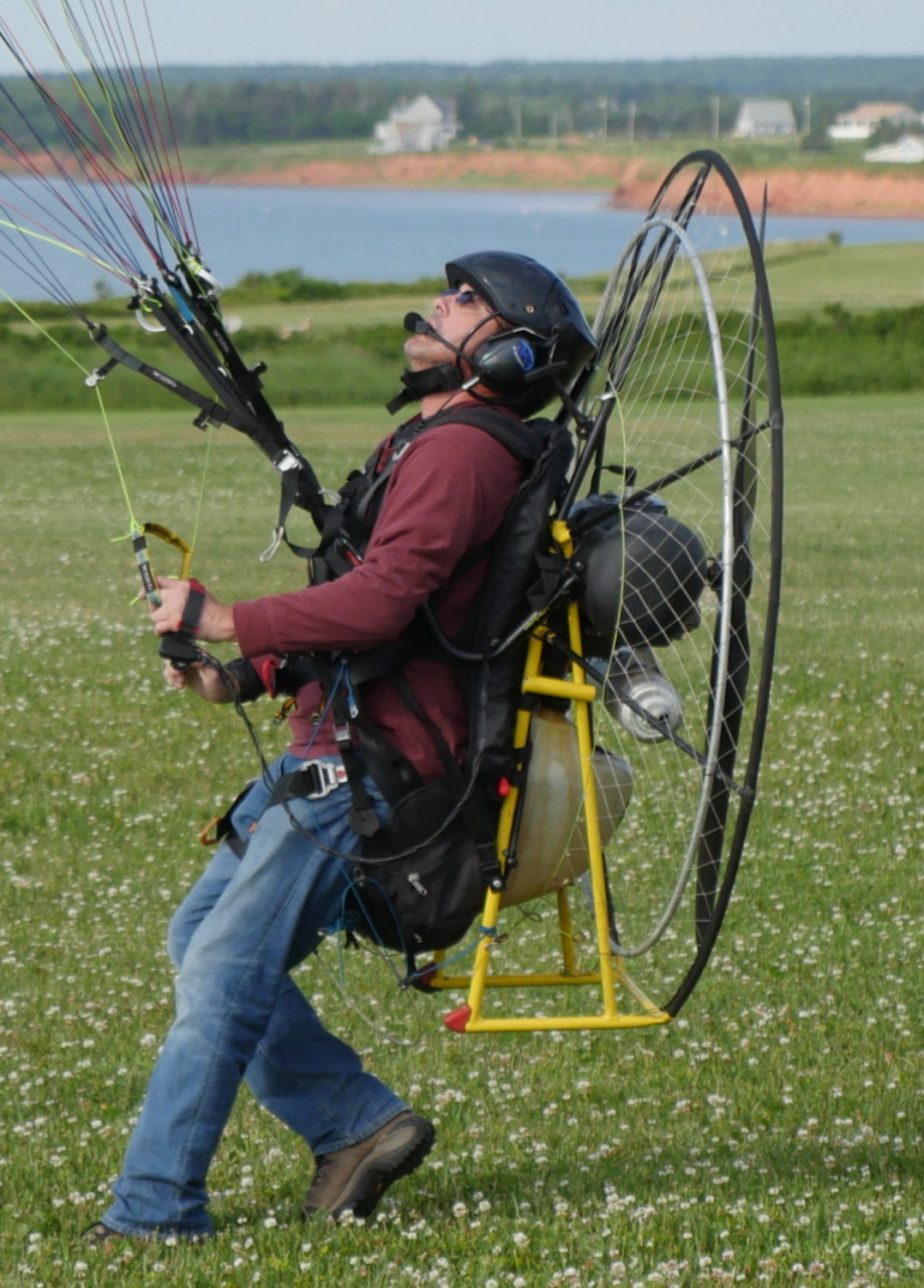 As I said, I can't prove the connection, but my theory is that somehow the skydiving craze and the hang gliding craze combined and produced the strange mutation known as a "paramotor."
They're easy to fly and a much lower cost way to have your own aircraft than buying a Cessna or something. But a caution: This looks easy, but you should not do it without professional training. Tucker Gott, the maker and star of this video came from a flying family. His grandfather was a hobby pilot—meaning that he had a private pilot license, and loved to talk about flying, but never did it professionally. But Tucker's mother was a commercial hot air balloon pilot. So this guy has been flying since he was very small.
I said all that to say that when you see an expert aviator like this, you may have the impulse to rush out and buy one yourself and head for the sky. Flying sports like this that do not require a pilot's license can be dangerous, because people may be inclined to think that the absence of license requirement means that you can just sorta pick it up on your own. Don't do that. You have the ability to become a very skilled paramotor pilot. But get a lot of training from professionals before you try it yourself. Overdo training on the front end of your participation in any flying sport, especially the ultralight variety. Better safe than sorry. I would also advise watching some crash videos, to see what kinds of mistakes lead to trouble. Most problems are simple to avoid, and would have been avoided if the pilot had gotten just a little more training.
Labels: Aerospace
Monday, January 20, 2020
Science Night - Space Suits
It's actually like a small spacecraft for one person. The space suit is designed to protect astronauts when they are in space, but outside the space station or other spacecraft. When we see astronauts in these things, we don't realize what goes into making them, and the kinds of problems that they have to address. As we contemplate the development of new kinds of spaceships, the space suit remains one of the most extraordinary technological developments in aerospace history. I still don't get how a suit like this can protect against the hideous extremes of temperature in space. The range is five hundred degrees (250 degrees above zero to 250 degrees below zero). But they manage to do it. Another problem in space is that, since there is no atmosphere, astronauts can be hit with tiny particles travelling at very high speeds. It all just seems very risky. But to this day, no astronaut has ever died in a space suit in space.
Labels: Aerospace
Monday, December 30, 2019
Science Night - What is a gyrocopter?
What is a gyrocopter? It is probably the most misunderstood aircraft. Gyrocopters came into the news a few years ago when a postal worker from Florida landed a gyrocopter on the White House lawn. I was amused to see news personalities refer to the craft as a "small helicopter." A gyrocopter is not anything like a helicopter. It looks like a helicopter. But that is where the similarity ends.
A gyrcoplter does not fly like a helicopter. Everyone knows how a helicopter flies. A giant rotor spins and creates lift. But a gyrocopter could never fly like that. Why? Because the rotor on a gyrocopter has no motor attached to it. It is free-wheeling. What good is a rotor that doesn't even have a motor? If you look at a gyrocopter closely, you will see that there is a propeller behind the airman that pushes the craft forward. The forward motion of the aircraft causes the rotor to spin, and once it starts spinning, it essentially becomes a wing. So a gyrocopter flies just like a fixed-wing aircraft. But why would you want to use a spinning rotor as a wing instead of a regular wing? Because a wing made out of a solid sheet of metal (even aluminum) with that kind of wing space would be much heavier.
I always used to say that the gyrocopter is the original ultralight, because gyrcopters were ultralight when ultralight wasn't cool Ultralights became popular in the seventies and eighties. It started with hang gliding. Hang gliding became a fad during the time that I was in college. I remember when a guy jumped off of Pike's Peak with a hang glider. Later they started adding motors to them. So the first ultralights were basically motorized hang gliders. In fact, that's what I used to call them. I did not hear the term ultralight until later.
In contrast, the first gyrocopler flew the year my father was born (1923). But it must be admitted that the first gyrocopters looked more like conventional airplanes than ultralights, so perhaps it is more accurate to say that when the ultralight movement started, it was easier for the gyrocopter to adapt to that mode, since it had always been designed as a craft that could be aerodynamically efficient at slow speeds. It was a natural fit.
But I need to be clear that having a free-wheeling spinning rotor is not the only way to create a wing that is light-weight. The Rogallo wing for example, which I will talk about another time, was made of fabric, which is very light. So as the ultralight movement has developed, experimenters have found other ways to create lift with a very light wing in a way that allows efficient flight at slow speeds.
Years ago, when I was in the trucking industry, I worked for a flatbed outfit out of Fargo that had a contract with Reynolds Aluminum. I hauled many loads of aluminum out of the huge Reynolds plant in McCook, Illinois, a suburb of Chicago. One time had a load of wing skins going to Boeing in Auburn, Washington. If you saw those huges sheets of metal, you would not believe they could fly. They were very thick and very heavy. How can something like that be made to fly? The answer, of course, is speed. I heard once that you could fly the Empire State Building if you could get it going fast enough.
So speed compensates for weight. But if you want a vehicle that flies slowly, it needs to be very, very light. The gyrocopter was really an ingenious way to do this. Not the only way to be sure--as I said, as the ultralight movement has developed there have been many innovations seeking to maximize lift by minimizing weight.
Now back to the guy who landed on the Capitol lawn. Aside from being amused at how the news media couldn't resist calling a gyrocopter a "small helicopter," I was curious to see how the law would deal with a guy who was basically harmless--he obviously wasn't a terrorist--but who had violated very serious laws about flight safety and security. Landing on the lawn of the Capitol is quite obviously a breach of security that should not be taken lightly.
He got a four month jail sentence. I think the reason they gave him such a light sentence was because he was clearly not a terrorist. He did not hurt anybody and did not intend to. But I am not concerned about the threat to the Capitol. I am more concerned about the threat to general aviation. I don't know any country in the world that gives experimental airmen as much freedom to innovate as the United States. This is a privilege that should not be taken lightly. There is nowhere near that kind of freedom in China. When one person abuses that privilege, it is jeopardized for every other flyer. Countries that do not have a strong general aviation system are forced to borrow innovation from countries that do. That is just a fact. This guy was not a terrorist, I get that. But he was not a hero either. He did not really put the Capitol at risk. But he did put general aviation at risk. He should not be allowed to fly.
Labels: Aerospace
Friday, January 04, 2019
China on the Far Side
China has landed on the far side of the moon. At least, that's what the pictures show. I have mixed feelings about this. In a sense, it is a good idea, because it has not been done before. But another part of me wonders if this is another expression of China's age-old secretiveness. The moon changes in terms of it's relationship with the sun, but not with the earth. In other words, the near side of the moon sees darkness and also sees the sun. The far side of the moon sees both light and darkness. But due to the pattern of its rotation and revolution around the earth (it's rotation exactly equals it's revolution), the far side of the moon never sees the earth. So there is absolutely no way to get communication from an object on the far side of the moon, except from a satellite station that is currently traveling around the moon. I don't know. We'll have to wait and see.
Will China ever put a man on the moon? I think they want to. But if it happens, it will be a few years. It's a very big step from sending an unmanned object, to sending a human being. What is most interesting is the independent nature of China's space program. As far as I know, they have never been part of the International Space Station. Is that because of China, or because of America? I don't know the answer to that, either. How is it that, for all their differences, the Russians and the Americans can find a way to work together, but China is isolated? We'll have to see how that goes. But China has stated emphatically that if they build a space station, they intend to bring in countries from the developing world. If that's true, then I tend to think that China's independence could end up being a good thing.
Talk about a "space race" doesn't really bother me. The moon is so inhospitable, the chances of being able to establish a permanent presence are, I think, very slim. The Americans are talking now about a space station in moon orbit. That would seem to be easier than building a permanent station of any kind on the moon. The moon is incredibly hot during the moon day (half of that 28 day period) and unimaginably cold during the moon night. So I don't see them ever being able to establish a moon-based station that is more or less permanent. But a rotating space station is a distinct possibility if they are willing to pay for the process of resupply, which would, of course, be much more costly than resupplying a space station that is in low orbit around the earth. One thing is clear: China is determined to have a space presence, so that will continue. But just what form it will take is uncertain. The world is going to be watching.
Labels: Aerospace
