Links
- CV
- Titles
- Topics
- Tickets
- Science
- About Eric
- Book Reviews
- Country Profile
- Modern China
- Contact Eric
- Podcast
- Vision
- Sekai
- John
Archives
RSS

Reflections on a Wandering Life.....
Thursday, November 25, 2021
First Missionaries to Gansu Province

Very brief but well-written overview of initial missions to the Hui Muslims in China. It is part 9 of a series, so the whole piece is longer. But worth reading. I was interested in it because I spent four summers in Gansu Province during the years that I was teaching in Beijing.
I first traveled to Gansu back in 2006.
I had an idea to try to get in touch with a village school in Gansu. So I didn’t want to stay in a youth hostel. Truth be told, there wasn’t much for youth hostels in Lanzhou at that time anyway, but I would not have wanted to go to one even if there was. That’s very unusual for me. A good youth hostel is usually the first thing I look for. But my idea was to be near Northwest Normal University so that I could try to meet a teacher from the countryside who could put me in touch with village education. So I got the brainstorm to call the university and ask for the Foreign Experts building, not knowing if there even was one.
Fortunately, there was one, and I was able to stay there for a nominal cost. Then I walked around the campus until I met a teacher and asked him if I could visit his village. Turned out his cousin was running a summer school, so I met up with her and helped her teach the children. That was the first of four summers I spent up on the Tibetan Plateau in “Gannan’” the southern part of Gansu Province bordering Sichuan.
Labels: China Missions, Hui Muslims, Travel Gansu
Saturday, August 31, 2019
The Boxer Rebellion

Click for article.
The other day I opened the History Channel app on my little Samsung tablet and a documentary on the Boxer Rebellion in China caught my attention. The Boxer Rebellion is often misunderstood as "Chinese attacking foreigners." But the Boxers were a select group. This was a strange, devilish religious cult of rural people who had come to believe that they were impervious to foreign bullets.
This term is misleading for those who come from a western context. In America we think of boxing as hitting. But when Chinese people talk about martial arts like Tai Chi, they often use the term "boxing" when they are speaking English. Their reasoning is that since it involves the hands, it must be like boxing. But it's not really the same.
Much debate has centered around the original cause for their anger at foreigners. Since missionaries became the primary target, there seems to be the impression that missionaries did something to offend the Boxers (and by extension, the Chinese people in general). But is this fair? The documentary mentions the fact that the missionaries attacked ancestor worship, which was a cherished tradition and very much ingrained in Chinese culture. I question whether that was really the main issue, because it has never been clear to me the extent to which the Boxers were angry because of things the missionaries had actually done, or by crazy rumors about the foreigners that had no basis in fact. But, just for the sake of argument, let's examine the charge. Did the missionaries really attack the practice of ancestor worhip?
Yes. Guilty as charged. This had not always been true historically in China, and was in sharp contrast to Matteo Ricci (利玛窦), who tended to downplay the significance of ancestor worship. Ricci had a problem with Buddhism. But he had no real quarrel with the Confucian practice of ancestor worship, which he dismissed as veneration for the dead.
But the evangelical Christian missionaries who spread across China in the 19th and 20th centuries saw things very differently. To them, worshiping ancestors was no different from worshiping idols. So, to the extent that the Boxers may have been angered at the missionaries for threatening traditional beliefs, their fears were richly justified. But my problem is that I don't know if that's true. What I mean is, as I have stated earlier, I don't know if the anger of the Boxers really had anything to do with things like ancestor worship, or if they had somehow become convinced the foreigners were actually responsible for the drought that had plagued the countryside.
Whatever the case, it is important to point out that there were many ordinary Chinese people who were very much opposed to the Boxers, and, in fact, many of them also became victims of the Boxers. The great question historically is the extent to which the Dragon Lady supported the Boxers. Initially she seemed to be taking a neutral position, although I tend to think that she was secretly glad the foreigners were having trouble. But the documentary says that corrupt ministers in her government tricked her into thinking that the foreigners were trying to dethrone her. She blew a gasket and ordered the imperial army to aid the Boxers. This was a fatal error, because the Boxers were sure to fail eventually, and she bore the brunt of the blame for everything the Boxers did.
But let's get back to the missionaries for a minute. I guess I pay attention to this, because my parents were missionaries. So when I hear reports like this, I am struck by the contrast between what is often expressed, and what I see from my frame of reference. You see, from a secular perspective, helping people with education or medical services is considered a good thing for missionaries to do. But changing people's beliefs is considered an invasion of their culture. I don't agree with this. If people are worshiping their ancestors and their ancestors cannot really help them, then we are doing them a kindness if we point them toward a loving God who really interested in their concerns, who wants to reveal himself to them, and who is mighty to save. So the role of missionaries as belief changers can be just as important and just as life changing as the work they do in ministering to practical needs.
For example, it was the missionaries who put an end to the cruel practice of foot binding. This required changing the people's beliefs about women, about children, about people in general and about God and the purpose for which he has created us, and it is my firm belief that the missionaries were ideally suited for this task, because effective missionaries are nothing if not belief changers.
So if you believe that changing people's beliefs is always bad, then I can understand why you would not like missionaries. But if there are times when the best thing you can do for people is to change their beliefs, then missionaries surely have a roll to play in the development of civilized society.
Did anything good come out of the Boxer rebellion? Yes. After the eight powers liberated the foreign community, the Chinese government was required to pay a huge indemnity to those eight countries. Each country took their portion as payment for the damage done by the Boxers. Except the Americans. There was feeling in America, that the amount was excessive. In fact, it exceeded what the Americans had demanded. So, with the permission of TR, who thought it was a good idea, a very large portion of the American indemnity was returned to China, on the condition that it be used to provide scholarships for Chinese students to study in the United States. Part of this process involved the establishment of a prepratory school called "Tsinghua College" for the purpose of preparing students to go to America.
The China Inland Mission was offered indemnity payment for the great losses they had suffered, but they refused to accept it.
Labels: Boxer Rebellion, China Inland Mission, China Missions, History, Indemnity, Tsinghua University
Friday, February 23, 2007
Hudson and Maria
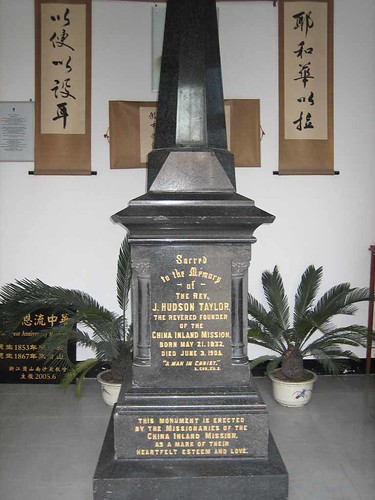 Zhenjiang. It was in a nice, quiet cemetary where he was laid to rest. His first wife had died years earlier. During the Cultural Revolution, the Red Guards vandalized the cemetary. It is now covered over with industrial buildings. A few years ago, Hudson Taylor's tombstone was discovered in an old museum. It is now in a display room at the old Methodist Church in Zhenjiang.
 How do we evaluate someone like Hudson Taylor? By training he was a missionary doctor, but he never really distinguished himself as a physician. I guess he did write a few books, but nothing really earthshaking. He was viewed by many of his contemporaries as a man with off-beat ideas. Those early CIM missionaries were a little strange, you know, walking around with their pigtails and gowns. To the Brits in Shanghai, their behavior was downright scandalous.
He was not a man of great talent or genious. But Hudson Taylor was blessed with an extraordinary gift of faith. He just would not stop believing in God and in God's provision. Taylor was a clear thinker, and built his life on principles well thought out and held to with tenacity, such as:
"God's work done God's way will never lack God's supply."
Hudson Taylor baptized something in the neighborhood of 50,000 Chinese believers. But he was also noted for bringing many missionaries to China. By the end of his life, the CIM had about a thousand missionaries on the field. He expressed his concern for China with deep passion:
"Oh, for eloquence to plead the cause of China, for a pencil dipped in fire to paint the condition of this people."
The list of great missionaries who were developed by Hudson Taylor is long and impressive. Fraser, who developed a Lisu alphabet, and wrote a Lisu hymnbook, Isobel Kuhn, who also went to the Lisu Tribesmen, Jonathan and Rosalind Goforth--all of them were with the China Inland Mission. C.T. Studd, who started the Worldwide Evangelization Crusade is known as a missionary to Africa, but he got his start with the CIM in China.
Hudson Taylor was deeply affected by the death of his first wife Maria Jane, an orphaned MK, who succumbed to cholera in Zhenjiang. After his second wife had died in Switzerland, Taylor returned to China. A few short months later, he died and was laid beside Maria.
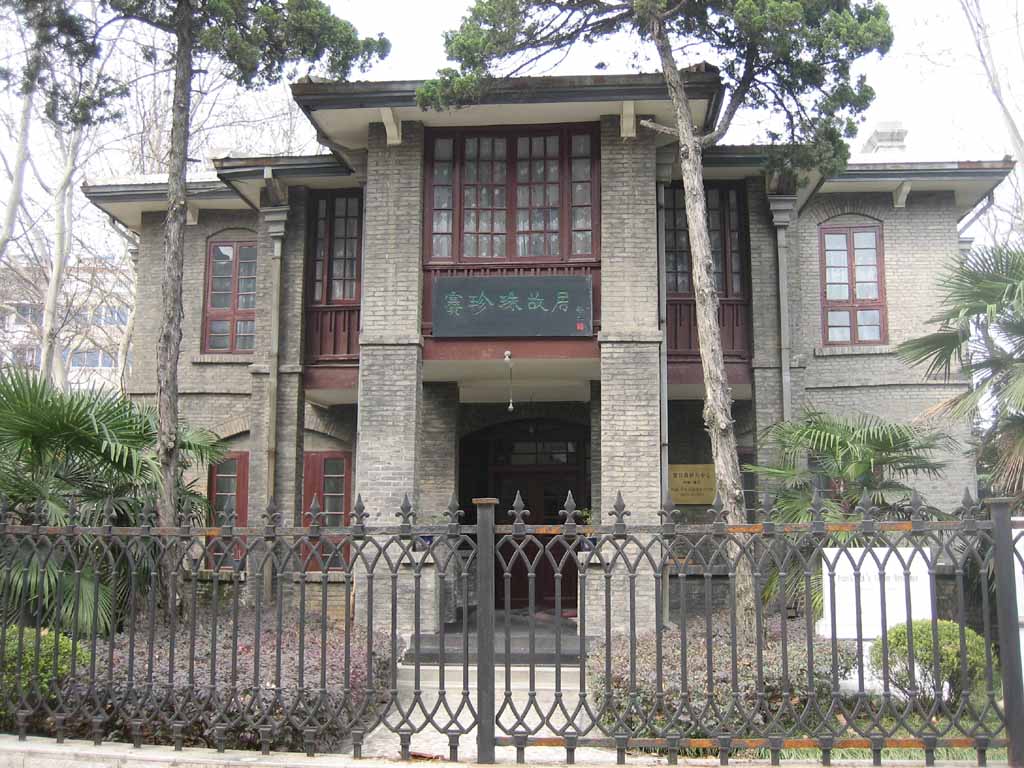 This is the home of Pearl Buck, also in Zhenjiang. The contrast between Pearl Buck and Hudson Taylor could not be more profound. Pearl Buck was a gifted writer, whose literary genius won her the Nobel prize for literature in 1938 mainly, I think, for "The Good Earth." Her talent and creativity were overwhelming and indisputable. She published over a hundred works of literature during her long and prolific life. But although the daughter of missioanries, she seemed to be hopelessly tone deaf when it came to the things of God. Ironically, her spiritual blindness seems to have affected her cultural insight. Her work does show a knowledge of the factual details of how people lived, but is sometimes lacking in genuine understanding of the fundamental differences between Eastern and Western culture. "The fear of God," as Proverbs says, "is the beginning of wisdom."
Labels: China Inland Mission, China Missions
