Links
- CV
- Titles
- Topics
- Tickets
- Science
- About Eric
- Book Reviews
- Country Profile
- Modern China
- Contact Eric
- Podcast
- Vision
- Sekai
- John
Archives
RSS

Reflections on a Wandering Life.....
Thursday, February 12, 2009
The Conclusion of the Matter
But it was good to go, too. The little town of Nancha is really interesting, and the surrounding countryside is so white and clear. And you can't beat the food. Really exceptional for a small town like that. The place where I stayed after I went to Harbin was low cost and very nice, and the shower house was close by. No wireless. I doubt if the little lady even knows what wireless is. But as luck would have it, I was situated next to the Shangdao Cafe, so I was able to tap into theirs. Weak connection, but good enough to bring in the BBC, and get my email. Don't worry. I had to go to the coffee bar once to get the password, and I was there several times after that, so they got their money's worth out of me.
Harbin was interesting. If you don't share my interest in history, perhaps you wouldn't think so, but do try, at least to develop an appreciation for the contribution that ordinary people in extraordinary times make to the history of a country or people.
That brings me to the Harbin Jews. The other day, I was having coffee at the KFC near the place I was staying in Harbin, and the plastic cover on my Styrofoam coffee cup was not fastened properly. The result was that I picked up my cup to take a sip and poured half a cup of coffee all over everything. It was not a disaster for me personally, because my scarf sorta acted as a bib (I do tend to do better with a bib). But my Bible was drenched. Jeremiah was swimming in coffee. That's OK. What good is a Bible without coffee stains? Would you want one? People would start to ask questions. "No coffee stains on your Bible? What. Don't you ever read it?"
But it did get my attention. I thought perhaps there must be something in Jeremiah I should pay attention to, so I dried out the pages and read the same pages every day for several days. One particular passage caught my attention:
27 But as for you, have no fear, my servant Jacob, and do not be dismayed, O Israel; for I am going to save you from far away, and your offspring from the land of their captivity. Jacob shall return and have quiet and ease, and no one shall make him afraid.Of course these words were not directed at the (current) Diaspora. They refer to the Babylonian captivity. Nevertheless, they do emphasize that God preserves his people, and that this preservation overwhelms whatever we have done to deserve the trouble we are in.
28 As for you, have no fear, my servant Jacob, says the Lord, for I am with you. I will make an end of all the nations among which I have banished you, but I will not make an end of you! I will chastise you in just measure, and I will by no means leave you unpunished.(Jeremiah 46)
But there is something else that is more germane to my thinking over the past couple weeks. It is the idea of "returning." Always, throughout history, the life and faith of the Jews is influenced by this idea. There is always and always the idea that the place where they are currently living is not really home. I have mentioned some of the factors that influenced the departure of the Harbin Jews from Harbin. The harassment of the Jews, as exemplified most poignantly by the gruesome kidnapping, torture, and murder of Simon Kaspe, son of Joseph Kaspe, proprietor of the Hotel Moderne (which is now a bank), certainly had a lot to do with why they left and when they left.
The Jews were troubled by anti-Semites among the White Russians. They were troubled by the Japanese. At the end of World War II, they were troubled by the Soviets, who entered Manchuria as conquerors, and sent many of them to the Gulag. But even if none of those things had happened, they still would have left. That's my point.
I visited the cemetery, which is located in a beautiful countryside spot. But the cemetery is not in the original location. It was moved out in the country by the Chinese to make room for development. I am not saying the local people did not have a right to do this. But think about it..if your relative was buried there, would you be comfortable about his or her grave being moved? You see, even in death, the Harbin Jews were wanderers. They could never really rest in peace, because they were not home. So they had to leave. They wanted a place where they would never again be forced out of their homes. I think they only place this could really happen is Palestine.
I have had this discussion many times with Israelis I meet in China. Most of my Israeli friends tell me they are not religious. They say that the land isn't really important to them. Whenever I hear this, I always ask them if they really wouldn't mind living in Uganda. Personally, I think the land matters. Of course there are all kinds of Biblical reasons why the land matters. But I mean even in terms of Jewish social life. I don't think Israel could be Israel without the land.
Think about the current situation. Public Jewish life often seems to be driven by the large number of common people in Israel who just want to be left alone to live their lives in peace. And sometimes (especially during war), those of us who do not live in Israel sometimes get the impression that the Israeli government is pursuing a policy that is at odds with the Israeli people. Palestinians speaking about Israel often make that point. But the fact is that conflicts like the current one tend to move the common people to the right. The recent "victory" of Tzipi Livni seems, at first, to indicate the Israel may not be quite so conservative. But I don't see it this way. If you read the news reports, it really looks like the hardliners are splitting the right-wing vote. The land seems to matter to most people.
I am not sure what percentage of the Harbin Jews would have described themselves as "not religious." But the presence of two synagogues seems to indicate to me that faith and life were intertwined for the Harbin Jews. And Zionism had lots of adherents in the Harbin community. At least I would say that even if everything had been peaceful for the Harbin Jews throughout their stay in Harbin, the Jewish community would have dwindled (although perhaps not as quickly as it in fact happened) once the nation of Israel came into being.
Well, I have to admit that is speculation. We can only surmise. What is not open to question is that the Harbin Jews played a very important role in the development of modern China. A thorough understanding of the history of modern China is not possible without considering their place as players on the stage of the troubled Twentieth Century in China.
I did come across one book in my research over the past couple weeks that I really would like to read. It is called White Terror, by Jamie Bisher. It is available on Amazon, but it's terribly expensive. If anybody sees this thing in pdf form, do please let me know.
Labels: Jews in China, Manchuria, Travel Heilongjiang
Monday, January 16, 2006
Jilin Rime
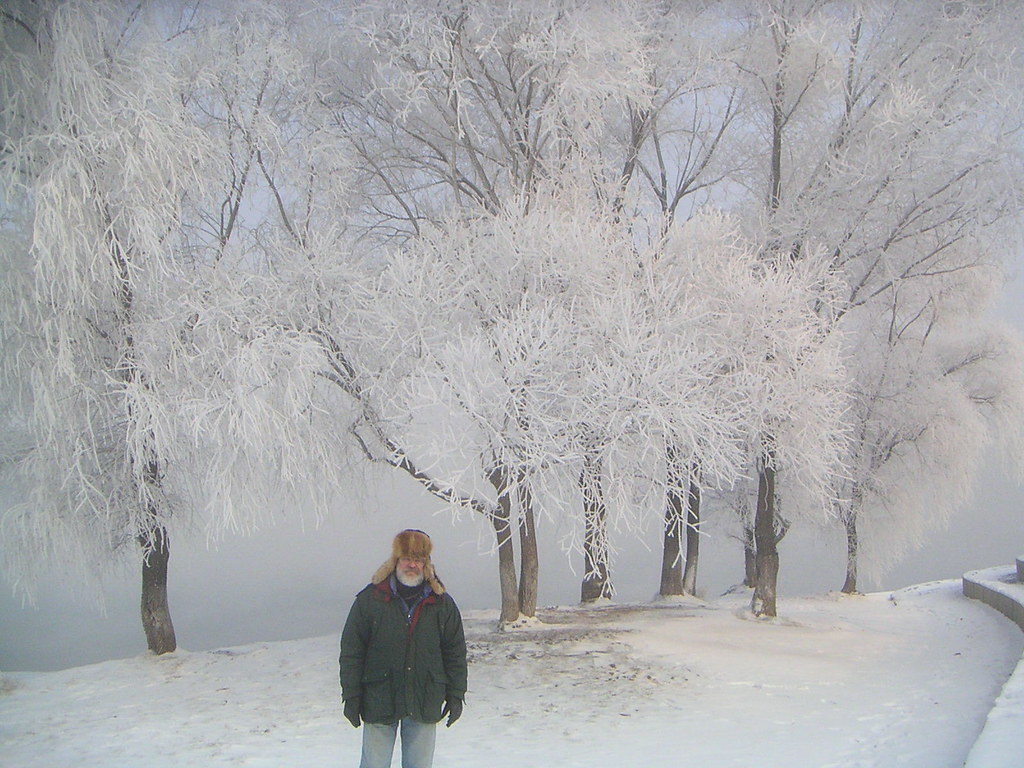 Surprise, surprise, Saturday morning dawned with clear air, so the rime was on the trees. Jenny and I walked down to the river, and hiked along the bank for quite a distance. It struck me as I was walking, that a person really ought to get up before sunrise and do this, to put a little red into the scenery...but I don't know. The mystical white is kinda pretty, too.
After hiking along the river, we went to the museum to meet Jenny's classmate, and take a look at the largest meteorite in the world. 1700 kilograms. The original meteorite from which it came, entered the atmosphere as a huge 15 ton piece of rock, and exploded over Jilin, creating a spectacular meteor shower.
Saturday afternoon, we met with an official from what Grace calls the "Chemical Hospital." The Chemical Hospital is owned by Petro China. Jilin has been much in the news lately, because of an explosion at one of the Petro China plants in November, which released a huge slick of Benzine into the Songhua River. The 100 tons of Benzine floated down the river toward Harbin, slowly dissipating, but not fast enough, shutting down the city water supply in Harbin for four days. Then, it was on to Russia, which is not exactly good for foreign relations.
Anyway, I was aware of the plant because of all the news about it, but I had not known how big the company really is in Jilin. I am not even sure how many plants they have in Jilin, but we saw four or five of them. We then toured the "Chemical Hospital" burn ward, as well as the orthopedic section. Somehow, the sight of some broken bones is not nearly as depressing as seeing patients in the burn ward completely bandaged up, staring morosely into space while the time passes ever so slowly.
After the tour, we went to a traditional Manchurian restaurant and tasted some traditional Manchu cuisine. It is really very delicious food. We washed it down with some rich Manchurian wine, for which I was grateful, because I needed something to settle my stomach. The problem is that we have been having lunch at the hospital cafeteria, and then going to a restaurant in the evening. But for some reason, they have hired a gourmet chef for the hospital who can match any chef in any restaurant in Jilin. So lunch in that place is quite a feast. Still, that Manchurian dinner was really something special. After we had finished eating, I started asking Jenny's mom about her own studies. Madame JinShu, as Grace calls her, grew up during the Cultural Revolution. She started talking about her university experience, which consisted of working in a factory and on a farm. She also talked about covering her books with neat paper covers, so that she could turn the four classics of China (Journey to the West, Outlaws of the Marsh, Dream of the Red Mansion, and The Three Kingdoms) into the "Sayings of Chairman Mao." Finally, in 1977, the examination system was restored, and she was able to go to school.
Madame JinShu is part of the "Lost Generation." I meet them in many parts of China. They grew up during a time when studying was considered "counterrevolutionary," and one's university experience was supposed to have a healthy dose of working with the common people. There are quite a number of accounts of this period, but one of the most informative is Jan Wong's book, because it is written from a North America perspective. I also like that book, because Jan Wong writes with a sense of humor, which is sorely needed when examining that dark period. The members of China's "Lost Generation" roughly parallel the American "Baby Boomers" in their generation. There are similarities, but also notable differences, mainly in that the "Baby Boomers" were born during a time of prosperity in America. Children of the "Lost Generation" were definitely not born to privilege. They were born to hardship. Children growing up in a world gone mad. Many of them, of course, were part of that madness, although I have never met a "Lost Generation" child who identifies him or herself as one of the crazy young people who tore the country apart. Perhaps it's all better forgotten. It's hard, though. There are so many sad stories that keep coming back as reminders of that tragedy. The ones who somehow managed to endure became stronger. The ones (like Deng Xiao-ping's son) who could not seem to cope ended up jumping out of windows.
Yesterday, we drove to Changchun, which was the seat of government during the Japanese occupation of Manchuria. The emperors palace has been turned into a very well presented museum. It is the site of the "Last Emperor's" reign as the puppet emperor under the Japanese. It's kinda depressing in a way, because it is clear that, while at first he dreamed of being able, under the Japanese, to restore the Qing Dynasty, it slowly became clear to him that he was only a puppet. He was basically a prisoner under house arrest. Interesting that he turned his rage on his wife when he discovered that she had had an affair, and kept her as a prisoner inside the palace. She turned inward and spent her days smoking opium, which, of course, is a downward spiral to Hell. The tour is self-guided, but you can rent a device which contains a sensor that detects where you are, and gives you an audio presentation in English of the specific location. It has a few glitches, but it really is very informative. If you haven't seen the movie, "The Last Emperor," it might be a good idea to watch that before you come.
Labels: Manchuria, Travel Jilin
