Links
- CV
- Titles
- Topics
- Tickets
- Science
- About Eric
- Book Reviews
- Country Profile
- Modern China
- Contact Eric
- Podcast
- Vision
- Sekai
- John
Archives
RSS

Reflections on a Wandering Life.....
Thursday, April 04, 2019
The Shanghai Ghetto

This the picture I took in the old Ohel Moshe Synagogue
in Shanghai, which is now the Jewish Refugee Museum.
Throughout the Diaspora (71 AD to 1948), the Jews were scattered to the ends of the earth. It seems that every country has their "Jew story." The Jews came to China in three places. First, they came to Kaifeng during the Song Dynasty.
The second main entry of Jews into China was over a hundred years ago, when the Russians made an agreement with China to allow them to build the railroad across the northeast tip of China, because they wanted to go straight to Vladivostok from Moscow. If you look at a map, you will see what I mean. Anyway, the agreement gave them the little village of Harbin, which the Russian Jews built into a prosperous city.
The third place the Jews came to was Shanghai. That was during the years before World War II, and the reason they came that time was in order to get away from Adolf Hitler.
I went to Kaifeng back in 2005 to study the Kaifeng Jews.
In February of 2009, I went up to Harbin in Heilongjiang Province to study the Harbin Jews But until last week I had never been to the neighborhood in Shanghai where the Shanghai Jews lived under Japanese occupation. Since this was my first visit, I focused on the museum (located in the old Ohel Moshe synagogue) rather than the neighborhood itself. So I need to come back again, probably several times to see the rest of it.
Shanghai was far from a perfect solution--I mean showing up in a city occupied by a foreign power--but in a strange way, it was a gift from Heaven for the Jews, because the Japanese had made Shanghai an open city. You could enter without a visa. Refugees streamed in, and this became the Shanghai Ghetto.
The following video gives a powerful and tremendously informative description of the Shanghai Ghetto by the Jewish children (now grown, of course) who lived there. This is a small, but very important part of the Jewish story. Do not try to understand Israel today without this history under your belt.
I should note that there is a brief silent spot toward the end of the video where there is no audio for about half a minute while they are showing pictures of the holocaust. You might want to keep your eyes closed during that part.
Labels: Jews in China, Shanghai
Sunday, February 25, 2007
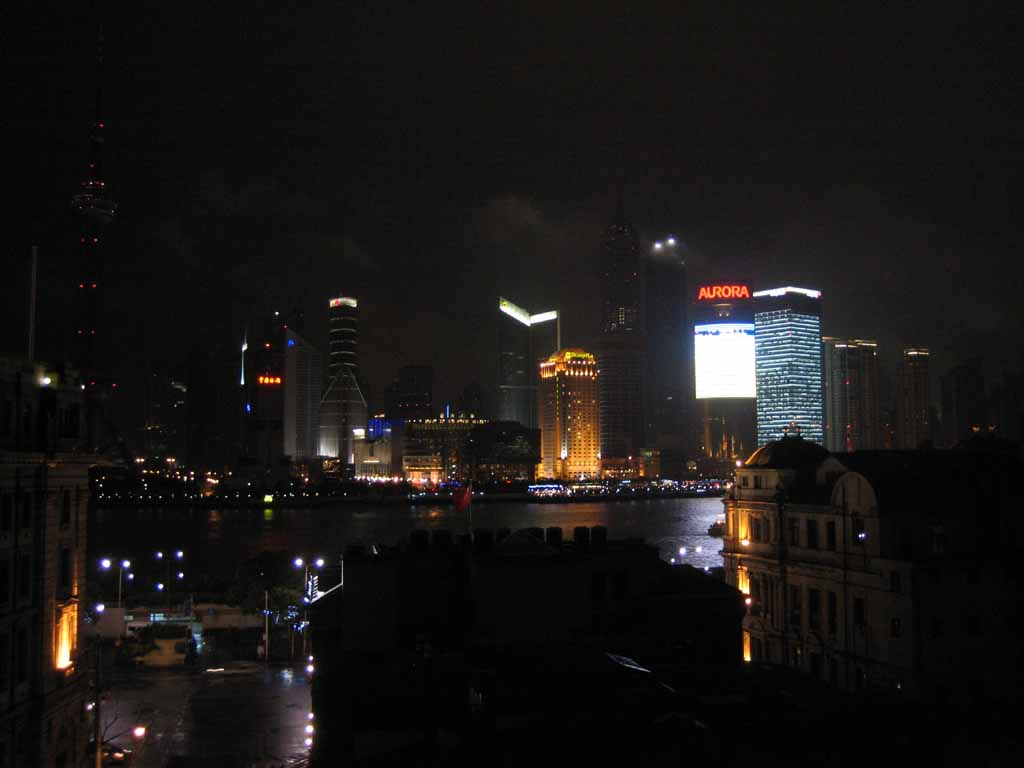 This is Shanghai. I took this picture last night looking toward the buildings on the South side of the Huang Pu river from the 6th floor veranda of the Captain Youth Hostel in an old colonial building right off the Bund. I think you could safely call this a typical Shanghai scene. I talked to a couple guys from Denmark who commented on the contrast between Shanghai and Copenhagen, which has some pretty rigid height restrictions for buildings. I have just been in Tokyo, so this scene doesn't really awe me in that way. What is most impressive to me is the phenomenal change in a country where the kind of business that made this commercial development possible used be regarded as downright immoral. This is the richness of capitalism in a "socialist" society. The next World Exposition (2010) will be here in Shanghai, so one can expect business development to increase.
  This is also Shanghai. I took this picture this morning from my dorm window in the youth hostel. The contrast to last night's scene couldn't be more profound. Yet, this scene also is typical. This is China. Land of contrasts. And perhaps no city in China epitomizes this contrast like Shanghai. A rich and prosperous city fueled by the labor of poor people who come to the city from the countryside looking for any means of bettering their condition.
Thibet Road between Avenue Eddie the Seventh and Nanking Road is practically infested with these charming ladies from the earliest sign of twilight until three and four in the morning. From one A.M. on, the region around Kiukiang Road and on over to Peking Road from Nanking Road is the hunting ground of the damsels and hunting ground it is. The weak of resistance are the prey of sometimes two and three of the gals who work in a concerted onslaught, grasping the victim firmly by the clothing and doing their best to work him into a doorway or other place where they can compromise him to the extent that he loses face if he doesn't accede."
Labels: Shanghai
