Links
- CV
- Titles
- Topics
- Tickets
- Science
- About Eric
- Book Reviews
- Country Profile
- Modern China
- Contact Eric
- Podcast
- Vision
- Sekai
- John
Archives
RSS

Reflections on a Wandering Life.....
Monday, May 11, 2015
The Salary Gender Gap
Click for larger image.
 During the time that I lived in America, I was an elementary teacher for a number of years. In my profession, there was complete equality between men and women with respect to individual incomes. We were paid according to a matrix negotiated by collective bargaining. An individual man and an individual woman with exactly the same education and exactly the same years of experience had exactly the same salary. Yet even back then there was considerable discussion about how to address the disparity between men and women with respect to average incomes. Women often spend several years out of the work force during their childbearing years, and this affects the averages for all women. One idea being discussed was to give women credit on the matrix for the years they spent at home raising their children. But do you know who objected to that most strongly? Not men. No, it was the women who had stayed in the work force and paid for daycare all those years.
So, to the question: What should be done to narrow the gap between average salaries for men and women?
Answer: Nothing. It's an unworthy goal. The reason it's an unworthy goal is because the only way to accomplish it would be to force women to be in the work force for exactly the same number of years as men. But would anyone want to live in such a world? The other day I was listening to Elizabeth Elliot on BBN Radio talking about her mother. I found myself asking, "Is there still room in today's world for this kind of mother?" If the answer to that question is still "yes," then we have to accept the fact that average incomes for men are going to be higher than those for women. You see, the ideal society is not a society where all women are forced into the work place away from their children. The ideal society is a society where a woman who wants to work can have any job she wants and can expect to be paid exactly the same as any man who has the same education and experience as she does, but also where a woman who prefers to stay home with her children is free to do so. There is no way that average incomes for men and women would be the same in such a world. The math just isn't there. So the problem with the gender gap is not that it is too wide, but that it is too narrow. In an ideal society the gap would be considerably wider, since I'm sure we can all agree that if every woman who would prefer to stay home with her children could afford to do so, there would be even fewer women in the work force than there are now, and thus, women would have fewer average years of experience than men.
But what about turning it around? How about a world where men and women took turns staying home with the children? Would this work? I think it could perhaps be done to a larger extent than it is now, but men will never stay home as much as women. Unweaned children are not easy to care for. Once they are weaned, it is easy. But there is that period of time before they're weaned when it is really tough. It's hard to explain the frustration of holding my precious little one, and she is crying her little heart out and sucking on my shirt pocket and I don't know how to tell her that I'm really not trying to starve her to death, I just don't have anything to give. As I said, once they are weaned it's a whole different ball game. Weaned kids are easy to please. Perhaps I am saying this partly as a matter of comparison--I was an elementary school teacher, so I took care of kids for a living, and it's easier to take care of your own kids than to take care of someone else's. Anyway, I fully understand that not everyone is into working with kids, I'm just saying that I think anyone who has will tell you that it is much easier to care for young children after they get to the point where you can feed them manually, or they can feed themselves. But before they are weaned, it's really frustrating.
China and America are basically the same--both parents work. Japan is different. In Japan, women are expected to leave the work force at about 25 years of age and get married. A women over 25 who applies for a job is almost viewed with suspicion. I was talking with a woman from Beijing who is married to a Japanese man. She said she went to apply for a job once, and the boss asked her, "Does your husband allow you to work?" No boss in America would ask a question like that if he valued his life. In China, it probably would not occur to him to ask. So China and the US are basically the same in that regard, but with one important difference: In China, there is a built-in cultural expectation that grandparents should care for their grandchildren. This is starting to change now, but I still see a lot of children with their grandmothers. So women usually can expect that the little one will be raised by the grandmother (usually the father's mother). I have tested this assumption many times.
Every year I ask students, "How many of you want to get a job when you graduate?" In a class of 25 students, usually about 20 of them will be women. When I was teaching database in the Software College at Beihang University it was the opposite, but I am teaching at an arts school now. At first they don't get what I am driving at, but then I ask, "How many of you would prefer to marry a rich man so that you don't have to work?" No takers.
I try to sweeten the pot a little. "How about if he buys a car for you?" Nope.
"How about if he hires a maid so that you don't have to do any housework?" Maybe.
"His mother will be your servant." That might get a hand or two.
In the main, though, women expect (and want) to have a career. I'm sure part of the reason is that I teach college freshmen. They are focussed on school right now, so the idea of throwing it all away after all they went through to get here is not going to be appealing. I suspect the answers would be different if I asked the same question down the road a few years.
This year, I tried a completely different approach. I said, "If you had a really good job, how would you feel if your husband stayed home and cared for the children, and then you could support him?" They spat that one out without chewing it.
"If he is my husband, then of course he should provide for our family! He's a man!" Another young lady stood to her feet. "I cannot accept this. I do not want to marry a small white face!"
 When young ladies in China talk about their own careers, they sound like feminists. But they're not, really. They expect men to be men. I was asking the question seriously, because I had read about a couple here in Beijing who chose to try that approach. She had a very good job and made a lot more money that he did, so they decided that he would be a house-husband and stay home with the children. She said it was hard for her to come home from work after a long day and see the children all running to their dad to talk about what they had done in school or something. He was the mom. Come to think of it, if I remember correctly, this was a Chinese American couple who had come back to China to work. Perhaps this would not be accepted in ordinary Chinese culture. Would I do this myself? Well, I would not want to do it for a lifetime, but I think for two or three years I could accept it. Kids only have one childhood, and if you have to make a few sacrifices to make it a secure one, I think you should be willing to do that. But I think we can all agree that in most societies, the predominant stay-at-home parent will be the mother. For how long? It's hard to nail it down to an exact time period, but we'll say eighteen months. Most children would be able to be weaned by eighteen months. So multiply eighteen months by the number of children and you have the minimum amount of time that a mother would need to be out of the work force to provide for unweaned children. But that's just the minimum. Many women will elect to stay home until their children are in school. But even after they start school, some mothers will feel that it is better to be more or less available. How many grade school kids do you know who wouldn't rather come home to a mother if they had a choice between that and an empty house?
Even good kids get themselves into trouble when they lack supervision. I remember years ago, I was walking across an open field in North Dakota and I saw a neighbor kid standing by a pole. It was in the dead of winter--maybe 10 below zero. I couldn't figure out what she was doing there. But I could hear her crying. As I came near, I saw what had happened. Walking by the pole she just couldn't resist the temptation to stick out her tongue and touch the pole with it. Of course, her tongue immediately froze to the pole and she was a prisoner. I said, "Hold still." I took my fingernail and scraped her tongue away from the pole. She lost a little skin off the tip of her tongue, but other than that she was none the worse for wear. Kids need parents.
Some people seem to have the idea that professional women are not capable of being stay-at-home moms. But that's not necessarily true. Perhaps we can agree that they have a harder time making that decision, but once they have made it, they are often very competent homemakers. They are educated, intelligent, often well organized and often have well-developed people-management skills. So if they can figure it out financially, not a few of them will be inclined to extend that eighteen months a few years. In fact, many professional women who originally intended to return to the work force after a few years, end up becoming entrapraneurs in order to give themselves greater flexibility. So they will experiment with a variety of options and spend many more years out of the work force than they originally intended. Is this a bad thing? Maybe in some cases, but I would think that most women who have done it would tell you that the benefits gained were well worth the cost of putting family first. But that cost does include spending significantly less time (on the average) in the work force than men, and thus, having a significantly lower salary.
Of course we believe that a man and woman who do the same job should be paid the same. But to advocate a society where average salaries for men and women are exactly the same is to long for a world too horrible to contemplate. May it never be.
Monday, April 21, 2008
Sweater Factory
Yesterday Snow (holding the oranges behind her sister's head) took me to a sweater factory in a neighboring town. Her sister and her sister-in-law both work there. The factory is located in a small village in the countryside. I asked the manager why the factory was located here instead of in the Pearl River Delta, which is so well known for its factories. He told me that it was easier to locate closer to where people in the countryside lived, because they would be more willing to leave their farms to work in the factory if it was nearby. Makes sense, really. In a way, it is a repeat of what happened at the time of the return of Hong Kong to China. Prior to 1997, many in Hong Kong were worried about how the transfer of power would affect life in Hong Kong. But in fact, the transition was a boon to the manufacturing industry, because the cost of manufacturing in Hong Kong itself had slowly risen over the years, mainly because the slow, steady increase in the cost of labor. Companies who decided to stay and sweat out the transition actually benefited tremendously from the fact that they could now build their factories in Mainland China and save a lot of money on labor. But now, of course, after all these years, the wages in and around Guangzhou itself have also risen, and manufacturers are tending to move even further out away from the main industrial center, where the cost of labor is lower.
Learning the trade.
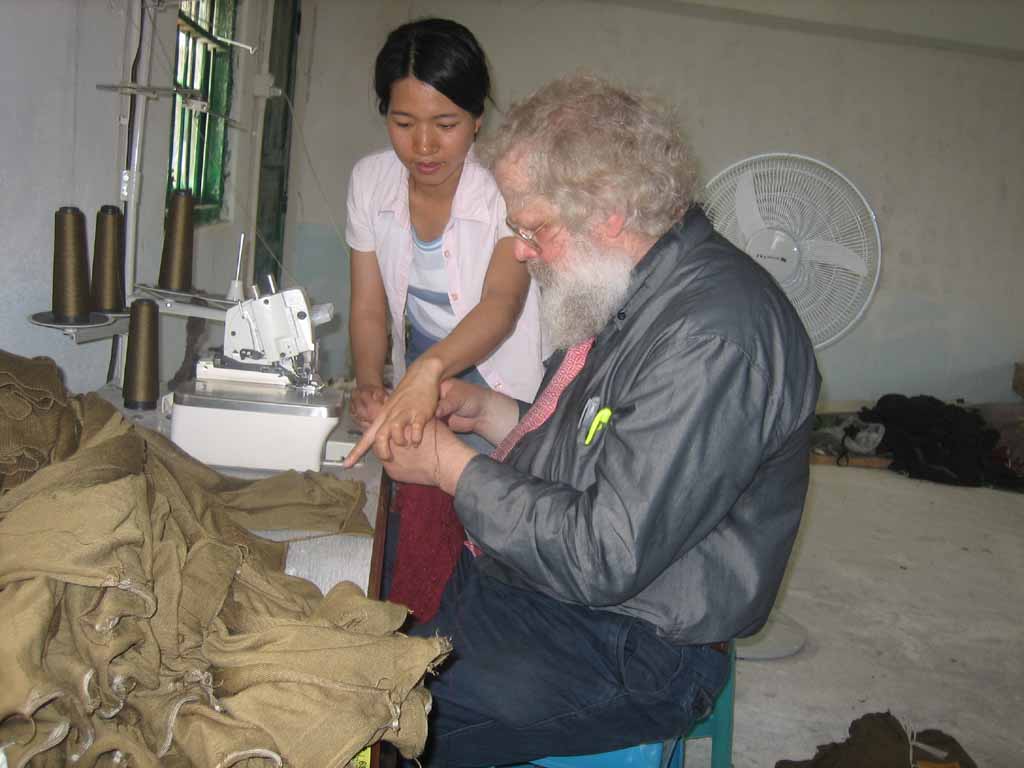
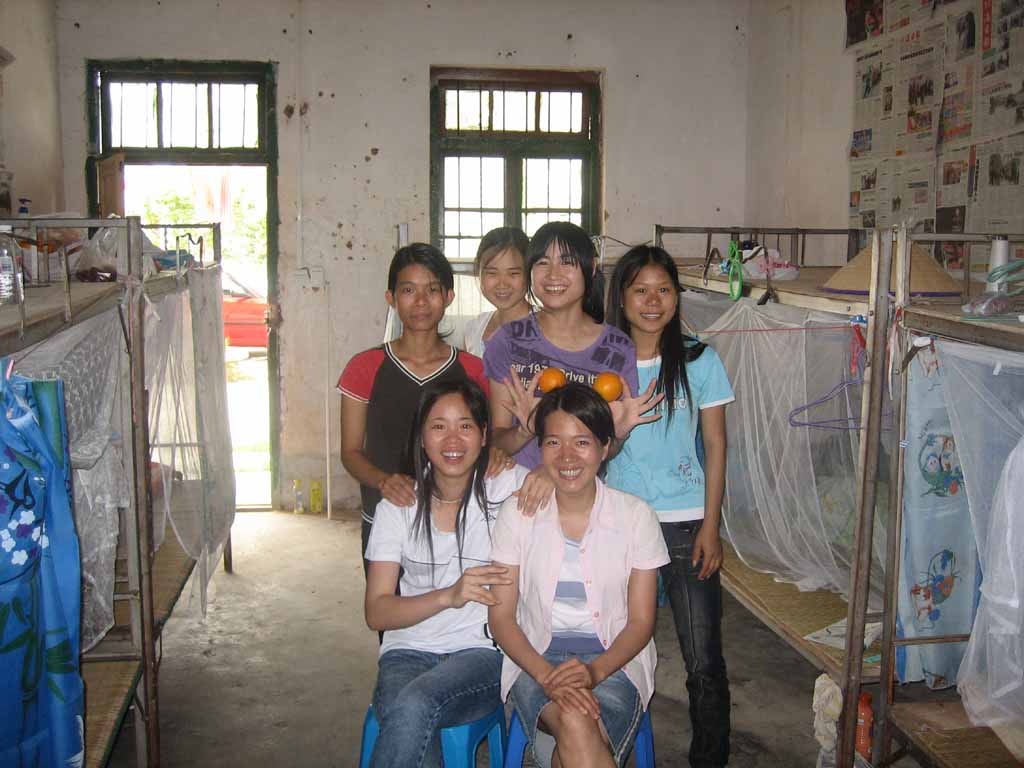 It is hard to describe the innate refinement of these quiet peasant women. Some things have to be experienced. They were a little shy at first, but actually quite friendly. All of them come from farm families. When Snow introduced me to her sister, I was a bit curious. You know, in China, people use the word "sister" to refer both to their sister and to their cousin. So to clarify this, I asked Snow if she and her "sister" had the same parents. Snow told me the story. She said, "When I was born, my parents wanted a son. But I am not a boy; I am just a girl." She then told me how this kind peasant family had taken her in. Her sister was eight years old when Snow entered her family.
The tremendous demand for low cost goods is putting many, many people to work throughout this country. There is a backlash, of course. Many people in the United States decry the loss of jobs to China. It is understandable that they would be upset, but their anger is misplaced. Whatever else you can say about the mass migration of manufacturing to Asia, it is not China's fault. The simple fact is that the cost of labor in the United States is just too high. The unions, which once had a purpose, overplayed their hand.
The recent protest against Walmart notwithstanding, Americans will continue to purchase lower cost goods from Asia, because they need the significant savings that it gives them in their cost of living. And speaking of protest, it is well to point out, I think, that the protest against Walmart was not financed by nickels and dimes from working people. It was funded by the big labor unions, because they see companies like Walmart as a threat to their power. During the current election, the AFL-CIO announced a budget of 53 million dollars to keep the Republican candidate from being elected. Where in the world did the labor unions get that kind of money? That's a rhetorical question; I know the answer. They got it because of states that have laws that force you to pay dues even if you are not a member of the union. When I was a schoolteacher in Oregon, I had to pay union dues every month. During my college days, when I worked in the cannery, I had 30 days to join the union or lose my job. North Dakota and Arizona are both "right to work" states, and I chose to exercise that right, thank-you. But my point is that the labor unions managed to pass laws in many states that gave them far too much power.
Certainly there are differences of opinion about this. I remember once when I was in the trucking industry, I was sitting in a truck stop watching a movie about Jimmy Hoffa (can't remember the name of it). We were talking about the movie a bit, and one guy said, "Every truck driver in America owes that man a debt of gratitude." I was a non-union truck driver, but I had to admit that he had a point. There was a time in America when unions were necessary. But they went too far.
In my opinion, the biggest mistake the American labor unions made was that they consolidated power by encouraging an adversarial relationship between management and labor. In the sixties and seventies, union workers managed to force greater and greater wage increases, particularly in the auto industry, because companies could compensate by raising prices. Unions cultivated loyalty to themselves. Workers got together for union picnics (not company picnics), and they sang their anthem: "The union is behind us, we shall not be moved..." But then the Japanese came in. The Toyota Corolla came to town during the Saudi oil embargo and sold like hotcakes. That started the trend. After China opened up, more and more companies moved their manufacturing to China. Before these companies moved to China, their employees had shown no sense of loyalty to them, so when the crunch came, the companies had no qualms about leaving them to their unions and going to Asia. The unions had forced higher and higher labor costs, and the companies finally got fed up with it. So the jobs left. And they are not coming back.
Certainly I have sympathy for those workers who have lost their jobs in this process. But they don't have to stay unemployed. They just need to become a little more global in their outlook. I remember once when I was living in North Dakota, I was talking to a guy who had a small business. At that time, Japan was the great nemesis. He said, "What are you going to do, if your kids grow up and all the jobs have moved to Japan?" Obviously, this guy didn't know me very well. I said, "I'd tell them to go to Japan and get a job." A couple days later, I saw the same guy driving in his car. Know what he was driving? A Datsun 240Z. Interesting. But I shouldn't judge him. Maybe he bought it the day after I talked to him.
But let's get to the bottom line. In long run, free trade is good for everyone. It is good for companies, because they are able to stay profitable by finding the lowest cost of production. But it helps workers too, because it levels the playing field, and provides more jobs for more people.
I don't say that China doesn't have problems. This is a developing country, and it is going to take some time to find the balance. For example, the workers at the small factory I visited have one day off a month. They work seven days a week except the first of every month. That's not good. Every working person should have one day a week to go to church or be with their families. But this little factory was not a "sweatshop" by any means. These ladies were glad to have the opportunity to make a little extra money. And no one was forcing them to stay. At any time, they can quit and go back to the farm if they want to. I asked Snow if any of them would go to university. She said their families didn't think they needed to go to university, because they would get married. That, of course, is old thinking, because more and more women are working even after they get married. In fact, Snow's sister is married and has a daughter. She is a very bright lady, but has an elementary education. Her daughter is being cared for by her inlaws. So you could say that the factory is taking her from her child. But will refusing to shop at Walmart make her life better? I need someone to explain to me how that works. Here, then, is the bottom line: Every time you shop at places like Walmart, you are taking money from the coffers of the union fat cats, and sending it to the poor working people of Asia. What is wrong with that?
Labels: Work
Tuesday, January 02, 2007
AN INVISIBLE ARMY BUILDS BEIJING
by Mei Fong
Less than a kilometer from Tiananmen Square lies a pit from which a 28-story hotel rise in a little more than a year. An army of construction workers lives and works at the open site, enduring plunging temperatures and freezing winds.
Some work the midnight hours, while the rest of the city sleeps.
Others rise at dawn. They work 15-hour days or longer, seven days a week. When they topple onto their bunk beds, it is 12 to a room. There is no heat.
One of them is Wei Zhongwen. He has more than two decades as a construction worker, and the injuries to prove it: a missing pinkie and a palm-size dent on his head under his neatly cropped hair. In the past decade, the 41-year-old has helped build skyscrapers, shopping malls and much else in Beijing and nearby provinces. He hasn't seen his wife or daughter in two years, and because of the press of work ahead of the Beijing Summer Olympics in 2008, he may not see them this year either.
"For me, one of the biggest problems of this job is loneliness," says Mr. Wei, puffing on a cigarette.
In his rural hometown, the money Mr. Wei has sent back has built his extended family a five-room house with a thatch roof, 21-inch color television set and rooms housing a horse and some pigs. The hardship of his work is worth it, Mr. Wei says, to educate his daughter and sustain his family on their farm.
Beijing is in the midst of an enormous building boom--one of the most ambitious construction projects the world has ever seen. Cranes clutter its skyline. At more than 10,000 sites across the city, there is a total of more than 150 million square meters of floor space under construction--an area that, if laid out, would be nearly three times the size of Manhattan.
This colossal development is due to the efforts of a nearly invisible army, a group of almost two million migrant workers who drift from China's farmlands. Toting their bedrolls from work site to work site, they earn as little as 50 cents an hour. They work in a hazardous profession with practically no workplace protections and little or no medical coverage. Many of the workers live right in the heart of the city, yet few ordinary Beijing residents ever glimpse their crowded barracks, where privacy, cleanliness--even meat--are luxuries.
They often get paid late or not at all. A report this year by the research arm of the State Council, China's highest administrative body, found that in 2004, construction firms in Beijing owed roughly 700,000 of their workers more than $380 million in wages. Mr. Wei is fighting to collect about $400 he says he is owed--half his earnings last year--and he may never see it.
In such an uncertain environment, workers drift from job to job together. They rely on word of mouth to protect themselves against bad bosses. And in bad times, they rely on each other.
These men--there are few women in their crews--are working against a deadline: December 2007. That is when the bulk of the Olympic construction work must be completed so that Beijing, one of the world's most polluted cities, has time for the air to clear of construction dust before the Games begin.
There is a lot to finish. The Olympics will attract a flood of foreign visitors and unprecedented media attention. Beijing's construction workers are aiming to have built a chunk of a subway system that, when completed, is projected to be the longest in the world, surpassing London's underground. They are erecting an airport terminal bigger than all five at London's Heathrow Airport and about 110 hotels. Including suburbs of Beijing, the building binge could cost more than $180 billion. Some call it China's most ambitious construction project since the Great Wall.
What happens to these workers after the boom already has become a topic of controversy. Beijing officials have made it clear they want to clear them out ahead of the Olympics. But authorities also fear political instability if so many workers are forced to leave because they may have trouble finding work back home.
As it is, the construction workers have a tenuous standing in the city. Lacking the papers to stay in Beijing legally, most work off the books, relying on oral promises instead of contracts. When they are sick, they visit illegal clinics, which are cheap but often dirty and run by unlicensed doctors.
Mr. Wei speaks proudly of his 18-year-old daughter Xiaowei, who lives with the rest of his family on a farm in Yushu county, in northern Jilin province. He says the girl is a good student and obedient. "We're not that close. I don't know what she likes," he says, awkwardly fingering a bunch of keys on his belt. A badge of prosperity among middle-age Chinese men, Mr. Wei's keys are a small vanity. He says he picked them up on the street. They are keys to things he doesn't have: a car, an apartment.
Like other construction workers, he lives frugally in the city. In his latest job he earns about $300 or so a month, but keeps only about $60 of it. The rest he sends home to the "3681 army" --a term used to describe the women and children left behind in China's interior. (March 8 is China's Women's Day, June 1 Children's Day.)
Next to coal mining, construction work has the highest number of casualties in China, with 2,607 reported fatalities in 2005. Steel-tipped boots are rare. China's workers clamber around in thin canvas shoes, often without safety harnesses, and buy their own work gloves. Many of their hard hats are just thin plastic shells, sold for a dollar apiece.
Wang Qishan, the mayor of Beijing, said in a recent interview that he personally reviews construction accident statistics daily. "I can never be happy when I read such reports," he said, "Beijing can't do without these people." The city tries to provide services such as health care for registered migrant workers, but its resources are overstretched, he said.
Like many other construction workers, Mr. Wei entered the trade because there was little else to do on his family's farm, a small plot where corn and soybeans grow. He left home at 17 for a province next to Beijing.
When Mr. Wei was in his 20s, his left little finger was sliced off by an electric saw. In 1994, he was hit on the head by a steel rod, landing him in the hospital for more than a month. He counts himself lucky because his employer paid for his medical bills.
Last year, the owner of an art gallery in Tongzhou, a Beijing suburb, stiffed Mr. Wei and 76 crew mates, according to the men and a later court ruling. They had been paid half-way through the project and promised the rest of the pay upon completion. Instead, when they finished they say they were driven from the site by thugs armed with iron staffs and meat cleavers.
China's state-controlled banks have poured credit into real estate, where many companies are politically connected. The easy money often leads to ill-conceived projects that quickly go bust. When financing collapses, construction workers--the ones at the bottom of the totem pole--aren't paid. They find it difficult to claim restitution because they often are employed indirectly through subcontractors.
Mr. Wei and his friends say they had no success appealing to authorities in Tongshou. About 20 of the workers drifted home, defeated. With no money, Mr. Wei and the remaining workers were forced to make camp in the neighboring province of Hebei, eking out a living with odd jobs. They say they lived on steamed buns, mostly, six for one yuan, or about 13 cents.
In November 2005, more than 50 of them rose at dawn. They marched for more than five hours to central Beijing to appeal to authorities there. They wound up at Beijing's Legal Aid office on Qianmen West Street.
Wang Xuefa, the center's director, remembers the sight of Mr. Wei and his friends kneeling en masse on the office floor. "It was sad to see men brought so low," he says.
The Intermediate People's Court in Tongshou ruled in the group's favor on Jan. 6, ordering the Hong Kong developer Lian Ka Fu International to pay more than $30,000 in back wages to the workers. They haven't seen a cent. Lian Ka Fu's proprietor, Wang Xiaohu, told the court she doesn't have the money, says, Chang Mingchuan, a lawyer at Beijing Legal Aid. Ms. Wang couldn't be reached for comment, and her Europe American Art Gallery--a green low-rise with gold Corinthian columns--is now shuttered.
Going home for Chinese New Year, China's most important holiday, is a ritual for construction workers. It is the only time in the year they see their families. Like returning heroes, they are feted and tell tales of car choked streets and the towering skyscrapers they helped build. "Some of my neighbors have not even seen a train," Mr. Wei says.
Back home, Mr. Wei is a man of substance. Over the years, his wages, which are higher than average among construction workers because of his bricklaying expertise, have helped his family enjoy some comforts. We're very well respected in my home," he says.
Last January, however, Mr. Wei stayed in a Hebei flophouse instead of returning home for the new-year holiday. Penniless, he and his friends were too ashamed to go. To cheer up, they went to an airfield and watched planes taking off.
"Really, that's the only time I felt like suicide. I thought if a car hit me, at least I can get some compensation," Mr. Wei says.
Reached by telephone, his wife, Ding Guiying, says it is a hard life taking care of Mr. Wei's aged parents, raising her daughter alone and tending the crops. Mr. Wei's wages nowadays go to pay for his daughter's secondary education--which isn't free in China, even at public schools. Ms. Ding says the bill comes to around $1,300 a year.
Ms. Ding, 42, hopes her husband can come home when their daughter has finished school. "We keep being separated for such a long time, and I can hardly count how many days we've been together in the past 19 years," she says.
Mr. Wei spent most of this year in Hebei, the province surrounding Beijing. In May, he and his friends found a job at a residential site. Mr. Wei roomed in a wooden shack with 10 other workers. The floor was a brick-and-dirt mixture. The only running water was from a sink in the courtyard. The toilet was a shed with wooden planks over a hole. In the kitchen, flies clustered thickly.
In Hebei, as is common on such jobs, Mr. Wei paid his employer 60 cents daily for three meals, mostly rice and tofu. Meat was rare, but he is a vegetarian. Growing up poor, he never got used to the taste of meat.
One of the crew, Yang Xinguo, 53, injured his leg in a traffic accident and had to stop working in September. After lingering for awhile, hoping to get compensation from the art-gallery job, he decided to go home in mid-November. He had a few dollars earned before the accident and $50 or so that Mr. Wei and other friends gave him.
"We will send your pay to you, once we get it," promised Mr. Wei, sitting on Mr. Yang's bed. He offered his departing friend a cigarette. Through the smoke, Mr. Yang's eyes shimmered. "Men don't want to cry, but we have cried many times," he said.
By late November, Mr. Wei and his crew had moved back to Beijing. They found better work building the 28-story, four-star hotel. Conditions are cleaner. Mr. Wei now lives in barracks perched next to the yawning site. He has 10 roommates, including some new ones. There is no canteen, so they cook in the room, using a gas ring attached to a 1.5 meter canister next to Mr. Wei's bed.
With no heating, they sleep in their jackets, and sometimes hats and gloves, too. Temperatures can drop below minus-20 degrees Celsius in Beijing's winter. Some have electric blankets they bought for about $1.25 each.
They are creative with their limited space, rolling back their bedrolls and using the boards beneath as makeshift tables. The cook, Wen Fenglin, adroitly uses the space to chop cabbages and peel onions, ladling water from an old paint bucket to clean the food and utensils. The 55-year old used to work on the crew but now is employed by the construction company to cook. "Boss said I have to learn because I'm too old to do heavy work," he says, browning onions for an omelet.
There are no washing facilities, so baths and clean clothes are treats. Mr. Wei remembers taking a bath well more than a month ago at a bathhouse, paying about 60 cents.
With no laundry, Mr. Wei buys second-hand clothes, wearing them until they get too dirty. Currently, his favorite is a gray cotton shirt he bought for a little more than a dollar, which looks as if it once might have belonged to a corporate executive. "I normally throw away the clothes after wearing, but maybe I'll sell this. In about 10 days," he says.
Around Beijing's small alleyways, an underground economy caters to construction workers. Vendors often do their business by barter because the workers don't have space to keep much, and adopt a throwaway culture. One popular item is underwear with zippered pockets, to keep money and valuables close.
Mr. Wei's pace of work is now frenetic. The hotel still is just a big hole in the ground. Under city ordinances, concrete trucks from the hundreds of factories ringing the city are allowed in the city center only after 11 p.m. and on weekends, so he and his friends must work long past midnight curing concrete. Once the hotel's foundation is done, in about two months, Mr. Wei says the plan is to build a floor every five days.
On the next-to-last day of November, Mr. Wei and his comrades crowded into a small postal outlet, their grimy appearance setting them apart from other customers. The air smelled of unwashed clothes, and some people edged away.
It was exactly a year since they had made their long march to the Beijing Legal Aid office. Mr. Wei had given up hope of recovering his lost wages, but on this day the mood was celebratory. It was payday, and the men wanted to mail their money home. There was a flurry of bewilderment as they fumbled with forms. Mr. Wei, his eyes red-rimmed after a 20-hour shift, helped some of the workers who can't write well fill out the forms.
Zhang Tao, 20, in a paint-stained blue sweater and matted hair, slowly scrawled the amount he is sending home: 900 yuan, or about $115. He said he earns 1000 yuan, or $128 a month.
On another night, Mr. Wei took a walk, wandering around the city's glittering towers and looming cranes, "I have no regrets," he said. "I'm the migrant worker who stays out all year so home is better. I've seen things my neighbors have never imagined--50-story buildings, planes so big they can carry hundreds."
He stopped in front of a European five-star hotel near his work site. "I build these things, but I have never been inside," he said.
Timidly, he pushed the swing door and went in.
Sue Feng contributed to this article.
In one sense, Mr. Wei would be considered by many poor, rural people to be very, very fortunate. The monthly salary quoted in this article ($300/mo.) would be pretty good wages for someone from the countryside--about three times minimum wage. But remember, to get this income, he is basically working a double shift. I have done it before, working in the fish processing plants in Alaska. Work at eight hour shift, have lunch, then put in another eight hours. It is a real grind. But that was for a short period in the summer. These guys work like this all the time. And what troubles me most is that far too often the contractors pay them late, or don't bother to pay them at all, and the migrant workers have very little recourse. It is a sobering story of what life is really like for so many migrant working people in China. For them, it is a great opportunity. But too often they are taken advantage of by unscrupulous or inept employers, with very little recourse.
Labels: Migrant Workers, Work
Saturday, June 24, 2006

Workers protesting a company and a boss who has absconded with their wages.
Flew into Shenzhen this morning. I have always wanted to see this "miracle city" of China. Shenzhen was born out of Deng Xiaoping's economic reforms, which began in the eighties. Shenzhen, which used to be a small fishing village, was commissioned as an "special economic zone." The official word was that Shenzhen was being set up to facilitate trade with Hong Kong (which was true, of course), but the more important issue, in my opinion, is that Shenzhen was an "experiment" with capitalism. Picture the situation: You have Hong Kong, the most capitalistic enterprise in history, just across the causeway from a little fishing village in a country where established orthodoxy says that business is evil. Suddenly, the government in that country says, "OK Shenzhen, you can operate like Hong Kong, and we will look the other way for now." The result was an economic force flow that saw a city of 10 million people explode out of the Delta in a 20 year period of time. It is meaningless to talk about what Shenzhen was before this happened, because it's basically irrelevant. There is virtually no relationship between what is here now, and what was here then. This is not a metamorphosis. This is a quantum leap.
Linda picked me up at the airport, and we took the bus back to her dormitory. After a good afternoon nap, we decided to walk around a bit, and happened to walk by some protestors sitting in front of a restaurant that was closed. There was a whole bunch of them. I don't read Chinese very well, yet, but Linda told me that they were protesting because they had worked for many months without pay, and their boss had just absconded with the money. Disappeared. They had no chance of being paid. I took a picture of them, and we walked on...oops, not so fast. The police officer stopped us abruptly and told me that I had to delete the picture from my camera. I told him that I didn't know how to do that. It was the simple truth. When I bought this new pocket camera a few months ago over in Zhonguancun, I went to the Canon web site and downloaded a .pdf file of the manual in English. But I haven't had a chance to go through all of it, and truthfully, this was not one of the things that I needed to know, because when I bought the camera, I also purchased a 1 GB memory stick. I can take hundreds of pictures before having to worry about filling up the space (unless I am taking lots of movies). So I usually offload the jpegs to my laptop, and then decide which ones I want to keep. Anyway, the police officer was definitely not satisfied with my story, and it was beginning to look like it was going to be a long day. Linda to the rescue. She grabbed my camera cheerfully and said, "No problem, I can delete it." She fingered my camera like an expert for a few seconds and deleted the offending picture. She gave it back to me, OK, it's done. The cop let us go. I was a bit disappointed to lose the picture, but Linda assured me that we had no choice, and I didn't want trouble, either.
Actually, the fact that a police officer can walk up to you and tell you what you can and cannot take a picture of, is, in some ways, a bigger story than the protest itself. Or maybe I just feel that way because I have been so thoroughly inculcated with the "right to know" as a divine right. To be honest, I'm not sure exactly what the concern would be here, it is very possible that the cop was acting on his own, I just don't know. After all, these folks weren't protesting the government. They were protesting (a bit futilely, I think) against a boss who was not even in the picture any more (no pun intended). At any rate, it does seem to be another example of the extreme image-consciousness in this country that is so noticeable to foreigners. This is one problem I have with journalism in China. China wants the world to understand and appreciate it's perspective, and even advertises the news show on CCTV as bringing the "Chinese perspective" to the world. But the purpose of journalism is not to present a particular perspective. It is to present the facts. To be sure, that would include the perspectives of parties involved, but the perspectives should be presented as objectively as possible. So I do not completely buy into the Chinese approach to journalism. But the American approach to journalism is so far to the other end of the spectrum, that it becomes repulsive and amoral. Objectivity at the expense of humanity. I will never forget hearing Peter Arnett in "Live from the Battlefield" describing the self-immolation of a Buddhist monk in Vietnam,
"As a human being, I wanted to intervene, but as a journalist, I knew I could not."
So Arnett stood there and watched a Buddhist monk burn himself to death because he didn't want to be come "part of the story." American journalists often go to such elaborate lengths to avoid being "part of the story," that they lose their humanity in the process. That's not good news. And it's not good journalism. Objectivity is not a god to be worshiped, it is a value we adopt as a matter of integrity. But when objectivity becomes detatchment from reality, this detachment itself becomes a more important story than the one being covered.
My purpose in taking a picture like this is not to show how bad China is. It is simply to give a voice (for whatever it's worth) to people who don't have anyone to speak for them. Have you ever been in a situation where you desperately wished you had someone to speak for you? It's a desperate, helpless feeling.
Linda and I proceeded to a coffee bar, where we met a guy from Istanbul who was waiting for his wife to do some shopping. I talked with him about my visit with the Turkic Uygur people in Xinjiang last summer. While we were talking, I was flipping through the pictures on my camera, and realized that the "deleted" picture was still there. Linda said, "I know. I'm not familiar with that camera. I don't know how to delete pictures." Could have fooled me. Did fool me. Anyway, that's the long and short of it. I got the picture, and Linda gets an Oscar.
