Links
- CV
- Titles
- Topics
- Tickets
- Science
- About Eric
- Book Reviews
- Country Profile
- Modern China
- Contact Eric
- Podcast
- Vision
- Sekai
- John
Archives
RSS

Reflections on a Wandering Life.....
Tuesday, January 30, 2007
Went to Guomao to buy my plane ticket today. I met a guy on the subway who asked me if I was a movie director. Do I really look that much like Spielberg? I don't know...it never would have occurred to me, but someone in Japan made the same observation once. In China, it's usually Marx or Santa Claus. Maybe that's because Japan doesn't have a "Marx." But the main thing, I think, is that someone with a beard generally gets stereotyped as an image of someone people relate to among the foreigners they have seen or heard of. Beards just aren't very common in Asia.
Compared to Tokyo, Beijing's subway system seems small townish. But it is changing. Beijing is building several subway lines in preparation for the Olympics. Although I sometimes dread the changes, the tremendous investment in infrastructure development may turn out to be the main benefit of the Olympics. Still not sure, though, whether it will be mainly curse or blessing. I'm just crossing my fingers and hoping all the change doesn't do too much damage to the older communities. There is quite a bit of overbuilding in Beijing, now, and much of it is done for speculation. If the bubble bursts, we could end up with a whole lot of empty concrete structures. Life in newer communities does have it's conveniences, but it is also more complicated and more expensive. Most of the time, I find myself hoping the whole thing can come off without doing too much damage.
Compared to Tokyo, Beijing's subway system seems small townish. But it is changing. Beijing is building several subway lines in preparation for the Olympics. Although I sometimes dread the changes, the tremendous investment in infrastructure development may turn out to be the main benefit of the Olympics. Still not sure, though, whether it will be mainly curse or blessing. I'm just crossing my fingers and hoping all the change doesn't do too much damage to the older communities. There is quite a bit of overbuilding in Beijing, now, and much of it is done for speculation. If the bubble bursts, we could end up with a whole lot of empty concrete structures. Life in newer communities does have it's conveniences, but it is also more complicated and more expensive. Most of the time, I find myself hoping the whole thing can come off without doing too much damage.
Monday, January 29, 2007
This afternoon, I went to the clinic at the Peking University Health Sciences Center (which is across the street from the Southeast gate of Beihang) to have my blood pressure checked. During the Christmas season, I happened to be at the Walmart Super Store, and they were selling those little electric blood pressure checkers. That one showed me at 152 over 86. I don't trust those gizmos, so I wanted to have it checked by a doctor. Cost me 5 kuai. 130 over 70. Those little electric gadgets are a nice idea, but they just aren't accurate enough to be worth buying.
 Ran into Eric Zhang in Wudaokou this evening. He recognized me from my blog. We went to an Italian restaurant that my neighbor told me about. Nice place, and the Lasagna is pretty good, too. Eric Zhang works for Semantic, one of the many companies that are springing up around this area. Zhongguancun has been referred to as the "Silicon Valley" of China, and it is rapidly developing in the area around Qinghua University. It is really amazing to see the companies that have sprung up just in the three years I have been living here. Zhongguancun is also the name of a major street in the Haidian District, and the primary Zhongguancun businesses have tended to center around that area, which is a couple miles west of where I live. But now, many multinational companies are setting up on the north side of Wudaokou, where Qinghua University (the "M.I.T." of China) is located.
Ran into Eric Zhang in Wudaokou this evening. He recognized me from my blog. We went to an Italian restaurant that my neighbor told me about. Nice place, and the Lasagna is pretty good, too. Eric Zhang works for Semantic, one of the many companies that are springing up around this area. Zhongguancun has been referred to as the "Silicon Valley" of China, and it is rapidly developing in the area around Qinghua University. It is really amazing to see the companies that have sprung up just in the three years I have been living here. Zhongguancun is also the name of a major street in the Haidian District, and the primary Zhongguancun businesses have tended to center around that area, which is a couple miles west of where I live. But now, many multinational companies are setting up on the north side of Wudaokou, where Qinghua University (the "M.I.T." of China) is located.
Wednesday, January 24, 2007

 Can you believe I won a contest? That sure doesn't happen very often. Lessee...the last time I won a contest is when I first went to work for UAT. I was in the IT department half time, and teaching the other half. They had this contest in the IT department where you would get a point every time you said someone's name. At the end of the week, the one with the least points was the winner. That was me. I won the contest by not saying anything to anybody. The prize was a $75 gift certificate to Barnes and Noble. Well, you know, when you give a gift card for a bookstore to a bookaholic, it isn't going to last long. Still, it was nice.
 This time, it was a photo contest. Don't get excited, though, it was just "honorable mention." That's alright. I like being honorable, and I don't mind being mentioned. The Beijing Municipal Education Communication put together an album of pictures taken by foreign experts living in Beijing. I sent them four or five jpegs, and they chose two of them for the book.
The picture on the right surprised me a bit. I took that shot of the Ming Dynasty guard tower at the Forbidden City with my old 2 megapixel Minolta. Two megapixels is more than enough for putting pictures on a website (1024 * 768 = 786,432), but prints are a whole different story. For prints you really need mexapixels. I almost didn't submit it, because I didn't think they would be able to use it. But it actually blew up pretty nice.
Realistically, you can't expect to win first prize with a pocket camera even if you are a pretty good photographer, which I am not. But the age of digital cameras has definitely changed things. Pictures are free. There is no cost for taking them, or for developing them, unless you want prints. But you can view pictures and show pictures without printing them. Because of this, you can take as many pictures as you want to make sure you get a good one. Sometimes this creates a problem, because you have to discipline yourself to throw away the shots you know you will never use. Last summer I took 300 pictures to get a hundred for my website. But the upside is that if you click the shutter enough times, even a very amateur photographer can accidentally come up with something good once in awhile. And there isn't much chance that someone like me would ever go in for one of those fancy cameras. I wouldn't use it. Not very often, anyway. I would be thinking of excuses not to bring it with me. Take these two pictures, for example. The one on the right I would have, because I was on a self-guided bicycle tour that day. That's the kind of situation where you tend to bring a camera. But I would not have the picture of the juggler, because I would not have had my camera with me. I was busy and the sky was cloudy--not a day for taking pictures. But for me, pictures are about life, not just about scenery. I take pictures to enhance descriptions of life. I really need to have a camera so small that I can take it with me all the time.
Thursday, January 18, 2007
Coffee. Walked into the coffee bar this evening and went to my regular study spot on the third floor. I overheard the fuwuyuan talking to the folks below on her walkie-talkie (in Chinese, of course), "Grandpa Marx is here, so get the coffee ready, and make sure it's very hot." Good. They're getting the message. Actually, I've never complained. But several times I have taken my coffee to the bar to have it heated.
The problem is that sometimes coffee bars like this use a thermos. You wouldn't have a coffee bar like this in America with only one coffee pot. But here, many people order other things, like tea. And the ones who do order coffee often order the gourmet stuff, brewed by the cup. Not that many people order the house coffee. So they make some coffee and pour it in the thermos and let it sit. It isn't really that bad, especially when the place is busy. But the coffee does cool off a bit. When that happens, I just take my cup to the counter and have them put it in the microwave. But if the place is not very busy, then sometimes the coffee sits for quite awhile. I know, I sound picky, don't I?
Tea is different. The rest of the world uses tea bags, which dissolve quickly, because tea bags are made from ground up tea leaves. But in China we don't use tea bags. We sprinkle a few leaves in the bottom of the cup and pour in very hot water. The leaves are dehydrated and shriveled up, but not ground up. When you pour in hot water, the leaves open up. But you have to steep them longer, because they are whole leaves. When you finish a cup, you don't need to dump the leaves out. Just pour in more hot water. Of course, you can't keep doing this forever. Certainly not for a week or month. But one day isn't bad. After the day is over, I will usually dump the leaves.
But you can't do that with coffee. I was at a coffee bar over by Beida one evening, and noticed that the house coffee came with free refills. I tried it and it was unbelievably horrible. I asked the fuwuyuan about this, and she told me that the house coffee was not brewed by the cup (Starbucks style). I had no problem with that, but I told her that it tasted very old. She said it couldn't be old, because they made it fresh every morning. I couldn't help laughing. You just can't do that with coffee. Coffee gets rancid pretty quickly. Bottom line is that in China, you get both the best coffee and the worst coffee.
Speaking of Starbucks, bloggers in China have stirred up a minor furor over the presence of a Starbucks establishment in the Forbidden City. But the spokesman from Starbucks said that the government actually invited them to set up shop there. Traditionalists think that it is a sign that the Forbidden City is going to the dogs.
Personally, I am no fan of the excessive commercialism of historic sites, but I don't think that Starbucks should take all the blame. And if Starbucks was forced to move, what would replace it? Don't think for a minute that the Forbidden City would be less commercialized.
The problem is that sometimes coffee bars like this use a thermos. You wouldn't have a coffee bar like this in America with only one coffee pot. But here, many people order other things, like tea. And the ones who do order coffee often order the gourmet stuff, brewed by the cup. Not that many people order the house coffee. So they make some coffee and pour it in the thermos and let it sit. It isn't really that bad, especially when the place is busy. But the coffee does cool off a bit. When that happens, I just take my cup to the counter and have them put it in the microwave. But if the place is not very busy, then sometimes the coffee sits for quite awhile. I know, I sound picky, don't I?
Tea is different. The rest of the world uses tea bags, which dissolve quickly, because tea bags are made from ground up tea leaves. But in China we don't use tea bags. We sprinkle a few leaves in the bottom of the cup and pour in very hot water. The leaves are dehydrated and shriveled up, but not ground up. When you pour in hot water, the leaves open up. But you have to steep them longer, because they are whole leaves. When you finish a cup, you don't need to dump the leaves out. Just pour in more hot water. Of course, you can't keep doing this forever. Certainly not for a week or month. But one day isn't bad. After the day is over, I will usually dump the leaves.
But you can't do that with coffee. I was at a coffee bar over by Beida one evening, and noticed that the house coffee came with free refills. I tried it and it was unbelievably horrible. I asked the fuwuyuan about this, and she told me that the house coffee was not brewed by the cup (Starbucks style). I had no problem with that, but I told her that it tasted very old. She said it couldn't be old, because they made it fresh every morning. I couldn't help laughing. You just can't do that with coffee. Coffee gets rancid pretty quickly. Bottom line is that in China, you get both the best coffee and the worst coffee.
Speaking of Starbucks, bloggers in China have stirred up a minor furor over the presence of a Starbucks establishment in the Forbidden City. But the spokesman from Starbucks said that the government actually invited them to set up shop there. Traditionalists think that it is a sign that the Forbidden City is going to the dogs.
Personally, I am no fan of the excessive commercialism of historic sites, but I don't think that Starbucks should take all the blame. And if Starbucks was forced to move, what would replace it? Don't think for a minute that the Forbidden City would be less commercialized.
Wednesday, January 17, 2007
Click for larger image.
 Asia lives on bikes. I know, everybody says it's changing, and when I see the old pictures of Beijing and Shanghai in the seventies, when streets were totally clogged with bicycles, I can believe it. But bicycles are still very much a part of life in this city, and many other cities in China. There are exceptions, such as Chongqing, which is much to hilly for bicycles to be practical. That's one thing I really like about Beijing. It is flat enough that you can ride anywhere in the city. And it is dry enough that you can do this year-around. And since there so many bikes, every street has a bicycle lane. Even when you cross the ring road, there is a special lane for bycyclists to work their way through the cloverleaf. It is really quite impressive.
Takes me about 45 minutes to get to the Forbidden City. But I usually don't go down that far. I ride down to Houhai lake and explore the hutongs. But that's touring. It is the every day use that really saves me. You don't really need a car in China. I do take a taxi once in awhile, but very rarely. Busses I take more often than taxis, especially if I am with someone. But even that I don't do very often. It's just so easy to get around on a bike. And cheap. The only significant overhead is the cost of thievery. I have been here for three years, and I am on bike number 4. If I can make this thing last at least one more year, I will be down to one bike a year. Still not good, but my point is that even with that problem, getting around on a bicycle is relatively inexpensive. In three years, the total amount I have spent buying bicycles and keeping them in good repair probably doesn't come to more than a couple hundred dollars.
 Asia lives on bikes. I know, everybody says it's changing, and when I see the old pictures of Beijing and Shanghai in the seventies, when streets were totally clogged with bicycles, I can believe it. But bicycles are still very much a part of life in this city, and many other cities in China. There are exceptions, such as Chongqing, which is much to hilly for bicycles to be practical. That's one thing I really like about Beijing. It is flat enough that you can ride anywhere in the city. And it is dry enough that you can do this year-around. And since there so many bikes, every street has a bicycle lane. Even when you cross the ring road, there is a special lane for bycyclists to work their way through the cloverleaf. It is really quite impressive.
 Takes me about 45 minutes to get to the Forbidden City. But I usually don't go down that far. I ride down to Houhai lake and explore the hutongs. But that's touring. It is the every day use that really saves me. You don't really need a car in China. I do take a taxi once in awhile, but very rarely. Busses I take more often than taxis, especially if I am with someone. But even that I don't do very often. It's just so easy to get around on a bike. And cheap. The only significant overhead is the cost of thievery. I have been here for three years, and I am on bike number 4. If I can make this thing last at least one more year, I will be down to one bike a year. Still not good, but my point is that even with that problem, getting around on a bicycle is relatively inexpensive. In three years, the total amount I have spent buying bicycles and keeping them in good repair probably doesn't come to more than a couple hundred dollars.
Tuesday, January 16, 2007
 You know, winter really is a nice time of the year in Beijing. Problem is, it's only January, and I have spring fever. I'm supposed to be studying, and I'm looking out the window. I don't like summer in Beijing; I'm sure I've said that before. It's much worse than Phoenix. Not necessarily hotter, but very, very humid. I haven't figured it out yet, because Beijing is usually considered a dry climate. I guess that's why it's so nice the rest of the year. Fall would be the nicest, I suppose, but winter is nice too. Sunny. Cold, yes. But not terribly cold. I remember when Michael first got to Beijing. Michael is a mountain man. He has hiked both the Appalachian and Pacific trails from Mexico to Canada. He said, "They told me this place was going to be cold! This isn't any different than standing on a mountain ridge." That's just about it. Beijing is "mountain ridge" cold. Except this winter. This winter it has been unusually mild. Still winter, but warmer than usual. But even at its worst, Beijing is not cold like the American Midwest. Harbin is. Every member of the Canadian National hockey team is from Harbin. That is cold country. Like Minnesota or North Dakota. But Beijing is much milder. And dry and sunny.
 I don't know--I suppose it depends on your perspective. I was talking to a student once. He said, "I hate Beijing; it's too cold!" I looked at him. "I'd hate Beijing too, if I dressed like you did." It's all about layers. You do need to dress for winter. But it's not very hard in Beijing. And of course, since Beijing is north of the Yangtze River, all the buildings have heat. They turn on the water in November, and keep it on until March. So the inside temperature is quite comfortable. As I said before, this winter is especially warm. Some think it is because of global warming, but I don't think so. I have lived in snow country most of my life, and these things do fluctuate some. I heard the other day that Russia is having one of the warmest winters on record. I have a fur cap that I bought in the summer of 2005 when I was in Central Asia, and I haven't worn it yet this winter.
Thursday, January 11, 2007
The professor was from South Korea. In his student days, he had been part of the student movement that helped to dethrone Singman Rhee (1960), South Korea's president turned despot.
The two debaters were young Africans. One, a mild-mannered young man from Ethiopia, was defending his country's position in refusing to grant independence to the rebellious province of Eritrea. The second student was a zealot. A bit of a hothead. He was an activist in the Eritrean independence movement. Knowing that the discussion could get heated, Professor Kim repeatedly thanked the two students for their civility.
The place: Monmouth Oregon. Oregon College of Education. During my undergraduate days, among other things, I did a minor in Public Administration. Sitting in Professor Kim's political science class and listening to this debate, I was inclined, as I suppose anyone would be, to focus on the discussion of the moment, and what the odds might be for one side or the other winning out.
That was in the early Seventies, during the civil war in Ethiopia that lasted thirty years, giving Eritrea independence in 1991. But the truth is, they're still going at it. The seemingly endless conflict between these two forces is being played out today in neighboring Somalia, with Ethiopia supporting the internationally recognized federal government, and Eritria supporting the Islamist militia. Strange how some corners of the world seemed to be adicted to endless, protracted conflict.
China has a strong interest in Africa, so conflicts such as this are easy to follow, because they are well covered. I don't think anyone doubts, though, that the current interest in Somalia is largely due to the American targeting of an Al Qaeda terrorist--an attack that was initially reported to be successful, but now seems doubtful. But as China wants to be seen more as an arbiter in these kinds of disputes, I wonder how much attention is being paid to the history behind these conflicts. The Americans got into a lot of trouble in Vietnam because they paid far too little attention to the impact of French colonialism in hardening the resistance movements that would cause the most powerful nation in the history of the world to be bogged down for ten years. We ignore history at our peril.
The two debaters were young Africans. One, a mild-mannered young man from Ethiopia, was defending his country's position in refusing to grant independence to the rebellious province of Eritrea. The second student was a zealot. A bit of a hothead. He was an activist in the Eritrean independence movement. Knowing that the discussion could get heated, Professor Kim repeatedly thanked the two students for their civility.
The place: Monmouth Oregon. Oregon College of Education. During my undergraduate days, among other things, I did a minor in Public Administration. Sitting in Professor Kim's political science class and listening to this debate, I was inclined, as I suppose anyone would be, to focus on the discussion of the moment, and what the odds might be for one side or the other winning out.
That was in the early Seventies, during the civil war in Ethiopia that lasted thirty years, giving Eritrea independence in 1991. But the truth is, they're still going at it. The seemingly endless conflict between these two forces is being played out today in neighboring Somalia, with Ethiopia supporting the internationally recognized federal government, and Eritria supporting the Islamist militia. Strange how some corners of the world seemed to be adicted to endless, protracted conflict.
China has a strong interest in Africa, so conflicts such as this are easy to follow, because they are well covered. I don't think anyone doubts, though, that the current interest in Somalia is largely due to the American targeting of an Al Qaeda terrorist--an attack that was initially reported to be successful, but now seems doubtful. But as China wants to be seen more as an arbiter in these kinds of disputes, I wonder how much attention is being paid to the history behind these conflicts. The Americans got into a lot of trouble in Vietnam because they paid far too little attention to the impact of French colonialism in hardening the resistance movements that would cause the most powerful nation in the history of the world to be bogged down for ten years. We ignore history at our peril.
Tuesday, January 09, 2007
The fuwuyuan at the coffee bar wanted to borrow my black winter cap. I guess she is going to be in some kind of show or something, and needs it for her costume. Interesting. Not really eager to give it up in the middle of the winter, but it's only for a week, and I just bought a brown one at the hat store on Wangfujing Street, so I let it go.
Monday, January 08, 2007
Here's one from Helen Keller:
Question: What is worse than being born blind?
Answer: Having sight without vision.
Vision. What is vision? I have spoken about this before. It is the ability to see things that are not there, and call them into being by faith. Vision is terribly important. Absolutely essential if you want to accomplish anything of value. But every bit as important as vision is annointing. If you have vision but no annointing, your way will be fraught with constant friction. So what is annointing? It is the oil of God's blessing that lubricates the circumstances to provide a smooth transition to the purpose for which the vision calls us.
But is it possible to have vision without annointing? Moses would be an example. His failure to enter the promised land was not from lack of vision. He was a man of vision, and he was allowed to see the promised land, but he was not allowed to enter, because he struck the rock.
I, myself experienced a situation where I had vision, but did not seem to have annointing. Many years ago, I put together a non-profit organization to lobby at the North Dakota State Legislature. At the time, I said many times that what we really needed was not money, but vision. But as an organization, it never seemed to get off the ground, and it was not for lack of vision. The problem was annointing. You see, I wanted to change the world. But God's purpose was not for me to build an organization that would turn the world upside down. I believe now that He wanted me to have a vehicle in place to address my own situation. Viewed from that perspective, it was very useful, because two years after I was at the Legislature, I needed to lobby the Attorney General's office about another part of the problem, and my experience at the legislature proved to be invaluable.
Now I find myself in China. The other day I was talking with a brother from Singapore about this issue, and he mentioned the importance of establishing first why we are here. This is important, becuase it turns out that, while I certainly have an interest in helping the people of China, I am far more concerned about encouraging Chinese Christians to develop a sense of vision about missions, and reaching out to the world around them. So how does one go about this? I don't know, exactly, but one thing is certain. It cannot be done without the annointing. It is very important to pray for the annointing. This should never be taken for granted. There have been times that I have neglected to pray for the annointing. I have always regretted it.
Bottom line: God will lead one step at a time. Slowly, but surely, the vision will be clarified. And as the picture starts to come together, I will continue to pray for God's annointing on the work he has called me to do, because, as Hudson Taylor said, "God's work, done God's way, will never lack God's supply."
Question: What is worse than being born blind?
Answer: Having sight without vision.
Vision. What is vision? I have spoken about this before. It is the ability to see things that are not there, and call them into being by faith. Vision is terribly important. Absolutely essential if you want to accomplish anything of value. But every bit as important as vision is annointing. If you have vision but no annointing, your way will be fraught with constant friction. So what is annointing? It is the oil of God's blessing that lubricates the circumstances to provide a smooth transition to the purpose for which the vision calls us.
But is it possible to have vision without annointing? Moses would be an example. His failure to enter the promised land was not from lack of vision. He was a man of vision, and he was allowed to see the promised land, but he was not allowed to enter, because he struck the rock.
I, myself experienced a situation where I had vision, but did not seem to have annointing. Many years ago, I put together a non-profit organization to lobby at the North Dakota State Legislature. At the time, I said many times that what we really needed was not money, but vision. But as an organization, it never seemed to get off the ground, and it was not for lack of vision. The problem was annointing. You see, I wanted to change the world. But God's purpose was not for me to build an organization that would turn the world upside down. I believe now that He wanted me to have a vehicle in place to address my own situation. Viewed from that perspective, it was very useful, because two years after I was at the Legislature, I needed to lobby the Attorney General's office about another part of the problem, and my experience at the legislature proved to be invaluable.
Now I find myself in China. The other day I was talking with a brother from Singapore about this issue, and he mentioned the importance of establishing first why we are here. This is important, becuase it turns out that, while I certainly have an interest in helping the people of China, I am far more concerned about encouraging Chinese Christians to develop a sense of vision about missions, and reaching out to the world around them. So how does one go about this? I don't know, exactly, but one thing is certain. It cannot be done without the annointing. It is very important to pray for the annointing. This should never be taken for granted. There have been times that I have neglected to pray for the annointing. I have always regretted it.
Bottom line: God will lead one step at a time. Slowly, but surely, the vision will be clarified. And as the picture starts to come together, I will continue to pray for God's annointing on the work he has called me to do, because, as Hudson Taylor said, "God's work, done God's way, will never lack God's supply."
Saturday, January 06, 2007
 Monument to the People's Heroes. It stands in the center of Tiananmen Square. Hard to believe that such a plain looking structure could be the centerpoint of so much tumultuous history. One of the most poignant moments took place in April of 1976. Zhou had died in January, but the April was the traditional time for honoring the dead. In a mass demonstration of grief and admiration, and what was perceived to be (and probably was) a thinly veiled protest, people buried the monument in flowers and other memorials. Most significant was the poetry, such as a poem which blasted an obscure princess in Chinese history who assumed power because of her husband's position. Jiang Qing (Mao's fourth wife) was not happy. She hated Zhou anyway, but she also got the message. She ordered the square cleared of flowers, but it did no good. People just replaced them. The conflict with the government and particularly with the "Gang of Four" erupted into a riot that has become known as the "Tiananmen Incident."
Friday, January 05, 2007
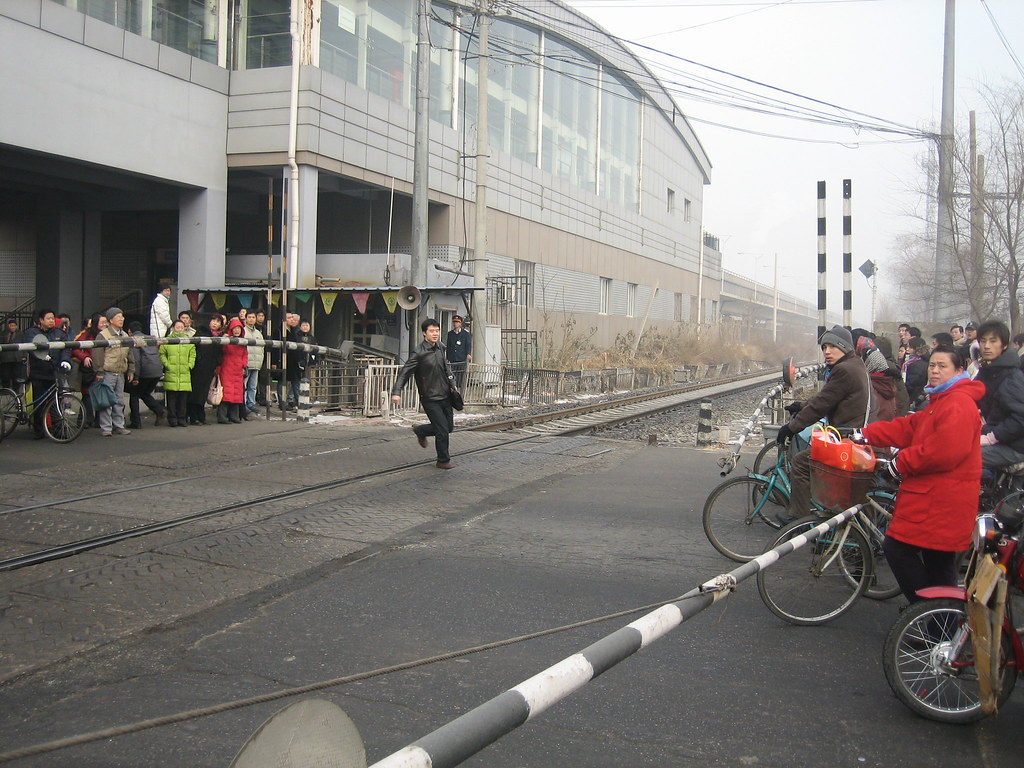 The wait at Junction Number 5 this morning got a little long. It's interesting to watch people. Most of them will wait, because they don't want to get hit by a train. But at some point, the masses will lose patience. It happens at train crossings, and it happens at intersections, like the one in Wudaokou, where the light stays red for a very long time. People just give up and start walking across.
 Some time ago, I was watching Dialogue, and they were discussing the tragic fact that many Chinese students are killed every year in accidents in other countries. During the discussion, it came out that in most cases, the students were violating traffic rules. At one point, Yang Rui made the comment that Chinese drivers are more careful to watch out for pedestrians, but drivers in other countries don't have this cultural tradition. I laughed out loud. Chinese drivers careful? But you know, there is a sense in which he is right. Drivers in China do tend to be very aggressive, but pedestrians notoriously ignore traffic signals, so drivers know that they have to watch out for them.
At the Zhongguancun intersection during the traffic rush, there are crossing guards at every corner. Their basic job is to tell pedestrians that the light is green so they can go, or that the light is red, so they really do need to stop. It takes two crossing guards at each corner to enforce obedience to the traffic lights. Students who grow up in this environment sometimes don't realize that drivers in other countries are not expecting to see a pedestrian walk right through a red light in front of oncoming traffic.
Tuesday, January 02, 2007
This article is a little long, but I would really encourage you to read it. It gives a good feel for the lives of the migrant workers in Beijing who bear the brunt of the work that is progressing at such a frenzied pace right now in this city. From the Asia Wall Street Journal:
AN INVISIBLE ARMY BUILDS BEIJING
by Mei Fong
Less than a kilometer from Tiananmen Square lies a pit from which a 28-story hotel rise in a little more than a year. An army of construction workers lives and works at the open site, enduring plunging temperatures and freezing winds.
Some work the midnight hours, while the rest of the city sleeps.
Others rise at dawn. They work 15-hour days or longer, seven days a week. When they topple onto their bunk beds, it is 12 to a room. There is no heat.
One of them is Wei Zhongwen. He has more than two decades as a construction worker, and the injuries to prove it: a missing pinkie and a palm-size dent on his head under his neatly cropped hair. In the past decade, the 41-year-old has helped build skyscrapers, shopping malls and much else in Beijing and nearby provinces. He hasn't seen his wife or daughter in two years, and because of the press of work ahead of the Beijing Summer Olympics in 2008, he may not see them this year either.
"For me, one of the biggest problems of this job is loneliness," says Mr. Wei, puffing on a cigarette.
In his rural hometown, the money Mr. Wei has sent back has built his extended family a five-room house with a thatch roof, 21-inch color television set and rooms housing a horse and some pigs. The hardship of his work is worth it, Mr. Wei says, to educate his daughter and sustain his family on their farm.
Beijing is in the midst of an enormous building boom--one of the most ambitious construction projects the world has ever seen. Cranes clutter its skyline. At more than 10,000 sites across the city, there is a total of more than 150 million square meters of floor space under construction--an area that, if laid out, would be nearly three times the size of Manhattan.
This colossal development is due to the efforts of a nearly invisible army, a group of almost two million migrant workers who drift from China's farmlands. Toting their bedrolls from work site to work site, they earn as little as 50 cents an hour. They work in a hazardous profession with practically no workplace protections and little or no medical coverage. Many of the workers live right in the heart of the city, yet few ordinary Beijing residents ever glimpse their crowded barracks, where privacy, cleanliness--even meat--are luxuries.
They often get paid late or not at all. A report this year by the research arm of the State Council, China's highest administrative body, found that in 2004, construction firms in Beijing owed roughly 700,000 of their workers more than $380 million in wages. Mr. Wei is fighting to collect about $400 he says he is owed--half his earnings last year--and he may never see it.
In such an uncertain environment, workers drift from job to job together. They rely on word of mouth to protect themselves against bad bosses. And in bad times, they rely on each other.
These men--there are few women in their crews--are working against a deadline: December 2007. That is when the bulk of the Olympic construction work must be completed so that Beijing, one of the world's most polluted cities, has time for the air to clear of construction dust before the Games begin.
There is a lot to finish. The Olympics will attract a flood of foreign visitors and unprecedented media attention. Beijing's construction workers are aiming to have built a chunk of a subway system that, when completed, is projected to be the longest in the world, surpassing London's underground. They are erecting an airport terminal bigger than all five at London's Heathrow Airport and about 110 hotels. Including suburbs of Beijing, the building binge could cost more than $180 billion. Some call it China's most ambitious construction project since the Great Wall.
What happens to these workers after the boom already has become a topic of controversy. Beijing officials have made it clear they want to clear them out ahead of the Olympics. But authorities also fear political instability if so many workers are forced to leave because they may have trouble finding work back home.
As it is, the construction workers have a tenuous standing in the city. Lacking the papers to stay in Beijing legally, most work off the books, relying on oral promises instead of contracts. When they are sick, they visit illegal clinics, which are cheap but often dirty and run by unlicensed doctors.
Mr. Wei speaks proudly of his 18-year-old daughter Xiaowei, who lives with the rest of his family on a farm in Yushu county, in northern Jilin province. He says the girl is a good student and obedient. "We're not that close. I don't know what she likes," he says, awkwardly fingering a bunch of keys on his belt. A badge of prosperity among middle-age Chinese men, Mr. Wei's keys are a small vanity. He says he picked them up on the street. They are keys to things he doesn't have: a car, an apartment.
Like other construction workers, he lives frugally in the city. In his latest job he earns about $300 or so a month, but keeps only about $60 of it. The rest he sends home to the "3681 army" --a term used to describe the women and children left behind in China's interior. (March 8 is China's Women's Day, June 1 Children's Day.)
Next to coal mining, construction work has the highest number of casualties in China, with 2,607 reported fatalities in 2005. Steel-tipped boots are rare. China's workers clamber around in thin canvas shoes, often without safety harnesses, and buy their own work gloves. Many of their hard hats are just thin plastic shells, sold for a dollar apiece.
Wang Qishan, the mayor of Beijing, said in a recent interview that he personally reviews construction accident statistics daily. "I can never be happy when I read such reports," he said, "Beijing can't do without these people." The city tries to provide services such as health care for registered migrant workers, but its resources are overstretched, he said.
Like many other construction workers, Mr. Wei entered the trade because there was little else to do on his family's farm, a small plot where corn and soybeans grow. He left home at 17 for a province next to Beijing.
When Mr. Wei was in his 20s, his left little finger was sliced off by an electric saw. In 1994, he was hit on the head by a steel rod, landing him in the hospital for more than a month. He counts himself lucky because his employer paid for his medical bills.
Last year, the owner of an art gallery in Tongzhou, a Beijing suburb, stiffed Mr. Wei and 76 crew mates, according to the men and a later court ruling. They had been paid half-way through the project and promised the rest of the pay upon completion. Instead, when they finished they say they were driven from the site by thugs armed with iron staffs and meat cleavers.
China's state-controlled banks have poured credit into real estate, where many companies are politically connected. The easy money often leads to ill-conceived projects that quickly go bust. When financing collapses, construction workers--the ones at the bottom of the totem pole--aren't paid. They find it difficult to claim restitution because they often are employed indirectly through subcontractors.
Mr. Wei and his friends say they had no success appealing to authorities in Tongshou. About 20 of the workers drifted home, defeated. With no money, Mr. Wei and the remaining workers were forced to make camp in the neighboring province of Hebei, eking out a living with odd jobs. They say they lived on steamed buns, mostly, six for one yuan, or about 13 cents.
In November 2005, more than 50 of them rose at dawn. They marched for more than five hours to central Beijing to appeal to authorities there. They wound up at Beijing's Legal Aid office on Qianmen West Street.
Wang Xuefa, the center's director, remembers the sight of Mr. Wei and his friends kneeling en masse on the office floor. "It was sad to see men brought so low," he says.
The Intermediate People's Court in Tongshou ruled in the group's favor on Jan. 6, ordering the Hong Kong developer Lian Ka Fu International to pay more than $30,000 in back wages to the workers. They haven't seen a cent. Lian Ka Fu's proprietor, Wang Xiaohu, told the court she doesn't have the money, says, Chang Mingchuan, a lawyer at Beijing Legal Aid. Ms. Wang couldn't be reached for comment, and her Europe American Art Gallery--a green low-rise with gold Corinthian columns--is now shuttered.
Going home for Chinese New Year, China's most important holiday, is a ritual for construction workers. It is the only time in the year they see their families. Like returning heroes, they are feted and tell tales of car choked streets and the towering skyscrapers they helped build. "Some of my neighbors have not even seen a train," Mr. Wei says.
Back home, Mr. Wei is a man of substance. Over the years, his wages, which are higher than average among construction workers because of his bricklaying expertise, have helped his family enjoy some comforts. We're very well respected in my home," he says.
Last January, however, Mr. Wei stayed in a Hebei flophouse instead of returning home for the new-year holiday. Penniless, he and his friends were too ashamed to go. To cheer up, they went to an airfield and watched planes taking off.
"Really, that's the only time I felt like suicide. I thought if a car hit me, at least I can get some compensation," Mr. Wei says.
Reached by telephone, his wife, Ding Guiying, says it is a hard life taking care of Mr. Wei's aged parents, raising her daughter alone and tending the crops. Mr. Wei's wages nowadays go to pay for his daughter's secondary education--which isn't free in China, even at public schools. Ms. Ding says the bill comes to around $1,300 a year.
Ms. Ding, 42, hopes her husband can come home when their daughter has finished school. "We keep being separated for such a long time, and I can hardly count how many days we've been together in the past 19 years," she says.
Mr. Wei spent most of this year in Hebei, the province surrounding Beijing. In May, he and his friends found a job at a residential site. Mr. Wei roomed in a wooden shack with 10 other workers. The floor was a brick-and-dirt mixture. The only running water was from a sink in the courtyard. The toilet was a shed with wooden planks over a hole. In the kitchen, flies clustered thickly.
In Hebei, as is common on such jobs, Mr. Wei paid his employer 60 cents daily for three meals, mostly rice and tofu. Meat was rare, but he is a vegetarian. Growing up poor, he never got used to the taste of meat.
One of the crew, Yang Xinguo, 53, injured his leg in a traffic accident and had to stop working in September. After lingering for awhile, hoping to get compensation from the art-gallery job, he decided to go home in mid-November. He had a few dollars earned before the accident and $50 or so that Mr. Wei and other friends gave him.
"We will send your pay to you, once we get it," promised Mr. Wei, sitting on Mr. Yang's bed. He offered his departing friend a cigarette. Through the smoke, Mr. Yang's eyes shimmered. "Men don't want to cry, but we have cried many times," he said.
By late November, Mr. Wei and his crew had moved back to Beijing. They found better work building the 28-story, four-star hotel. Conditions are cleaner. Mr. Wei now lives in barracks perched next to the yawning site. He has 10 roommates, including some new ones. There is no canteen, so they cook in the room, using a gas ring attached to a 1.5 meter canister next to Mr. Wei's bed.
With no heating, they sleep in their jackets, and sometimes hats and gloves, too. Temperatures can drop below minus-20 degrees Celsius in Beijing's winter. Some have electric blankets they bought for about $1.25 each.
They are creative with their limited space, rolling back their bedrolls and using the boards beneath as makeshift tables. The cook, Wen Fenglin, adroitly uses the space to chop cabbages and peel onions, ladling water from an old paint bucket to clean the food and utensils. The 55-year old used to work on the crew but now is employed by the construction company to cook. "Boss said I have to learn because I'm too old to do heavy work," he says, browning onions for an omelet.
There are no washing facilities, so baths and clean clothes are treats. Mr. Wei remembers taking a bath well more than a month ago at a bathhouse, paying about 60 cents.
With no laundry, Mr. Wei buys second-hand clothes, wearing them until they get too dirty. Currently, his favorite is a gray cotton shirt he bought for a little more than a dollar, which looks as if it once might have belonged to a corporate executive. "I normally throw away the clothes after wearing, but maybe I'll sell this. In about 10 days," he says.
Around Beijing's small alleyways, an underground economy caters to construction workers. Vendors often do their business by barter because the workers don't have space to keep much, and adopt a throwaway culture. One popular item is underwear with zippered pockets, to keep money and valuables close.
Mr. Wei's pace of work is now frenetic. The hotel still is just a big hole in the ground. Under city ordinances, concrete trucks from the hundreds of factories ringing the city are allowed in the city center only after 11 p.m. and on weekends, so he and his friends must work long past midnight curing concrete. Once the hotel's foundation is done, in about two months, Mr. Wei says the plan is to build a floor every five days.
On the next-to-last day of November, Mr. Wei and his comrades crowded into a small postal outlet, their grimy appearance setting them apart from other customers. The air smelled of unwashed clothes, and some people edged away.
It was exactly a year since they had made their long march to the Beijing Legal Aid office. Mr. Wei had given up hope of recovering his lost wages, but on this day the mood was celebratory. It was payday, and the men wanted to mail their money home. There was a flurry of bewilderment as they fumbled with forms. Mr. Wei, his eyes red-rimmed after a 20-hour shift, helped some of the workers who can't write well fill out the forms.
Zhang Tao, 20, in a paint-stained blue sweater and matted hair, slowly scrawled the amount he is sending home: 900 yuan, or about $115. He said he earns 1000 yuan, or $128 a month.
On another night, Mr. Wei took a walk, wandering around the city's glittering towers and looming cranes, "I have no regrets," he said. "I'm the migrant worker who stays out all year so home is better. I've seen things my neighbors have never imagined--50-story buildings, planes so big they can carry hundreds."
He stopped in front of a European five-star hotel near his work site. "I build these things, but I have never been inside," he said.
Timidly, he pushed the swing door and went in.
Sue Feng contributed to this article.
In one sense, Mr. Wei would be considered by many poor, rural people to be very, very fortunate. The monthly salary quoted in this article ($300/mo.) would be pretty good wages for someone from the countryside--about three times minimum wage. But remember, to get this income, he is basically working a double shift. I have done it before, working in the fish processing plants in Alaska. Work at eight hour shift, have lunch, then put in another eight hours. It is a real grind. But that was for a short period in the summer. These guys work like this all the time. And what troubles me most is that far too often the contractors pay them late, or don't bother to pay them at all, and the migrant workers have very little recourse. It is a sobering story of what life is really like for so many migrant working people in China. For them, it is a great opportunity. But too often they are taken advantage of by unscrupulous or inept employers, with very little recourse.
AN INVISIBLE ARMY BUILDS BEIJING
by Mei Fong
Less than a kilometer from Tiananmen Square lies a pit from which a 28-story hotel rise in a little more than a year. An army of construction workers lives and works at the open site, enduring plunging temperatures and freezing winds.
Some work the midnight hours, while the rest of the city sleeps.
Others rise at dawn. They work 15-hour days or longer, seven days a week. When they topple onto their bunk beds, it is 12 to a room. There is no heat.
One of them is Wei Zhongwen. He has more than two decades as a construction worker, and the injuries to prove it: a missing pinkie and a palm-size dent on his head under his neatly cropped hair. In the past decade, the 41-year-old has helped build skyscrapers, shopping malls and much else in Beijing and nearby provinces. He hasn't seen his wife or daughter in two years, and because of the press of work ahead of the Beijing Summer Olympics in 2008, he may not see them this year either.
"For me, one of the biggest problems of this job is loneliness," says Mr. Wei, puffing on a cigarette.
In his rural hometown, the money Mr. Wei has sent back has built his extended family a five-room house with a thatch roof, 21-inch color television set and rooms housing a horse and some pigs. The hardship of his work is worth it, Mr. Wei says, to educate his daughter and sustain his family on their farm.
Beijing is in the midst of an enormous building boom--one of the most ambitious construction projects the world has ever seen. Cranes clutter its skyline. At more than 10,000 sites across the city, there is a total of more than 150 million square meters of floor space under construction--an area that, if laid out, would be nearly three times the size of Manhattan.
This colossal development is due to the efforts of a nearly invisible army, a group of almost two million migrant workers who drift from China's farmlands. Toting their bedrolls from work site to work site, they earn as little as 50 cents an hour. They work in a hazardous profession with practically no workplace protections and little or no medical coverage. Many of the workers live right in the heart of the city, yet few ordinary Beijing residents ever glimpse their crowded barracks, where privacy, cleanliness--even meat--are luxuries.
They often get paid late or not at all. A report this year by the research arm of the State Council, China's highest administrative body, found that in 2004, construction firms in Beijing owed roughly 700,000 of their workers more than $380 million in wages. Mr. Wei is fighting to collect about $400 he says he is owed--half his earnings last year--and he may never see it.
In such an uncertain environment, workers drift from job to job together. They rely on word of mouth to protect themselves against bad bosses. And in bad times, they rely on each other.
These men--there are few women in their crews--are working against a deadline: December 2007. That is when the bulk of the Olympic construction work must be completed so that Beijing, one of the world's most polluted cities, has time for the air to clear of construction dust before the Games begin.
There is a lot to finish. The Olympics will attract a flood of foreign visitors and unprecedented media attention. Beijing's construction workers are aiming to have built a chunk of a subway system that, when completed, is projected to be the longest in the world, surpassing London's underground. They are erecting an airport terminal bigger than all five at London's Heathrow Airport and about 110 hotels. Including suburbs of Beijing, the building binge could cost more than $180 billion. Some call it China's most ambitious construction project since the Great Wall.
What happens to these workers after the boom already has become a topic of controversy. Beijing officials have made it clear they want to clear them out ahead of the Olympics. But authorities also fear political instability if so many workers are forced to leave because they may have trouble finding work back home.
As it is, the construction workers have a tenuous standing in the city. Lacking the papers to stay in Beijing legally, most work off the books, relying on oral promises instead of contracts. When they are sick, they visit illegal clinics, which are cheap but often dirty and run by unlicensed doctors.
Mr. Wei speaks proudly of his 18-year-old daughter Xiaowei, who lives with the rest of his family on a farm in Yushu county, in northern Jilin province. He says the girl is a good student and obedient. "We're not that close. I don't know what she likes," he says, awkwardly fingering a bunch of keys on his belt. A badge of prosperity among middle-age Chinese men, Mr. Wei's keys are a small vanity. He says he picked them up on the street. They are keys to things he doesn't have: a car, an apartment.
Like other construction workers, he lives frugally in the city. In his latest job he earns about $300 or so a month, but keeps only about $60 of it. The rest he sends home to the "3681 army" --a term used to describe the women and children left behind in China's interior. (March 8 is China's Women's Day, June 1 Children's Day.)
Next to coal mining, construction work has the highest number of casualties in China, with 2,607 reported fatalities in 2005. Steel-tipped boots are rare. China's workers clamber around in thin canvas shoes, often without safety harnesses, and buy their own work gloves. Many of their hard hats are just thin plastic shells, sold for a dollar apiece.
Wang Qishan, the mayor of Beijing, said in a recent interview that he personally reviews construction accident statistics daily. "I can never be happy when I read such reports," he said, "Beijing can't do without these people." The city tries to provide services such as health care for registered migrant workers, but its resources are overstretched, he said.
Like many other construction workers, Mr. Wei entered the trade because there was little else to do on his family's farm, a small plot where corn and soybeans grow. He left home at 17 for a province next to Beijing.
When Mr. Wei was in his 20s, his left little finger was sliced off by an electric saw. In 1994, he was hit on the head by a steel rod, landing him in the hospital for more than a month. He counts himself lucky because his employer paid for his medical bills.
Last year, the owner of an art gallery in Tongzhou, a Beijing suburb, stiffed Mr. Wei and 76 crew mates, according to the men and a later court ruling. They had been paid half-way through the project and promised the rest of the pay upon completion. Instead, when they finished they say they were driven from the site by thugs armed with iron staffs and meat cleavers.
China's state-controlled banks have poured credit into real estate, where many companies are politically connected. The easy money often leads to ill-conceived projects that quickly go bust. When financing collapses, construction workers--the ones at the bottom of the totem pole--aren't paid. They find it difficult to claim restitution because they often are employed indirectly through subcontractors.
Mr. Wei and his friends say they had no success appealing to authorities in Tongshou. About 20 of the workers drifted home, defeated. With no money, Mr. Wei and the remaining workers were forced to make camp in the neighboring province of Hebei, eking out a living with odd jobs. They say they lived on steamed buns, mostly, six for one yuan, or about 13 cents.
In November 2005, more than 50 of them rose at dawn. They marched for more than five hours to central Beijing to appeal to authorities there. They wound up at Beijing's Legal Aid office on Qianmen West Street.
Wang Xuefa, the center's director, remembers the sight of Mr. Wei and his friends kneeling en masse on the office floor. "It was sad to see men brought so low," he says.
The Intermediate People's Court in Tongshou ruled in the group's favor on Jan. 6, ordering the Hong Kong developer Lian Ka Fu International to pay more than $30,000 in back wages to the workers. They haven't seen a cent. Lian Ka Fu's proprietor, Wang Xiaohu, told the court she doesn't have the money, says, Chang Mingchuan, a lawyer at Beijing Legal Aid. Ms. Wang couldn't be reached for comment, and her Europe American Art Gallery--a green low-rise with gold Corinthian columns--is now shuttered.
Going home for Chinese New Year, China's most important holiday, is a ritual for construction workers. It is the only time in the year they see their families. Like returning heroes, they are feted and tell tales of car choked streets and the towering skyscrapers they helped build. "Some of my neighbors have not even seen a train," Mr. Wei says.
Back home, Mr. Wei is a man of substance. Over the years, his wages, which are higher than average among construction workers because of his bricklaying expertise, have helped his family enjoy some comforts. We're very well respected in my home," he says.
Last January, however, Mr. Wei stayed in a Hebei flophouse instead of returning home for the new-year holiday. Penniless, he and his friends were too ashamed to go. To cheer up, they went to an airfield and watched planes taking off.
"Really, that's the only time I felt like suicide. I thought if a car hit me, at least I can get some compensation," Mr. Wei says.
Reached by telephone, his wife, Ding Guiying, says it is a hard life taking care of Mr. Wei's aged parents, raising her daughter alone and tending the crops. Mr. Wei's wages nowadays go to pay for his daughter's secondary education--which isn't free in China, even at public schools. Ms. Ding says the bill comes to around $1,300 a year.
Ms. Ding, 42, hopes her husband can come home when their daughter has finished school. "We keep being separated for such a long time, and I can hardly count how many days we've been together in the past 19 years," she says.
Mr. Wei spent most of this year in Hebei, the province surrounding Beijing. In May, he and his friends found a job at a residential site. Mr. Wei roomed in a wooden shack with 10 other workers. The floor was a brick-and-dirt mixture. The only running water was from a sink in the courtyard. The toilet was a shed with wooden planks over a hole. In the kitchen, flies clustered thickly.
In Hebei, as is common on such jobs, Mr. Wei paid his employer 60 cents daily for three meals, mostly rice and tofu. Meat was rare, but he is a vegetarian. Growing up poor, he never got used to the taste of meat.
One of the crew, Yang Xinguo, 53, injured his leg in a traffic accident and had to stop working in September. After lingering for awhile, hoping to get compensation from the art-gallery job, he decided to go home in mid-November. He had a few dollars earned before the accident and $50 or so that Mr. Wei and other friends gave him.
"We will send your pay to you, once we get it," promised Mr. Wei, sitting on Mr. Yang's bed. He offered his departing friend a cigarette. Through the smoke, Mr. Yang's eyes shimmered. "Men don't want to cry, but we have cried many times," he said.
By late November, Mr. Wei and his crew had moved back to Beijing. They found better work building the 28-story, four-star hotel. Conditions are cleaner. Mr. Wei now lives in barracks perched next to the yawning site. He has 10 roommates, including some new ones. There is no canteen, so they cook in the room, using a gas ring attached to a 1.5 meter canister next to Mr. Wei's bed.
With no heating, they sleep in their jackets, and sometimes hats and gloves, too. Temperatures can drop below minus-20 degrees Celsius in Beijing's winter. Some have electric blankets they bought for about $1.25 each.
They are creative with their limited space, rolling back their bedrolls and using the boards beneath as makeshift tables. The cook, Wen Fenglin, adroitly uses the space to chop cabbages and peel onions, ladling water from an old paint bucket to clean the food and utensils. The 55-year old used to work on the crew but now is employed by the construction company to cook. "Boss said I have to learn because I'm too old to do heavy work," he says, browning onions for an omelet.
There are no washing facilities, so baths and clean clothes are treats. Mr. Wei remembers taking a bath well more than a month ago at a bathhouse, paying about 60 cents.
With no laundry, Mr. Wei buys second-hand clothes, wearing them until they get too dirty. Currently, his favorite is a gray cotton shirt he bought for a little more than a dollar, which looks as if it once might have belonged to a corporate executive. "I normally throw away the clothes after wearing, but maybe I'll sell this. In about 10 days," he says.
Around Beijing's small alleyways, an underground economy caters to construction workers. Vendors often do their business by barter because the workers don't have space to keep much, and adopt a throwaway culture. One popular item is underwear with zippered pockets, to keep money and valuables close.
Mr. Wei's pace of work is now frenetic. The hotel still is just a big hole in the ground. Under city ordinances, concrete trucks from the hundreds of factories ringing the city are allowed in the city center only after 11 p.m. and on weekends, so he and his friends must work long past midnight curing concrete. Once the hotel's foundation is done, in about two months, Mr. Wei says the plan is to build a floor every five days.
On the next-to-last day of November, Mr. Wei and his comrades crowded into a small postal outlet, their grimy appearance setting them apart from other customers. The air smelled of unwashed clothes, and some people edged away.
It was exactly a year since they had made their long march to the Beijing Legal Aid office. Mr. Wei had given up hope of recovering his lost wages, but on this day the mood was celebratory. It was payday, and the men wanted to mail their money home. There was a flurry of bewilderment as they fumbled with forms. Mr. Wei, his eyes red-rimmed after a 20-hour shift, helped some of the workers who can't write well fill out the forms.
Zhang Tao, 20, in a paint-stained blue sweater and matted hair, slowly scrawled the amount he is sending home: 900 yuan, or about $115. He said he earns 1000 yuan, or $128 a month.
On another night, Mr. Wei took a walk, wandering around the city's glittering towers and looming cranes, "I have no regrets," he said. "I'm the migrant worker who stays out all year so home is better. I've seen things my neighbors have never imagined--50-story buildings, planes so big they can carry hundreds."
He stopped in front of a European five-star hotel near his work site. "I build these things, but I have never been inside," he said.
Timidly, he pushed the swing door and went in.
Sue Feng contributed to this article.
In one sense, Mr. Wei would be considered by many poor, rural people to be very, very fortunate. The monthly salary quoted in this article ($300/mo.) would be pretty good wages for someone from the countryside--about three times minimum wage. But remember, to get this income, he is basically working a double shift. I have done it before, working in the fish processing plants in Alaska. Work at eight hour shift, have lunch, then put in another eight hours. It is a real grind. But that was for a short period in the summer. These guys work like this all the time. And what troubles me most is that far too often the contractors pay them late, or don't bother to pay them at all, and the migrant workers have very little recourse. It is a sobering story of what life is really like for so many migrant working people in China. For them, it is a great opportunity. But too often they are taken advantage of by unscrupulous or inept employers, with very little recourse.
Labels: Migrant Workers, Work
Monday, January 01, 2007
This morning I went with Rose and Titus to a New Year's Day service at a house church. Actually, it was a group of house churches meeting together in a rented auditorium. One thing about house church meetings: they tend to go a little long. But it was very good. Those guys really know how to worship. Can't think of a better way to start the year. And their decision to begin the year by worshipping God will surely lead to blessing.
After the service, we went out to dinner with a brother who happens to have a car, and took us to a restaurant. As we were eating, they asked me if I thought Bush was really a Christian. I have had this discussion many times in China. I told them that I believe he is. He made a decision based on what he wanted to believe, rather than making sure he was on a firm foundation. It is called presumption. He is not the first Christian in human history to make that mistake.
It hasn't quite hit me that a new year is upon us. But the inexorable passing of time never waits for our realization that it is happening. It happens whether we are ready or not. Like the picture I showed you the other day. The year 2006 is going out on a train, and the year 2007 is coming in on a bicycle. What does that mean? Probably nothing. We must be careful not to attach too much meaning to incidentals. But time moves on. The forward motion of time is unstoppable. It doesn't wait for us. All the more reason to turn our minds and hearts to the One who speaks from Heaven, and seek His purpose. As chaotic as this world may seem at times, it is ruled by a God who is intensely personal, and purposeful. This, really, is our greatest hope. Purpose. Direction. Focus. My God give us a passion for His heart and purpose.
After the service, we went out to dinner with a brother who happens to have a car, and took us to a restaurant. As we were eating, they asked me if I thought Bush was really a Christian. I have had this discussion many times in China. I told them that I believe he is. He made a decision based on what he wanted to believe, rather than making sure he was on a firm foundation. It is called presumption. He is not the first Christian in human history to make that mistake.
It hasn't quite hit me that a new year is upon us. But the inexorable passing of time never waits for our realization that it is happening. It happens whether we are ready or not. Like the picture I showed you the other day. The year 2006 is going out on a train, and the year 2007 is coming in on a bicycle. What does that mean? Probably nothing. We must be careful not to attach too much meaning to incidentals. But time moves on. The forward motion of time is unstoppable. It doesn't wait for us. All the more reason to turn our minds and hearts to the One who speaks from Heaven, and seek His purpose. As chaotic as this world may seem at times, it is ruled by a God who is intensely personal, and purposeful. This, really, is our greatest hope. Purpose. Direction. Focus. My God give us a passion for His heart and purpose.


