Links
- CV
- Titles
- Topics
- Tickets
- Science
- About Eric
- Book Reviews
- Country Profile
- Modern China
- Contact Eric
- Podcast
- Vision
- Sekai
- John
Archives
RSS

Reflections on a Wandering Life.....
Monday, June 30, 2008
Gerald Curtis from Columbia University was on Dialogue this morning, talking about the relationship between Japan and China. He reiterated the point I made in my previous post: Fukuda's popularity rating should not be taken as a direct measure of the value of the Japan--China relationship. I guess you have to have lived in China for the past five years to really appreciate the sea change that the current warming represents. When I first came to China, I was not really surprised to hear people say, "we hate Japanese," because I knew the history. But after awhile, I began to notice that many of the people who were making that statement really didn't know much about the history. The relentless programming of an attitude of resentment on CCTV began to wear on me. After Koizumi left office, there was hope that the new leader would abandon the provocative practice of visiting the Yasukuni Shrine. And China needs a relationship with Japan, a country which has no problem regarding Tibet as part of the Chinese sphere.
Thursday, June 26, 2008
Last night I finished the Business Presentation class I have been teaching. As I do in all my classes, I gave my students a chance to express themselves re: anything they liked or disliked about the class. One young lady gave me a very nice appraisal of the course and how it had helped her. At the end, she said, "P.S. You are really a lovely old man." Isn't that special? I guess if you must be old, it doesn't hurt to be lovely. But I don't question her sincerity; I think she would have said that even if I wasn't good looking. The truth is, I have had the opportunity to teach a lot of lovely students. You kinda get spoiled teaching in a system like this.
Tuesday, June 24, 2008
Physical examination today. I guess they do this once a year, but somehow, I don't usually get the announcement. We boarded the bus at the North Gate at 7:30 and headed to the clinic. I was ready for a long day, but somewhere in the process, someone stamped VIP on my paperwork, so things moved pretty quickly.
After the physical, I took my laptop to the coffee bar to get some work done, but I could not manage to connect. Said I was connected, but nothing work. I actually moved to another coffee bar, but I had the same problem there. Maddening. Finally, I checked the IP configuration, entered everything manually, but changed the IP address. Worked perfectly. I'm not even sure why. Sometimes there is one person in a network who enters an IP address manually, so the DHCP server is not aware of this system's presence on the network, and assigns the same address to another computer, creating a conflict. Wireless technology has come a long way, but improvement is needed. You shouldn't have to be an engineer to get online. In the present state of things, though, it sometimes helps.
After the physical, I took my laptop to the coffee bar to get some work done, but I could not manage to connect. Said I was connected, but nothing work. I actually moved to another coffee bar, but I had the same problem there. Maddening. Finally, I checked the IP configuration, entered everything manually, but changed the IP address. Worked perfectly. I'm not even sure why. Sometimes there is one person in a network who enters an IP address manually, so the DHCP server is not aware of this system's presence on the network, and assigns the same address to another computer, creating a conflict. Wireless technology has come a long way, but improvement is needed. You shouldn't have to be an engineer to get online. In the present state of things, though, it sometimes helps.
Monday, June 23, 2008
Strange. Usually they take graduation pictures on Monday, but this time they decided to do everything on Sunday. I found out about it by accident from my TA. Not saying I couldn't have known about it--maybe it was in one of those emails that gets sent around to faculty. Sometimes I take the time to run them through the Babelfish translator to see if they contain anything important. Other times, I just never get around to it. Anyway, I hurried home right after church, but most everything was completed by then, although I did find a couple small groups of students still taking pictures.
Sunday, June 22, 2008
Last night, I was at McDonald's with Jordan. I left and headed back over the the coffee bar where I usually park my bike. Not there. I wasn't worried. I hadn't stayed at that coffee bar. But for some reason I didn't remember taking my bike with me when I moved. I walked back over to the place I had moved to. Not there either. Now I was starting to get a little worried. I walked back over to the first place, determined to find my bike. Not there. Definitely not there. I walked back one more time to the coffee bar I had moved to. Nothing. I didn't want to accept it. I have had this bicycle for more than two years, now. That's a record. I have been in China for four-and-a-half years. This is bicycle number 4. I guess I should not complain. One bike per year.
But why now? I racked my brain for reasons. The most likely is that I just bought a new lock. When I bought the lock I opted for the stronger of the two available. This may have been my mistake. When a new lock with special keys comes on the market, the lock is presented to the public at a higher price, because it is viewed as the latest invention to keep one's bicycle from being taken. But too often bicycle thieves somehow get a copy of the master key, and when this happens, the newer locks are actually easier to open than the poorer quality old ones (obviously).
Cursing corruption, I finally gave up and decided to go home. It was getting late, but I just couldn't resist a walk through the bicycle lot at the light rail station. Why do I do this to myself? Denial. I just didn't want to accept it. It shouldn't be quite that traumatic. Bicycles aren't that expensive. But it is a bit of trouble, because if you buy a new one you won't have it long, and it takes a little while to buy a good old one. I walked home slowly, thinking all sorts of terrible things about bicycle thieves. As I walked in the North Gate, I was struck by one last, desperate thought: What if. Just what if...what if I had actually ridden my bike to McDonald's and parked it there. It was after midnight, and I couldn't afford to spend the whole night chasing wild possibilities. But I knew that I would not rest as long as there was "hope." I took a cab to McDonald's, and there was my bicycle, waiting patiently. And chuckling (it obviously knows my condition well). Oh, wretched absent mindedness!
Funny how one little event like that can change the whole landscape. The company employee who sold the master key to underworld for a high price is off the hook (for now). The bicycle thief who was pining away in a dark, musty dungeon with no hope of ever seeing the light of day is breathing free air. And I, who wasted two hours of precious time, am feeling like I have gained something.
Actually, I have heard that the cops have shut down the big used bicycle lots. In a way this is unfortunate, because there certainly hundreds of abandoned bikes every year that have to be rounded up and disposed of, and there certainly shouldn't be anything wrong with selling them. But the problem with those lots is that they created a market for bicycle thieves to easily dispose of their take. So they could grab a whole bunch of bikes off the street without paying attention to what they were worth, because they had a place to take them and immediately get reimbursed for their trouble. Now they can no longer unload large numbers of bikes, so they just don't have the motivation to steal them. They will still steal bikes one at a time, but not without first assessing the resale value. Since my bike doesn't have much resale value, it has so far not fallen victim to the thieves.
But why now? I racked my brain for reasons. The most likely is that I just bought a new lock. When I bought the lock I opted for the stronger of the two available. This may have been my mistake. When a new lock with special keys comes on the market, the lock is presented to the public at a higher price, because it is viewed as the latest invention to keep one's bicycle from being taken. But too often bicycle thieves somehow get a copy of the master key, and when this happens, the newer locks are actually easier to open than the poorer quality old ones (obviously).
Cursing corruption, I finally gave up and decided to go home. It was getting late, but I just couldn't resist a walk through the bicycle lot at the light rail station. Why do I do this to myself? Denial. I just didn't want to accept it. It shouldn't be quite that traumatic. Bicycles aren't that expensive. But it is a bit of trouble, because if you buy a new one you won't have it long, and it takes a little while to buy a good old one. I walked home slowly, thinking all sorts of terrible things about bicycle thieves. As I walked in the North Gate, I was struck by one last, desperate thought: What if. Just what if...what if I had actually ridden my bike to McDonald's and parked it there. It was after midnight, and I couldn't afford to spend the whole night chasing wild possibilities. But I knew that I would not rest as long as there was "hope." I took a cab to McDonald's, and there was my bicycle, waiting patiently. And chuckling (it obviously knows my condition well). Oh, wretched absent mindedness!
Funny how one little event like that can change the whole landscape. The company employee who sold the master key to underworld for a high price is off the hook (for now). The bicycle thief who was pining away in a dark, musty dungeon with no hope of ever seeing the light of day is breathing free air. And I, who wasted two hours of precious time, am feeling like I have gained something.
Actually, I have heard that the cops have shut down the big used bicycle lots. In a way this is unfortunate, because there certainly hundreds of abandoned bikes every year that have to be rounded up and disposed of, and there certainly shouldn't be anything wrong with selling them. But the problem with those lots is that they created a market for bicycle thieves to easily dispose of their take. So they could grab a whole bunch of bikes off the street without paying attention to what they were worth, because they had a place to take them and immediately get reimbursed for their trouble. Now they can no longer unload large numbers of bikes, so they just don't have the motivation to steal them. They will still steal bikes one at a time, but not without first assessing the resale value. Since my bike doesn't have much resale value, it has so far not fallen victim to the thieves.
Monday, June 16, 2008
Very interesting piece in the South China Morning Post. Kevin Rafferty writes about the denial that is part of Japanese culture. This is a long article, but I think you should read it, because it addresses the key point of tension between Japan and her neighbors in the Asian sphere:
Poor Yasuo Fukuda: Japan's lackluster leader did his best to charm President Hu Jintao and to set the relationship between Asia's two great powers on a more co-operative course. He got Mr. Hu to take his jacket off to play ping-pong, and to promise two new pandas to replace the recently deceased Ling Ling at Tokyo's Ueno Zoo. The two leaders signed a friendly communique that, according to the Chinese, marked a "warm spring visit." In Japan, no one is thanking the prime minister. Bets are being taken on when Mr. Fukuda's personal popularity ratings, currently at a dismal 21 per cent, will plunge below the all time low for a prime minister of 16 per cent (held by Junichi Koizumi's predecessor, Yoshiro Mori). Mr. Fukuda's unpopularity ratings are between 65 per cent and 70 per cent, depending on the poll. There is open discussion inside the ruling Liberal Democratic Party that it needs to ditch Mr. Fukuda if it hopes to win an election, so the only questions are when and with whom. Right-wing members of his own party are accusing him of being a traitor for cosing up to China. Maverick Tokyo governor Shintaro Ishihara called the so-called "panda diplomacy" into doubt, questioning sardonically the divinity of pandas. Veteran television commentator Yoshiko Sakurai accused both Mr. Fukuda and his father, former prime minister Takeo Fukuda, who signed the original friendship treaty with China, of "injuring Japan's national interests and betraying the people." On one level, it is all just good political theatre. But, more importantly, the drama of absurd opinions means that Japan is still refusing to come to terms with its past -- which means that it faces a risky future. This problem is exacerbated by this abysmal political leadership. Mr. Fukuda represents the well-meaning but powerless face of Japan's politics today. All the other putative candidates would be tempted to play to the nationalist gallery. Japanese politicians and media protest that the country has apologized many times over, officially and unofficially, for its wartime conduct and ask how many apologies are necessary. The answer is that, as long as leading Japanese politicians claim -- as they continue to do, that it was Japan that was wronged, that the Nanjing Massacre was a myth and that the "comfort women" volunteered to be sex slaves, China will have the opportunity to claim that "the 1.3 billion Chinese people are hurt" by Japanese ministerial visits to the Yasukuni Shrine, where the souls of war criminals are supposedly interred along with those of 2.5 million soldiers and civilians who died during the war. I is wonderful political capital for Beijing to shelve discussions on the real issues dividing the two countries, while the Japanese people are the ones really hurt by their own politicians throwing away reality to pander to a world of myth and fantasy. Since it has only 10 per cent of China's population, and a rapidly ageing one -- this week it was announced that 10 per cent of Japanese are 75 or older -- it ill behooves Japan to flex its muscles in China's face. The reality is that China and Japan are linked so closely economically that it is in their best interests to sort out their political differences, to maximise their future potential. China has supplanted the US as Japan's biggest trading partner, with bilateral trade of about US $250 billion. China benefits from US $6 billion of investment by 20,000 Japanese concerns, its largest national source of foreign direct investment. For all this, Mr. Hu's "warm spring visit" did little to get to grips with potentially dangerous differences. Disputes over the East China Sea, with its valuable natural gas reserves, remain unsettled. China's rapid increases in military spending are causing widespread unease in Japan. For its part, Beijing is worried that Japan could exploit its industrial, nuclear and technological skills to become a military power. The passing this week by the Diet of a law authorising Japan to use and develop space for national security, including deployment of spy satellites, drops the customary principle of "non-military" use. Given China's demonstrated capacity in space technology, it risks sparking a space war. The decision to pass the law on space shows that the LDP is moving to the right, even in the face of public opinion. Some leading politicians, backed by the powerful Yomiuri newspaper group, are still trying to stoke the smouldering nationalist embers of former prime minister Shinzo Abe's efforts to revise the constitution to make Japan -- in their view -- a more normal nation with proper armed forces, even though only 23 per cent of Japanese want to change the constitution. An overwhelming 66 per cent prefer to keep the existing constitution with its famous Article 9, which declares: "The Japanese people forever renounce war as a sovereign right of the nation and the threat or use of force as a means of settling international disputes... Land, sea and air forces, as well as other war potential, will never be maintained. The right of belligerency of the state will not be recognised." Japan has two unique virtues: as a victim of nuclear slaughter and as Asia's first beneficiary of economic globalisation, albeit often heavily manipulated. It should show the supreme moral leadership of being a pioneer of peaceful development. The greatest tragedy of modern Japan is that its business corporations have demonstrated superior performance in every corner of the globe, but its politicians and bureaucrats -- and the media -- seem to have no idea of where the rest of the world is, let alone how other people feel or how Japan impacts the world. How different it could have been; should have been. With the shield of the US nuclear umbrella and the memories of the horrors of war, Japanese political and intellectual leadership could have been free to explore and suggest new ways to bring the world together, to beat those swords into ploughshares and to suggest practical ways to share the fragile peace and plenty of the planet. Is it too late?Mr. Rafferty makes some good points. This article is insightful for me, because in China, Hu's trip is presented as representative of warmer feelings between China and Japan. I think it is, but it is interesting to note that the policy Fukuda is implementing does not enjoy universal support in Japan. But I also think that perhaps Rafferty is a bit too negative. Fukuda's problems, and particularly his popularity rating, are not all related to this issue. The fact that he is unpopular does not establish that his policy of getting along with China is exactly as unpopular. Certainly there is a right wing in China that continues to portray Japan as a victim. You only have to pay a visit to the war museum at the Yasukuni Shrine to see this (worth the 800 yen ticket, by the way). But there are more and more Japanese who are beginning to understand that their ignorance or stubbornness re: the history of relationship with China has not been helpful. China and Japan need each other, and China's determination to portray the relationship in a good light is promising.
Labels: Japan
Friday, June 13, 2008
Beihai Sea
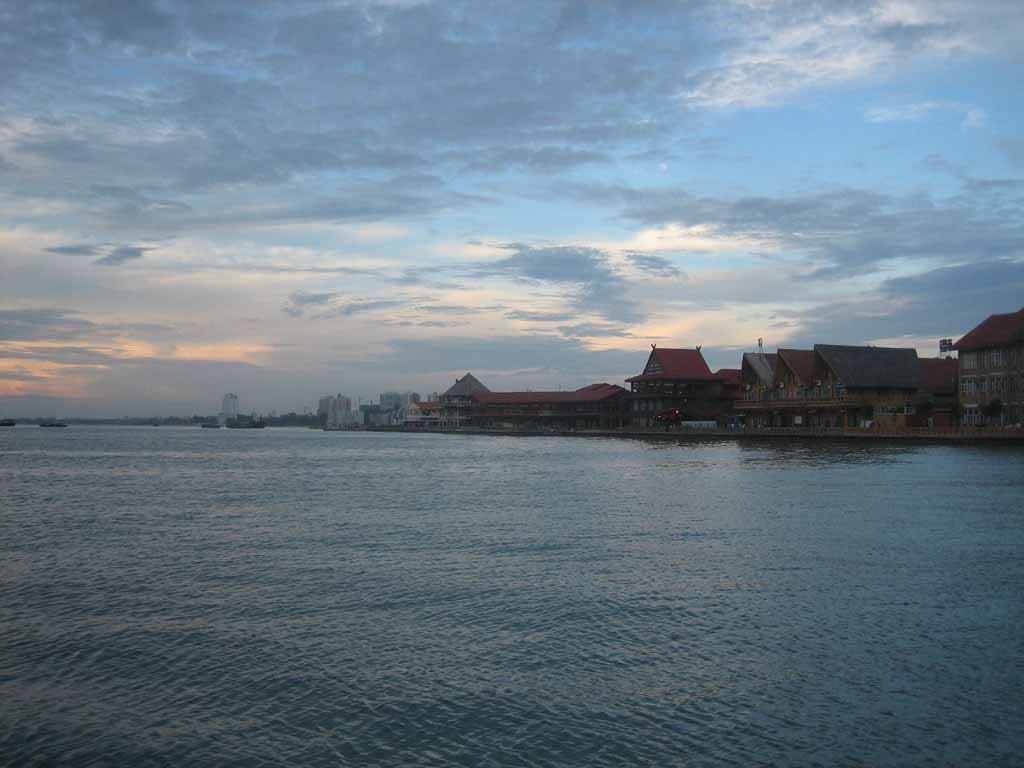 It's time to leave again. Tomorrow I fly to Beijing. It's a different feeling leaving this time..I guess because I know that the Beihai I see now is soon going to be a very different place. I don't know...maybe it won't change that fast. Beihai is a laid back town. Several times I have come up to a rickshaw driver with money in my hand ready to hire him or her for a ride down to the Seafood Island, and had the driver point at a motorcycle. No problem, those guys are generally willing to take you anywhere for three kuai. Sometimes they try to get more, especially if it is quite a distance, but most of the time three will do it. I guess there is a helmet law of some kind in Beihai, because often the biker I am riding with hands me a hardhat to wear while I am riding behind him, as if that would protect me in an accident. Half the time it is so small, I have to hold it to keep it from flying off. But if it keeps the guy from getting a 100 kuai fine, oh, well. One bad thing about the motorcyclists is that they sometimes like to run red lights. With cars and motorcycles whizzing by in front of you and right behind you, it is a bit unnerving. But it is an exhilarating feeling to get through an intersection and realize that you are still in one piece.
Things are always changing in this world, and in China it seems so much more so. Now Beihai has been targeted for development by the government. Good for the economy, I guess, but the increase in business so often brings with it a loss of simplicity. I hate to wish failure on any enterprise that promises to bring prosperity to people who are hoping for a better life. But if this new plan doesn't manage to bring millions of people to this little town, I don't think I'll shed any tears. And the people shouldn't be too disappointed if things don't quite turn out they way they are hoping. After all, they got a nice big new airport out of the deal. Pretty fancy, but not too tough to deal with. No need to worry about which gate to go to. Just look for the one with the plane parked next to it.
It's time to leave again. Tomorrow I fly to Beijing. It's a different feeling leaving this time..I guess because I know that the Beihai I see now is soon going to be a very different place. I don't know...maybe it won't change that fast. Beihai is a laid back town. Several times I have come up to a rickshaw driver with money in my hand ready to hire him or her for a ride down to the Seafood Island, and had the driver point at a motorcycle. No problem, those guys are generally willing to take you anywhere for three kuai. Sometimes they try to get more, especially if it is quite a distance, but most of the time three will do it. I guess there is a helmet law of some kind in Beihai, because often the biker I am riding with hands me a hardhat to wear while I am riding behind him, as if that would protect me in an accident. Half the time it is so small, I have to hold it to keep it from flying off. But if it keeps the guy from getting a 100 kuai fine, oh, well. One bad thing about the motorcyclists is that they sometimes like to run red lights. With cars and motorcycles whizzing by in front of you and right behind you, it is a bit unnerving. But it is an exhilarating feeling to get through an intersection and realize that you are still in one piece.
Things are always changing in this world, and in China it seems so much more so. Now Beihai has been targeted for development by the government. Good for the economy, I guess, but the increase in business so often brings with it a loss of simplicity. I hate to wish failure on any enterprise that promises to bring prosperity to people who are hoping for a better life. But if this new plan doesn't manage to bring millions of people to this little town, I don't think I'll shed any tears. And the people shouldn't be too disappointed if things don't quite turn out they way they are hoping. After all, they got a nice big new airport out of the deal. Pretty fancy, but not too tough to deal with. No need to worry about which gate to go to. Just look for the one with the plane parked next to it.Labels: Beihai
Tuesday, June 10, 2008
Would you believe I found the North Star last night? Believe it or not, I have been to Beihai six times, and this is the first time I have seen it. The north star rides pretty low in the sky when you're this far south, so it would not be easy to find in any case, but with the lights on campus, it is especially hard. The dormitory I am in this year is closer the northeast end of the campus than the other two I have stayed at.
I think that's one of the things that makes it a little hard to get used to this southern country. The sky just doesn't look the same. Sorta the opposite of when I was working in North Central Alaska. The North Star was almost directly overhead there. But at least it was easy to find. I think I would have a hard time living in Australia. No Big Dipper. No North Star. Guess I could get used to the Southern Cross, but I don't know..maybe I'm too old to change. In Beijing I see the same stars I have been looking at all my life.
I think that's one of the things that makes it a little hard to get used to this southern country. The sky just doesn't look the same. Sorta the opposite of when I was working in North Central Alaska. The North Star was almost directly overhead there. But at least it was easy to find. I think I would have a hard time living in Australia. No Big Dipper. No North Star. Guess I could get used to the Southern Cross, but I don't know..maybe I'm too old to change. In Beijing I see the same stars I have been looking at all my life.
Monday, June 09, 2008
This evening, after I finished my New Zealand lamb chops, I got into a discussion with some folks about local dialects. The Beihai dialect is always referred to as "Baihua." This always puzzled me, because it seemed to me that the Beihai dialect should be called "Beihua." But I have asked several people, including Snow. Definitely Baihua. Baise de bai. So what does it mean? My dictionary translates Baihua as vernacular, which would be right, but not specific enough. If all Baihua means is "vernacular," then every village's language would be called, "Baihua." But when you ask people here, that's what they say. Anyway, tonight the discussion wandered off into a description of local dialects everywhere. This Irish guy who builds golf courses talked about how, in his home community, you could hear a different dialect in every village as you moved up into the hills. He also said that there were places where the old folks did not speak any English. This surprised me, because I had always thought that Gaelic had pretty much gone out of use in Ireland. I suppose that's because all the Irish folks I have met in China have clearly been native speakers of English, albeit with a bit of an Irish brogue. Tommy was talking about how, as a child in Sweden, when he traveled to a different valley just a few miles away, he couldn't understand anything. They pointed right across the bay to the little village of Hepu (location of the sweater factory), and gave some examples of how things are pronounced in that community. Sounded very different from Beihai, but one American was not impressed. "That's nothing," he said. "In my neighborhood, it changes when you cross the street. We say, 'hello.' They say ola. We say, 'Thank-you.' They say gracias."
Sunday, June 08, 2008
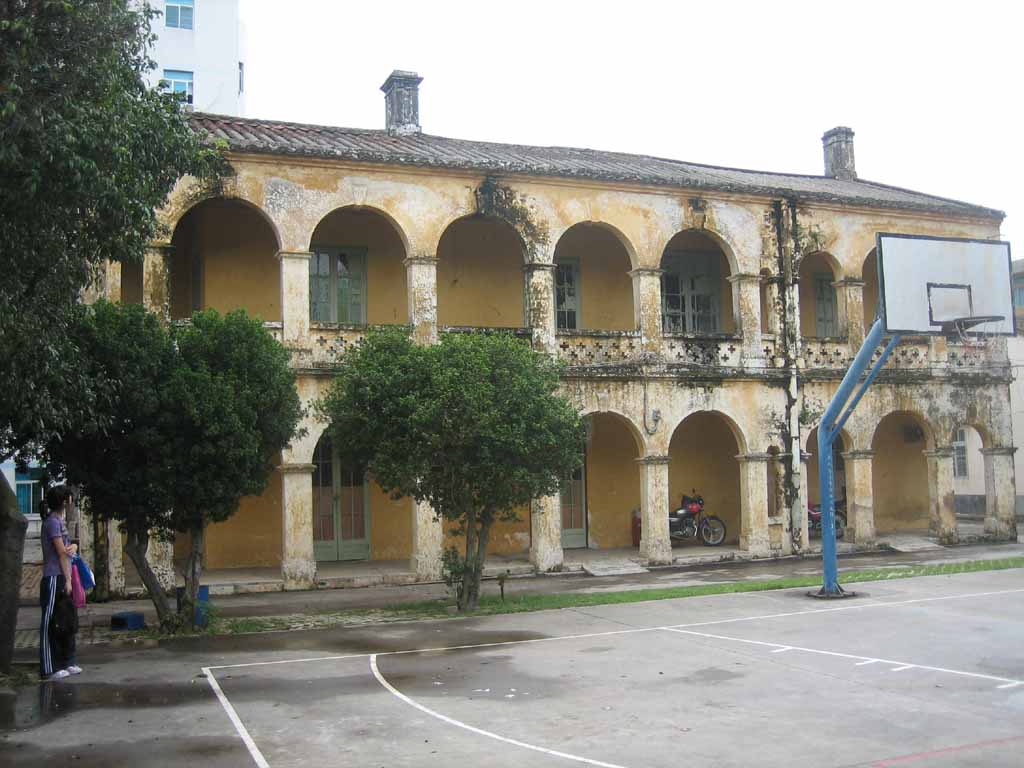 This afternoon Snow and I went on a scavenger hunt for the old diplomatic missions from the treaty port days. At first Snow was not exactly sure what I was up to, but after we found the first one, she caught on pretty quickly and got into the game. Good thing I had her with me; she was a big help. The old German consulate is now a kindergarten. The British consulate is inside the grounds of a middle school. We could see it, but we couldn't get close, because the composition section of the National College Entrance Examination is being held today. Security was tight; they absolutely would not let us in the gate.
 We found the French consulate inside the compound of a hotel complex. That one we might be able to see if we come back on a week day--doesn't look like it is being used for anything else. Snow said she thought there was another one on the grounds of People's Hospital, so we went there. I was a bit puzzled by that one, because there was no plaque in English, and the building we were looking at (pictured) was identified as having something to do with the Anglican Church. It sure didn't look like a church building, so some kind of office or something, but I can't imagine why in the world the Archbishop of Canterbury would have an emissary in a small time treaty port. I'll have to try to research that one.
Well, three down and five more to go. But that's only the consulates themselves. I have heard that there are about 15 buildings remaining in Beihai from that period. Could keep me busy for some time, if I had it. That's the trouble with history, you know. So much of it.
Saturday, June 07, 2008
Last night Richard mentioned that the torch relay would be passing through Nanning today. For a brief minute, I considered taking the ten o'clock train up there to see what I could see. But last minute plans don't always work that well, and I had not really researched where to stay. Also, I wanted to be back for church tomorrow. So I gave it a miss. This evening I asked Richard if he had seen the torch. He said he saw lots of people and lots of cops, but no torch. Not sure why. Maybe they stuck it in a van for security reasons or something. You know, torch relays have become a little more complicated in recent years.
Hard to believe it is already forty-four years ago that I saw my first Olympic torch. I was ten years old. The Summer Olympics of 1964 were held in Tokyo, and the torch relay route ran within walking distance of our school in Northern Japan. The '64 Olympics were held in October, so I would think it must have been early in the fall that the torch passed through town. We took a break from classes and walked to the parade site. I'm sure there must have been some cops there, but I don't remember seeing them. I remember the students, though. Thousands of them. Dark blue and white everywhere in sight. We waited for what seemed like a long time, but was probably not. Young people everywhere, talking of course, but otherwise amazingly well behaved. You know how it is in those situations..you get caught up in the whole experience, and slowly your focus begins to shift from the event you're supposed to be waiting for, to the waiting itself.
But suddenly, it happened. I could hear it before I could see it, not because it was so noisy, but because the reaction of the crowd moved toward me like a tidal wave. I don't mean wild cheering. Actually, I can't remember if people were cheering. I sure wasn't. I guess I was just sorta awed by the uniqueness of it all. But awe has a sound to it, even if that sound is silence. And then she came into view. A young woman, holding a flaming torch. I remember her being very muscular. I don't mean in an ugly, body-building sort of way, but she was obviously chosen for strength and endurance. She was a powerful young woman. She was running easily, not sweating. Her expression was not one of grim determination, but a look of quiet, definite resolve. She didn't stop, and seemed not to know the crowd was there, although I'm sure she was quite conscious of our presence. It was all over so quickly, but the impression was not easily lost.
I think if I had had enough information to know exactly where the torch was going to pass, I might have been inclined to take the trip to Nanning, because it is a compelling picture of triumph not easily replicated. But to go all that way just to see an entourage move through a crowd and hear someone else tell me what was happening...no. I would rather sit here in the breeze by the sea, and live, with my thoughts, in a time and place that seems now so much simpler.
Hard to believe it is already forty-four years ago that I saw my first Olympic torch. I was ten years old. The Summer Olympics of 1964 were held in Tokyo, and the torch relay route ran within walking distance of our school in Northern Japan. The '64 Olympics were held in October, so I would think it must have been early in the fall that the torch passed through town. We took a break from classes and walked to the parade site. I'm sure there must have been some cops there, but I don't remember seeing them. I remember the students, though. Thousands of them. Dark blue and white everywhere in sight. We waited for what seemed like a long time, but was probably not. Young people everywhere, talking of course, but otherwise amazingly well behaved. You know how it is in those situations..you get caught up in the whole experience, and slowly your focus begins to shift from the event you're supposed to be waiting for, to the waiting itself.
But suddenly, it happened. I could hear it before I could see it, not because it was so noisy, but because the reaction of the crowd moved toward me like a tidal wave. I don't mean wild cheering. Actually, I can't remember if people were cheering. I sure wasn't. I guess I was just sorta awed by the uniqueness of it all. But awe has a sound to it, even if that sound is silence. And then she came into view. A young woman, holding a flaming torch. I remember her being very muscular. I don't mean in an ugly, body-building sort of way, but she was obviously chosen for strength and endurance. She was a powerful young woman. She was running easily, not sweating. Her expression was not one of grim determination, but a look of quiet, definite resolve. She didn't stop, and seemed not to know the crowd was there, although I'm sure she was quite conscious of our presence. It was all over so quickly, but the impression was not easily lost.
I think if I had had enough information to know exactly where the torch was going to pass, I might have been inclined to take the trip to Nanning, because it is a compelling picture of triumph not easily replicated. But to go all that way just to see an entourage move through a crowd and hear someone else tell me what was happening...no. I would rather sit here in the breeze by the sea, and live, with my thoughts, in a time and place that seems now so much simpler.
Friday, June 06, 2008
Click here for larger image.
 Snow told me she was going to take me to a fish market today. When we got there, I was surprised. No fish tanks. No smell of fresh fish. This was a dried fish market. Very interesting, because, generally speaking, Chinese people will not eat fish that is not fresh. If you go to a supermarket in the States, you have a frozen food section where you can buy frozen seafood. If you go to the Walmart Superstore near my home in Beijing, you see fish tanks. You really do get spoiled in China. Fresh fish is not a luxury. It is the bottom line. When you go to a restaurant, the fish are live and swimming around until after you have ordered the meal for which it is going to be prepared. Somehow, though, dried fish is not like frozen fish. When you eat dried fish, it really is a different sort of thing. Not really a meal item. A snack most of the time, I think. Sorta like beef jerky. In the States, you probably wouldn't sit down and have a meal of beef jerky.
This evening, I went to the English corner at McDonald's. I met these guys by accident last Friday evening. Nice group of people. But I sorta lost track of time, and by the time I looked at my watch, it was twenty after eleven. One guy offered to take me out the the college, so I took him up on the offer. A bunch of us got in his car, because he is new in town, and wanted some help with directions. I was the only foreigner at this English corner. I think that's understandable in a town the size of Beihai. But, while I think it's very important for people learning English to listen regularly to native English, I also believe that speaking English with other folks at their own level is good practice, even if their language partners are not native speakers.
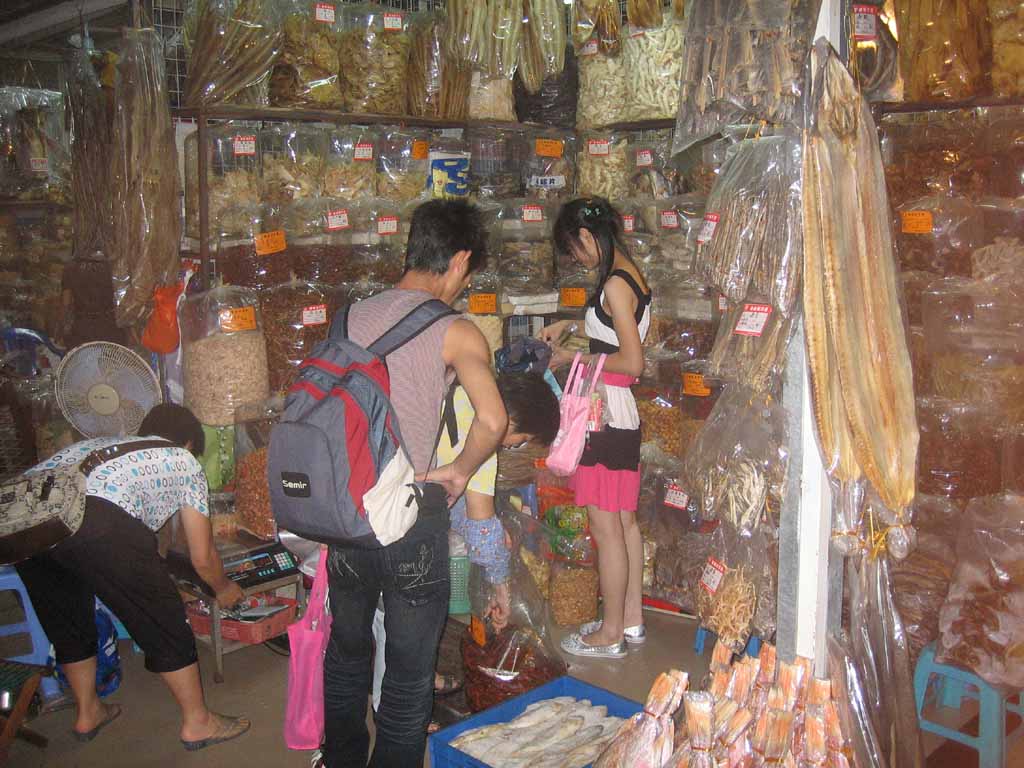 Snow told me she was going to take me to a fish market today. When we got there, I was surprised. No fish tanks. No smell of fresh fish. This was a dried fish market. Very interesting, because, generally speaking, Chinese people will not eat fish that is not fresh. If you go to a supermarket in the States, you have a frozen food section where you can buy frozen seafood. If you go to the Walmart Superstore near my home in Beijing, you see fish tanks. You really do get spoiled in China. Fresh fish is not a luxury. It is the bottom line. When you go to a restaurant, the fish are live and swimming around until after you have ordered the meal for which it is going to be prepared. Somehow, though, dried fish is not like frozen fish. When you eat dried fish, it really is a different sort of thing. Not really a meal item. A snack most of the time, I think. Sorta like beef jerky. In the States, you probably wouldn't sit down and have a meal of beef jerky.
 This evening, I went to the English corner at McDonald's. I met these guys by accident last Friday evening. Nice group of people. But I sorta lost track of time, and by the time I looked at my watch, it was twenty after eleven. One guy offered to take me out the the college, so I took him up on the offer. A bunch of us got in his car, because he is new in town, and wanted some help with directions. I was the only foreigner at this English corner. I think that's understandable in a town the size of Beihai. But, while I think it's very important for people learning English to listen regularly to native English, I also believe that speaking English with other folks at their own level is good practice, even if their language partners are not native speakers.
Sunday, June 01, 2008
Children's Day. Jeremy threw a party for the kids today at the new Old Town Cafe. He had set up two tables for us to show kids the correct way and incorrect way to use a knife and fork in the western style. I don't know how informative it was, but it was lots of fun, anyway.

Children's Day is celebrated in the "Communist" world on June 1st every year. I remember when I was a kid in Japan, they used to have "Boy's Day," and "Girl's Day." But I can't remember what the dates were. Anyway, I was supposed to show kids the correct way, and a guy from Australia was recruited to show the incorrect way. Some questions arose when I began, because I am left-handed, and I was holding the knife and fork opposite from what you would see in the movies. I explained to the kids that when you're cutting, you should hold the knife in the hand that you usually use for writing. It's amazing how clever these kids are--they really did catch on pretty quickly.
 After lunch, the reporter from the paper wanted to continue our interview from the day before. Fortunately, one of my colleagues from the college was there, so she was able to translate for me. He was very interested in my impressions of the Old Street. Apparently, this is part of the development plan for Beihai. I told him that so far my impression was positive, because businesses weren't tearing down the old historical structures, just remodeling them. The Old Time Cafe is a good example of this, actually. Creative blending of the old and the new.
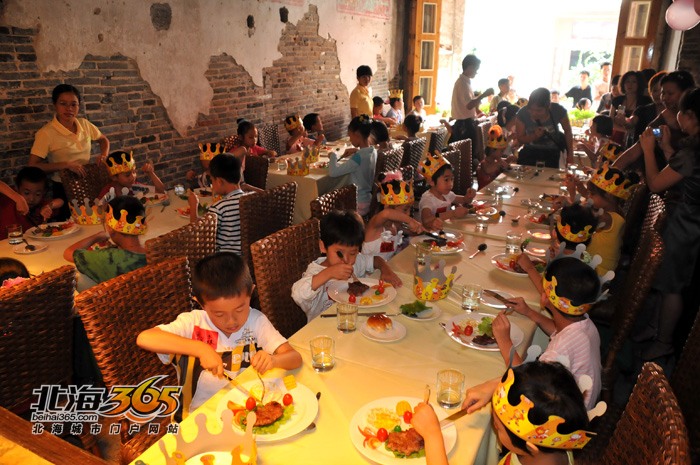
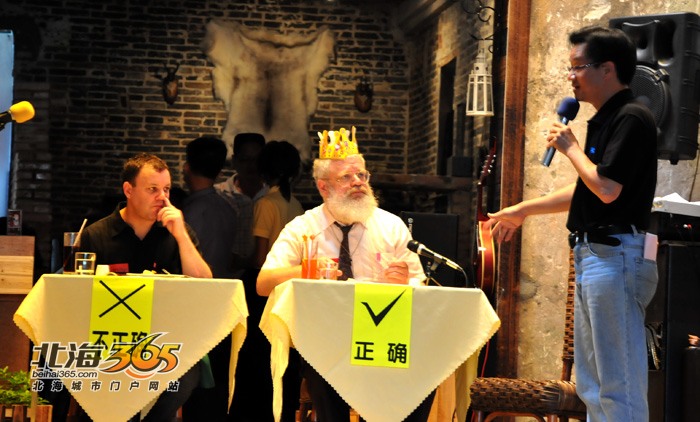
Children's Day is celebrated in the "Communist" world on June 1st every year. I remember when I was a kid in Japan, they used to have "Boy's Day," and "Girl's Day." But I can't remember what the dates were. Anyway, I was supposed to show kids the correct way, and a guy from Australia was recruited to show the incorrect way. Some questions arose when I began, because I am left-handed, and I was holding the knife and fork opposite from what you would see in the movies. I explained to the kids that when you're cutting, you should hold the knife in the hand that you usually use for writing. It's amazing how clever these kids are--they really did catch on pretty quickly.
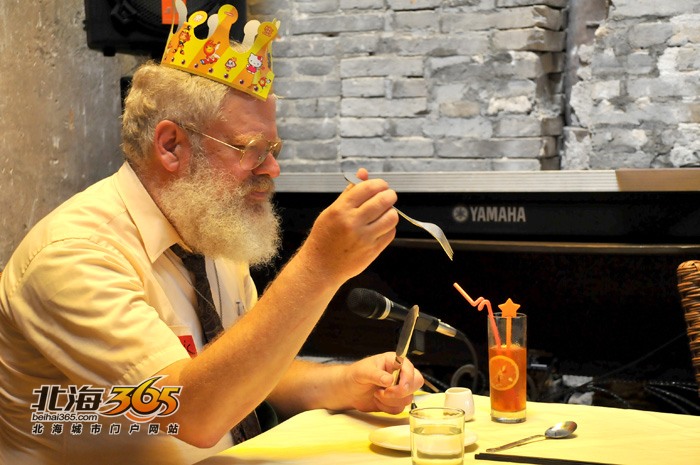
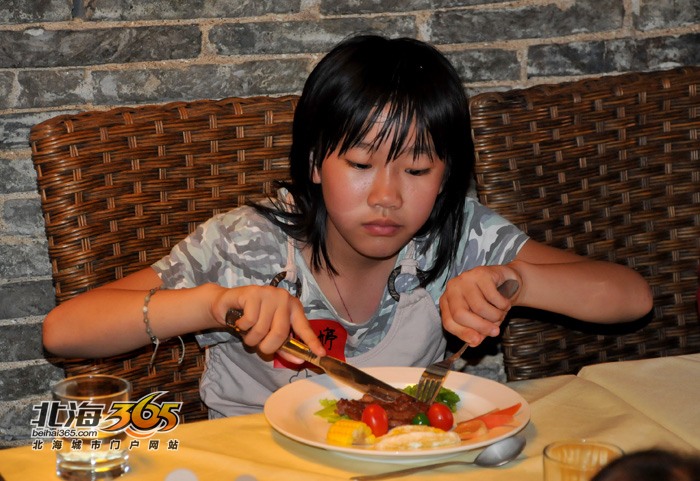 After lunch, the reporter from the paper wanted to continue our interview from the day before. Fortunately, one of my colleagues from the college was there, so she was able to translate for me. He was very interested in my impressions of the Old Street. Apparently, this is part of the development plan for Beihai. I told him that so far my impression was positive, because businesses weren't tearing down the old historical structures, just remodeling them. The Old Time Cafe is a good example of this, actually. Creative blending of the old and the new.

