Links
- CV
- Titles
- Topics
- Tickets
- Science
- About Eric
- Book Reviews
- Country Profile
- Modern China
- Contact Eric
- Podcast
- Vision
- Sekai
- John
Archives
RSS

Reflections on a Wandering Life.....
Wednesday, April 24, 2024
A Doctor in China
When I write an account like this I strongly prefer to wait until I have all the facts before I start, and to keep conjecture to a minimum. But as I said, there are many as yet unanswered questions: Did he actually murder her, or did she try to make it look that way? His case was helped by the fact that she was the one who brought the knife to the encounter. Was he actually Jewish, and why did he suddenly decide to make that known? His mother was an illegitimate child, so it’s hard to prove anything. Maybe that’s a story she told him to deflect from her own uncertain past. But who knows? Maybe it was true. But if so, then why did he return from Palestine? Why didn’t he stay there?
Anyway, although questions remain, it is time for this story to be told.
His name was Karl Fink. Or at least it started out that way. He was to assume a couple other identities before he came to China. His medical practice began the city of Hamburg, after a brief stint as a military doctor in World War I (I think), but most of his medical career was spent in China, and much of it, I believe, was affiliated with an orphanage in Changsha.
He had been married very briefly after World War I, but divorced a year or two later. He did have a son from that marriage, but I don’t know what became of him. Later he had some sort of relationship with a patient that led to the drama that overshadowed so much of his life. She was trying to blackmail him, I guess, and came to his place with a dagger. There was a scuffle of some kind, and she ended up dead. Did she attack him? Did he grab the knife and stab her? Or did she try to manipulate him by threatening suicide? The most likely is that she attacked him and ended up getting the wrong end of the knife herself. We will probably never know just what happened, but she was dead and the doctor fled.
He ran. Changed his name and ran. He was eventually arrested and jailed, but he escaped. I don’t know how. He fled to Czechoslovakia, but eventually came back and presented himself to a charity organization saying that he wanted to go to China as a doctor. How well did they vet him? Did they ask any questions? They no doubt did, but apparently not the right ones. Like “why would such a promising young physician want to go to China?
He was sent to Hunan province. He first worked in a hospital in the city of Hongjiang, where he met and married one of the single woman missionaries.
I don’t know all the details, but there was a terrible fire in the town and his hospital was destroyed. The hospital was rebuilt, but he was eventually assigned to open a new hospital in Changsha, the capital city of Hunan. He actually lived in the house where Hudson Taylor had died, which building was eventually used as part of a new hospital.
The Sino-Japanese War began in 1937. The Chinese had a practice of burning the area they thought the Japanese were going to invade so there would be nothing left for them when they came. There was a false rumor that the Japanese were coming, so the Chinese started burning the area, but they did it in secret, so the local population was not warned and many people died. Lots of wooden houses—maybe 30 or 40 thousand people died. It is also reported that many local people who sought to put out the fires were shot by Chinese soldiers who wanted to “burn the ground” in front of the Japanese.
Chiang Kai-shek came to Changsha and held a court martial. The officers responsible were executed. As it turned out, the Japanese never came, so the whole burning campaign had been unnecessary.
In 1939 he returned to Germany for a furlough. He was arrested and imprisoned in Hamburg. Did he turn himself in? I don’t think so, because he and his wife had gone to Germany for a furlough back in 1934. They had been in Germany for about a year that time, and nothing had happened. Whatever the case, this time he was apprehended and brought to trial.
From the police report:
Dr. Fink is about 1.75 to 1.78 m tall, slender, close-cropped, dark hair, slightly thinned at the front of the forehead, elongated narrow face with sunken cheeks of yellowish brown color, dark eyes, piercing gaze, clean-shaven, early hint of dark blond moustache, somewhat curved nose (hooked nose).In 1939, He was given a two year sentence for manslaughter.
Here’s where I have a question: Why manslaughter? I’m not a lawyer, but I do have a reasonable familiarity with the three basic categories. Manslaughter is when you did not intend to kill someone—weren’t even angry with them, but you do something unlawful that results in somebody dying.
Second degree murder is when you did not originally intend to kill someone, but you kill them in the heat of the moment.
First degree murder is intentional homicide.
It seems to me that if she killed herself in front of him to try to frame him, he was innocent, because he didn’t kill her. But if he grabbed the knife from her and then killed her, that would be second degree murder.
I do have sympathy for someone confronted with a crazed person and having to deal with this person alone. Many years ago I worked at Oregon State Hospital. Every once in awhile, one of the patients would flip out and become really crazy. The staff would then call every ward to see if there was an extra man on duty who could come and help. We would all take our glasses off and then come at this person calmly with seven or eight guys, lead them to an isolation room, and restrain them on a bed with belts. I can’t imagine what it would be like to confront someone like that alone, especially someone who had a knife and was threatening me with it. Still, I don’t see why he would have to stab her. Was he angry with her for trying to blackmail him? If so, that’s not manslaughter.
I don’t know. Reportedly, the court was influenced by many reports from China about his humanitarian work there. I don’t doubt that, because the doctor and his missionary wife were very well liked here in China—no question about that. But I still think that from a legal standpoint, the key factor was that she brought the knife, not him.
Whatever the case may be, he was given a suspended sentence and allowed to return to China in 1940.
World War II pretty much disabled the relationship between China and Germany and the Germans in Changsha were expelled from China. The doctor and his wife got around this by going to the city of Qingdao, which was in that part of China occupied by the Japanese. So they actually lived out World War II in China (1942-1947). This is the irony of war. While the whole world was falling apart, the doctor and his wife were living a life of peace, hanging out with other foreigners in Qingdao by the sea. If you’ve never been to Qingdao, it’s a really nice place, situated right on the coast, with a moderate climate. The doctor was quite a musician, I guess, so they would get together and have concerts and stuff, relatively untouched by the chaos everywhere else. Sorta like me hanging out in a COVID-free zone in the mountains of western China for the three years of COVID, while people were getting sick and dying in places to which foreigners who had been in China fled for “safety.” They should have stayed here.
The doctor and his wife returned to Changsha in 1947, but as you may know, if you’ve read your history, in 1949 the Communists took over, and the missionaries were kicked out of China. This was viewed as a disaster by mission organizations, but it was a blessing in disguise, because the “caretaker” missionaries were gone, so leadership had to emerge from within the Chinese church, and the result was exponential growth of Christianity.
They went to Germany from where the doctor, who had announced that he was actually a Jew, went to Palestine where he worked in Arab refugee camps. What’s up with that? Was this just some new identity that he pasted on himself? That was my first reaction, but upon reflection, I think he was probably just looking for something to do. He did not stay long. Having lived in China for 20 years, now, I can imagine that going from China to Palestine would have been quite an adjustment. After a year or so, he returned to Germany.
When the missionaries were kicked out of China, many of those who were nearing retirement just decided to remain in their home countries. But the younger ones weren’t ready to relinquish the calling they had given their lives to. The doctor was sixty years old by now, so I guess he could have retired, but he was not ready to quit yet. He seemed to be living as if he had one more life to save. So he presented himself to his old mission board and asked to be placed. One could bemoan the fact that he could not return to China, I guess, but in fact, China was a pretty chaotic place at this point in time, so for the doctor, his new assignment at the International Catholic Hospital in Shinjuku (the Manhattan of Tokyo) was really made to order, and it was to this hospital that a young missionary brought his wife in the spring of 1954.
She had hepatitis. As soon as he saw her, he told her she needed to go right to bed. His reaction was very different from that of the countryside doctor she had gone to up on the field, who thought her yellow skin looked perfectly normal.
The doctor told them to wait right there, and he went to arrange a bed for her. As soon as he left the room, the woman turned to her husband and said, “Let’s get out of here.” She wanted to go home.
Her husband said, “Nothing doing.”
They had their daughter with them, I guess, so the husband returned to the field with the little girl, leaving his wife in the care of the doctor. It wasn’t that night, but maybe the next night that the unthinkable happened: She went into labor. That wasn’t supposed to happen. She wasn’t due for another two months. But then things went from bad to worse. She started hemorrhaging, and they could not stop the bleeding. Nothing seemed to work.
As she lay dying in her hospital bed in Shinjuku, her one consuming thought was that she did not want to die alone. She was a nurse. She had seen it. They drag the dying person on a gurney down to the end of a darkened hallway with the other hopeless cases. Then they check the bodies once in a while to see which ones are already dead and ready to be sent to the morgue. That was before hospice.
Such were the thoughts that plagued her soul as the life was ebbing out of her body. Did she share her fears with the doctor? I am inclined to think so, because the doctor left to call her husband. I wasn’t privy to his conversation with the staff, but it was something on the order of, “Keep her comfortable; I need to get her husband on the phone. She’s not going to make it.”
He called her husband and told him that he had better get down there right away. That call was a “hail Mary” if there ever was one. Thre was no way he could get right down there. He had his daughter with him—not sure where the other child was—and he was several hundred miles away. It was completely unrealistic. I think the doctor just did it because she had wanted to have her husband with her when she died. Anyway, the doctor and her husband talked and decided to wait until the morning and reconnect. The husband went to bed, waiting to see what the morning would bring. The doctor went to work. He was not one to give up when there was a life to save.
I don't know what he did, but somehow he was able to get the bleeding stopped. Or maybe it stopped by itself. I don’t know. Nosebleeds stop by themselves, so maybe that’s what happened. Anyway, I don’t know what he did, but it finally worked. The baby was born at 4:30 in the morning, and at 5:30, her husband got a call, “You have a new baby boy, and the mother and baby are doing fine.”
Doing fine?? That was a stretch. She was still very sick. In her case, “doing fine” meant that she was going to live. As for the baby, he was very weak and heavily jaundiced, but alive. I guess “doing fine” meant that the doctor was betting that he would eventually pull through, and I am here alive to tell you, seventy years later, that he did.
Mom said, “You were so weak you couldn’t even cry. You just squeaked.”
Dad said, “You looked like a little Indian.”
In today’s woke America, some people might call that a racist statement. But Dad was a farm kid from North Dakota. He was just making an observation. A heavily jaundiced Norwegian-American baby would look like a little Indian, right? You gotta believe me, you guys—I really wasn’t trying to look like a little Indian. It was the furthest thing from my mind. Fortunately, there were no woke morons yelling, “CULTURAL APPROPRIATION!!” So I was allowed to heal in peace.
I never told my mother the doctor’s story. I wonder if she would have seen him differently. But differently from what? In all my conversations with my mother about my childbirth, she never said a word about her impressions of the doctor. Nothing good, nothing bad. I have no idea what she thought of him. Did she know his story? Perhaps. But I don’t know how she could have known. If she did, she never let on.
What kind of person was he, really? Well, you have to give him credit for persistence. Twice his hospital was destroyed by fire, but he kept going. On his seventy-fifth birthday, he was awarded Federal Cross of Merit by the German government. And of course he was well recommended by everyone who knew him. I met one of those people years ago. In 2006, on a visit to Tokyo, I went back to the hospital where I was born and met a nurse who had worked with him. From everything we can tell, he was well liked and respected wherever he worked. And yet something very terrible took place that he was somehow involved in.
So what do we conclude from this? Did he get away with murder? Or was he confronted with a situation that was too much for hm to handle? Maybe both. These are questions that must be asked, because this wasn’t just a “he said, she said.” This was not a made up crime. There was a dead body. This calls for accountability. But how do do that? It’s not easy.
The court decided that he was in some way responsible for her death. But again, she brought the knife. So I just don’t know. So many questions remain unanswered. But one thing I do know: He saved my life, and he saved my mother’s life, and the rest, as they say, is history.
Labels: Japan
Saturday, September 14, 2019
Is Japan Dying?

This man lives in the same house with his doll, his wife, and his daughter.
The video below outlines a serious problem in current Japanese demographics. Put simply, more people are dying than are being born. If this trend continues, the task of providing for the elderly will place an impossible burden on working people.
For some reason, many young people not only do not want m(any) children, but many of them do not even want to get married. This documentary also discusses briefly a strange fetish some have with the idea of establishing romantic relationship with unreal personages as a substitute for genuine human relationship. This program shows an example of a man who "married" a hologram. Where is this nonsense coming from? I don't know, but it suggests that Japan is becoming far too inbred, and that an infusion of different people with different ideas would be helpful.
So there are two things: One is economic. Japan simply does not have enough young people. But there also seems to be a cultural sickness that is developing a generation of young people terrified of genuine intimacy. The cultural problem underscores the need, but the economic problem is what is going to force action. Japan is going to have to open to many different kinds of people.
So what could stand in the way of this? Well, there is considerable resistance to accepting that which comes from outside as being "Japanese." But even where there is openness, or at least a grudging acceptance of the need for bringing in outsiders, there is a language barrier. Japanese young people are like Americans. They tend to be monolingual. They speak their own language. So young people from other places who want to go to Japan have to bridge that gap.
Fortunately for Japan, Chinese young people are actually quite good at this. When I was teaching in the Software College at Beihang University, we had a hundred interns in Japan. We had a "Japanese Software" major, which allowed students to learn Japanese before they went, but there were students who weren't in that program who just went to Japan and taught themselves Japanese.
Of course it isn't just Chinese young people who are interested in Japan. When I was teaching at the University of Advancing Technology in Arizona, I had students who told me they wanted to go to Japan and write game software. They would tell me how they were studying hiragana. That's a start, but it doesn't quite get you there. I don't know a single one who actually did it.
American young people who are interested in Japan do have an advantage: They can teach English. I don't say that disparagingly. It's not that Americans do not possess the talent required to excel in the business world. It's just that in Japan, you can teach English even if you're Japanese language skills are marginal. But if you want to work in business you have to be really good. In fairness, there are probably lots of Americans in Japan who are like me: they have no interest in going to a big company in Tokyo and working their way up the corporate ladder. But for those from any country who are interested, this is an extraordinary time of opportunity. The video says there are 161 jobs for every 100 people who are interested in finding work.
INSIGHT is a documentary program produced by Channel NewsAsia in Singapore.
Thursday, February 28, 2019
In a war between China and Taiwan, who would win?

Taiwanese soldiers training in January for a possible invasion from China.
Click for larger image.
Don't get excited, I don't anticipate a war between China and Taiwan. But the question comes up every once in awhile, and the issue was raised again the beginning of January when Xi Jin-ping gave a speech reiterating China's claim to Taiwan. By the way, I use the terms "China" and "Taiwan" because it's simpler. But it is important to point out that both terms are technically inaccurate. "China" is inaccurate, because both China and Taiwan claim to be the "real" China. "Taiwan" is inaccurate, because there is no country in the world that calls itself "Taiwan." Taiwan is not the name of a country, it's the name of an island. The name of the country is "Republic of China." So the accurate way to talk about it would be "People's Republic of China" and "Republic of China." But that gets confusing, so most of the time you will hear people say, "China and Taiwan." It is important to note that both the Republic of China and the People's Republic of China claim all of China, but govern only part of it. The Republic of China claims all of China including Tibet and Mongolia (which was taken by the Soviet Union, and is now an independent republic), but only actually governs Taiwan. The People's Republic of China also claims all of China (although I think they have given up on Mongolia), but only actually governs the mainland. So understand that when I say "Taiwan" I mean the Republic of China, and when I say "China," I mean the People's Republic of China.
I don't want to go into detail on the history of this problem, because I have addressed that in a previous post, but just quickly, before and during World War II China was ruled by the KMT under Chiang Kai-shek. China was an ally of the United States in the fight against Japan, a conflict that temporarily overshadowed the ongoing civil war between the Guomindang (KMT) and the Communists. After World War II was over, the fight resumed, with the KMT being overwhelmed but never completely defeated by the Communists. In other words, technically, the civil war between the KMT and the Communists is still going on. The KMT under Chiang Kai-shek fled to Taiwan, and essentially set up a government in exile. The Communists were determined to invade Taiwan and finish off the KMT, thus becoming the undisputed ruler of China. Fortunately for the Communists, Truman hated the KMT. He felt they were corrupt and he did not want to get involved in any conflict between the two parties. In other words, he was strongly disinclined to "rescue" the Republic of China from the Communists. But unfortunately for the Communists, Kim Il-sung got the brainy idea to invade South Korea, thus starting the Korean War. Truman got cold feet and sent the Seventh Fleet into the Taiwan Strait, thus essentially putting the Chinese civil war into a stalemate that has lasted until this day.
Now, back to the present. As I said, Xi Jinping recently gave a speech where he advocated reunification, with the offer that Taiwan could have a "one country, two systems" arrangement.
The current leader of Taiwan (Tsai Ing-wen) rejected the offer. This has renewed criticisms of her and her "obstinate" approach, and also provoked negative comparisons of her with Ma Ying-jeou (leader of Taiwan before Tsai) and the party he represents. Tsai is from the Democratic Progressive Party (DPP), generally considered the party of the Taiwanese natives, and Ma represented the Guomindang (KMT), which has historically been the party for those who came from the mainland in 1949. But these comparisons are unfair and not entirely honest. It is true that the KMT supports the "one China" principle, but the one China they support is not one China under the Communist Party. Not at all. Supporting one China under the Communist Party would be tantamount to surrender. It would go against everything the KMT believes in. They want to see one China under the KMT. So in fact, both parties are equally opposed to one China under the Communist Party.
The other issue is the "one China, two systems" arrangement that China is proposing for Taiwan. Tsai is being criticized for rejecting it. Also unfair. The KMT also rejects, and has always rejected, the one country, two systems arrangement. Ma Ying-jeou's rejection of one China, two systems was clear and unambiguous:
If the system is good, then we believe it should be "One Country, One System." (from interview with Aljazeera)Here is how he defines it:
Mutual non-recognition of each other's sovereignty.So if the Guomindang (KMT) feels the same way about these issues as the Democratic Progressive Party (DPP), why does Beijing have a better relationship with the KMT? It seems that for Beijing, any kind of "one China" is better than no "one China." The KMT and the Communists fought a bloody war on the mainland. On April 12, 1927, Chiang Kai-shek began a purge of the Communists that ultimately resulted in the deaths of thousands of Communists. But the conflict between the Communists and the KMT was complicated by the Japanese invasion. Over time, the Communists gradually got the upper hand, and the KMT was forced to flee to Taiwan. In contrast, the DPP has never fought against the Communists, or taken a stand against them. They just want to be left alone on Taiwan--they have no interest in invading the mainland.
Mutual non-denial of each other's right to govern.
So here is the irony: The party that is committed to invading the mainland, totally defeating the PLA, wiping out the Communists, and taking control of the country, has a good relationship with Beijing. They send representatives to Beijing to meet with Chinese leaders, and several years ago, the KMT leader was awarded the Confucius Peace Prize.
But the party that has no interest in invading China, and just wants to live peacefully on the island, has a terrible relationship with China. Whenever the DPP is in power, China is constantly taking threatening actions and issuing warnings. It is as if China is saying, "We only love the ones who hate us."
But let's try to see this from Beijing's point of view. If China were to have good relations with the Democratic Progressive Party (DPP), they would be surrendering their claim to Taiwan, because the DPP has no interest in making Taiwan part of China--they are opposed to "one China" in any form. But if Beijing has a good relationship with the KMT, they don't have to give up anything. Since the KMT is committed to taking over China, China has no fear that they would declare independence, since that would be contrary to their ultimate aim, and also no fear that they would one day conquer China.
But there is a problem with Beijing's way of thinking: Being on good terms with the KMT still does not bring Taiwan back to China. Again, the KMT's "one China" and the Communist Party's "one China" are very different. Couldn't be more different. The KMT is not, and never will be in favor of one China under the Communist party. They are just as opposed to domination by the Communist Party as is the DPP. The KMT and the DPP are often portrayed as being different, but in fact, they are not, except in theoretical terms. Here's how it works:
Ulitmate long-term goal of Taiwan's two main parties:But does anyone really believe that the KMT has a chance to take over the mainland? Chiang Kai-shek never gave up that hope until the day he died. But he died in 1975. That's a long time ago. Officially, the KMT has never given it up. That's why Taiwan is still called the "Republic of China." But does anybody seriously believe today that Taiwan has a ghost of a chance of retaking the mainland? So if we can all agree that there is no possibility that the KMT will ever again govern all of China (unless China agrees to a multi-party system or something), then the KMT and the DPP are essentially the same with respect to their relationship with the mainland. Again, other than that theoretical difference, there is no daylight between them on that issue. Neither of them would ever consider being dominated by China.
But Beijing doesn't see it that way. They have convinced themselves that the KMT's belief in "one-China" means that they are easier to deal with. And it is this belief, rather than Tsai's (the current president) attitude that has produced the tension. She is protrayed as being obstinate and recalcitrant. Not fair. When she became president, she reached out to China. They rebuffed her, not the other way around. I suppose from Beijing's perspective, you could say that they rebuffed her because she rebuffed the one-China policy. That's fair as long as you let me point out that every KMT president has also rebuffed one-China under the Communist party. They only want one-China if China surrenders to the KMT and allows the KMT to govern all of China.
Mao: It's better for it to be in your hands. And if you were to send it back to me now, I would not want it, because it's not wantable. There are a huge bunch of counter-revolutionaries there. A hundred years hence, we will want it [gesturing with his hand], and we are going to fight for it.Does this conversation from the Seventies indicate that Mao did not care about Taiwan? No, I don't think so. I believe it reflects two things about Mao's thinking. First of all, Mao was a realist. He saw that the thinking of Taiwan people was very different from the thinking of mainland people, so taking over Taiwan by force would change Taiwan, but it would also change China in ways that Mao did not want China to change. Second, Mao was a very confident leader. He was not in a hurry, because he was confident that when he was ready to take Taiwan, he would take it, and nobody would stop him. So he could afford to wait.Kissinger: Not a hundred years.
Mao: [Gesturing with his hand, counting] It is hard to say. Five years, ten, twently, a hundred years. It's hard to say. [Points toward the ceiling] And when I go to heaven to see God, I'll tell him it's better to have Taiwan under the care of the United States now.
Kissinger: He will be very astonished to hear that from the Chairman.
Mao: No, because God blesses you, not us. [waves his hands] because I am a militant warlord, also a communist. That's why he doesn't like me. [Pointing to the three Americans] He likes you and you and you.
Modern Chinese leaders, in contrast, are much more insecure. China today seems burdened with an inferiority complex--forever needing to prove to the world, and even more to herself, that she is a major player on the world stage. Mao had no time for such antics. Building fake islands in the middle of the South China Sea would not appeal to him.
So where do we go from here? There are several possibilities, but let's talk about the impossibilities first, because if we can get them out of the way, the discussion about what is possible will not be burdened with unrealistic options. The following two things are impossible. They can never happen.
1. The KMT retaking the mainland by force and putting all of China (China + Taiwan) under its rule.I'll take them one at a time.2. The Communist Party taking over the island of Taiwan and putting all of China (China + Taiwan) under its rule.
The first impossibility we have already talked about. But I haven't mentioned yet that 70 percent of the people of Taiwan speak Taiwanese Hokkien. These people have never had any interest in taking over the mainland. But they do, of course, have an interest in defending their independence. They have not officially declared independence as a national act, but the individual leaders have. The current leader, of course. And Ma Ying-jeou before her said it very clearly. The only difference between him and Tsai is that she has declared independence from China, and while Ma declared independence as China. But again, practically speaking, those two are the same (since there is no possibility that Taiwan can ever take over the mainland and be the "real China"). Chen Shui-bian, of course, also declared that Taiwan was an independent country, and if I remember correctly, he even used the word "Taiwan" instead of Republic of China. I'm not sure about that part, but I seem to remember that. I don't specifically recall hearing Li Deng-hui proclaim Taiwan's independence, but he certainly believed in it. He was a member of the KMT, but he was a Taiwanese native, and was largely responsible for purging the KMT of old guard (as detailed in another previous post).
So in a defensive struggle, Taiwan would be completely unified. No one in Taiwan believes in "one-China" under the Communist party.
But in an offensive struggle it would be very different. Most of the people would be very opposed to trying to "retake" the mainland. That's before we even start talking about the logistics of it, which are obviously formidable. It's not going to happen.
Now let's talk about the second impossibility--that of China taking over Taiwan by force and bringing all of China under the rule of the Communist party. The following article addresses the logistics of such an effort:
Interesting article. I like it because it shows graphically the difference between China and Taiwan militarily. That's important. But remember, the difference between China and Taiwan militarily is nothing compared to the difference between the United States and North Korea, or between the United States and Vietnam, or between the United States and Iraq, or between the United States and Afghanistan. And the United States was not able to win any of those conflicts. Why? The reason is two-fold. First, it takes much more military force to attack than to defend. The second reason is that victory in conflict requires both military force and the will of the people to fight. The "human" side of war, if you will.
So let's take a look at the human side for a minute. If China attacked Taiwan, Taiwan would fight tooth and nail. Lots of people on both sides would die. I assume that the Americans would get involved to help Taiwan, but they wouldn't need to, as long as they were willing to supply Taiwan with the needed weapons of war. Believe me, when thousands of families throughout the countryside of China started getting their one and only son back in a body bag, there would be a revolt. Many people would be asking, "Why did my son have to die? Taiwan did not attack us. Why did we attack them? There is no reason for this. My son died for nothing." The common people would not support the war effort. Intellectuals in universities may support it, because their blood wouldn't be flowing in the streets. But the common people throughout the country would lose heart. Why? Because in order to have the people with you, you need a legitimate casus belli. It is very hard to be victorious without that, as the Americans have found in Iraq. Now, if Taiwan invaded China first, it might be different, at least for awhile. But if not, China would have no legitimate cause for action, either in the minds of the people, or in the eyes of the watching world. So an attack on Taiwan in these circumstances would be devastating for the current regime in China, both in terms of relationship with the other countries of the world, and in terms of relationship with China's own people. Most people in China are not Communists. But they do like stability. The current regime on the mainland has given them that. But if you take that away, the widespread support the current regime enjoys would disappear. Read history: a military attack that causes many people to die will never have the support of the masses unless you can convince them that you had to do it, and you had to do it now.
So with both of those impossibilities out of the way, where do we go from here? What is the wisest course of action? Can Taiwan and China ever be unified? Can they ever be one country? Yes, of course. But whatever happens, it must be something they both agree to. This is key. Neither side has either the power or the right to force its will on the other. Once we can accept this, they are many possibilities. But they will take time. Why? Because regardless of where you come down on this issue, China and Taiwan are very different. Mao understood this. And if it was true then, it is so much more true now. At the time Mao and Kissinger had that conversation, China and Taiwan had been separated for less than 25 years. Now it has been 70 years. So trying to join them today would be hugely problematic. But there are interesting changes going on in China that could produce a very different dynamic in years to come. For one thing, Christianity is growing very rapidly in China. In 20 years or so, China could be the largest Christian country in the world. In contrast, Taiwan, like America, seems to be moving toward secularism. When I was a child in Japan, no one would have believed that in 2019, China would be well on the way to becoming the largest Christian country in the world. for us in those days, China was like North Korea. Now we commonly say "China" and "Taiwan," but in those days, we often said, "Red China" or "Communist China," and "Free China," and the common expression during the Cold War was "I'd rather be dead then red." Never could we imagine China as a Christian country. Mind you, China is not Korea. Korea is 30% Christian. But Christianity is much more significant in the country of China than it was when the missionaries left after 1949. Christianity is growing. There is a spiritual hunger in China that is pretty impressive for someone like me who grew up in Japan. In Japan, there was great freedom for churches to operate as they wished. But there were no churches. I lived in towns of several hundred thousand people and one church. The countryside of Japan has not changed that much in all these years, but China has changed drastically. In Beijing today there might be 10 or 12 Three-Self Churches. but there are thousands of independent "family churches." I have never been to Taiwan, but data shows that when it comes to Christianity, Taiwan is much more like Japan than China, andChina is becoming more like Korea every day.
The other interesting thing about China is that, in contrast to America, the percentage of Evangelical Christians is very close to the percentage for all Christians. In China, if you are going to be a Christian, there is little reason to be anything but Evangelical. That may not seem important now, but you better believe the effect of that reality in 20 or 30 years will be astounding. If Taiwan were forced into China today, it would be perceived by everyone as a less free country swallowing a free country. But if Christianity continues to grow at the current rate, China will be a freer country than Taiwan in years to come.
I said all that to say that patience is to everyone's advantage. But let's talk about options. What can be done? What are the good options and the not so good?
First of all, "one country two systems" is clearly a non-starter. Why? Well, both political parties in Taiwan oppose it, as expressed recently by the great-grandson of Chiang Kai-shek:
I get the distinct impression from reading this article, that among the younger generation of political leaders, there seems to be a "moving together" of the two perspectives (KMT and DPP). But especially with respect to one China, two systems, they seem to be unified. So why are the people of Taiwan so overwhelmingly opposed to one country, two systems?
Perhaps I can explain this by way of analogy:
Let's suppose that China and Japan were fighting a war. Then let's suppose that the common people begin to hear the rumor that China had surrendered to Japan. They rush to turn on the television or radio, or go to the Internet to see what is happening. Now, imagine that they turn on the radio or something, and hear the announcer trying to reassure the public: "Please don't worry. Japan has promised that we can have one country, two systems."
What do you think? Do you think most people in China would be happy about this? Do you think they would say, "Oh, good. Nothing will change. And it's good for China to be together with Japan. After all, we are all Asians, so we must be related somewhere back there."
No. no way. I think they would be horrified. And picture the scene: At every elementary school, at every middle school, at every university, students would gather around the flagpole and watch the flag of their country coming down for the last time. Why? Because you can have one country, two systems, but you can't have one country, two flags. With tears streaming down their faces, they would sing their national anthem for the last time as they watched the flag slowly beijing lowered so that it could be replaced by the flag of Japan. Then they would have to go back to their classrooms and learn the national anthem of Japan. Why? Because you can have one country, two systems, but you can't have one country, two national anthems. Right now as I am writing this, Beijing is pushing a law in Hong Kong that could put you in prison for three years if you show disrespect for the national anthem of China.
Remember, this analogy is just that, an analogy. It's not true, and it would not happen. Japan is a peaceful country now, and they would not do that kind of thing today. But I share this analogy to make the point that if something like that did happen, it would not be accepted. Nobody would say, "Oh, look! We have a bright new flag with a big red sun in the middle! Isn't it lovely?" Nobody would say that. And nobody would say, "Japan is so kind to allow us to have one country, two systems. We don't even have to learn Japanese. We just have to learn the Japanese national anthem, so we can be loyal to our new mother country." Nobody would feel that way. There would be widespread unrest. Probably war in the streets. The mass of people would not be politely singing the Japanese national anthem. They would be singing, "Arise, ye who refuse to be slaves!" And they would be singing it with gusto.
Sometimes Chinese people puzzle themselves over why the Taiwanese do not like the "one country, two sytems" idea. But in fact, Chinese people themselves would never accept such a thing if it were imposed on them by another power.
In western culture, we have what is called the "Golden Rule:"
Do unto others as you would have them to unto you.It comes from the Bible--from the words of Jesus. But Confucius said something very similar:
Don't do to others what you don't want them to do to you.Since we are talking about China, we will use the Confucian version. Chinese people should not force something on Taiwan that they would not want forced on them.
So you see, a free people will always resist one country, two systems. In the interview I mentioned earlier, the interviewer, Steve Chao, who is ethnic Chinese, but very North American in his thinking (he's from Canada), seemed to be consumed with the idea that Taiwan people are watching Hong Kong and they see how one country, two systems is going, and they don't like it, so they decided not to accept it for Taiwan. I suppose this may be true to a certain extent, but Mr. Chao doesn't seem to realize that the KMT has always opposed one China, two systems as a matter of principle, for reasons that have little or nothing to do with Hong Kong. Hong Kong is a colony. Furthermore, there is a significant part of the government in Hong Kong (called the "pro-Beijing camp") that likes the one country, two systems idea. In other words, not everybody agrees that one country, two systems is not going well. I don't want to get sidetracked into talking about Hong Kong right now, because I plan to address that issue in a future post, but it's not the same, as Ma Ying-jeou articulates very effectively in the interview.
So what to do? I think there is a solution that can avoid the problems we have talked about. I don't know the Chinese name for it, but in America we use a Latin expression: status quo. It means "leave things the way they are for now."
What would be the advantage of this approach?
- Nobody dies. There would be no war. Under the 1992 Consensus, each side is allowed to believe that they are the "real China." As long as Taiwan continues to maintain that, they cannot be invaded. Right now, China has many missiles pointed at Taiwan. Missiles are indiscriminate. They don't just kill soldiers. If just one of those missiles were fired at a city like Taipei, many innocent people could die. We don't want that. As Xi-Jinping said in his speech, "Chinese don't fight Chinese."
- Trade across the Taiwan Strait would continue. This is very important for both sides of the strait.
- Taiwanese businessmen could continue to work in China. I heard somewhere that there are a million Taiwanese businessmen in China. I don't have any idea if they number is really that high, but there are a lot of them. They bring a lot of expertise to China, and a lot of income to Taiwan.
- Student exchanges could continue. Chinese students could continue to study in Taiwan, and Taiwanese students could continue to study in China. These exchanges are so important! They keep young people from both China and Taiwan communicating with each other. Chinese students tend to be openhearted and relational. I have never been to Taiwan, but if Taiwanese students are even half as openhearted as Chinese students, these student exchanges have huge possibilities. As communication continues, the people of China and Taiwan in the next generation would grow together more and more.
- Travel. Tourism is good for both sides of the Taiwan Strait. And as more and more people travel both ways, I believe that understanding between them will increase. When I first came to China, it was very rare to find Chinese people who had been to Taiwan. That has really changed and needs to change more.
- Discussions about this problem could continue peacefully. I believe these discussions are very important. I do believe Taiwan has a right to insist that discussions are not done under the threat of force. Nobody wants to negotiate with the cold steel of a gun barrel on his temple. But there should be negotiation and dialogue.
- The Americans would stay out of it. Sometimes I hear people in China talking about how America wants to control the Taiwan situation for their own purposes. I believe that is a misunderstanding. The Americans actually don't care that much about what happens in Asia. But they are desperately afraid of a land war in Asia. This is partly because of their experience in Korea, but also because of their experience in Vietnam. They did not win either one of those conflicts. Korea was a standoff, but Vietnam was a bitter defeat, with the Americans literally escaping in helicopters from the roof of the embassy in Hanoi. So whenever China talks aggressively toward Taiwan, the Americans become very concerned and sell lots of weapons to Taiwan. But when China talks peacefully toward Taiwan, the Americans lose interest. They have so many other things to worry about.
- Perhaps more important than anything else, the respect for Chinese people as a peaceful people would increase. When the people of the world hear talk of war between China and Taiwan, they begin to wonder if the Chinese, as a people, are peaceful, or addicted to violent conflict. The status quo would do much to put these fears to rest.
I realize that the status quo is not a permanent solution. But I think it is by far the best option for Taiwan's current circumstance. Patience is a virtue that will yield rich fruit in the relations between China and Taiwan, and among all Chinese people throughout the world, and also the relationship between Chinese people and the people of other nations. In the future, I want to brainstorm some more about what possible solutions may be available that might be more long-term, and less temporary than the status quo idea. For example, it is clearly impossible for Taiwan to take over the mainland. But what if China invited Taiwan to take over and change the name of China back to "Republic if China?" I don't want to go there right now, because that's just a wild idea that floated through my brain, and I haven't had time to process it yet. But all who love China (both China and Taiwan) must never give up trying to find a peaceful solution to this problem.
Wednesday, January 30, 2019
Japan in the Sixties
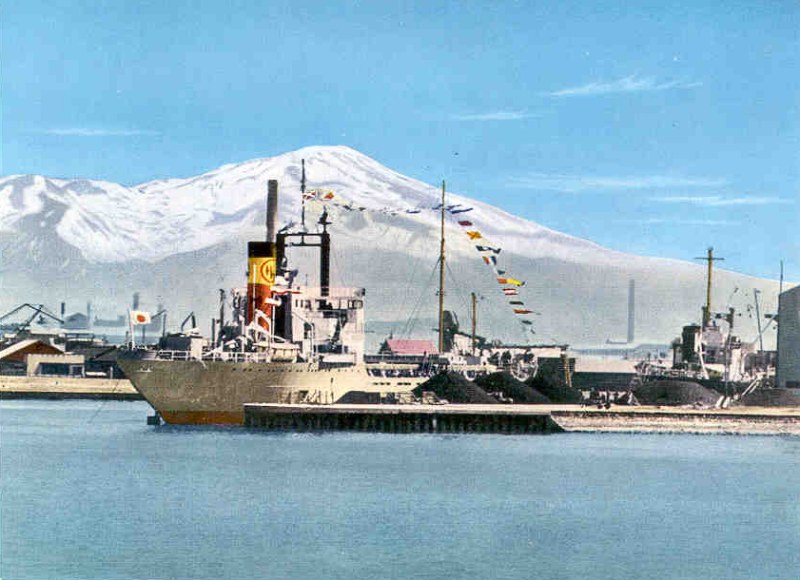
Mt. Chokai
The video below begins with my parents' wedding in June of 1948 and then jumps to the early sixties in northern Japan where I grew up.
In the days that followed World War II the field of operations for various missions was set out. I am not sure who made these decisions, but the Norwegian-Americans were assigned the northern part of the main island (Honshu). Northern Japan was a third world country in those days, and it might have been considered the worst possible place to be sent. But it really fit Norwegian-Americans, because in many cases it was not more primitive than what they, as farm kids from the upper Midwest had grown up with.
But Japan was not the American Midwest. It was very much a pagan culture, and the cultural contrast took its toll. Most the the original missionaries who went out with my parents during the earlier fifties quit soon afterward. What had began as a major thrust (in response to General MacArthur's call for 10 thousand Protestant missionaries) dwindled to a few families. The adjustment was just too much for most people. As a kid I had no comprehension of this. For a child, the gentle countryside of Northern Japan was Heaven.
 Japanese people tend to be indulgent toward children, sometimes to the point of absurdity, but you can bet we took full advantage of it. We loved Japan. Like the adults, we also went through a very difficult cultural adjustment. But it was the reverse of our parents. For us, it happened when we "returned" to the United States, a country of which we were citizens, but a country in which we found it very difficult to feel at home.
But even though we liked Japan, were were not really Japanese, so education was always an issue. Some of the American missionaries in the countryside sent their kids to Japanese schools because they did not want to send them away from home. They could come home every day. But, of course, there were things they missed in their schooling, which was designed for Japanese people. So some missionaries sent their children down to Tokyo to go to an international school. A good idea academically, but being so far from home, children were only able to come home for Thanksgiving, Christmas, and Easter.
The mission my parents were with found a compromise. They had a small school for children that operated very much like the one-room country schools they had attended as children in North Dakota and Minnesota, and then they sent their children to Tokyo for high school.
One of the best things Dad did when we returned to the field in 1961 after an extended furlough in North Dakota, was to buy a Bell & Howell movie camera. The camera you see pictured here is not Dad's. It is the camera used to film the Zapruder film (assassination of JFK). It is now held in the National Archives.
Although that took place in 1963 and Dad bought his camera in 1961, Dad's camera was actually a slightly newer version of this. I don't have a picture of it, but it looks exactly like this one, only newer. Perhaps it would seem primitive by today's standards, but it was really a pretty impressive machine. The 8mm camera was actually a modified 16 millimeter. It used 16 millimeter film. You would thread the film in the camera, run it through, then find a dark place, open the camera, turn the film over, thread it, and run it through again. Combine this ingenious device with Japanese color film, and you have a pretty good picture, with one caviat. It takes much more light to get a proper exposure on film than with digital. So anything shot inside would tend to be dark unless you had pretty powerful flood lights. But outside, the quality was pretty impressive for the time
Click for larger image.
 The video starts in Sakata (after the wedding). It then moves to the school in Akita, and then back and forth between the two, and includes a few scenes from our small farm in Honjo. There is nothing here from Nojiri for some reason. In the field day segment, you can see an amusing scene of me trying to bat right-handed. Apparently the grownups did not realize that I was a southpaw. There was no way I was going to hit that ball. Not then, not now, not in a million years.
The little vignette of settlers traveling across the prairie in their covered wagon was Johnny's brainchild. He directed that segment, which was filmed in Sakata. Costumes were a problem. Pretty hard to find cowboy hats in Japan. But we found some straw hats in the market that were the next best thing. Use your imagination. We brave the wilderness all day long, crossing all kinds of terrain in our journey to the west. At night, we wearily build our campfire and prepare to rest for the night. Suddenly, Johnny sees an arrow. Indians! We hit the ground and start shooting at the Indians from under the covered wagon. Not exactly politically correct by today's standards, but if you watched television in the fifties and sixties, it was a pretty standard scene.
There is brief footage from the Navy base in Sakata. During the first term, this was an Air Force base. At that time, Dad was actually on the payroll of the US Air Force as an auxiliary chaplain. I am not sure when the Navy took it over, but the second term (until we moved to Honjo) it was run by the Navy. Dad was not on the payroll, but the Church in Sakata he had worked with so much the first term had a Japanese pastor, so Dad and the other missionary, who was Morris Larson at the time, took turns preaching at the Navy chapel. Larsons then got involved in Tsuruoka at some point...can't remember just how that came about. Anyway, the irony of the whole thing is that even though we lived in the countryside of Japan where nobody spoke English, I spent many Sundays in the chapel at the Navy base listening to Dad preach in English.
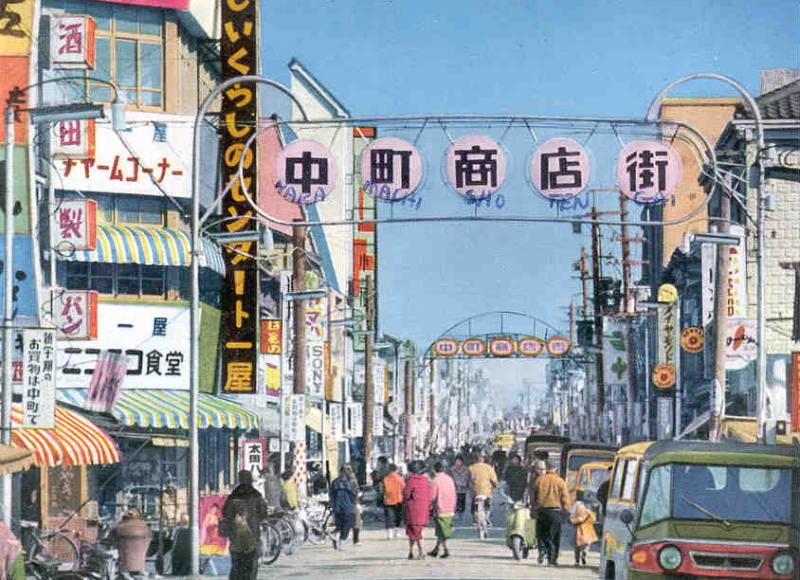
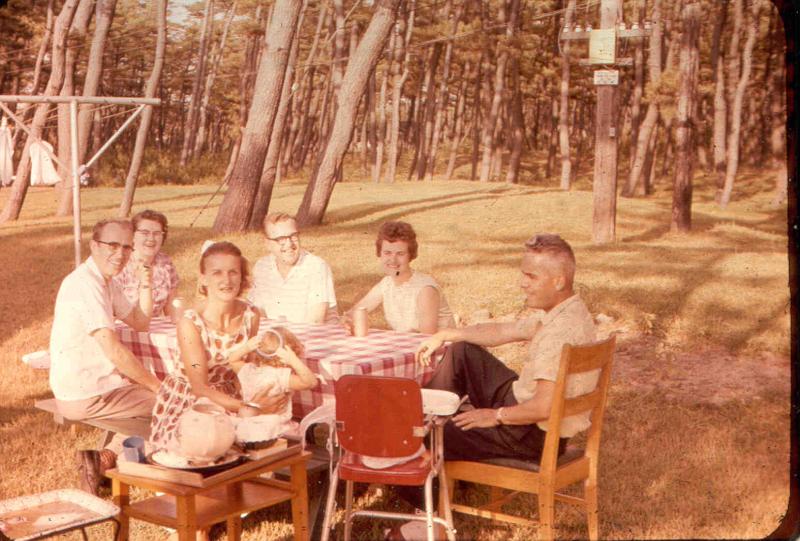 Above you can see a street scene of Nakamachi (from the old Sakatavets website)
taken near the old mission house in Sakata. In this picture to the right, you can see Larsons and Mom and Dad having a backyard dinner at the Navy base with one of the officers (also from the Sakatavets website). I thought at first that it was Lt. Michaels, but it comes from the photo collection of a different officer, and the child appears to be a good bit younger than Shelley. Anyway, you can see both Lt. Michaels and his wife (and Shelley) in the video, so take a look and decide for yourself. We also went to the Navy base at other times. I remember a baseball game there once, and also a Halloween party and once or twice we were there for a Fourth of July celebration. But the Navy base closed down and left town and we moved to Honjo, so those days have passed into history, only to be remembered.
Just before we left for the States in 1967, I gathered a bunch of the 8mm film reels that had survived the Honjo fire, got a pair of scissors and some scotch tape, and spliced them together to make one film that was about 30 minutes long. After we got to the States, Dad had gotten a Nikon and had lost interest in the old Bell & Howell. But I was fascinated with it, so the scenes in Fergus Falls were filmed by me. There is also brief footage of the Langager Family Reunion in 1971, which was at Lloyd Langager's place in Tioga. At the tail end is some stuff that looks like it was filmed at Mary's place in Eastern Oregon. No idea who did that.
Above you can see a street scene of Nakamachi (from the old Sakatavets website)
taken near the old mission house in Sakata. In this picture to the right, you can see Larsons and Mom and Dad having a backyard dinner at the Navy base with one of the officers (also from the Sakatavets website). I thought at first that it was Lt. Michaels, but it comes from the photo collection of a different officer, and the child appears to be a good bit younger than Shelley. Anyway, you can see both Lt. Michaels and his wife (and Shelley) in the video, so take a look and decide for yourself. We also went to the Navy base at other times. I remember a baseball game there once, and also a Halloween party and once or twice we were there for a Fourth of July celebration. But the Navy base closed down and left town and we moved to Honjo, so those days have passed into history, only to be remembered.
Just before we left for the States in 1967, I gathered a bunch of the 8mm film reels that had survived the Honjo fire, got a pair of scissors and some scotch tape, and spliced them together to make one film that was about 30 minutes long. After we got to the States, Dad had gotten a Nikon and had lost interest in the old Bell & Howell. But I was fascinated with it, so the scenes in Fergus Falls were filmed by me. There is also brief footage of the Langager Family Reunion in 1971, which was at Lloyd Langager's place in Tioga. At the tail end is some stuff that looks like it was filmed at Mary's place in Eastern Oregon. No idea who did that.
In preparation for Mom and Dad's 40th wedding anniversary, Anne Marie or somebody took all those videos and had them digitized into this one story. I should note that there is one anachronism. My sister(s) inserted an video from the fifties. I guess they thought that was the building of the house in Honjo, but in fact, it was the building of the church in Sakata. Fortuitous mistake, actually, because that little bit of history never would have seen the light of day. You will spot it right away, because it is an island of black and white in an ocean of Sakura color. I would guess that it was filmed by Morris Werdahl, because I'm pretty sure that's one of his daughters in the video. By the way, the video does have audio, but it is delayed a few seconds
Wednesday, May 29, 2013
What is Japan?
So what is Japan? Eating oyakodonburi at a small Japanese restaurant instead of going to McDonald's? I have been in China more than 9 years now. I have probably had more oyakodonburi in Beijing than I ever had in Japan. When I go to Tokyo now, I eat at McDonald's. I can't afford to go to a restaurant.
So what is Japan? Cheap mass transit? Basic bus fair in Beijing is 1 kuai. But if you have a bus card, they give you a 60 per cent discount, which brings it down to 4 jiao. That's a bout 7 cents. The subway costs more, but even that is cheap. Two kuai will get you anywhere you need to go in the city. Can't do that in Tokyo. Subway costs are actually reasonable in Tokyo, but not nearly as cheap as Beijing, and taxis are out of the question. My monthly cost for getting around Beijing is about what most Americans pay for two or three gallons of gas.
So what is Japan? Buying sweet potatos from the sweet potato man? Haven't done that in Japan since I was a kid. In Beijing I eat sweet potatos on the street every winter. That and corn on the cob, which is also sold everywhere. Another cheap roadside food is the "Xi'an burger." When I first came to China, I used to buy them for two kuai, but they cost a little more now. Still pretty cheap though. But lots of pork fat, so I try to stay away from them.
So what is Japan? Living in a local Asian village instead of an American subdivision? My little apartment in the village costs 900 RMB a month--about $125. Couldn't come close to that in Tokyo. That amount of money might get you one night in a cheap hotel in Tokyo, but then you'd be out of luck and out of money. Bottom line: Thomas Wolf was right. You can't go home again. The Japan I grew up in doesn't exist anymore--except in China.
Labels: Japan
Wednesday, September 15, 2010
Diaoyu dispute sowed by US
When the US decided to return the occupied Okinawa to Japan in 1972, the Diaoyu Islands and adjacent islets, which belong to China, were also handed over to Tokyo. In so doing, the US wanted to prevent China and Japan from getting too close and bring ties between the two countries under its control. Washington's viciously conceived move, a tactic often employed by imperialists, proved useful in serving its interests in the past decades.Such nonsense has to be an embarrassment to the China Daily. The agreement between the United States and Japan returning Okinawa to Japan was signed in 1971 before Nixon's trip to China. What are the odds that they Americans would take part of Okinawa and give it to "Red" China, a country with which the Americans had no diplomatic relations? It's absurd. The United States returned those islands to Japan for one simple reason: It was Japan that they had taken them from after World War II, and they had no interest in the islands themselves. To take a couple obscure islands that were considered part of Okinawa and give them to a third party would have placed the United States in the middle of an issue they did not want to be involved in. It's possible the young man who wrote this article was born after the Cultural Revolution, and perhaps even after the end of the Cold War. Still, his ignorance is distracting. The China Daily would be well advised to limit its editorial page to writers who have at least a middle school knowledge of Chinese history.
Labels: Japan
Tuesday, September 14, 2010
Diaoyu Islands
China has repeatedly lodged protests to Japan over the incident, and all Chinese people, including compatriots living overseas, have denounced Japan's illegal moves, Foreign Ministry spokeswoman Jiang Yu said on Monday.So all ethnic Chinese the world over have exactly the same opinion about this issue? It's not unusual to see this kind of statement in the Chinese media. The government decides what everyone is supposed to believe, then announces to the world what "all Chinese people" think. This includes all ethnic Chinese throughout the world. Of course this kind of statement is ridiculous when applied to all ethnic Chinese. But within China, the government strictly controls information, so the opinions of Chinese people tend to be much more uniform. In an amusing example of this, Han Han, noted Chinese blogger describes his attempt to post a comment about the issue on a forum:
A friend asked me how I haven't commented on the Diaoyu Islands incident, and suggested I take a few shots at Japan. I told him that while I myself may not have my own land to stand on, I care a lot about issues of territory. I first read about the incident on an online forum, and quite righteously posted, "Protect the Diaoyu Islands." However, this resulted in the forum telling me that my attempted sentence contained illegal content, and suggested that I change it. After puzzling over this for a while, I changed the sentence to read, "Protect the Senkaku Islands [the Japanese name for the Diaoyu Islands]," and the message was published without a hitch.The islands Japan calls "Senkaku" have been administered by Japan since they took over them in 1895, except for the quarter century following World War II. The United States administered these islands after World War II because they were considered part of Okinawa, which was occupied by the Americans until the early Seventies. At the time that Okinawa was returned to Japan, these islands were returned along with Okinawa. But the problem is that just about this time, word came that these islands might be sitting on a huge reserve of oil. Needless to say, China and Taiwan suddenly became very interested. One can be sympathetic with China's territorial concerns, given the history of relations between China and Japan, but it does appear that the fishing boat skipper in this instance did ram a Japanese Coast Guard vessel, and I don't see why he should get off without some consequence. If the Japanese don't take some action, what respect will anyone have for them? If a Japanese fisherman rammed a Chinese Coast Guard boat, would the Chinese just let him go?
Labels: Japan
Tuesday, May 19, 2009
Communications Revolution
As I look back over my life, and compare the Asia of my childhood to the Asia I live in today, perhaps the most significant difference is the phenomenal revolution in communication, and the availability of information.
This podcast episode is basically an explanation of how IP works, and how that differs from conventional radio signals, especially short wave, which was the radio of my childhood in Japan.
Labels: Communication, Japan, Technology
Monday, May 18, 2009
Burakumin
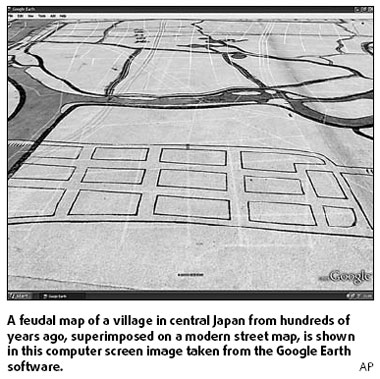 In my opinion, if this helps to raise the issue, then it's a good thing. I'm sure such discrimination would not be legal, but it is can be hard to deal with. The burakumin of Japan are the people historically assciated with "death trades," such as grave diggers. This may not be easy for Americans to understand, because in America, morticians are regarded as respected professionals, and if a college student wanted to make a little extra money digging graves, he would not be looked on as undesireable. But in fuedal Japan it was quite different.
In China, they don't really have "burakumin," but they sure do have regional prejudice. When I first came to China, there was a big controversy because of a television program in which all the bad guys had Henan accents. The idea that people from Henan are devious, or crafty is pervasive in China. And it's very hard to get a handle on just how this whole thing started. When I ask Chinese people about it, they say stuff like, "It's because they're lazy." One of my Chinese friends told me, "Henan is to China what China is to the rest of the world."
The racial issue in America gets a lot more attention, perhaps becuase it is racial. In China (and Japan--the Burakumin, unlike the Ainu, are ethnically indistinguishable from other Japanese), people group discrinminations are usually not racially based. They do often have to do with family, though. During the Cultural Revolution, if someone in your family had been a landlord in the past, you would be austricized. In India, they say, you don't cast your vote, you vote your caste. Fortunately, modern society tends to water down these old distinctions. But the recent flap over Google's historical maps has reminded us how hard it is to rid ourselves of age old bigotry.
In my opinion, if this helps to raise the issue, then it's a good thing. I'm sure such discrimination would not be legal, but it is can be hard to deal with. The burakumin of Japan are the people historically assciated with "death trades," such as grave diggers. This may not be easy for Americans to understand, because in America, morticians are regarded as respected professionals, and if a college student wanted to make a little extra money digging graves, he would not be looked on as undesireable. But in fuedal Japan it was quite different.
In China, they don't really have "burakumin," but they sure do have regional prejudice. When I first came to China, there was a big controversy because of a television program in which all the bad guys had Henan accents. The idea that people from Henan are devious, or crafty is pervasive in China. And it's very hard to get a handle on just how this whole thing started. When I ask Chinese people about it, they say stuff like, "It's because they're lazy." One of my Chinese friends told me, "Henan is to China what China is to the rest of the world."
The racial issue in America gets a lot more attention, perhaps becuase it is racial. In China (and Japan--the Burakumin, unlike the Ainu, are ethnically indistinguishable from other Japanese), people group discrinminations are usually not racially based. They do often have to do with family, though. During the Cultural Revolution, if someone in your family had been a landlord in the past, you would be austricized. In India, they say, you don't cast your vote, you vote your caste. Fortunately, modern society tends to water down these old distinctions. But the recent flap over Google's historical maps has reminded us how hard it is to rid ourselves of age old bigotry.Labels: Japan
Friday, August 29, 2008
 Took the new Line 10 over to the 798 Art District to have breakfast with Lyanne. Lyanne is a former table tennis champion (Barcelona and Atlanta) from Brazil who had contacted me before the Olympics after reading one of my book reviews on Amazon.
We had a very interesting discussion. Lyanne is Japanese Brazilian. I didn't know this before she told me, but the largest contingent of Japanese outside of Japan is in Brazil. She told me that the 100th anniversary of the migration had been held just recently. Sure enough, when I looked it up, I found that migration began in 1908 with 791 people. That's actually quite a significant number of people for 1908. And you know how it is; one group of migrants attracts others, so there have been many more migrations through the intervening years--more than a hundred thousand in the twenties and thirties.
But what's really interesting now, is that many of these Brazilians have started to migrate back to Japan. Did you know that the largest contingent of Portuguese speaking people in Asia is in Japan? It's because of Japan's immigration laws. I was born in Japan, but it would be tough for me to become a Japanese citizen, because my parents were Norwegian Americans. But the Japanese coming from Brazil are able to become Japanese. At least legally. Socially and culturally it would almost certainly be a whole different matter. Of course I expect to be treated as a foreigner when I go back to Japan, even though it is my home. But I have talked to Japanese people who tell me that even after being away for a few years, they are looked at differently. Henna Nihonjin.
Thanks, Lyanne, for a very pleasant morning.
Took the new Line 10 over to the 798 Art District to have breakfast with Lyanne. Lyanne is a former table tennis champion (Barcelona and Atlanta) from Brazil who had contacted me before the Olympics after reading one of my book reviews on Amazon.
We had a very interesting discussion. Lyanne is Japanese Brazilian. I didn't know this before she told me, but the largest contingent of Japanese outside of Japan is in Brazil. She told me that the 100th anniversary of the migration had been held just recently. Sure enough, when I looked it up, I found that migration began in 1908 with 791 people. That's actually quite a significant number of people for 1908. And you know how it is; one group of migrants attracts others, so there have been many more migrations through the intervening years--more than a hundred thousand in the twenties and thirties.
But what's really interesting now, is that many of these Brazilians have started to migrate back to Japan. Did you know that the largest contingent of Portuguese speaking people in Asia is in Japan? It's because of Japan's immigration laws. I was born in Japan, but it would be tough for me to become a Japanese citizen, because my parents were Norwegian Americans. But the Japanese coming from Brazil are able to become Japanese. At least legally. Socially and culturally it would almost certainly be a whole different matter. Of course I expect to be treated as a foreigner when I go back to Japan, even though it is my home. But I have talked to Japanese people who tell me that even after being away for a few years, they are looked at differently. Henna Nihonjin.
Thanks, Lyanne, for a very pleasant morning.Labels: 2008 Olympics, Japan
Monday, June 16, 2008
Poor Yasuo Fukuda: Japan's lackluster leader did his best to charm President Hu Jintao and to set the relationship between Asia's two great powers on a more co-operative course. He got Mr. Hu to take his jacket off to play ping-pong, and to promise two new pandas to replace the recently deceased Ling Ling at Tokyo's Ueno Zoo. The two leaders signed a friendly communique that, according to the Chinese, marked a "warm spring visit." In Japan, no one is thanking the prime minister. Bets are being taken on when Mr. Fukuda's personal popularity ratings, currently at a dismal 21 per cent, will plunge below the all time low for a prime minister of 16 per cent (held by Junichi Koizumi's predecessor, Yoshiro Mori). Mr. Fukuda's unpopularity ratings are between 65 per cent and 70 per cent, depending on the poll. There is open discussion inside the ruling Liberal Democratic Party that it needs to ditch Mr. Fukuda if it hopes to win an election, so the only questions are when and with whom. Right-wing members of his own party are accusing him of being a traitor for cosing up to China. Maverick Tokyo governor Shintaro Ishihara called the so-called "panda diplomacy" into doubt, questioning sardonically the divinity of pandas. Veteran television commentator Yoshiko Sakurai accused both Mr. Fukuda and his father, former prime minister Takeo Fukuda, who signed the original friendship treaty with China, of "injuring Japan's national interests and betraying the people." On one level, it is all just good political theatre. But, more importantly, the drama of absurd opinions means that Japan is still refusing to come to terms with its past -- which means that it faces a risky future. This problem is exacerbated by this abysmal political leadership. Mr. Fukuda represents the well-meaning but powerless face of Japan's politics today. All the other putative candidates would be tempted to play to the nationalist gallery. Japanese politicians and media protest that the country has apologized many times over, officially and unofficially, for its wartime conduct and ask how many apologies are necessary. The answer is that, as long as leading Japanese politicians claim -- as they continue to do, that it was Japan that was wronged, that the Nanjing Massacre was a myth and that the "comfort women" volunteered to be sex slaves, China will have the opportunity to claim that "the 1.3 billion Chinese people are hurt" by Japanese ministerial visits to the Yasukuni Shrine, where the souls of war criminals are supposedly interred along with those of 2.5 million soldiers and civilians who died during the war. I is wonderful political capital for Beijing to shelve discussions on the real issues dividing the two countries, while the Japanese people are the ones really hurt by their own politicians throwing away reality to pander to a world of myth and fantasy. Since it has only 10 per cent of China's population, and a rapidly ageing one -- this week it was announced that 10 per cent of Japanese are 75 or older -- it ill behooves Japan to flex its muscles in China's face. The reality is that China and Japan are linked so closely economically that it is in their best interests to sort out their political differences, to maximise their future potential. China has supplanted the US as Japan's biggest trading partner, with bilateral trade of about US $250 billion. China benefits from US $6 billion of investment by 20,000 Japanese concerns, its largest national source of foreign direct investment. For all this, Mr. Hu's "warm spring visit" did little to get to grips with potentially dangerous differences. Disputes over the East China Sea, with its valuable natural gas reserves, remain unsettled. China's rapid increases in military spending are causing widespread unease in Japan. For its part, Beijing is worried that Japan could exploit its industrial, nuclear and technological skills to become a military power. The passing this week by the Diet of a law authorising Japan to use and develop space for national security, including deployment of spy satellites, drops the customary principle of "non-military" use. Given China's demonstrated capacity in space technology, it risks sparking a space war. The decision to pass the law on space shows that the LDP is moving to the right, even in the face of public opinion. Some leading politicians, backed by the powerful Yomiuri newspaper group, are still trying to stoke the smouldering nationalist embers of former prime minister Shinzo Abe's efforts to revise the constitution to make Japan -- in their view -- a more normal nation with proper armed forces, even though only 23 per cent of Japanese want to change the constitution. An overwhelming 66 per cent prefer to keep the existing constitution with its famous Article 9, which declares: "The Japanese people forever renounce war as a sovereign right of the nation and the threat or use of force as a means of settling international disputes... Land, sea and air forces, as well as other war potential, will never be maintained. The right of belligerency of the state will not be recognised." Japan has two unique virtues: as a victim of nuclear slaughter and as Asia's first beneficiary of economic globalisation, albeit often heavily manipulated. It should show the supreme moral leadership of being a pioneer of peaceful development. The greatest tragedy of modern Japan is that its business corporations have demonstrated superior performance in every corner of the globe, but its politicians and bureaucrats -- and the media -- seem to have no idea of where the rest of the world is, let alone how other people feel or how Japan impacts the world. How different it could have been; should have been. With the shield of the US nuclear umbrella and the memories of the horrors of war, Japanese political and intellectual leadership could have been free to explore and suggest new ways to bring the world together, to beat those swords into ploughshares and to suggest practical ways to share the fragile peace and plenty of the planet. Is it too late?Mr. Rafferty makes some good points. This article is insightful for me, because in China, Hu's trip is presented as representative of warmer feelings between China and Japan. I think it is, but it is interesting to note that the policy Fukuda is implementing does not enjoy universal support in Japan. But I also think that perhaps Rafferty is a bit too negative. Fukuda's problems, and particularly his popularity rating, are not all related to this issue. The fact that he is unpopular does not establish that his policy of getting along with China is exactly as unpopular. Certainly there is a right wing in China that continues to portray Japan as a victim. You only have to pay a visit to the war museum at the Yasukuni Shrine to see this (worth the 800 yen ticket, by the way). But there are more and more Japanese who are beginning to understand that their ignorance or stubbornness re: the history of relationship with China has not been helpful. China and Japan need each other, and China's determination to portray the relationship in a good light is promising.
Labels: Japan
Thursday, March 13, 2008
Japanese Software Program
Labels: Japan
Sunday, February 05, 2006
Labels: Japan
Wednesday, February 01, 2006
Roots

I suppose everyone needs to return to the place where life began at least once in that life. Today I met Bulu and his girlfriend at the West Exit of the Shinjuku station, and we went to a restaurant to have lunch. This time I took the bowl of oyako-don. I had enlisted Bulu and his friend to help me find the International Catholic Hospital, which is where I was born.
After lunch, we took a local light-rail to a different part of town, and walked a few blocks to the hospital. It turns out that the hospital had just been remodeled a year or two earlier, so it did not look the same as it did when I was born. That didn't matter to me, because it was a long time ago, and I didn't remember it anyway. But I did meet a nun there by the name of "Sister Barbara,” who had been at that hospital since the sixties, and was well acquainted with Dr. Eitel, the German missionary doctor who delivered me almost 52 years ago. Dr. Eitel was one of the many Western missionaries who were kicked out of China after the Communists took over following World War II. He had served as chief consultant of a hospital in Changsha in Hunan Province for about thirty years before coming to Japan. According to Sister Barbara, he did quite a number of deliveries during his years here in Shinjuku.
The lady who showed us around was very friendly. She showed us some old pictures of the hospital at various stages of its life over the past 70 some years of its history, including a shot of the hospital personnel standing on the roof, receiving drops from the US military after World War II.
Seibo (Holy Mother) Byoin, as it is called in Japanese, is still a prominent hospital because of its international status, being utilized by various embassies. I don't much like hospitals. In fact, this is the only place I have ever been hospitalized. I was pretty sick then, because Mom had Hepatitis A when I was born prematurely. Nobody remembers the place where they were born, and there isn't really anything about the community that is familiar to me, because I did not grow up here. My home was in the countryside of Northern Japan. Still, it is interesting to go back to the place where everything started. And even though I don't like hospitals, this place does have a pleasant atmosphere.
Labels: Japan
Monday, January 30, 2006
Labels: Japan
