Links
- CV
- Titles
- Topics
- Tickets
- Science
- About Eric
- Book Reviews
- Country Profile
- Modern China
- Contact Eric
- Podcast
- Vision
- Sekai
- John
Archives
RSS

Reflections on a Wandering Life.....
Friday, April 29, 2022
Science Night - Shortwave Radio
I have had a life long obsession with electricity. I don’t know why, but I was always fascinated with electricity and how it worked. I remember when I was very small, Dad would buy a few batteries and bring them home for me to play with. I suppose he picked them up after I got tired of them and put them in a flashlight or something. That was when we were living in Williston. When I was seven, we returned to Japan.
One time Dad took Mary and I with him on one of his trips to Tokyo. We went shopping on the Ginza and I talked Dad into buying me a little toy phone. It had two little telephones with a wire strung between them and ran on D batteries. For some reason, the little two-prong plug on the end of the wire fit into the side of our table top radio. Curious, I plugged it in and burned out a tube on the radio.
Dad was not fond of my fascination with electricity. One time I got a hold of the cord for an old toaster. I got the brainy idea to use this cord to plug my battery powered phone set into the wall outlet so I wouldn’t have to use batteries. I cut and stripped the coating away from the ends of the wire and wound them around the positive and negative metal strips in the battery case. Dad saw what I was doing and freaked out. He ripped the cord out of the phone and told me in no uncertain terms what he thought of my idea.
Another time I took an old portable electric shaver Dad had given me and tried to turn it into a power station. It was a cheap little affair—a battery box that held 3 D cell batteries with a mirror on the front. You could plug the shaver into the battery box when you were a train or something and shave your beard.
I got a big board and mounted the battery box on it, then I took some wire and tried to wire a an assembly that would power a little light that I had—I can’t remember how I had it set up—anyway, it didn’t work. Useless. But at least it was harmless. After all, what kind of danger can you have with three D cell batteries? Nevertheless, Dad warned everybody to stay away from it. I think Dad was probably the most non-technical person I ever met in my life.
But not all my ideas were dangerous. We had a portable stereo with fold out speakers that were hung on hinges that were open at the top so that you could easily slide them off. Then you could pull the cord out that was stored in the speaker box and set the speakers out away from the stereo to increase the effect. I wrapped one end of the wire for my phone around the hinges and strung the wire into my bedroom. That way I could lay in my bed, pick up the receiver to my toy phone, and listen to the stereo in the living room. Dad thought that was pretty clever. So did Mom.
We lived in a duplex in Sakata. There was a wide hallway between the two units. When we came back to Japan in 1961 there were four kids in our family, so it was thought the back part of that wide hallway could be made into a bedroom for John and me. It was actually a clever use of wasted space, but it meant that anytime anyone wanted to use the bathroom, they had to walk through our bedroom. Dad has often recounted one time when he was walking through our bedroom and he saw me lying on my bunk staring into space. He said, “What are you doing, Eric?”
“Thinking.”
“What are you thinking about?”
“Electricity.”
But as the years went by, I began to see that electricity was not enough. There was more to life than electrons flowing through a wire. I became interested in radio, because I listened to the Voice of America, and also the Armed Forces Radio from Tokyo on our shortwave receiver (the one I ruined). When I was in 5th grade, I talked my parents into buying me a portable shortwave radio for Christmas.
I was moving from electricity to electronics. I remember my 9th grade science teacher defined the difference between electricity and electronics. I can’t remember if I asked him this question, or if someone else did. I hope I didn’t bother Mr. Hegland too much with my questions. One time I asked him what would happen if you breathed liquid oxygen.
He said, “I don’t know. Frost your tonsils?”
Anyway, he said electricity was about electrons traveling in a wire, while electronics had to do with the electron under souped up conditions. I knew right then and there which one was for me.
So I became less and less interested in electrons in a wire. I was fascinated with how they behave when you shoot them through a vacuum, such as in a vacuum tube. And especially I was interested in what happens when the frequency of the oscillation is so high that the current in the wire floats off the wire into space. Radio. I had first become interested in radio as a child listening to the portable shortwave radio that I had begged my parents to buy me for Christmas. Many years later, when I was living in North Dakota, I learned Morse code and became a licensed Amateur Radio operator.
So what is “shortwave?” How does a short wave radio work?
As radio developed through the first half of the 20th Century, there was a general classification into three ranges of frequency: Long Wave (LW), Medium Wave (MW), and Short Wave (SW). Long Wave doesn’t really count, because those frequencies are used for non-broadcast stuff, such as non-directional beacons for aircraft guidance, so we won’t be talking about them for our purposes today.
So the longest waves used in broadcast would be the Medium Wave, which are typically used for local AM stations, the Short Wave, used for commercial shortwave stations, and then very, very short wave, which is what FM stations usually use. But we didn’t have FM when I was growing up in Japan. Even in the United States, FM listening did not overtake AM listening until 1978. Now, of course, FM predominates, with AM being mostly the domain of talk radio.
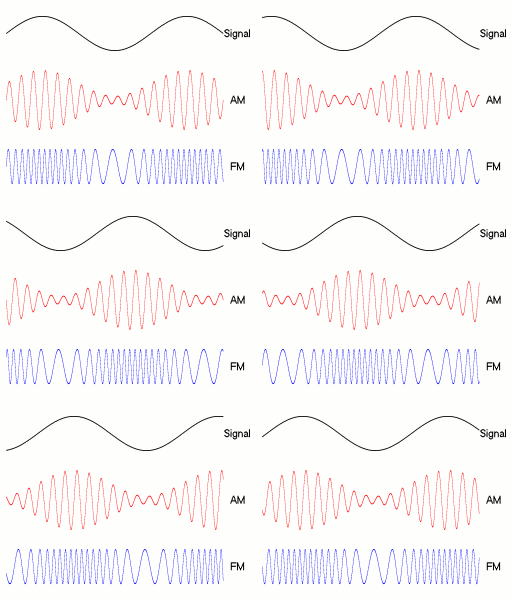 I should add, to avoid confusion, that abbreviations AM and FM refer to the way the signal is modulated, which is a separate issue from the frequency and wavelength issue. So we’ll leave the AM-FM discussion for another time, because I want to talk about the differences in wavelength, not the differences in modulation. Both shortwave and what we used to call “medium wave” stations use amplitude modulation. The only difference is the frequency, and how different wavelengths behave in nature. But it turns out that’s a pretty big difference.
So let’s take some examples just for purposes of illustration.
When I was a truck driver, I listened to a lot of AM radio, because that’s where talk radio tended to reside. Also, one of the characteristics of medium wave signals is that they tend to have better ground wave propagation than FM. You can often follow an AM station for a hundred miles, while an FM station will fade out much sooner.
So let’s take a typical AM (medium wave) station for example and determine the wavelength. The company I worked for was in Fargo, but the hub of our operation was really Chicago. Chicago is the transportation hub of North America. So I will use WLS Chicago as an example. WLS is at 890 on the AM dial. That would be 890 kilohertz, or kilocycles, as we used to say when I was a kid. That means that 890000 crests of a radio wave pass a given point in a given second.
Since the speed of light is constant at 300 million meters per second, there is obviously a direct relationship between frequency and wavelength. So let’s do the math:
300000000 ÷ 890000 = 337.08 metersSo the wavelength from crest to crest of a radio signal coming off the WLS tower would be 337.08 meters. If you use the wavelength calculator it comes to 336.8455. That’s because the wavelength calculator uses a more precise number for the speed of light. Anyway, it doesn’t matter—we’re just trying to get a general idea.
So now lets try an FM station just for kicks. One FM station I really like to listen to online is Heaven 88.7 from Fargo, North Dakota. That would be 88.7 Megahertz. So, again, let’s do the math:
300000000 ÷ 88700000 = 3.38 metersNow let’s do shortwave. I don’t remember the frequencies for the stations I listened to as a kid, but just as an example, the initial shortwave frequency for HCJB, a famous old missionary radio station in Ecuador was 5.986 Megahertz. The wavelength was 50.26 meters.
 So the wavelength from crest to crest of WLS Chicago is over 1000 feet—about 1100, the wavelength for Heaven 88.7 in Fargo is about 11 feet and HCJB’s wavelength was roughly 165 feet.
So what are the differences between those frequencies and the way they operate?
The signal from medium wave (what we now call AM) stations has very good ground wave propagation. That means you can follow an AM station for a long time. A hundred miles would not be unusual. That’s kinda nice if you’re listening to a specific program, because you can listen to the whole show without interruption. But AM stations are very susceptible to electric activity in the atmosphere. Thunderstorms, or even dry thunderstorms with no rain but with a lot of electric activity can wipe out the signal of an AM station.
FM stations are strictly line of sight. That would be a function of the frequency. But FM stations are almost immune to the kind of static that can totally destroy an AM signal. I think that’s really more a function of the way FM is modulated (by frequency rather than by amplitude). I will deal with that some other time. But now I want to talk about the strange and unique feature of shortwave signals.
In 1912, the U.S. Congress imposed the Radio Act of 1912 on amateur radio operators, limiting their operations to frequencies above 1.5 MHz (wavelength 200 meters or smaller). The government thought those frequencies were useless. This led to the discovery of HF radio propagation via the ionosphere in 1923.
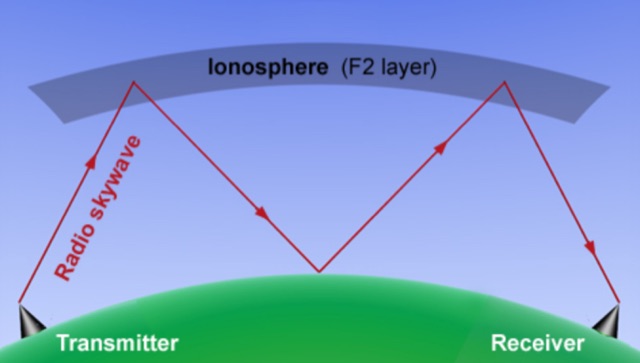
So what is the unique feature of those "garbage" wavelengths that was discovered by amateur radio operators? It’s so bizarre that no one could have imagined it. Shortwave radio signals travel in a straight line, of course, so since they do not follow the curvature of the earth, they go straight out into space. But when they hit the ionosphere, that band of highly ionized particles in the far outer atmosphere, they “bounce” back to earth. I put the word “bounce” in quotes, because it isn’t really reflection, it’s refraction. The ionized particles in the ionosphere bend the signal so that it does a hairpin turn and heads straight back to earth.
What does this mean? It means that with a shortwave receiver, you can get very strong signals from stations very far away. When I was a child, I used to listen to the Far East Network (Armed Forces Radio). I grew up I the northern part of Japan, about 350 miles from the transmission tower in Tokyo. A little less than 300 as the crow flies. You would think a signal from that tower would be really faint by the time it got to us. In fact, what we got was a very strong signal being beamed directly our way from outer space after bouncing off the ionosphere. As you can see in the diagram at the top of this post, sometimes a shortwave signal will even bounce back up and do it again. Eventually the signal would become pretty weak, though. But the signal from that first bounce—I mean right after it has been to the ionosphere for the first time—is pretty strong.
I also listened to the Radio Moscow English Language station. I don’t think it was being beamed all the way from Moscow. The studio would have been in Moscow, but the signal was probably relayed and then beamed across the Sea of Japan from Vladivostok, which was about 500 miles from where I grew up.
The other one was Voice of America. When I turned on my radio and heard a guy saying, “This is the Voice of America, coming to you from Omaha, Nebraska,” I don’think the signal was coming from Omaha. Probably relayed across the Pacific and beamed from a VOA tower in Okinawa. That’s just a guess.
Keep in mind that in northern Japan in the sixties, there was no internet. We had television, but it was mostly local programming. Same with radio. So as Americans living in the backwater of Northern Japan, we would have been pretty isolated. But because of shortwave radio, we had good access to information.
 The diagram at top of this blog post might be a little misleading, because it looks like the signal is a laser beam that is beamed back to earth at one precise location. In fact, when the signal comes back down to earth from the ionosphere, it is sprayed over a wide area. So there is considerable flexibility. Nevertheless, there is an area which is too far from the transmitter to get a direct signal (because of the curvature of the earth), but not far enough to get the first blast of signals that come back from the ionosphere. This area is called the “skip zone.”
I should add that the area where you get the strongest signal is also influenced by the frequency, and thus, by the length of the wave (since the speed of light is constant). For example, when I was sitting in my radio shack in western North Dakota tapping out Morse code, I found that if I was using the 80 meter band, the strong signal would likely be from western Montana. But if I was using the 15 meter band, I was more likely to get a strong signal from New York or New Jersey.
Fortunately for me, the place where I grew up (Tohoku region of northern Japan) was located far enough from Tokyo to get really good reception from that first bounce off the ionosphere.
It’s ironic, you know. I don't know just who was responsible for the allocation of mission fields for the MacArthur missionaries after World War II, but for some reason, they gave us the backwater. The back side of Japan. Inaka no inaka. But as any Tohoku MK can tell you, it was actually the best side of Japan. You couldn’t find a more peaceful, beautiful place for a kid to grow up. It was just a little isolated. But because of shortwave radio, we were not cut off from the world.
When we moved to the United States from Japan in 1967, I was 13 years old. Junior High. In terms of culture, there was so much about America that I had to get used to. In that sense you could say that I was behind. But in terms of information, I was really ahead. My peers grew up choosing between the rock station and the country station. I grew up choosing between the Voice of America and Radio Moscow. I spent my childhood thinking through issues that most kids my age had no knowledge of nor interest in. We did have other sources of information. The Japan Times was an English language newspaper that was freely available (by mail, I think). I learned about the Cultural Revolution in China from my Weekly Reader in school. And I would sometimes get 16 millimeter films from the Japan-America Culture Center at the public library in Akita. But it was really shortwave radio that opened a window of information for me as a child.
So what is the future of shortwave? Does it even have a future?
It’s hard to say. Certainly it is on the decline because of Internet radio, which I will discuss some other time. But there could be situations where it could become a last resort.
Many years ago, just after I had come to China, I used to hand out ITL (invitation to listen) cards for a Christian radio station (BBN Radio) that had—and still has—a very strong Internet portal.
I must have handed out four or five thousand of those things, mostly in front of Haidian Church in Beijing. Several of the church ladies thanked me profusely. They had never dared to believe that there could be such a thing as Christian radio, and in their own language.
One Sunday morning I was walking away from the church after the service on a Sunday morning. A young lady came running after me. I heard her yelling. I turned around as she said, “You have to come back! It’s very serious.”
I returned to the church with her, and she brought me to a lady who was on the verge of tears. She was desparate. Turns out she had not been able to connect to that Internet radio station, and she couldn’t figure out why. I explained to her that there had been an earthquake off the coast of Taiwan, and an underwater Internet trunk line had been severed.
I told her it might take a month and half to fix it. Later, I was reading an online Yahoo Group for teachers in China, and someone expressed concern about this. Another guy told him not to worry because the Internet is “robust by design.” I thought, “In your dreams, fella.”
The Internet was created by the US military, so the Internet backbone inside the continental United States is powerful. But international it was hanging by a thread. Not sure how it is now, but an international system so dependent on undersea cables could easily be sabatoged. Since every country uses the Internet, it would be tough for them to do it without hurting themselves, so that is a deterrent, I guess. And as satellite connectivity increases, undersea cables may become less and less of an issue. Still, the Internet does have an Achilles heel.
In contrast, if you and I are having a shortwave communication, World War III could be going on in between us and it would not affect our communication. To disrupt shortwave, you’d have to wipe out the ionosphere.
Practically speaking, though, it is on the wane and has become more and more the domain of hobbyists. People living in America don’t need to use shortwave to find that one rare English speaking station several hundred miles away. And, as I said, people in other parts of the world are relying more and more on Internet radio.
I can think there may be some left over confusion about the difference between “modulation” and “frequency.” We will definitely be expanding on this issue in the future. In this blog post we focused on the difference in frequency. When I was a kid in Japan, there was no FM. So we had a MW (medium wave) band and a SW (shortwave) band. It wouldn’t have made sense to say “AM” and “Shortwave,” because shortwave signals are also AM (amplitude modulated). In America there is no shortwave, so the only AM stations are the traditional MW (medium wave) local broadcast stations. So it’s easier to say “AM” and “FM,” than to say “medium wave” and “really, really, really short wave.”
For local transmissions were you are close to the radio transmitter, FM is clearly superior because it is impervious to static, and uses less power than AM. It has very poor ground wave propagation, but that’s not an issue if you’re just staying in one place. This has meant that more and more local stuff is becoming FM, which has stressed AM stations financially. If it wasn’t for Rush Limbaugh, many of those old AM stations would have gone bankrupt, which would be sad, because they are still good for rural areas where people typically drive for longer distances. With AM, they can listen to the same station for a long time, which would not be possible with FM.
Shortwave stations like the ones I listened to as a child are not that useful in the United States, but they do still have usefulness in developing countries because they can cross both physical and political boundaries, and provide access to poor people in remote areas who do not have good local radio.
Comments Science Night Home Lesson Seventeen Questions
Labels: Communication, Radio, Technology
Friday, December 31, 2021
Science Night - Bell and the Telephone
The original objective was to produce a telegraph system that would allow several communications on the same wire. This was what got Alexander Bell started. But actually, it was before that—I guess you’d have to say that it started when he became a teacher for the deaf. That’s what got him pondering the idea of visible speech.
As an interesting aside, Bell was the one who helped Captain Keller get a tutor for his daughter. Little Helen adored Bell and later in life she dedicated her autobiography to him. He was a very compassionate man, but also a curious man, who could not let an idea die, once it had staked its place in his imagination.
In 1872 he read a newspaper article about the Western Union Company paying a hefty sum to the inventor of a telegraph system that could transmit two messages at the same time over one wire. That was not his passion, but it was a start. But he had to convince his future father-in-law, who was financing his research, to allow him to work on both the idea of a telegraph that could carry more than one conversation on the same wire, and Bell’s first love, which was a telephone—a device that could actually carry speech signals on a wire, and reproduce them in a receiver on the other end.
The video at the bottom of this page tells the story. The first sentence spoken over the telephone was the result of an accident. Bell called for his assistant without realizing that he has already created a telephone, and his voice is transported across the device.
That’s the way it happens sometimes. Years ago, when I was teaching at a software university in Arizona, I was assigned the task of getting the Oracle server up to speed, because the person who had been responsible for it had left the company. I didn’t know anything about Oracle at the time, but I plowed into the project eagerly, because I was determined to learn this new system. It was a frustrating process, because I didn’t know what I was doing. I remember onc day I came to work and happened to see Dan the Oracle instructor on my way to the IT department. I said, “I’ll get right on that, Dan.”
He immediately said, “No, don’t touch it! It’s never worked better.” Looking back now, I think it is because there are a couple scripts that need to be run after installation, and the guy in charge of it before had carelessly left that part out, which meant that the database would not run the PL/SQL language (Oracle’s proprietary programming language) properly. Anyway, I had fixed it without knowing it.
Voice communication has experienced many innovations since then to become the miracle it is today. In my grandparents’ time, everybody in a given telephone exchange would hear everyone else’s phone ring. But each party on the line had a distinct ring. Two shorts and a long; a short two longs; a long, a short, and another long; or whatever. So what was to stop anyone on the line from picking up the phone when they heard someone else’s ring and listening in on the conversation? Nothing, and it happened quite often. That’s how my immigrant grandmother learned English.
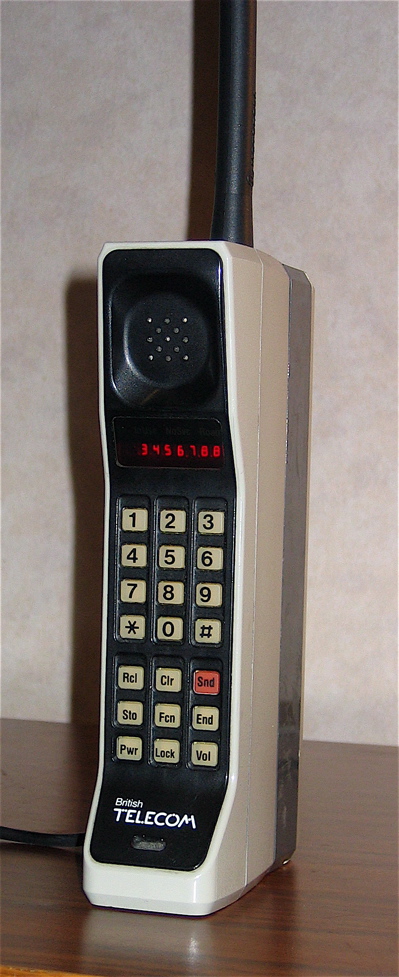
When I was a kid, every phone was a land line. I remember when the first cell phones became available for public purchase in the eighties, they were huge by today’s standards. It was given that they would gradually become smaller and smaller, and more and more removed from what we originally thought of when we heard the word “telephone.” In addition to this, with the development of 3 and eventually 4 G technology, cell phones began to be used for stuff that had little to do with basic voice communication. I purchased my first cell phone in Arizona back in the early noughties. It was basically a portable phone—much smaller than the original Motorola pictured above, but not fundamentally different in terms of it’s basic function. It was used for making phone calls. This was also true of the first cell phone I had in China. In fact, my first mobile phone was not actually a cell phone. It was called a “Little Smartie,” and used a technology first developed by the Japanese, whereby the phone would tie into local phone connections, and functioned basically as a roving wireless phone very much like the cordless receivers that became popular in America right before cell phones came into common use. The main difference was that with a cordless, you could walk out into the back yard and keep talking on the phone, but you were actually connected not to a cell tower, but to your own phone system. The Little Smartie had a way of allowing you to connect to each local phone system as you walked by it. It was clever technology, but was abandoned by the Japanese and had a relatively short life in China because it was so dependant on local phone systems rather than cell towers. With 3 and 4G phones came the development of cell phones that facilitated social networking. In today’s China, I have maybe a handful of conversations that use the regular phone system, and most of those are calls from people I know outside of China. Within China, I don’t know any of my friends’ phone numbers, and I never use the regular phone system to communicate with them. It is giant leap from Bell’s original invention, yet tied to it by history.
I once heard that the Bell telephone company had some 400 law suits defending Bell’s invention. They won every one of them. Why? Because patents work. It was his invention, and he had a right to profit from it.
What is the future of phone conversation? What is the next great communication innovation? I suppose it would be universal mobile connection to the Internet, particularly if low orbit satellites become the standard. When this happens, countries like China, where the government believes it has the right and responsibility to govern what people are allowed to see, will no longer be able to restrict access to the Internet. That is the future—not sure if I like it or not. I have often said that the two most ignorant groups of young people I encounter are Chinese young people and American young people. Chinese young people are ignorant because they always have only half the story (if that)—the half the Party wants them to have. And Americans are ignorant because they have very independent ideas, but precious little truly important information. So American young people are drowning in information, but not better informed.
Labels: Communication, Technology
Thursday, February 27, 2014
Code Monkeys and Network Junkies
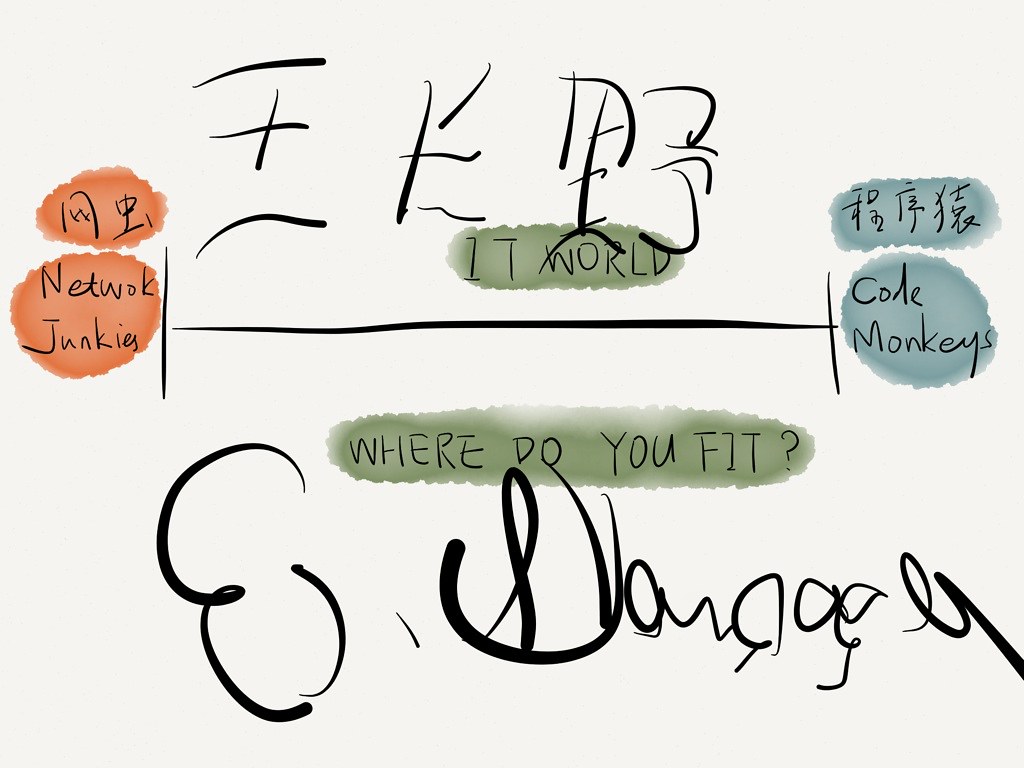 Jacky was so fascinated with our discussion that he pulled out his iPad and copied my sketch of the spectrum and then had me sign it. Zhou Tao is a computer science major, and seems quite able to function in either world. But some software people tend to be more intensely focussed on one particular skill area. And some simply don't know. I remember once talking to one of my networking students in Arizona who was very unhappy. I asked him a few questions and found out he had a Masters degree in material science. I asked him why he wasn't doing that. He told me that field wasn't very open at the moment. Then I asked him a few questions about the skills he already had, and found out he was a VB programmer. I said, "I don't think you belong at this university." He was surprised. I said, "Why don't you do application development?" He wasn't too sure about the field, so I explained to him that database application developers are involved with developing the front end of database. After talking for a few minutes, he said he would give it some thought. He went out and found a job nearby almost immediately and dropped out of school. I am not one to encourage students to drop out of school, but in his case, school was a waste of money. He already had marketable skills and he obviously didn't need the sheepskin. I used to run into him once in awhile after that. Every time he saw me he said, "You changed my life!" I didn't change his life. He changed his life. I just helped him to discover where he fit on the spectrum.
Labels: Technology
Monday, November 30, 2009
Oracle Testing System
In the fall semester I teach two sections with about eighty students in each section. The key to faciltating learning in this type of situation, is to evaluate frequently, and give fairly immedate feedback. I am using a text book with twenty review questions at the end of each chapter. If I have the students turn it in on paper, it is too easy for a group of students to each do a few questions, and then combine their work. But if I make it a blind test, I am requiring too high a level of memorization to be practical every week. So what I do is to tell them they are going to have a test, invite them to study the questions all week, and then take the test online without the benefit of the book. This effectively makes it a worksheet they have to memorize.
In a given semester, I give ten chapter tests. With 80 students in two sections each taking 10 tests with 20 questions each, that comes to 32,000 separate answers for my TA's to check in one semester (not counting the mid-term and the final). But that is only half the problem. Data entry for 160 students is a tedious process that lends itself to error. Students sometimes have numbers that are very similar. The last few digits might be the same, but the first few would be different. I am not good at this kind of work. And if I make one little mistake, I often have to start all over. My TA's can do this work for me, but I have no way of checking whether they have entered the grades accurately. Even if the papers were all graded by computer, the data entry process is a nightmare. Needless to say, I have to have a computerized system in order to do this effectively.
When I first came to Beijing, I was using a free online testing system that I had employed when I was in Arizona. But a couple years ago, this company announced that their testing system was no longer going to be free. They left the .html files in a special location on their website, but the database was no longer available. So when students took the test, I would get an email with their answers. But there was no longer any automatic scoring system. I had to have my TA's go through each test and compare the student's answers to the key. Fortunately, I had one TA who was a very fast and efficient young lady. She could check through a bunch of tests in a very short period. The other TA didn't like doing this. So he spent his time designing a program in C# that would read the emails, check the tests, and give the students a score. Using this program, it took me seconds to check all the tests. But the other thing he did, which saved my neck, was that he copied all the .html files for the tests, and went to work to develop a system that could function entirely independent of the Internet. Unfortunately, he had some stuff to do, so he left in the middle of the semester, and recruited another student to take his place.
Last year, just before the fall semester was going to start, I discovered that the online testing system had discarded all the .html files. Fortunately I had all the files that Titan had copied, and one of my new TA's was a good friend of his. Justin went to work right away to finish the program that Titan had started. What we have now is not really completed software. It is software in development, but it gets the job done.
Click picture for larger image.
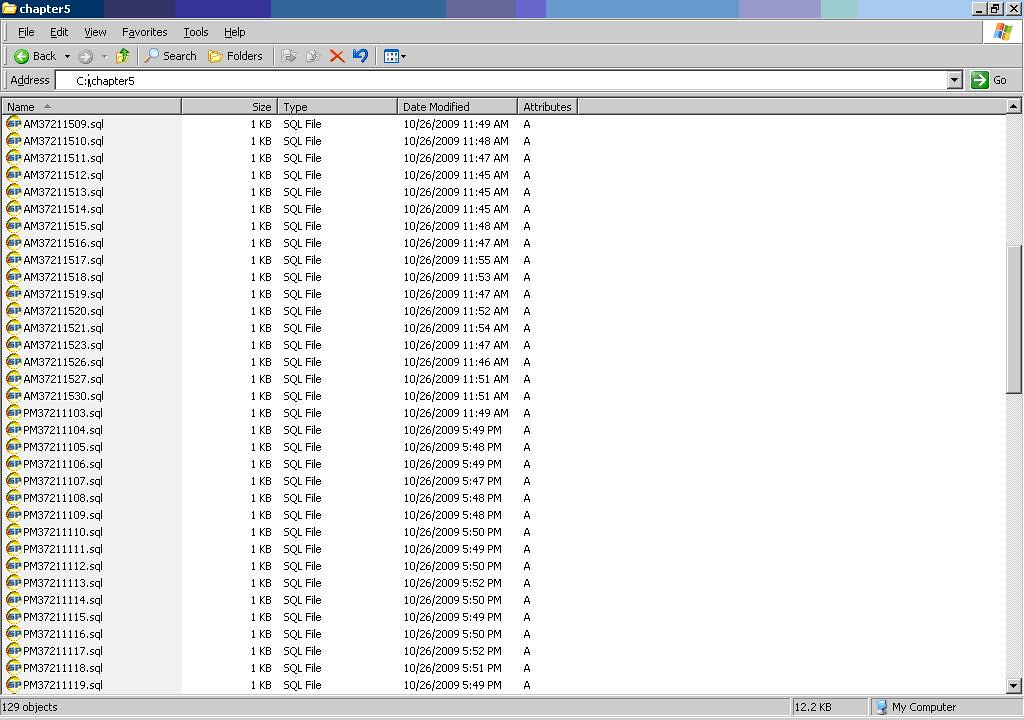 The students go to a private intranet web site on my server and take an objective test by clicking on the radio buttons. When they submit the test, the testing system that Titan and Justin built creates a .sql file with their score. Titan was worried about possible concurrency problems (a file being locked and the system crashing if two students submit at exactly the same time) if the results were entered into a single file, so Justin set it up so that I get a separate file for each student. When I open the file, I see a statment that looks like this:
update gradesheet set CHAP_05 = 85 where student_id= 'AM37211406';
This statement, when run, enters the student's score in the database. They were apologetic about having to create separate files for each student, but I told them it was a non-issue. I simply created a master file called loadscores.sql that calls the other files. When you open it, here is what you see:
@@AM37211404
@@AM37211405
@@AM37211406
@@AM37211407
@@AM37211423
@@AM37211408
@@AM37211409
So I call that one file from the database, and that file calls the others. This process takes about 3 to 5 seconds. Actually, it's closer to ten seconds if I run both classes at the same time. I spool the output to a .doc file so that I can check the results of this process. If a student is absent, I can tell right away, because their is no file for them. So the tests are scored by the system as soon as the tests are submitted, and the data is entered with I run the loadsores script. Less than ten seconds to have all the data in the database. The only thing on paper is the final exam. I give ten chapter review tests, and the mid-term in the lab using my automated system. At the end of the semester, I use Structured Query Language to create a view that subtracts the lowest score for each student (I don't allow makeup tests, so this effectively allows each student to miss one test without penalty), and gives them a grade based on the remaining 9 tests, the midterm, and the final exam. Here is what the SQL code for my final report view looks like:
create or replace view sqlreport as
with labgrades as
(select student_id, sum(score) LabTotal, min(score) Lowest
from sqlrecords group by student_id)
select student_id, labtotal, points bonus, labtotal+points Total,
lowest,
(labtotal+points)-lowest NetScore,
round(((labtotal+points)-lowest)/9) labavg, midterm, final_exam,
round(((((labtotal+points)-lowest)/9)*.5)+(midterm * .2)+(final_exam * .3)) Final_grade
from labgrades natural join bonus natural join gradesheet
order by student_id
This takes care of my end of it. But, as I mentioned previously, the most vital component of this system in rapid feedback. If students get constant feedback about their progress, they will do much better than if they are left to guess how well they are doing. What I do to facilitate this,is to create a user for each student, then create a view in each user's schema that will allow them to see their own grades at any time. I have the students register by entering their own data in the database at the beginning of each semester. Then I copy this list from the database to Excel, and use Excel to write repetitive statements to make a script that creates the users and views. This takes about 10 or 15 minutes at the beginning of the semester, and I usually do it in front of the class so that they can see how the process works. When I run this script, the users are created, given the needed permissions, and a view is created for each of them. When the log in and execute the code to look at the view, this is what they see:
SQL> select * from mygrades;
STUDENT_ID GRADE_ITEM SCORE
------------ ---------------- ----------
AM37211### Bonus Points 60
AM37211### Chapter Two 75
AM37211### Chapter Three 70
AM37211### Chapter Four 85
AM37211### Chapter Five 85
AM37211### Chapter Six 100
AM37211### Chapter Seven 95
7 rows selected.
SQL>
Every class period, I give students a chance to earn bonus points by doing hands on exercises in front of the class. They are hesitant to volunteer at first, but when they see the effect of the bonus points, they soon get bold enough to take the opportunity to improve their score.
After I had implemented this system last year, Alina observed that we there were fewer students in the room at test time than the number of tests would indicate. I told her that she would have to require the students to sign in so that only students who actually who had come and taken the test themselves would be given credit. But Justin told me he could fix the problem. He added a feature that creates an answer file for each student named by the MAC (Media Access Control) address and IP (Internet Protocol) address of each computer. If a student tried to take a test twice, the presence of the answer file from the previous test would block submission, and the student would get an error message:
Some clever students discovered that they could change the IP address and submit another test. But they were not clever enough to realize that the minute they did that, they would have red dye all over their hands. Here is what the results of that mischief looks like (the student_id's have been partially masked to protect the guilty):
50-63-1C-15-D0-B9_192.168.0.189_36211###.txt 12/17/2008 5:35 PM
50-63-1C-15-D0-B9_192.168.0.178_36211###.txt 12/17/2008 5:36 PM
50-63-1C-15-D0-B9_192.168.0.179_36211###.txt 12/17/2008 5:36 PM
You can see that all three tests were taken from the same computer (note the MAC address), but that the IP address has been changed so that the test could be submitted three times. I put the corresponding test scripts in a separate folder so that they would not upload, effectively giving all three students a 0 for that test. The student who had actually taken the test came to me and complained. I showed him the results. He insisted that this must be three separate people who couldn't find a free computer, so they had to change the IP address. I then pointed out the times to him. Not enough time for three separate people to take three separate tests. Just enough time for one person to copy the answers from his test to two others, change the IP address, and submit them separately. He finally admitted that his classmates didn't come that day, so he had taken the test for them. He conceded that they should not get a grade for the test, but he insisted that he was entitled to a grade, since he was the one who had actually taken the test. I disagreed.
| STUDENT_ID | LABTOTAL | BONUS | TOTAL | LOWEST | NETSCORE | LABAVG | MIDTERM | FINAL_EXAM | FINAL_GRADE |
|---|---|---|---|---|---|---|---|---|---|
| AM35211*** | 300 | 0 | 300 | 0 | 300 | 50 | 90 | 38 | 53 |
| AM36211*** | 270 | 0 | 270 | 0 | 270 | 45 | 60 | 53 | 51 |
| AM37211*** | 540 | 0 | 540 | 0 | 540 | 90 | 90 | 68 | 81 |
| AM37211*** | 525 | 0 | 525 | 0 | 525 | 88 | 100 | 63 | 80 |
| AM37211*** | 530 | 0 | 530 | 0 | 530 | 88 | 100 | 82 | 88 |
| AM37211*** | 450 | 0 | 450 | 0 | 450 | 75 | 93 | 92 | 85 |
| AM37211*** | 435 | 0 | 435 | 0 | 435 | 73 | 93 | 77 | 78 |
| AM37211*** | 440 | 0 | 440 | 0 | 440 | 73 | 93 | 78 | 79 |
| AM37211*** | 515 | 0 | 515 | 0 | 515 | 86 | 93 | 52 | 74 |
| AM37211*** | 435 | 0 | 435 | 0 | 435 | 73 | 93 | 83 | 81 |
| AM37211*** | 370 | 0 | 370 | 0 | 370 | 62 | 70 | 68 | 66 |
| AM37211*** | 510 | 0 | 510 | 0 | 510 | 85 | 93 | 62 | 77 |
| AM37211*** | 435 | 20 | 455 | 20 | 435 | 62 | 43 | 58 | 57 |
| AM37211*** | 520 | 10 | 530 | 0 | 530 | 76 | 93 | 79 | 80 |
| AM37211*** | 525 | 0 | 525 | 0 | 525 | 88 | 93 | 67 | 80 |
| AM37211*** | 400 | 0 | 400 | 0 | 400 | 67 | 93 | 77 | 76 |
| AM37211*** | 420 | 0 | 420 | 0 | 420 | 70 | 93 | 50 | 67 |
| AM37211*** | 340 | 0 | 340 | 0 | 340 | 57 | 93 | 90 | 77 |
| AM37211*** | 170 | 0 | 170 | 0 | 170 | 28 | 93 | 82 | 63 |
| AM37211*** | 380 | 0 | 380 | 0 | 380 | 63 | 93 | 93 | 81 |
| AM37211*** | 300 | 0 | 300 | 0 | 300 | 50 | 0 | 52 | 41 |
| AM37211*** | 375 | 0 | 375 | 0 | 375 | 63 | 93 | 53 | 65 |
| AM37211*** | 0 | 0 | 0 | 0 | 0 | 0 | 0 | 32 | 13 |
| AM37211*** | 250 | 20 | 270 | 0 | 270 | 45 | 66 | 83 | 64 |
| AM37211*** | 380 | 0 | 380 | 0 | 380 | 63 | 90 | 78 | 75 |
| AM37211*** | 375 | 0 | 375 | 0 | 375 | 54 | 93 | 42 | 57 |
| AM37211*** | 415 | 0 | 415 | 0 | 415 | 69 | 90 | 73 | 75 |
| AM37211*** | 500 | 0 | 500 | 0 | 500 | 83 | 100 | 82 | 86 |
| AM37211*** | 530 | 0 | 530 | 0 | 530 | 88 | 96 | 88 | 90 |
| AM37211*** | 550 | 10 | 560 | 10 | 550 | 92 | 100 | 85 | 91 |
| AM37211*** | 505 | 0 | 505 | 0 | 505 | 84 | 100 | 80 | 86 |
| AM37211*** | 535 | 10 | 545 | 10 | 535 | 89 | 96 | 82 | 88 |
| AM37211*** | 530 | 0 | 530 | 0 | 530 | 88 | 100 | 70 | 83 |
| AM37211*** | 647 | 92 | 739 | 90 | 649 | 108 | 100 | 85 | 97 |
| AM37211*** | 495 | 0 | 495 | 0 | 495 | 83 | 96 | 78 | 83 |
| AM37211*** | 550 | 0 | 550 | 0 | 550 | 92 | 100 | 76 | 87 |
| AM37211*** | 525 | 0 | 525 | 0 | 525 | 88 | 100 | 73 | 84 |
| AM37211*** | 575 | 0 | 575 | 0 | 575 | 96 | 100 | 98 | 98 |
| AM37211*** | 540 | 0 | 540 | 0 | 540 | 90 | 93 | 60 | 79 |
| AM37211*** | 555 | 0 | 555 | 0 | 555 | 93 | 93 | 57 | 78 |
| AM37211*** | 565 | 0 | 565 | 0 | 565 | 94 | 93 | 57 | 79 |
| AM37211*** | 550 | 10 | 560 | 10 | 550 | 92 | 93 | 82 | 88 |
| AM37211*** | 570 | 30 | 600 | 30 | 570 | 95 | 100 | 97 | 97 |
| AM37211*** | 535 | 0 | 535 | 0 | 535 | 89 | 96 | 73 | 84 |
| AM37211*** | 555 | 20 | 575 | 20 | 555 | 93 | 93 | 92 | 92 |
| AM37211*** | 595 | 40 | 635 | 40 | 595 | 99 | 100 | 90 | 96 |
| AM37211*** | 480 | 0 | 480 | 0 | 480 | 80 | 93 | 88 | 86 |
| AM37211*** | 570 | 50 | 620 | 50 | 570 | 95 | 100 | 88 | 93 |
| AM37211*** | 340 | 0 | 340 | 0 | 340 | 49 | 53 | 63 | 55 |
| AM37211*** | 600 | 60 | 660 | 60 | 600 | 100 | 100 | 97 | 99 |
| AM37211*** | 0 | 0 | 0 | 0 | 0 | 0 | 86 | 50 | 37 |
| AM37211*** | 525 | 10 | 535 | 10 | 525 | 88 | 96 | 88 | 89 |
| AM37211*** | 140 | 0 | 140 | 0 | 140 | 23 | 96 | 81 | 61 |
| AM37211*** | 445 | 0 | 445 | 0 | 445 | 74 | 100 | 62 | 74 |
| AM37211*** | 505 | 0 | 505 | 0 | 505 | 84 | 96 | 67 | 80 |
| AM56000*** | 140 | 0 | 140 | 0 | 140 | 23 | 93 | 82 | 61 |
| AM56000*** | 495 | 0 | 495 | 0 | 495 | 83 | 90 | 77 | 82 |
| PM31415*** | 0 | 0 | 0 | 0 | 0 | 0 | 0 | 0 | 0 |
| PM35211*** | 0 | 0 | 0 | 0 | 0 | 0 | 0 | 0 | 0 |
| PM36211*** | 470 | 0 | 470 | 0 | 470 | 78 | 100 | 57 | 74 |
| PM36211*** | 195 | 0 | 195 | 0 | 195 | 33 | 96 | 73 | 61 |
| PM37211*** | 550 | 0 | 550 | 0 | 550 | 92 | 100 | 97 | 95 |
| PM37211*** | 525 | 0 | 525 | 0 | 525 | 88 | 100 | 95 | 93 |
| PM37211*** | 540 | 10 | 550 | 10 | 540 | 90 | 100 | 97 | 95 |
| PM37211*** | 580 | 20 | 600 | 20 | 580 | 97 | 100 | 91 | 95 |
| PM37211*** | 495 | 0 | 495 | 0 | 495 | 83 | 80 | 75 | 79 |
| PM37211*** | 485 | 0 | 485 | 0 | 485 | 81 | 100 | 52 | 73 |
| PM37211*** | 410 | 0 | 410 | 0 | 410 | 68 | 83 | 77 | 75 |
| PM37211*** | 545 | 0 | 545 | 0 | 545 | 91 | 83 | 78 | 84 |
| PM37211*** | 520 | 0 | 520 | 0 | 520 | 87 | 83 | 68 | 78 |
| PM37211*** | 470 | 0 | 470 | 0 | 470 | 78 | 100 | 75 | 81 |
| PM37211*** | 475 | 0 | 475 | 0 | 475 | 79 | 96 | 83 | 84 |
| PM37211*** | 545 | 10 | 555 | 10 | 545 | 91 | 100 | 82 | 89 |
| PM37211*** | 480 | 0 | 480 | 0 | 480 | 80 | 96 | 72 | 80 |
| PM37211*** | 480 | 0 | 480 | 0 | 480 | 80 | 100 | 43 | 69 |
| PM37211*** | 545 | 0 | 545 | 0 | 545 | 91 | 100 | 82 | 89 |
| PM37211*** | 465 | 0 | 465 | 0 | 465 | 78 | 100 | 79 | 83 |
| PM37211*** | 470 | 0 | 470 | 0 | 470 | 78 | 100 | 87 | 86 |
| PM37211*** | 430 | 0 | 430 | 0 | 430 | 72 | 100 | 79 | 80 |
| PM37211*** | 500 | 0 | 500 | 0 | 500 | 83 | 93 | 70 | 80 |
| PM37211*** | 475 | 0 | 475 | 0 | 475 | 79 | 96 | 80 | 83 |
| PM37211*** | 430 | 0 | 430 | 0 | 430 | 72 | 93 | 82 | 80 |
| PM37211*** | 495 | 0 | 495 | 0 | 495 | 83 | 100 | 43 | 70 |
| PM37211*** | 470 | 0 | 470 | 0 | 470 | 78 | 100 | 72 | 80 |
| PM37211*** | 480 | 0 | 480 | 0 | 480 | 80 | 100 | 53 | 73 |
| PM37211*** | 435 | 0 | 435 | 0 | 435 | 73 | 100 | 57 | 72 |
| PM37211*** | 395 | 0 | 395 | 0 | 395 | 56 | 43 | 77 | 62 |
| PM37211*** | 515 | 0 | 515 | 0 | 515 | 86 | 100 | 62 | 79 |
| PM37211*** | 515 | 0 | 515 | 0 | 515 | 86 | 100 | 85 | 88 |
| PM37211*** | 415 | 0 | 415 | 0 | 415 | 59 | 100 | 91 | 80 |
| PM37211*** | 545 | 20 | 565 | 20 | 545 | 91 | 100 | 97 | 95 |
| PM37211*** | 565 | 0 | 565 | 0 | 565 | 94 | 96 | 78 | 88 |
| PM37211*** | 570 | 0 | 570 | 0 | 570 | 95 | 100 | 95 | 96 |
| PM37211*** | 430 | 0 | 430 | 0 | 430 | 72 | 43 | 68 | 64 |
| PM37211*** | 565 | 0 | 565 | 0 | 565 | 94 | 100 | 70 | 86 |
| PM37211*** | 555 | 0 | 555 | 0 | 555 | 93 | 96 | 69 | 84 |
| PM37211*** | 500 | 0 | 500 | 0 | 500 | 83 | 73 | 90 | 84 |
| PM37211*** | 555 | 0 | 555 | 0 | 555 | 93 | 96 | 90 | 92 |
| PM37211*** | 555 | 10 | 565 | 10 | 555 | 93 | 100 | 85 | 91 |
| PM37211*** | 125 | 0 | 125 | 0 | 125 | 21 | 50 | 54 | 40 |
| PM37211*** | 115 | 0 | 115 | 0 | 115 | 19 | 90 | 67 | 52 |
| PM37211*** | 430 | 0 | 430 | 0 | 430 | 72 | 63 | 49 | 61 |
| PM37211*** | 730 | 165 | 895 | 90 | 805 | 134 | 100 | 97 | 100 |
| PM37211*** | 430 | 10 | 440 | 0 | 440 | 73 | 80 | 83 | 79 |
| PM37211*** | 535 | 0 | 535 | 0 | 535 | 89 | 96 | 83 | 88 |
| PM37211*** | 550 | 10 | 560 | 10 | 550 | 92 | 96 | 88 | 91 |
| PM37211*** | 813 | 198 | 1011 | 65 | 946 | 135 | 93 | 92 | 100 |
| PM37211*** | 540 | 0 | 540 | 0 | 540 | 90 | 96 | 87 | 90 |
| PM37211*** | 570 | 0 | 570 | 0 | 570 | 95 | 100 | 90 | 94 |
| PM37211*** | 430 | 0 | 430 | 0 | 430 | 72 | 73 | 48 | 62 |
| PM37211*** | 470 | 0 | 470 | 0 | 470 | 78 | 93 | 89 | 86 |
| PM37211*** | 570 | 0 | 570 | 0 | 570 | 95 | 96 | 82 | 90 |
| PM37211*** | 350 | 0 | 350 | 0 | 350 | 58 | 90 | 47 | 60 |
| PM37211*** | 535 | 0 | 535 | 0 | 535 | 89 | 93 | 87 | 89 |
| PM37211*** | 280 | 0 | 280 | 0 | 280 | 47 | 90 | 62 | 61 |
| PM37211*** | 575 | 50 | 625 | 50 | 575 | 96 | 96 | 95 | 96 |
| PM37211*** | 570 | 0 | 570 | 0 | 570 | 95 | 100 | 80 | 90 |
| PM37211*** | 590 | 30 | 620 | 30 | 590 | 98 | 100 | 68 | 87 |
| PM37211*** | 615 | 50 | 665 | 50 | 615 | 103 | 93 | 93 | 97 |
| PM37211*** | 580 | 30 | 610 | 30 | 580 | 97 | 100 | 100 | 99 |
| PM37211*** | 550 | 0 | 550 | 0 | 550 | 92 | 100 | 65 | 83 |
| PM37211*** | 490 | 0 | 490 | 0 | 490 | 82 | 96 | 63 | 77 |
| PM37211*** | 590 | 40 | 630 | 40 | 590 | 98 | 100 | 97 | 98 |
| PM37211*** | 600 | 50 | 650 | 50 | 600 | 100 | 100 | 93 | 97 |
| PM37211*** | 585 | 20 | 605 | 20 | 585 | 98 | 96 | 87 | 93 |
| PM37211*** | 500 | 0 | 500 | 0 | 500 | 83 | 93 | 45 | 70 |
| PM37211*** | 540 | 0 | 540 | 0 | 540 | 90 | 100 | 47 | 75 |
| PM37211*** | 100 | 0 | 100 | 0 | 100 | 17 | 0 | 0 | 7 |
| PM37211*** | 560 | 20 | 580 | 20 | 560 | 93 | 93 | 88 | 91 |
| PM37211*** | 480 | 60 | 540 | 35 | 505 | 84 | 100 | 82 | 86 |
| PM37211*** | 597 | 62 | 659 | 62 | 597 | 100 | 93 | 97 | 97 |
| PM37211*** | 505 | 0 | 505 | 0 | 505 | 84 | 96 | 83 | 86 |
| PM37211*** | 525 | 0 | 525 | 0 | 525 | 88 | 90 | 92 | 90 |
| PM37211*** | 705 | 175 | 880 | 75 | 805 | 134 | 100 | 98 | 100 |
| PM37211*** | 550 | 0 | 550 | 0 | 550 | 92 | 96 | 83 | 89 |
| PM37211*** | 535 | 70 | 605 | 50 | 555 | 93 | 100 | 92 | 94 |
| PM37211*** | 420 | 0 | 420 | 0 | 420 | 70 | 96 | 84 | 81 |
| PM37211*** | 590 | 50 | 640 | 50 | 590 | 84 | 93 | 88 | 88 |
| PM37211*** | 550 | 10 | 560 | 10 | 550 | 92 | 93 | 78 | 86 |
| PM37211*** | 435 | 0 | 435 | 0 | 435 | 73 | 96 | 73 | 77 |
| PM37211*** | 300 | 0 | 300 | 0 | 300 | 50 | 90 | 69 | 66 |
| PM37211*** | 475 | 0 | 475 | 0 | 475 | 79 | 90 | 88 | 85 |
| PM37211*** | 645 | 65 | 710 | 65 | 645 | 108 | 96 | 88 | 97 |
| PM37211*** | 410 | 0 | 410 | 0 | 410 | 68 | 93 | 70 | 74 |
| PM56000*** | 485 | 0 | 485 | 0 | 485 | 81 | 36 | 67 | 66 |
| PM56000*** | 505 | 0 | 505 | 0 | 505 | 84 | 90 | 73 | 81 |
| PM56000*** | 520 | 0 | 520 | 0 | 520 | 87 | 93 | 72 | 82 |
Labels: Technology
Tuesday, May 19, 2009
Communications Revolution
As I look back over my life, and compare the Asia of my childhood to the Asia I live in today, perhaps the most significant difference is the phenomenal revolution in communication, and the availability of information.
This podcast episode is basically an explanation of how IP works, and how that differs from conventional radio signals, especially short wave, which was the radio of my childhood in Japan.
Labels: Communication, Japan, Technology
