Links
- CV
- Titles
- Topics
- Tickets
- Science
- About Eric
- Book Reviews
- Country Profile
- Modern China
- Contact Eric
- Podcast
- Vision
- Sekai
- John
Archives
RSS

Reflections on a Wandering Life.....
Wednesday, January 30, 2019
Japan in the Sixties
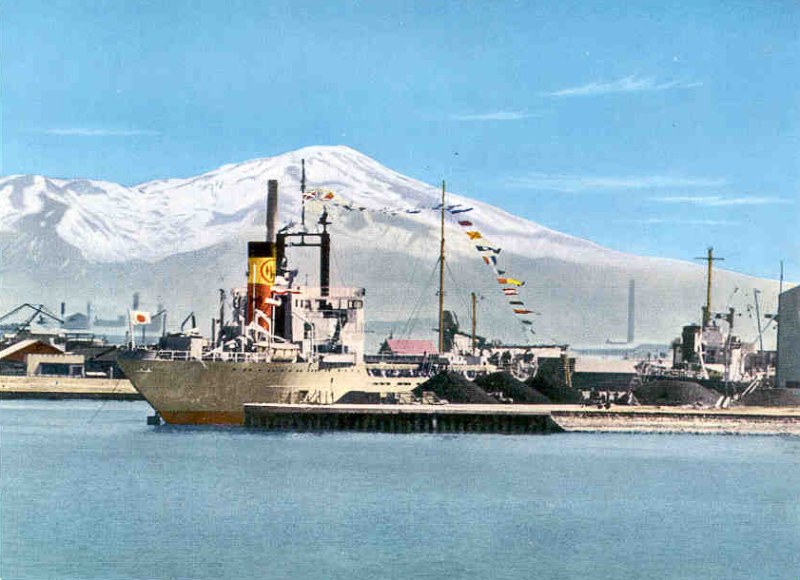
Mt. Chokai
The video below begins with my parents' wedding in June of 1948 and then jumps to the early sixties in northern Japan where I grew up.
In the days that followed World War II the field of operations for various missions was set out. I am not sure who made these decisions, but the Norwegian-Americans were assigned the northern part of the main island (Honshu). Northern Japan was a third world country in those days, and it might have been considered the worst possible place to be sent. But it really fit Norwegian-Americans, because in many cases it was not more primitive than what they, as farm kids from the upper Midwest had grown up with.
But Japan was not the American Midwest. It was very much a pagan culture, and the cultural contrast took its toll. Most the the original missionaries who went out with my parents during the earlier fifties quit soon afterward. What had began as a major thrust (in response to General MacArthur's call for 10 thousand Protestant missionaries) dwindled to a few families. The adjustment was just too much for most people. As a kid I had no comprehension of this. For a child, the gentle countryside of Northern Japan was Heaven.
 Japanese people tend to be indulgent toward children, sometimes to the point of absurdity, but you can bet we took full advantage of it. We loved Japan. Like the adults, we also went through a very difficult cultural adjustment. But it was the reverse of our parents. For us, it happened when we "returned" to the United States, a country of which we were citizens, but a country in which we found it very difficult to feel at home.
But even though we liked Japan, were were not really Japanese, so education was always an issue. Some of the American missionaries in the countryside sent their kids to Japanese schools because they did not want to send them away from home. They could come home every day. But, of course, there were things they missed in their schooling, which was designed for Japanese people. So some missionaries sent their children down to Tokyo to go to an international school. A good idea academically, but being so far from home, children were only able to come home for Thanksgiving, Christmas, and Easter.
The mission my parents were with found a compromise. They had a small school for children that operated very much like the one-room country schools they had attended as children in North Dakota and Minnesota, and then they sent their children to Tokyo for high school.
One of the best things Dad did when we returned to the field in 1961 after an extended furlough in North Dakota, was to buy a Bell & Howell movie camera. The camera you see pictured here is not Dad's. It is the camera used to film the Zapruder film (assassination of JFK). It is now held in the National Archives.
Although that took place in 1963 and Dad bought his camera in 1961, Dad's camera was actually a slightly newer version of this. I don't have a picture of it, but it looks exactly like this one, only newer. Perhaps it would seem primitive by today's standards, but it was really a pretty impressive machine. The 8mm camera was actually a modified 16 millimeter. It used 16 millimeter film. You would thread the film in the camera, run it through, then find a dark place, open the camera, turn the film over, thread it, and run it through again. Combine this ingenious device with Japanese color film, and you have a pretty good picture, with one caviat. It takes much more light to get a proper exposure on film than with digital. So anything shot inside would tend to be dark unless you had pretty powerful flood lights. But outside, the quality was pretty impressive for the time
Click for larger image.
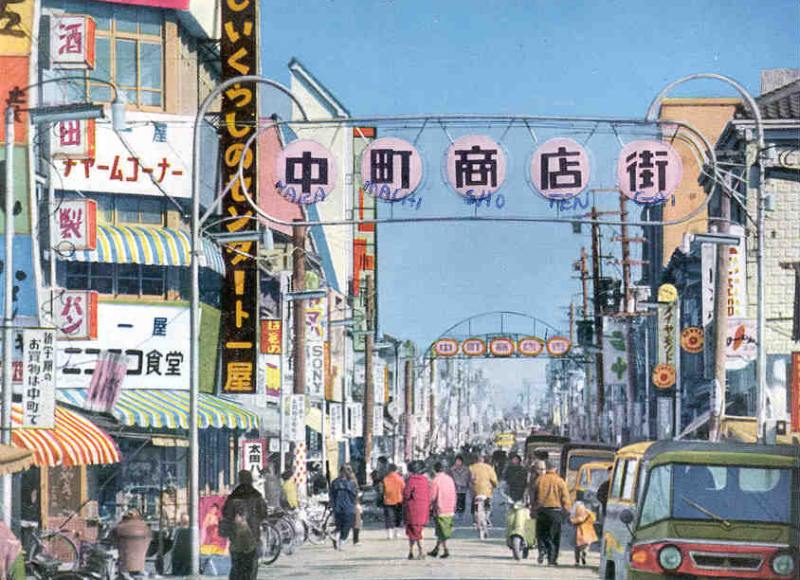 The video starts in Sakata (after the wedding). It then moves to the school in Akita, and then back and forth between the two, and includes a few scenes from our small farm in Honjo. There is nothing here from Nojiri for some reason. In the field day segment, you can see an amusing scene of me trying to bat right-handed. Apparently the grownups did not realize that I was a southpaw. There was no way I was going to hit that ball. Not then, not now, not in a million years.
The little vignette of settlers traveling across the prairie in their covered wagon was Johnny's brainchild. He directed that segment, which was filmed in Sakata. Costumes were a problem. Pretty hard to find cowboy hats in Japan. But we found some straw hats in the market that were the next best thing. Use your imagination. We brave the wilderness all day long, crossing all kinds of terrain in our journey to the west. At night, we wearily build our campfire and prepare to rest for the night. Suddenly, Johnny sees an arrow. Indians! We hit the ground and start shooting at the Indians from under the covered wagon. Not exactly politically correct by today's standards, but if you watched television in the fifties and sixties, it was a pretty standard scene.
There is brief footage from the Navy base in Sakata. During the first term, this was an Air Force base. At that time, Dad was actually on the payroll of the US Air Force as an auxiliary chaplain. I am not sure when the Navy took it over, but the second term (until we moved to Honjo) it was run by the Navy. Dad was not on the payroll, but the Church in Sakata he had worked with so much the first term had a Japanese pastor, so Dad and the other missionary, who was Morris Larson at the time, took turns preaching at the Navy chapel. Larsons then got involved in Tsuruoka at some point...can't remember just how that came about. Anyway, the irony of the whole thing is that even though we lived in the countryside of Japan where nobody spoke English, I spent many Sundays in the chapel at the Navy base listening to Dad preach in English.
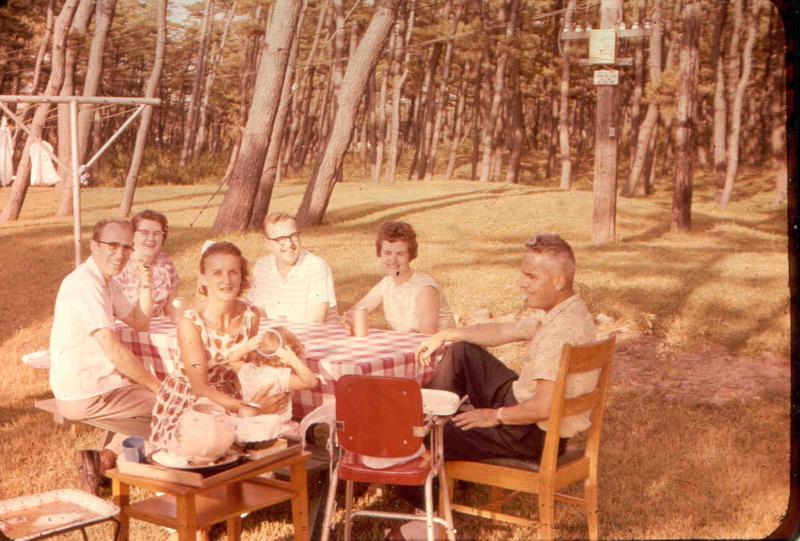 Above you can see a street scene of Nakamachi (from the old Sakatavets website)
taken near the old mission house in Sakata. In this picture to the right, you can see Larsons and Mom and Dad having a backyard dinner at the Navy base with one of the officers (also from the Sakatavets website). I thought at first that it was Lt. Michaels, but it comes from the photo collection of a different officer, and the child appears to be a good bit younger than Shelley. Anyway, you can see both Lt. Michaels and his wife (and Shelley) in the video, so take a look and decide for yourself. We also went to the Navy base at other times. I remember a baseball game there once, and also a Halloween party and once or twice we were there for a Fourth of July celebration. But the Navy base closed down and left town and we moved to Honjo, so those days have passed into history, only to be remembered.
Just before we left for the States in 1967, I gathered a bunch of the 8mm film reels that had survived the Honjo fire, got a pair of scissors and some scotch tape, and spliced them together to make one film that was about 30 minutes long. After we got to the States, Dad had gotten a Nikon and had lost interest in the old Bell & Howell. But I was fascinated with it, so the scenes in Fergus Falls were filmed by me. There is also brief footage of the Langager Family Reunion in 1971, which was at Lloyd Langager's place in Tioga. At the tail end is some stuff that looks like it was filmed at Mary's place in Eastern Oregon. No idea who did that.
In preparation for Mom and Dad's 40th wedding anniversary, Anne Marie or somebody took all those videos and had them digitized into this one story. I should note that there is one anachronism. My sister(s) inserted an video from the fifties. I guess they thought that was the building of the house in Honjo, but in fact, it was the building of the church in Sakata. Fortuitous mistake, actually, because that little bit of history never would have seen the light of day. You will spot it right away, because it is an island of black and white in an ocean of Sakura color. I would guess that it was filmed by Morris Werdahl, because I'm pretty sure that's one of his daughters in the video. By the way, the video does have audio, but it is delayed a few seconds
Thursday, April 15, 2004

Commander Burns
Well, I think I am finding the balance for the freshmen in Langfang. I am supposed to be teaching them Technical English, but the whole idea of the class is to help them feel comfortable speaking English, and they just don't get very conversational about technology. This week I wrote another essay for them. Wonder if Mel remembers this one:
-------------------------
It was late in the fall of 1961 or early in ‘62. We were living in the city of Sakata, Japan. We were only there on weekends, because during the week we attended a boarding school in another city about 60 miles away. We went to school on Tuesday morning, and came back on Saturday afternoon.
I remember one Monday morning we were sitting around the house waiting for the day to get started, when there was a knock on the door. It was the Commander of the local United States Navy base in Sakata. His name was Burns. Commander William Burns. He had dropped by to see if my two sisters wanted to go with him to his house to play with his two daughters. Mary was about nine then—she made the decision rather quickly. But Melody was much more hesitant. Mel was six. I could tell that she really wanted to go, but she wasn’t quite sure if she should. My parents asked her several times if she wanted to go, but she couldn’t seem to make up her mind. Finally she decided to play it safe, and chose to stay.
Well, the moment Mary left with Commander Burns, I could tell that Mel was regretting her decision. She had made the choice herself; nobody pushed her one way or the other. Still, there are times when you make a decision that you don’t really like because you can’t find within yourself the strength to make the decision that you would prefer to make if you could be sure that everything would turn out right. Somehow the fact that it is your decision doesn’t seem to make you feel any better about it. In fact, I think sometimes it makes you feel worse, because you are kicking yourself for not having enough courage to do what you really wish you could do, but none of that changes the fact that you are just a little more afraid of getting into a situation that you can’t get out of because you made a decision that you can’t change. Anyway, what’s done is done, and Mel soon got about the business of making the best of things.
About an hour and a half later, there was a knock on the door. To our surprise, it was Commander Burns again. He had taken Mary all the way out to the Navy base, and then he had come back to see if Melody didn’t want to reconsider. Well, this time Melody was ready to go. She had had plenty of time to think about what she must be missing, and when the chance came to do things right, she wasn’t going to miss it a second time.
Seize the Day! That’s how the saying goes. But sometimes we just aren’t ready to make the decision when the decision needs to be made. Most of the time, you don’t get a second chance. So what made Commander Burns turn around and come all the way into town to give Melody another shot at the opportunity? We usually don’t think of leadership in those terms. Military commanders are generally evaluated on the basis of how many battles they win, not on how many children they keep happy. But battles are fought and won to make sure that kids have the freedom to be kids. So really, when it comes right down to it, there isn’t that much difference between leadership in battle and leadership in life. Anyway, it is clear that Commander Burns came back because he was concerned about a little girl who wanted to play, but who just didn’t have the courage to make the decision. If he had thought for a moment that she really didn’t want to go, he would never have tried to force the issue. But that was not the case. What she wanted to do was obvious. It was written all over her face. She just needed a little help making the decision. A little time. A little encouragement. A second chance. If Commander Burns had merely been concerned with fulfilling his neighborly duty, he could have called and asked if Mel wanted to go. He could have offered to come and get her. Then my parents would have said, that no, she made her decision, and they didn’t want him to go to all that trouble. That would have fulfilled his gentlemanly obligation, but it wouldn’t have helped Mel.
Commander Burns acted as he did because he really was concerned about a little girl who needed a friend. Burns was a man of responsibility. The Navy base in Sakata was part of the NSGA (Naval Security Group Activity). The function of this base was to monitor the activities of the Soviet Union during the height of the “Cold War.” But on this day, Commander Burns wasn’t thinking about the Soviet Union. He wasn’t thinking of all the men under his charge. He was only thinking about one little girl who needed leadership. The kind of leadership that cares about little girls, not just big wars.
1. How do you think Melody felt when Commander Burns and Mary left the first time?
2. Consider this statement in the third paragraph: “…there are times when you make a decision that you don’t really like because you can’t find within yourself the strength to make the decision that you would prefer to make if you could be sure that everything would turn out right. Have you ever been in a situation like this? How did you feel?
3. What do you think it was that made Melody change her mind? Time, regret, wishing she had another chance…all of these may have been factors. Which do you think was most significant?
4. How do you feel when you have made a decision that you wish you could change?
5. If Mel had gone the first time, do you think she would have been more likely to regret her decision and wish that she had stayed home?
6. Do you think Commander Burns did the right thing to come back? How might things have turned out differently if he had not? What other options did he have? How do you think he arrived at the decision he made?
7. Do you think Commander Burns was a good leader or a poor leader. Should a military officer with this level of responsibility allow himself to be distracted by the childish concerns of a little girl? What weakness, if any, does this demonstrate?
----------------------------------
When I asked them the question about situations where they wanted to do something but were afraid, most of them mentioned their fear about speaking up in an English class. I then asked them how many of them had never had a native speaker for a teacher. Most of them said that I was the first native speaking English teacher they had ever had. One student actually told me that I was the first foreigner he had ever talked to! This, of course, is a real problem, and China is trying very hard to deal with it. Interaction with native speakers at an early age is a very big part of developing the kind of "near native" proficiency that is going to make young people competetive in the market place. There are more English speaking people in Asia than there are in America. English is the international language of trade, and students who are not comfortably conversational will certainly be left behind.
Labels: Sakata
