Links
- CV
- Titles
- Topics
- Tickets
- Science
- About Eric
- Book Reviews
- Country Profile
- Modern China
- Contact Eric
- Podcast
- Vision
- Sekai
- John
Archives
RSS

Reflections on a Wandering Life.....
Saturday, September 27, 2008
Wednesday, September 24, 2008
Some foreigners complain about it, but I actually like the stuff. It's good milk. But the problem is that UHT milk has a shelf life of several months, so if the milk is found to be tainted now, it affects the sale of several months worth of milk Yogurt is different. In China, yogurt is a beverage, and it is kept in the cooler. Still, it's pretty certain that sales of any kind of dairy product will be severely affected by the current crisis.
One has to wonder what kind of sick mind would put poison in milk supplies just because the chemical in question elevates the protein count. But it points to a great weakness in Chinese society. The two brothers involved in the original scandal said that they were very careful not to give their own families any of the milk they had poisoned. "Me and my family against the world." It is quite disturbing to see how prevalent this attitude is among the laobaixing in this country.
But the larger problem is the "old China" way of doing things. Lie cheat or steal as long as you don't get caught. I hasten to interject that there are those in this country who object to this mentality. But there are also far too many who seem to feel that it is perfectly acceptable to lie about the ages of Olympic athletes, but not OK to lie about the ingredients in milk. Lying is lying, and fostering falsehood in one situation tends to encourage a general spirit of lawlessness that comes back to haunt the society in ways they never could have anticipated. China is learning the hard way that you can't have it both ways.
Monday, September 22, 2008
Saturday, September 20, 2008
This morning, Joy invited us to a badminton court to play a few rounds with a group of alumni from Renmin University, where she went to law school. I haven't played badminton much since I left Japan as a kid, but it was fun. Just shows you don't have to be good at something to enjoy it.
 After we finished, Joy found a really good restaurant. I really like Shanghai food. The roast beef was the best I have had in a long time. I have said this before, but in China, the best food is not found in the most expensive restaurants. The more you pay, the better the food? Don't believe it. Small restaurants staffed by cooks who really know how to make the local specialties--these are always my favorite places.
 This evening, I boarded the train with two tickets. I had stopped by the train station this morning on the way to the badminton court to get my ticket. There are lots of trains between Shanghai and Beijing, so I wasn't too worried. But the lady told me I had to take a seat to Nanjing, and then get a sleeper to Beijing. I kept trying to ask her how long the layover was, and she kept repeating that the Shanghai to Nanjing leg would be a little over two hours. I didn't take this as a direct answer, and asked her several times. I finally decided to just go ahead and buy the ticket(s), 'cause life can get complicated if you don't have a ticket for the evening train. It turns out it was a direct answer, because it was not a matter of changing trains. Same train, different car. Always something new.
Friday, September 19, 2008
Hmmm....yes, but I could imagine that a small town in Israel might be more likely to foster innovation than the communities and culture most Chinese people have grown up in.
This is an often discussed subject today. What part does culture play in developing creativity? The point has often been made that the Chinese are good at manufacturing the innovations of others, but not as strong in developing their own inventions. But we used to say the same thing about the Japanese, and now, today, in the field of robotics, for example, it would be very hard to make that case. So a certain amount of innovation seems to be a natural function of development. It takes time for any developing country to get on its feet, and the development process will include the development of technology.
But we still have to come back to the question of what factors are most influential in "turning loose" the creative elements in a people, because the Japanese culture had been around for a lot of years before the tremendous technological and economic expansion that took place in the years following World War II. Something about that war and the way the recovery from that horrible tragedy was handled, had the effect of freeing the culture and people of Japan to do what they perhaps might not have done otherwise.
I posed the question to Boris, another innovator from this company, putting it a little differently, "Is it possible to develop the kind of creativity you are talking about in an authoritative society?" He told me that he grew up in Russia, which was very authoritative. OK, so perhaps one can develop a certain measure of creativity even under a system like the old Soviet Union. But it is not surprising that in order to fully express his innovative nature, he had to leave the land of his birth. Alla, one of his colleagues, said that in order for innovation to happen, you have to have stability, and that it is not for us to dictate to China exactly how they are to maintain it. I agreed with her on that point. I do not propose that China adopt American style democracy. I think it would be a disaster. But while I am not passionate about democracy, I am passionate about freedom and justice. Regardless of which type of government you have, there must be some means of avenging the victims of injustice. And, in my mind, there must be a sense in society that, while new ideas may not always be readily accepted, they will not be met with punishment and repression.
But that doesn't take away from the lady's point. You do need stability in a society. And sometimes that stability may seem authoritarian to someone from a permissive society like America. Again, it would be well to look at the example of Japan. Many Americans don't realize that after World War II, Japan was ruled for five years by a dictator. The Americans didn't object to this, because it was an American dictator. I have mentioned this before, but when I was a kid and I used to buy old, occupation era currency, every bill included the following statement: "The government of Japan agrees to pay the bearer on demand one yen in silver." It was signed by General Douglas MacArthur. Japan could not have begun the tremendous economic development which characterized the post war period without this stability. But this stability was enforced by a man who was a passionate believer in freedom. He did not merely allow the Japanese to set up a democratic government. He forced them to set up a democratic government. The Japanese people still use the constitution that MacArthur's team wrote for them.
So while it is true that China does need stability, we should not expect to see great innovation in a society where stability comes at the expense of justice for the oppressed. During the Olympics, the government set up several areas for demonstrators. They couldn't just demonstrate anywhere. They had to go to specifically designated places. But when a few naive Chinese demonstrators showed up to take the government up on their offer, they were arrested and sentenced to education through labor.
No trial. No right to a lawyer. Their sentences are "extrajudicial." I do not believe creativity will flourish under such a system. China is almost certainly doomed to "piggy back" on the creativity of other countries until this situation changes.
Wednesday, September 17, 2008
I'm on the train to Shanghai. Mali Browne, my friend from Arizona who is working in Shanghai invited me to a two-day seminar on innovation. At first I told her I couldn't come, but it turns out that I don't have any undergraduate classes on Thursday or Friday, and the graduate classes don't start until after the October holiday.
This evening, I walked to the North Gate to get a taxi at 6:30. My train left at 7:44, so I had plenty of time. Or so I thought. We ran into really bad traffic, which isn't that unusual, but after getting down toward the city center and sitting for what seemed like forever, it turned out that the Second Ring Road was blocked off by the police. Great. That's when I began to wonder if I would really be going to Shanghai. I told my driver when my train was leaving, to sorta give him a little extra motivation to get there in time. He did the best he could, but it was just very obvious that we were going to be late.
I tried to be philosophical. When you are about to miss a train, is it bad news because of all the things you could have done that you will miss out on? Or is it good news because of what you will be spared? For some reason, I thought of my great uncle, who had booked passage to Norway on the Lusitania and had to cancel at the last minute. Sometimes it is a blessing to miss opportunities.
As it turned out, the driver did drop me off in front of the station about five minutes before the train left, but I was on the other side of the street. I still had to get up over the sky bridge and then walk across the large square in front of the station. Then there was security, which fortunately went pretty quickly. But I was really late. I ran up the stairs, but couldn't see my train listed anywhere (not a good sign), so I went to the information booth and she pointed in the general direction. I pointed myself in the direction she had indicated, but as I proceeded, I still could not Z7 listed anywhere. I did see Z5, though, so I headed for that platform. I pointed to the ticket and asked the lady if that was the right platform. She nodded and punched my ticket, but it turned out she wasn't paying attention. Z5 is Z5 and Z7 is Z7. When I showed my ticket to the lady standing by the door, she wouldn't let me on the train, and called to ask someone else. I finally found someone who had a little authority, and she motioned me to wait while she checked to see what was available. Finally it was time for this train to leave, so she motioned for me to get on, and the train began to move. Too late now. Missed my chance to avoid being sunk by a German sub. I decided to view the matter positively. There must be something valuable ahead of me that God didn't want me to miss. It became a little easier to look at matters this way when she found me a bed, and sitting here in the dining car with eggs and shrimp and a cold beer, I choose to anticipate good things. Hope I'm right.
Anyway, that's my story. Just call me "Winston."
Tuesday, September 16, 2008
 Believe it or not, this Wheelchair race ended in a dead tie between China and the US. For some reason, they decided to give the gold to China. They didn't say why.
I hadn't really given much thought to attending the Paralympics. But then, I don't give much thought to attending any athletic event. Tickets are not hard to come by. You don't need to bum tickets for the Paralympics. Tickets for the main Olympics were pricey, and there were many scalpers buying them up to make money. But Paralympics tickets can be obtained quite easily by any sports-minded person with a little initiative. Seriously lacking in such initiative, I had told Andy in an off-handed way, to let me know if he came up with anything. Yesterday he texted me that he had a ticket to the athletic events at the Bird's Nest.
Because the tickets are being distributed rather loosely, they are all "General Admission," so the earlier you get there the better. By the time we walked in, the place was pretty much full, except for the area on one side that was in the sun (seating areas are covered, but the sun comes in at an angle). Andy got a brainstorm to go to that area and pick a good seat toward the bottom side of it. It was really easy to get a good seat, and 15 minutes later, we were in the shade.
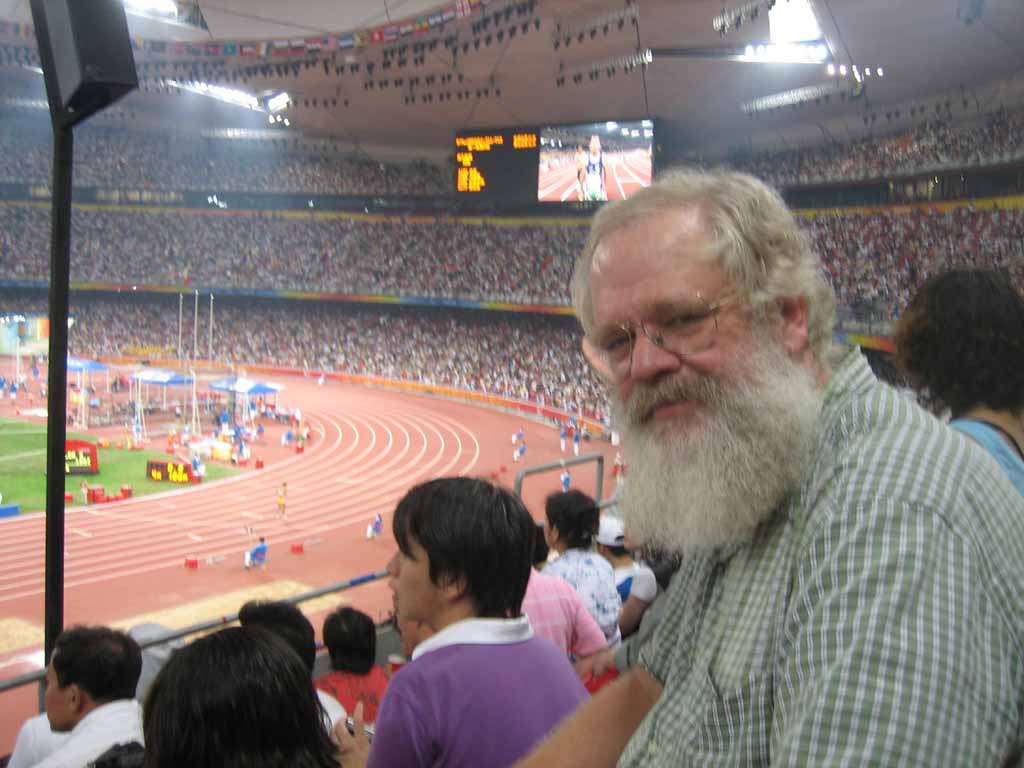 This is definitely the most impressive stadium I have ever been in. It's about the size of the Cotton Bowl, I guess. But I was in the Cotton Bowl once when it rained cats and dogs, and I got very wet. Every seat in this stadium is covered, but the field is not.
 I have never been to an event like this, so I was struck by the extent of the handicaps, especially the runners. They really were blind. Each runner was allowed to have a guide running with him. This presented some questions I don't know the answer to. What if the guide can't keep up with the runner? Don't know how this works. But you can imagine the Keller--Sullivan relationship that must exist between some of these teams. During one of the medals ceremonies, a Canadian runner took off his medal and put it on his guide.
Monday, September 15, 2008
I still don't have an explanation for the extreme roughness of the ride, though. The owner of the guest house suggested that it might be a matter of training. He said his horse wasn't that bad. I don't know about that. It's possible. Could just be a matter of getting used to the unusual gait of the Mongolian horse, and a saddle that is quite restricting. I saw lots of guys riding those horses and doing quite well. I definitely want to go back. Mongolian horses are much different from what I am used to, but they are good horses. Small, but very strong for their size. I guess they'd have to be; the great Mongol hordes conquered Asia on them.
Friday, September 12, 2008

Labels: Mongolians
Thursday, September 11, 2008
North China Kang Bed
Yesterday evening they fired up the kang in the yurt where the Swiss guy and I were sleeping. I'm glad, because Jane told me this morning that she had been cold last night. I was warm and toasty. They didn't keep the fire going all night, but the bricks were hot when we went to bed--that's the main thing. It was a little hard, though. A true North China kang is a brick bed covered with a layer of clay. It is firm (to say the least), but still quite comfortable. These guys forgot the clay and used mats instead. Didn't quite do it for me.

Labels: Mongolians
Wednesday, September 10, 2008
I have always shied away from "sleep in a yurt" tours. What's the point? Mongolians don't live in yurts anymore; they are no longer nomadic. Can't blame them, can you? Anyway, I just could not get excited about some place where they have a gazillion yurts crammed together filled with tourists who came there just to have the beer party and say they slept in one.
Jane and the Swiss guy.

I'll tell you one thing for sure. Mongolian horses are rough riding! They have a short gait, so the ride does not even out as you pick up speed. I don't know, maybe I'm just not used to them, but it seemed to me that anything faster than walking was pretty rough. I remember riding Queen bareback when I was kid. Trotting was a bit rough, but as soon as she broke into a gallop, the ride actually got quite smooth. Not so with the Mongolian horse.
Labels: Mongolians
Tuesday, September 09, 2008
 Nanyuan. I've heard of this place, but I had never been here before today. It's an old military airfield that is starting to be used for civilian flights. I think I read somewhere that part of its purpose is to accommodate China's move toward general aviation, but I may have misunderstood that. I have never seen a private plane in China. The last time I saw a light plane of any kind was last spring, when I was in Hong Kong during the Spring Festival break, and it blew me away, because I couldn't figure out what anyone would want with a small plane in Hong Kong. Where would you fly to? Just get up in the air and fly around in circles, I suppose. I don't know...flying back and forth between Hong Kong and Macau might be kinda handy, I guess. Anyway, I have never seen anything like that in China. I don't know the future of this airfield. Right now there is only one civilian airline flying out of here (China United), but I heard that ANA is going to start flying charters in here from Japan, which would make it an international airport.
 When I landed at Hohhot, I came out to the taxi line and got into a taxi. I couldn't see a meter, so I asked the guy about it, because I didn't want to take a "black" taxi. He showed me the meter over by the driver side door. Curious. I called the Guest house and they gave the guy directions. As we started out, I looked over to make sure the meter was working. Seemed to be OK, but as we got close to our destination, I saw the driver reach over to the meter. I couldn't prove it, but I am quite sure he was punching up the meter to increase the fare. No wonder he had it mounted way over there by the driver side window. I have seen a lot of hustles in this country, but that is the first time I have seen that one.
After the driver dropped me off, I made a phone call, and Jane and Dragon came from the Guest house to pick me up.
Monday, September 08, 2008
Cover-up?
I remember when Nadia Comăneci made history with a perfect score at the Montreal Olympics. She was doing stuff that looked almost miraculous. She was 14 years old. That isn't legal now. Gymnasts are supposed to be at least 16. With this in mind, there are two issues creating a cloud over the Chinese gold count at the Beijing Olympics.
The first is visual. Those kids look very, very young. There are a couple of them that just don't look 16. So people started asking questions and doing some investigation. Upon investigation, several documents surfaced that showed the birth dates as different from the dates that were presented for the Olympics. As far as I know, every available listing of He Kexin's birth date before the Olympics states it as January 1, 1994. The date of January 1st catches my attention, because it strongly suggests that they may not know the exact date of her birth. But again, every time He Kexin's name has appeared, her date of birth has always been listed as January 1, 1994. Until the Olympics. Then it suddenly appeared as January 1, 1992.
Gao Zhikai insisted that nothing more could be said about the issue, because the government has provided birth certificates for the girls, and the birth certificate is the proof of age. But nobody is suggesting that the girls don't have birth records. They are charging that the records have been falsified. So the proof that they have not been falsified is that they exist? This isn't going to wash. He stated that in America, the birth record is also the proof of age. He seemed to be suggesting that in America, the birth records would be accepted. Not even close. In the United States, if documents appeared that contradicted the birth records, this would be prima facie evidence that the birth records had been falsified. There would have to be a complete investigation, because the media would insist on it. In China, there will not be a media uproar, of course, because the government controls the media. I do not say this to suggest that America is a more honest society. But it is a more open society, so certain types of dishonesty are harder to hide if someone has an interest in exposing them.
China has a well established pattern of age fixing. The 2000 Summer Olympic Games were held in Sydney, Australia. Chinese gymnast Yang Yun, who won bronze medals there as a "sixteen-year-old," was later presented to a national television audience as having only been 14 at the time.
And regarding age fixing in country, Hannah Beech of TIME reports the following:
Under intense pressure, the FIG does seem to have backtracked on it's initial reticence. They now say that they are investigating the matter. We'll see.
The question of cheating in China is a personal one for me, because I live in China, and it upsets me to see China portrayed as a nation of people who don't play fair. There are lots of honest people in this country. The fuwuyuan who comes running out of the coffee bar after me, holding my flash disk, which I had dropped on the floor, "Grandpa Marx! You forgot something!" The young man who comes running up to me, breathless, as I am parking my bicycle. He is holding my backpack, which had fallen off a few hundred yards back. The wait staff in restaurants who compensate for my absent mindedness by keeping the stuff I leave behind and presenting it to me the next time I show up; the cab driver who voluntarily shuts his meter off early after having made a wrong turn.
In my opinion, what China needs to do is to set up an independent commission to investigate this matter. Some in the foreign media would laugh at the thought of the Chinese investigating themselves, but I have faith in the Chinese people. Sure there are cheaters. But as I said, there are also many decent, honest people.
I would have full confidence in a commission made up of people like the ones I mentioned. And if this commission could be fully independent (which, admittedly, would probably be a first), I am optimistic that China could get to the bottom of this, and find out what is really going on. I am not talking about merely chasing rumours. I am talking about seeking truth from facts. And when I say, "seeking truth from facts," I do not mean seeking "truth" from "facts." I mean seeking truth from facts. It really does matter what the truth is. Right now, there is still much fog surrounding this controversy. But one thing we know for sure. This issue is not going to go away.
Labels: Corruption, Obfuscation


