Links
- CV
- Titles
- Topics
- Tickets
- Science
- About Eric
- Book Reviews
- Country Profile
- Modern China
- Contact Eric
- Podcast
- Vision
- Sekai
- John
Archives
RSS

Reflections on a Wandering Life.....
Friday, September 18, 2020
The Atlantic Fiasco
The headline for the story in the Atlantic reads: "Americans Who Died in War Are ‘Losers’ and ‘Suckers’." Controversy has arisen about this statement, and whether Trump actually said it. But my concern in this essay is not so much with the statement itself, but with a disturbing trend in modern journalism: We are now supposed to accept as truth a report based on "anonymous sources." We are assured (of course) that these sources have been "confirmed," presumably by other anonymous sources, or by the journalist who claims to have actually spoken with the sources, and not merely made up the story (and the "sources").
But how are we to know? During the Russia Collusion fiasco, I remember Reince Priebus talking about a story in the New York Times—again, based on "anonymous sources"—saying that members of the Trump team were in daily conversation with the Russians. This was nonsense, of course. Since I do not read the Times, I don't know the details of that story, but during that time I did watch CBS News quite a bit, because they have a 24/7 news site accessible from anywhere in the world. I was dismayed by how much American news agencies had turned into propaganda networks. They were clearly assuming something to be true and desperately trying to prove it. To my knowledge, neither the New York Times nor CBS News has ever been called to account for their chicanery.
Before I go further, let me get right to the principle that I have tried to hold to and that I feel is being compromised by modern "journalists." It is based on a passage in the Book of Proverbs in the Bible:
He that is first in his own cause seemeth just; but his neighbour cometh and searcheth him. (Proverbs 18:17)Here's how the ESV (English Standard Version) puts it:
The one who states his case first seems right, until the other comes and examines him.So let me state the principle this way:
No man shall be considered guilty based on testimony which is not subject to cross-examination. Period.By the way, this is one of the strengths of the American legal system. I remember many years ago having a discussion in Beijing with a lawyer friend of mine. He said that the weakness of the Chinese legal system was the lack of independence of the judiciary. What he meant by that is that in China, judicial decisions can be dictated by the Party. In America, a political leader cannot tell a judge how to decide a case.
I said that what was needed was the right of the accused to be represented by counsel of his choice. A very notable example is the blind lawyer from Shandong, whose personal lawyers were not allowed in the courtroom. The government provided other lawyers for him. Sometimes those other lawyers are really little more than prosecutor's assistants.
After having lived in China for years now, I see that my friend's issue (independence of the judiciary) is important. But I also feel that the right to a lawyer of your choice is one of the strengths of the American system. If you are accused, you have a right to face your accuser and question him. Or you can have a professional lawyer question him for you. This is because sometimes accusations are brought forward by people with ulterior motives. A classic example is the Kavenaugh case brought forward by Christine Blasey Ford
Many people thought she sounded very credible. So why didn't she succeed? The answer, of course, is cross-examination. Her story fell apart. The people she named contradicted her and the friend she said was at the party said she did not know Kavanaugh, did not see anything, and later said that the former FBI agent working with Blasey Ford had put undue pressure on her. It was clear that she did not believe her friend's story.
There is some talk that the FBI did not do a thorough enough job in that case. One guy complained that they should have interviewed him because he was a "corroborating witness." He said he had met Blasey Ford in a coffee bar or something in 2016, and she had told him the same story. That's not a corroborating witness. Listen to me. Here is your free civics lesson for the day: A corroborating witness is someone who was physically present at the alleged event, who saw it happen with his own eyes, and can thus corroborate the testimony of the accuser, by virtue of having been there and having witnessed the crime. But this genius civically challenged product of the American public school system thought he should be regarded as a corroborating witness just because he had heard the same story about an event that took place in 1982, and which he had no knowledge of before 2016, more than 30 years after it happened!
This is the problem, you see. American students are woefully ignorant of basic principles of civics. When I was in middle school in Minnesota, we had to take a civics class. I don't think they even teach it anymore. Over and over I hear Americans saying things that betray their embarrassing ignorance of the most basic principles of justice. I actually heard and saw Senator Coons say that Kavenaugh should have to prove he did not do it. In other words, he should be presumed guilty unless and until he is proven innocent. Anyway, it's all moot now, because we now know that the whole case was a fraud.
Her lawyer has now admitted that they brought the case forward because of Kavenaugh's politics. That's disgusting. In fairness to Blasey Ford, I have never heard her say that. But you can listen to her lawyer Debra Katz say it here.
You don't accuse someone of that kind of crime because you don't like his politics or because you are mad at him for some reason. You accuse him because and only because he has committed a crime and he needs to be brought to justice. But she openly admits that the prosecution was politically motivated. So the whole thing was a fraud.
The Bible teaches (Deuteronomy 19:16-19) that if a person brings forward a false accusation, they should get the same punishment as would have been due to the person they accused if he had been guilty. As a matter of principle, I think Blasey Ford should be given one chance to disavow the statement of her lawyer, since she did deny it in the hearing. But if she supported her lawyer, then they should both go to prison.
And I'm not letting the Republicans off the hook, either. In an earlier case, the Republican Party dropped its support of a Republican Senate candidate in Alabama because of accusations of this nature. Leader McConnell said that their claims "sounded credible." What's that supposed to mean? Let me see if I can phrase the new belief that this kind of statement is based on:
If people sound credible, they must be telling the truth, because if they weren't telling the truth, they wouldn't sound credible.As ridiculous as that sounds, that is literally what modern Americans believe. But if that statement were true, slander would be harmless, because we would always know when someone was lying. The reason slander is so harmful, and why it is illegal, is precisely because slander often sounds credible. Not always, but very often. That's why we can't assume someone is telling the truth just because they sound credible, because that has nothing to do with whether or not they are telling the truth.
Ruth Bader Ginsburg, infamous champion of the slaughter of the innocent unborn, has now passed from the scene. The attacks on Amy Coney Barrett (her probable replacement) are going to be mean and vicious. People who have no conscience about killing innocent little unborn children will will be ugly and hateful in their attacks on someone who dares to believe that all children's lives matter. And no one should be surprised if these attacks are based on "unnamed sources." This is the new standard in American journalism. Vicious attacks from unnamed sources who cannot be cross-examined are considered truth. This is immoral, and journalists who expect you to accept this standard are truly enemies of the people.
As a classic example of how short the news cycle is in America, the Trump haters have moved on now to the latest "bombshell." I am speaking of Trump's statements to Woodward about downplaying the corona virus. I think it's much ado about nothing, and it wouldn't really be honest for me to criticize him because I'm a dad. That is exactly the kind of thing I would try to do with my kids. That's what dads are for. We take the worry off our children's shoulders and put it on our own shoulders, and we don't let them see that we're even thinking about it. So I can't really criticize him. But if you want to criticize him, I will listen. But if you're a Democrat, I am going to call you a hypocrite, because it was, in fact, the Democrats who were downplaying it at that point in the history of this virus. After all, it was Trump who closed the border to China and the Democrats who blasted him for it.
But there is something about that news item that does cause me some concern about Trump. Woodward's report presents one more example of Trump's lack of judgment when it comes to dealing with the media. He criticizes them, but he can't resist talking to them. Now, press conferences are one thing--I give him high marks for that. But what in the world was he doing talking to Bob Woodward for hour after hour--eighteen interviews in all? I wouldn't have given Woodward 15 minutes. He built his career on "unnamed sources."
For those of you unfamiliar with Bob Woodward, he has a long-standing reputation for dishonesty. He wrote a book about William Casey, published, conveniently, right after Casey's death, where he claims to have had a deathbed interview with Casey, which the security detail around Casey said could not have happened because Woodword was thrown out when he tried to get to Casey.
The comparison between these two news stories and the two impeachment inquiries is interesting. In both cases, the first was completely bogus—based on unnamed sources, and the second was a matter of interpretation over a conversation, the details of which are not in dispute.
But let's get back to the Atlantic story. What has happened since it was written, is that so many people who were on that trip (where Trump supposedly made disparaging comments about American troops) have come forward to say that they did not hear him say anything of the kind, that there aren't enough people left to be the "unnamed sources." According to Brieitbart, the Ambassador to France has also come out against it. Now, I know many consider Brietbart to be a propaganda paper, but in this instance, Breitbart was the one news entity doing actual journalism. Why? Because they named the source. You can go to him and ask him and verify the report.
Everybody else just seems to think that we are obligated to take their word for it. This includes Jennifer Griffin of Fox News, who claims to have "confirmed" the story. She got a lot of flak for that. Trump demanded that she be fired. Then some of her colleagues at Fox came to her defense. OK, I am willing to accept, based on their character reference, that she did not just make up a story and call it unnamed sources. But I would also have to say that she is unprincipled. Why? Because she also expects us to believe a story based on "unnamed sources." That's just not something a man or woman of integrity would do. Of course she says they are "confirmed." But what does that mean? I'll tell you what it is supposed to mean. It is supposed to mean that the information provided by unnamed sources has now been confirmed by other courses that can be verified. But for these modern "journalists" it means...who knows what it means? Again, here is the principle:
The one who states his case first seems right, until the other comes and examines him. (Proverbs 18:17)Apparently according to Jennifer Griffin (and other "journalists" who are as unprincipled as she), the word "confirmed" means that unnamed sources have been confirmed by other unnamed sources, so that "proves" that he said it. What nonsense.
So what is the solution to this? It is very simple. Build your life on the time honored principles in the Bible, and DO NOT WAVER FROM THEM no matter how much unscrupulous "journalists" try to convince you that God won' t mind if you throw his principles to the wind just this once. Friends, slander is one of the purest forms of evil. If you pass on slander and someone believes it, you are responsible for that. And if they pass it on, and other people believe it, you are also responsible for that. God is not mocked. You will reap what you sow. (Galatians 6:7)
So what will come of this? Well, if the "unnamed sources" come forward, I will eager to hear what they have to say, but I would expect that some of them would have to be the same people who denied that Trump said those things, because, as the Breitbart article points out, there aren't enough people left who haven't already denied that Trump said anything like that. On a trip like that, every contact a president has is a matter of record. He can't just break away from the group and walk down to the store or something. We know exactly who he encountered, and one after another they have come forward to dispute the story.
My prediction: I don't believe they will ever come forward. Jeffrey Goldberg, the journalist propagandist who wrote the original piece for the Atlantic, says they are afraid to come forward because they might be teased on Twitter. Really? So it's perfectly fine to trash Trump on Twitter about statements he has denied and which are based on "unnamed sources," but it is not appropriate for those “unnamed sources” to face criticism (examination) for their statements? Have you ever known Trump to hold back from speaking the truth because he was afraid of being bullied on Twitter? Trump says what he thinks even if he knows he is going to be ciriticized for it. Some people hate him for that. Are you one of them? So you would rather put your faith in those pathetic souls who hide behind unscrupulous "journalists" like Jennifer Griffin and Jeffrey Goldberg so they can pour out their vile without having to answer for it because they haven't got the manhood to be held to their convictions? I pity you.
Again, I cannot say this with enough emphasis. Expecting a man to be regarded as guilty without allowing him to face his accusers is unspeakably dishonorable. One more time, here is the principle:
The one who states his case first seems right, until the other comes and examines him. (Proverbs 18:17)Journalists who throw this principle to the wind and expect you to regard gossip as truth are not nice people. But this is the new normal now, you guys. We are supposed to accept unnamed sources as truth. It's partly the fault of the gullible America public, who swallows this stuff far too easily. And it's also partly the fault of unprincipled "journalists" like Jennifer Griffin and Jeffrey Goldberg, who ask us to believe vicious accusations without a shred of evidence. And no, unnamed sources are not evidence. The legal term is "hearsay." Hearsay is not admissible as evidence in a court of law. I think this is going to backfire on the Atlantic. I am old enough to remember when the Atlantic was a respectable periodical. Now it has been shown to be a rich person's propaganda rag, trading on the light of its former reputation, which is fading fast.
Labels: American Society, Fake News, Mainstream Media
Tuesday, September 15, 2020
A World Split Apart

Click to see Solzhenitsyn's reflections on his Harvard commencement speech in June of 1978
I graduated from college (Oregon College of Education) in June of 1978. The commencement address was given by a Congressman, who lectured us about the evils of inflation. I was left feeling empty by such a morally vacuous speech. A few days later, I opened the Portland Oregonian and saw the text of Solzhenitsyn's address to the graduating class at Harvard. The reaction to his speech is a study in itself, but rather than discuss that right now, I will let you read the speech and then, if you like, you can read his own reflections by clicking on the photo above.
A World Split Apart
An Address by Aleksandr Solzhenitsyn
Harvard College
June 1978
I AM SINCERELY HAPPY to be here with you on this occasion and to become personally acquainted with this old and most prestigious university. My congratulations and very best wishes to all of today's graduates.
Harvard's motto is Veritas. Many of us have already found out, and others will find out in the course of their lives, that truth eludes us if we do not concentrate with total attention on its pursuit. And even while it eludes us, the delusion still lingers of knowing it, and that leads to many misunderstandings. Also, truth seldom is pleasant; it is almost invariably bitter. There is some bitterness in my speech today, too. But I want to stress that it comes not from an adversary but from a friend.
Three years ago in the United States I said certain things which at that time appeared unacceptable. Today, however, many people agree with what I then said . . .
The split in today's world is perceptible even at a hasty glance. Any of our contemporaries can readily identify two world powers, each of them already capable of entirely destroying the other. However, understanding of the split often is limited to this political conception, to the illusion that danger may be abolished through successful diplomatic negotiations or by achieving a balance of armed forces. The truth is that the split is a much profounder and more alienating one, that the rifts are more than one can see at first glance. This deep, manifold split bears the danger of manifold disaster for all of us, in accordance with the ancient truth that Kingdom---in this case, our Earth--- divided against itself cannot stand.
Then there is the concept of the Third World: thus, we already have three worlds. Undoubtedly, however, the number is even greater; we are just too far away to see. Any ancient, deeply rooted, autonomous culture, especially if it is spread over a wide part of the earth's surface, constitutes an autonomous world, full of riddles and surprises to Western thinking. At a minimum, we must include in this category China, India, the Muslim world, and Africa, if indeed we accept the approximation of viewing the latter two as compact units. For one thousand years Russia belonged to such a category, although Western thinking systematically committed the mistake of denying its autonomous character and therefore never understood it, just as today the West does not understand Russia in Communist captivity. It may be that Japan has increasingly become a distant part of the West, I am no judge here; but as to Israel, for instance, it seems to me that it stands apart from the Western world in that its state system is fundamentally linked to religion.
How short a time ago, relatively, the small new European world was easily seizing colonies everywhere, not only without anticipating any real resistance but also usually despising the conquered peoples and denying any possible value in their approach to life. On the face of it, it was an overwhelming success. There were no geographic frontiers to it; Western society expanded in a triumph of human independence and power. Then all of a sudden, in the twentieth century, came the discovery of its fragility and friability. We now see that the conquests were short-lived and precarious, and this in turn points to defects in the Western view of the world which led to these conquests. Relations with the former colonial world now have turned to the opposite pole, and the Western world often goes to extremes of obsequiousness, but it is difficult yet to estimate the total size of the bill which former colonial countries will present to the West, and it is difficult to predict whether the surrender, not only of its last colonies, but of everything it owns will cover the bill.
But the blindness of superiority continues in spite of all and supports the belief that vast regions everywhere on our planet should develop and mature to the level of present-day Western systems, which in theory are the best and in practice the most attractive. There is this belief that all those other worlds are only being temporarily prevented by wicked governments or by heavy crises or by their own barbarity and incomprehension from taking the way of Western pluralistic democracy and adopting the Western way of life. Countries are judged on the basis of their progress in this direction. However, this is a conception which developed out of Western incomprehension of the essence of other worlds, out of the mistake of measuring them all with a Western yardstick. The real picture of our planet's development is quite different.
Anguish about our divided world gave birth to the theory of convergence between leading Western countries and the Soviet Union. It is a soothing theory which overlooks the fact that these worlds are not at all developing into similarity; neither one can be transformed into the other without the use of violence.Besides, convergence inevitably means acceptance of the other side's defects, too, and this is hardly desirable.
If I were today addressing an audience in my country, examining the overall pattern of the world's rifts, I would have concentrated on the East's calamities. But since my forced exile in the West has now lasted four years and since my audience is a Western one, I think it may be of greater interest here to concentrate on certain aspects of the West in our days, as I see them. A decline in courage may be the most striking feature which an outside observer notices in the West in our days. The Western world has lost its civic courage, both as a whole and separately, in each country, each government, each political party, and of course in the United Nations. Such a decline in courage is particularly noticeable among the ruling groups and the intellectual elite, causing an impression that the loss of courage extends to the entire society. Of course there are many courageous individuals, but they have no determining influence on public life. Political and intellectual bureaucrats show depression, passivity, and perplexity in their actions, in their statements, and most of all in their theoretical reflections intended to explain how realistic and reasonable as well as intellectually and even morally warranted it is to base state policies on weakness and cowardice. The decline in courage is ironically emphasized by occasional explosions of anger and inflexibility on the part of those same bureaucrats when dealing with weak governments and weak countries that are not supported by anyone, or with currents which cannot offer any resistance. But they get tongue-tied and paralyzed when they deal with powerful governments and threatening forces, with aggressors and international terrorists.
Should one point out that from ancient times a decline in courage has been considered the beginning of the end?
When the modern Western states were created, the following principle was proclaimed: governments are meant to serve man, and man lives to be free and to pursue happiness. (See, for example, the American Declaration of Independence.)
Now at last, during recent decades, technical and social progress has permitted the realization of such aspirations: the welfare state. Every citizen has been granted the desired freedom and material goods in such quantity and of such quality as to guarantee in theory the achievement of happiness, in the morally inferior sense which has come into being during those same decades. In the process, however, one psychological detail has been overlooked: the constant desire to have still more things and a still better life, and the struggle to obtain them, imprints many Western faces with worry and even depression, though it is customary to conceal such feelings. Active and tense competition permeates all human thoughts without opening a way to free spiritual development. The individual's independence from many types of state pressure has been guaranteed; the majority of people have been granted well-being to an extent their fathers and grandfathers could not even dream about; it has become possible to raise young people according to this ideal, leading them to physical splendor, happiness, possession of material goods, money, and leisure-to an almost unlimited freedom of enjoyment. So who should now renounce all this? Why and for what should one risk one's precious life in defense of common values, and particularly in such nebulous cases as when the security of one's nation must be defended in a distant country?
Even biology knows that habitual extreme safety and well-being are not advantageous for a living organism. Today, well-being in the life of Western society has begun to reveal its pernicious mask.
Western society has given itself the organization best suited to its purpose, based, I would say, on the letter of the law. The limits of human rights and righteousness are determined by a system of laws; such limits are very broad. People in the West have acquired considerable skill in using, interpreting, and manipulating law, even though the laws tend to be too complicated for an average person to understand without the help of an expert. Any conflict is solved according to the letter of the law, and this is considered to be the supreme solution. If one is right from a legal point of view, nothing more is required; nobody may mention that one could still be not entirely right, and urge self restraint, a willingness to renounce such legal rights, sacrifice, and selfless risk: it would sound simply absurd. One almost never sees voluntary self-restraint. Everybody operates at the extreme limit of the legal frames. An oil company is legally blameless when it purchases an invention for a new type of energy order to prevent its use. A food-product, manufacturer is legally blameless when he poisons his product to make it last longer: after all, people are free not to buy it.
I have spent all my life under a Communist regime and I will tell that a society without any objective legal scale is a terrible one indeed. But a society with no other scale but legal one is not quite worthy of man either. A society which is based on letter of the law and never reaches higher is scarcely taking advantage of the high level of human possibilities. The letter of the law is too cold and formal to have a beneficial influence on society. Whenever the tissue of life is woven of legalistic relations, there is an atmosphere of moral mediocrity, paralyzing man's noblest impulses.
And it will be simply impossible to survive the trials of this threatening century with only the support of a legalistic structure.
In today's Western society, the equality has been revealed between freedom to do good and the freedom to do evil. A statesman who wants to achieve something important and highly constructive for his country has to move cautiously and even timidly; there are thousands of hasty and irresponsible critics around him, parliament and press keep rebufling him. As he moves ahead, he has to prove that each single step of his is well-founded and absolutely flawless. Actually, an outstanding and particularly gifted person who has unusual and unexpected initiatives in mind hardly gets a chance to assert himself; from the very beginning, traps will be set out all around him. Thus mediocrity triumphs, with the excuse of restrictions imposed by democracy.
It is feasible and easy everywhere to undermine administrative power, which, in fact, has been drastically weakened in all Western countries. The defense of individual rights has reached such extremes as to make society as a whole defenseless against certain individuals. It is time, in the West, to defend not so much human rights as human obligations.
Destructive and irresponsible freedom has been granted boundless space. Society appears to have little defense against the abyss of human decadence, such as, for example, the misuse of liberty for moral violence against young people, motion pictures full of pornography, crime, and horror. This is considered to be part of freedom, and theoretically counterbalanced by the young people's right not to look or not to accept. Life organized legalistically has thus shown its inability to defend itself against the corrosion of evil.
And what shall we say about the dark realm of criminality as such? Legal frames (especially in the United States) are broad enough to encourage not only individual freedom but also certain individual crimes. The culprit can go unpunished or obtain undeserved leniency with the support of thousands of public defenders. When a government starts an earnest fight against terrorism, public opinion immediately accuses it of violating the terrorists' civil rights. There are many such cases.
Such a tilt of freedom in the direction of evil has come about gradually, but it was evidently born primarily out of a humanistic and benevolent concept according to which there is no evil inherent in human nature; the world belongs to mankind and all the defects of life are caused by wrong social systems which must be corrected. Strangely enough, though the best social conditions have been achieved in the West, there still is criminality, and there even is considerably more of it than in the pauperized and lawless Soviet society. (There is a huge number of prisoners in our camps who are termed criminals, but most of them never committed any crime; they merely tried to defend themselves against a lawless state, resorting to means outside of a legal framework.)
The press too, of course, enjoys the widest freedom. (I shall be using the word press to include all media.) But what sort of use does it make of this Freedom?
Here again, the main concern n is to avoid infringing the letter of the law. There is no moral responsibility for deformation or disproportion. What sort of responsibility does a journalist have to his readers, or to history? If he has misled public opinion or the government by inaccurate information or wrong conclusions, do we know of any cases where the same journalist or the same newspaper has publicly recognized and rectified such mistakes? No, it does not happen, because it would damage sales. A nation may be the victim of such a mistake, but the journalist always gets away with it. One may safely assume that he will start writing the opposite with renewed self-assurance.
Because instant and credible information has to be given, it becomes necessary to resort to guesswork, rumors, and suppositions to fill in the voids, and none of them will ever be rectified, they will stay on in the readers' memory. How many hasty, immature, superficial, and misleading judgments are expressed every day, confusing readers, without any verification? The press can both stimulate public opinion and mis-educate it. Thus we may see terrorists turned into heroes, or secret matters pertaining to one's nation's defense publicly revealed, or we may witness shameless intrusions on the privacy of well-known people under the slogan: "Everyone is entitled to know everything." But this is a false slogan, characteristic of a false era: people also have the right not to know, and it is a much more valuable one. The right not to have their divine souls stuffed with gossip, nonsense, vain talk. A person who works and leads a meaningful life does not need this excessive burdening flow of information.
Hastiness and superficiality are the psychic disease of the twentieth century, and more than anywhere else this disease is reflected in the press. In-depth analysis of a problem is anathema to the press. It stops at sensational formulas.
Such as it is, however, the press has become the greatest power within the Western countries, more powerful than the legislature, the executive, and the judiciary. One would then like to ask: By what law has it been elected and to whom is it responsible? In the Communist East, a journalist is frankly appointed as a state official. But who has granted Western journalists their power, for how long a time, and with what prerogatives?
There is yet another surprise for someone coming from the East, where the press is rigorously unified: one gradually discovers a common trend of preferences within the Western press as a whole. It is a fashion; there are generally accepted patterns of judgment and there may be common corporate interests, the sum effect being not competition but unification. Enormous freedom exists for the press --- but not for the readership, because newspapers mostly give stress and emphasis to those opinions which do not too sharply contradict their own, or the general trend.
Without any censorship, fashionable trends of thought and ideas in the West are carefully separated from those which are not fashionable; nothing is forbidden, but what is not fashionable will hardly ever find its way into periodicals or books or be heard in colleges. Legally, your researches are free, but they are conditioned by the fashion of the day. There is no open violence such as in the East; however, a selection dictated by fashion and the need to match mass standards frequently prevents independent-minded people from giving their contribution to public life. There is a dangerous tendency to form a herd, shutting off successful development. I have received letters in America from highly intelligent persons, maybe a teacher in a faraway small college who could do much for the renewal and salvation of his country, but his country cannot hear him because the media are not interested in him. This gives birth to strong mass prejudices, to blindness, which is most dangerous in our dynamic era. There is, for instance, a self-deluding interpretation of the contemporary world situation. It works as a sort of petrified armor around people's minds. Human voices from 17 countries of Eastern Europe and Asia cannot pierce it. It will only be broken by the pitiless crowbar of events.
I have mentioned a few traits of Western life which surprise and shock a new arrival to this world. The purpose and scope of this speech will not allow me to continue such a review, to look into the influence of these Western characteristics on important aspects of a nation's life, such as elementary education, and advanced education in the humanities and in art.
It is almost universally recognized that the West shows all the world a way to successful economic development, even though in the past years it has been strongly disturbed by chaotic inflation. However, many people living in the West are dissatisfied with their own society. They despise it or accuse it of not being up to the level of maturity attained by mankind. A number of such critics turn to socialism, which is a false and dangerous current.
I hope that no one present will suspect me of offering my personal criticism of the Western system in order to present socialism as an alternative. Having experienced applied socialism in a country where that alternative has been realized, I certainly will not speak for it. The well-known Soviet mathematician Shafarevich, a member of the Soviet Academy of Science, has written a brilliant book under the title Socialism; it is a profound analysis showing that socialism of any type and shade leads to a total destruction of the human spirit and to a leveling of mankind unto death. Shafarevich's book was published in France almost two years ago, and so far no one has been found to refute it. It will shortly be published in English in the United States.
But should someone ask me whether I would indicate the West such as it is today as a model to my country, frankly I would have to answer negatively. No, I could not recommend your society in its present state as an ideal for the transformation of ours. Through intense suffering our country has now achieved a spiritual development of such intensity that the Western system in its present state of spiritual exhaustion does not look attractive. Even those characteristics of your life which I have just mentioned are extremely saddening.
A fact which cannot be disputed is the weakening of human beings in the West, while in the East they are becoming firmer and stronger. Six decades for our people and three decades for the people of Eastern Europe; during that time we have been through a spiritual training far in advance of Western, experience. Life's complexity and mortal weight have produced stronger deeper, and more interesting characters than those generated by standardized Western well-being. Therefore, if our society were to be transformed into yours, it would mean an improvement in certain aspects, but also a change for the worse on some particularly significant scores. It is true, no doubt, that a society cannot remain in an abyss of lawlessness, as is the case in our country. But it is also demeaning for elect such mechanical legalistic smoothness as you have. After suffering decades of violence and oppression, the human soul longs for things higher, warmer, and purer than those offered by today's mass living habits, exemplified by the revolting invasion of publicity, by TV stupor, and by intolerable music.
All this is visible to observers from all the worlds of our planet. The Western way of life is less and less likely to become the leading model.
There are various meaningful warnings which history gives a threatened or perishing society --- the decadence of art, for instance, or a lack of great statesmen. There are open and evident warnings, too. The center of your democracy and of your culture is left without electric power for a few hours only, and all of a sudden crowds of American citizens start looting and creating havoc. The smooth surface film must be very thin, then; the social system quite unstable and unhealthy.
But the fight, physical and spiritual, for our planet, a fight of cosmic proportions, is not a vague matter of the future: it has already started. The forces of Evil have begun their decisive offensive, you can feel their pressure, and yet your screens and publications are full of prescribed smiles and raised glasses. What is the joy about?
Very well-known representatives of your society, such as George Kennan, say: We cannot apply moral criteria to politics. Thus we mix good and evil, right and wrong, and make space for the absolute triumph of absolute Evil in the world. On the contrary, only moral criteria can help the West against Communism's well-planned world strategy. There are no other criteria. Practical or occasional considerations of any kind will inevitably be swept away by strategy. After a certain level of the problem has been reached, legalistic thinking induces paralysis; it prevents one from seeing the size and meaning of events.
In spite of the abundance of information, or maybe because of it, the West has difficulties in understanding reality such as it is. There have been naive predictions by some American experts who believed that Angola would become the Soviet Union's Vietnam or that Cuban expeditions in Africa would best be stopped by special U.S. courtesy to Cuba. Kennan's advice to his own country ---- to begin unilateral disarmament --- belongs to the same category. If you only knew how the youngest of the Moscow Old Square officials laugh at your political wizards! As to Fidel Castro, he frankly scorns the United States, sending his troops to distant adventures from his country right next to yours.
However, the most cruel mistake occurred with the failure to understand the Vietnam War. Some people sincerely wanted all wars to stop just as soon as possible; others believed that there should be room for national, or Communist, self-determination in Vietnam, or in Cambodia, as we see today with particular clarity. But members of the U.S. antiwar movement wound up being involved in the betrayal of Far Eastern nations, in a genocide, and in the suffering today imposed on thirty million people there. Do those convinced pacifists hear the moans coming from there? Do they understand their responsibility today? Or do they prefer not to hear? The American intelligentsia lost its nerve, and as a consequence thereof danger has come much closer to the United States. But there is no awareness of this. Your shortsighted politicians who signed the hasty Vietnam capitulation seemingly gave America a carefree breathing space; however, a hundredfold Vietnam now looms over you. That small Vietnam had been a warning and an occasion to mobilize the nation's courage. But if a full-fledged America suffered a real defeat from a small Communist half country, how can the West hope to stand firm in the future?
I have had occasion already to say that in the twentieth century Western democracy has not won any major war without help and protection from a powerful Continental ally whose philosophy arid ideology it did not question. In World War II against Hitler, instead of winning that war with its own forces which would certainly have been sufficient, Western democracy cultivated another enemy who would prove worse and more powerful yet: Hitler never had so many resources and so many people, nor did he offer any attractive ideas, or have such a large number of supporters in the West --- a potential fifth column --- as the Soviet Union does. At present, some Western voices already have spoken of obtaining protection from a third power against aggression in the next world conflict, if there is one; in this case the shield would be China. But I would not wish this on any country in the world. First of all, it is again a doomed alliance with Evil; also, it would grant the United States a respite, but when at a later date China with its billion people would turn around armed with American weapons, America itself would fall prey to a genocide similar to the one perpetrated in Cambodia in our days.
And yet ---- no weapons, no matter how powerful, can help the West until it overcomes its loss of will-power. In a state of psychological weakness, weapons become a burden for the capitulating side. To defend oneself, one must also be ready to die; there is little such readiness in a society raised in the cult of material well being. Nothing is left, then, but concessions, attempts to gain time, and betrayal. Thus, at the shameful Belgrade conference, free Western diplomats in their weakness surrendered the line where enslaved members of Helsinki Watch groups are sacrificing their lives.
Western thinking has become conservative: the world situation should stay as it is at any cost, there should be no changes. This debilitating dream of a status quo is the symptom of a society which has come to the end of its development. But one must be blind in order not to see that the oceans no longer belong to the West, while the land under its domination keeps shrinking. The two so-called world wars (they were by no means on a world scale, not yet) meant the internal self-destruction of the small progressive West, which has thus prepared its own end. In the next war (which does not have to be an atomic one, and I do not believe it will) may well bury Western civilization forever.
Facing such a danger, with such historical values in your past, at such a high level of realization of freedom and apparently of devotion to freedom, how is it possible to lose to such an extent the will to defend oneself?
How has this unfavorable relation of forces come about? How did the West decline from its triumphal march to its present sickness? Have there been fatal turns and losses of direction in its development? It does not seem so. The West kept advancing socially in accordance with its proclaimed intentions, with the help of brilliant technological progress. And all of a sudden it found itself in its present state of weakness.
This means that the mistake must be at the root, at the very basis of human thinking in the past centuries. I refer to the prevailing Western view of the world which was first born during the Renaissance and found its political expression starting in the period of the Enlightenment. It became the basis for government and social science and could be defined as rationalistic humanism or humanistic autonomy: the proclaimed and enforced autonomy of man from any higher force above him. It could also be called anthropocentricity, with man seen as the center of everything that exists.
The turn introduced by the Renaissance evidently was inevitable historically. The Middle Ages had come to a natural end by exhaustion, becoming an intolerable despotic repression of man's physical nature in favor of the spiritual one. Then, however, we turned our backs upon the Spirit and embraced all that is material with excessive and unwarranted zeal. This new way of thinking, which had imposed on us its guidance, did not admit the existence of intrinsic evil in man, nor did it see any higher task than the attainment of happiness on earth. It based modern Western civilization on the dangerous trend toward worshiping man and his material needs. Everything beyond physical well-being and accumulation of material goods, all human requirements and characteristics of a subtler and higher nature, were left outside the range of attention of the state and the social system, as if human life did not have any higher meaning. That provided access for evil, of which in our days there is a free and constant flow. But freedom does not in the least solve all the problems of human life, and it even adds a number of new ones.
At that, in early democracies, as in American democracy at the time of its birth, all individual human rights were granted because man is God's creature. That is, freedom was given to the individual conditionally, on the assumption of his constant religious responsibility. Such was the heritage of the preceding thousand years. Two hundred years ago --- even fifty years ago --- it would have seemed quite impossible, in America, that an individual could be granted boundless freedom simply for the satisfaction of his instincts or whims. Subsequently, however, all such limitations were discarded everywhere in the West; a total liberation occurred from the moral heritage of Christian centuries, with their great reserves of mercy and sacrifice. Meanwhile, state systems were becoming increasingly materialistic. The West ended up by truly enforcing human rights, sometimes even excessively, but man's sense of responsibility to God and society grew dimmer and dimmer. In the past few decades, the legalistic, selfish aspect of Western thinking has reached its apogee, and the world is now in a harsh spiritual crisis and a political impasse. All the glorified technological achievements of Progress, including the conquest of outer space, do not redeem the twentieth century's moral poverty, which no one could imagine even as late as in the nineteenth century.
As humanism in its development became more and more materialistic, it made itself increasingly accessible to speculation and manipulation, at first by socialism and then by Communism. So that Karl Marx was able to say in 1844 that "Communism is naturalized humanism."
This statement turned out to be not entirely meaningless. One does see the same stones in the foundations of a despiritualized humanism and of any type of socialism: endless materialism; freedom from religion and religious responsibility, which under Communist regimes reaches the stage of anti-religious dictatorship; concentration on social structures, with a seemingly scientific approach (this is typical of the Enlightenment in the eighteenth century and of Marxism). Not by coincidence, all of Communism's meaningless pledges and oaths are about Man, with a capital M, and his earthly happiness. At first glance it seems an ugly parallel: common traits in the thinking and way of life of today's West and today's East? But such is the logic of materialistic development.
The interrelationship is such, too, that the current of materialism which is farthest Left always ends up being stronger, more attractive, and finally, victorious, because it is more consistent. Humanism without its Christian heritage cannot resist such competition. We watch this process over the past centuries and, especially in the past decades, on a world scale, as the situation becomes increasingly dramatic. Liberalism was inevitably displaced by radicalism, radicalism had to surrender to socialism, and socialism could never resist Communism. The Communist regime in the East could stand and grow, thanks to the enthusiastic support of an enormous number of Western intellectuals who felt a kinship with Communism and refused to see its crimes. When they could no longer ignore them, they tried to justify them. 'In our Eastern countries, Communism has suffered a complete ideological defeat; it is zero and less than zero. But Western intellectuals still look at it with interest and with empathy, and this is precisely what makes it so immensely difficult for the West to withstand the East.
I am not examining here the disastrous case of a world war and the changes which it would produce in society. As long as we wake up every morning under a peaceful sun, we have to lead an everyday life. There is a disaster, however, which has already been under way for quite some time. I am referring to the calamity of a despiritualized and irreligious humanistic consciousness.
To such consciousness, man is the touchstone in judging and evaluating everything on earth. Imperfect man, who is never free of pride, self-interest, envy, vanity, and dozens of other defects. We are now experiencing the consequences of mistakes which had not been noticed at the beginning of the journey. On the way from the Renaissance to our days we have enriched our experience, but we have lost the concept of a Supreme Complete Entity which used to restrain our passions and our irresponsibility. We have placed too much hope in political and social reforms, only to find out that we were being deprived of our most precious possession: our spiritual life. In the East, it is destroyed by the dealings and machinations of the ruling party. In the West, commercial interests tend to suffocate it. This is the real crisis. The split in the world is less terrible than the fact that the same disease is plaguing its two main sections.
If humanism were right in declaring that man is born to be happy, he would not be born to die. Since his body is doomed to die, his task on earth evidently must be of a more spiritual nature. It cannot be unrestrained enjoyment of everyday life. It cannot be the search for the best ways to obtain material goods and then cheerfully get the most out of them. It has to be the fulfillment of a permanent, earnest duty, so that one's life journey may become an experience of moral growth, so that one may leave life a better human being than one started it. It is imperative to review the table of widespread human values. Its present incorrectness is astounding. It is not possible to reduce the assessment of the President's performance to the question of how much money one makes or of unlimited availability of gasoline. Only voluntarily inspired self-restraint can raise man above the stream of materialism.
It would be retrogression to attach oneself today to the ossified formulas of the Enlightenment. Social dogmatism leaves us completely helpless before the trials of our times.
Even if we are spared destruction by war, our lives will have to change if we want to save life from self-destruction. We cannot avoid revising the fundamental definitions of human life and human society. Is it true that man is above everything? Is there no Higher Spirit above him? Is it right that man's life and society's activities have to be determined by material expansion in the first place? Is it permissible to promote such expansion to the detriment of our spiritual integrity?
If the world has not come to its end it has approached a major turn in history, equal in importance to the turn from the Middle Ages to the Renaissance. It will exact from us a spiritual upsurge, we shall have to rise to a new height of vision, to a new level of life where our physical nature will not be cursed as in the Middle Ages, but, even more importantly, our spiritual being will not be trampled upon as in the Modern Era.
This ascension will be similar to climbing onto the next anthropological stage. No one on earth has any way left but --- upward.
(From National Review, July 7, 1978; pages 836-855)
Labels: A World Split Apart, American Society, Communism, Materialism, Russia, Solzhenitsyn
Tuesday, March 31, 2020
What is racism?
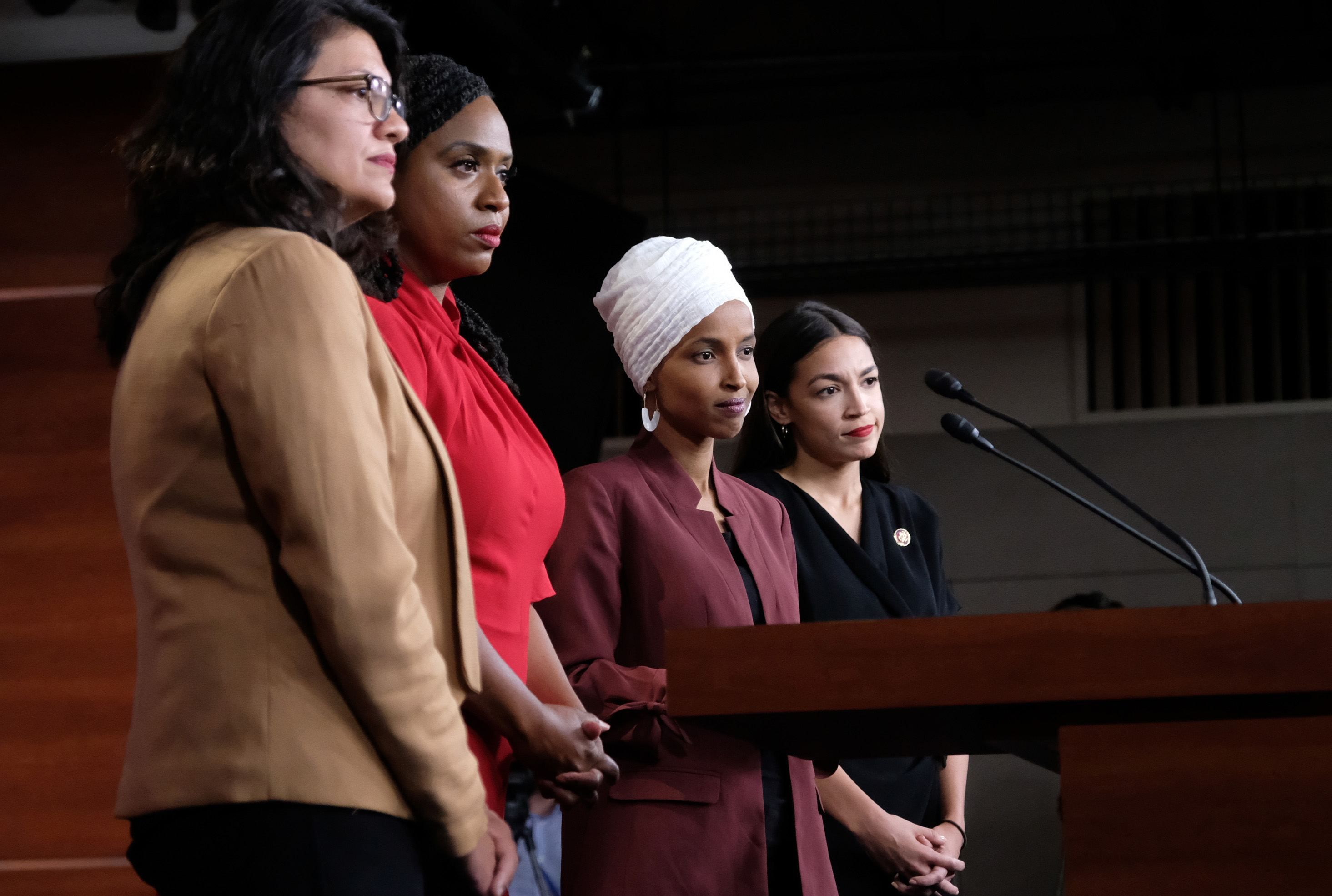
Context: Trump was asked if he thought White nationalism was on the rise around the world. He said that he didn't think so. So AOC concluded that this response meant that he would turn a blind eye to acts of terrorism. I was arrested by her bizarre conclusion, because I myself would have responded pretty much the way Trump did, and that doesn't mean I like terrorism.
This is a big subject. Hard to talk about it without bringing in so many side issues. It's very involved. To get the history, it may be to your advantage to give a listen to my podcast on the American Civil War, but you don't necessarily need to do it first.
Although I have been interested and concerned about this issue since I was a kid reading about the Underground Railroad, the thing that set me off this time was the media reaction to Trump's statement to the "Squad:"
[So interesting to see ‘Progressive’ Democrat Congresswomen, who originally came from countries whose governments are a complete and total catastrophe, the worst, most corrupt and inept anywhere in the world, now loudly and viciously telling the people of the United States, the greatest and most powerful Nation on earth, how our government is to be run. Why don’t they go back and help fix the totally broken and crime infested places from which they came. Then come back and show us how it is done.]Now as I explain in the podcast, Trump applied this statement too broadly. For three of the four people, it doesn't fit. I don't want to elaborate here, because I explain it in detail in the podcast. But for one of them (Ilhan Omar), it fits perfectly. It is not racist, and is entirely appropriate. So let me edit the above statement to make it apply to one person:
[So interesting to see a ‘Progressive’ Democrat Congresswoman, who originally came from a country whose government is a complete and total catastrophe, the worst, most corrupt and inept anywhere in the world, now loudly and viciously telling the people of the United States, the greatest and most powerful Nation on earth, how our government is to be run. Why doesn't she go back and help fix the totally broken and crime infested place from which she came. Then come back and show us how it is done.]As you can see, the only thing I have changed is the reference (from three persons to one person). There is nothing racist about that statement. It is a very appropriate and needed exhortation. I certainly do not deny that Trump has said things with which I do not agree. But I could not agree with this one more. But it happens to be a criticism of a person of color, so to the media, it is automatically regarded as racist. That's stupid and dishonest. When you define racism as disagreeing with a Black person, you have robbed it of any significant meaning.
But, as I mentioned in the podcast, the thing that really set me off was watching a CNN "journalist" who was interviewing some folks about racism. She read a definition of racism from a dictionary, by which definition Trump was clearly not a racist. She then looked triumphantly at them as if she had just proven that Trump was a racist. This made me realize that I had to come up with a definition for racism that is so simple that even a CNN journalist can understand it. So here it is: A racist is someone who believes that moral qualities are genetically derived. That's it. Very simple. Even a CNN journalist could figure it out. I am not a racist. I do not believe it is right to present someone's ethic grouping as being morally inferiur. Genes are morally neutral. But I am a critic of culture. Culture is not morally neutral. As Frances Schaeffer said, "If there are no absolutes by which to judge society, society is absolute." I have been a student of culture since I moved to America when I was thirteen years old. I do believe that people of conscience should stand in judgment of culture when it strays from the moral standard God has written on our hearts--such as Confucius (孔子) in The Analects, which I read from in this podcast. So I guess you could say I am a culturist. Here then are the definitions we are going to be using in our discussion of this subject:
racism the belief that moral qualities are genetically derivedIf you don't like my definitions, you can throw them away when you finish listening to this podcast. But if you listen carefully, I hope you won't want to.culturism the belief that some cultures are morally superior to others, or more precisely, that certain aspects of some cultures are morally superior to certain aspects of other cultures
The video below contains a discussion about Kanye West. In the video, Bakari Sellers says "This is what happens when Negroes don't read." This is a reference to a Chris Rock comedy routine from the nineties. You don't need to watch all of that comedy routine, but if you can manage to endure the first three-and-a-half minutes, you will hear the statement that Bakari Sellers paraphrases in the video below. Clearly, Sellers is saying that Kanye West belongs to the category of Black people to whom Chris Rock is referring. That is unfair and disgusting. Listen yourself and see what you think.
Book List:
The Warmth of Other SunsMovie List:Gone With the Wind
Green BookMississippi Burning
Labels: American Society, Philosophy, Racism
Friday, February 28, 2020
Why a Woman Cannot Be Elected President

Recently there was a conflict between Bernie Sanders and Elizabeth Warren. She accused him of saying that she could not be elected president. He denied it. This podcast is not about which one of them is telling the truth. The question of whether or not Elizabeth Warren can be elected president is moot, because in fact, no woman can be elected president, and the reason why that is true trumps (no pun intended) any petty discussion about one particular woman who is running this time. This is really one part of a two and potentially three part discussion, as follows:
- Why cannot a woman be elected president?
- Is that a good thing or a bad thing? In other words, should a woman be able to be elected president?
If we decide the second question in the affirmative, then
- What needs to be done to make it possible for a woman to be elected president?
Labels: American Society, Women
Thursday, May 30, 2019
American Civil War

Click on the image above to view presentation slides. Note that this is a recording of a classroom lecture, so you will not have a prompt to tell you when to adance to the next slide. Pay attention. 😄
Back in the spring of 2016, I gave a lecture at my university on the American Civil War. I thought perhaps I would put it online, but I got busy with other things, so it sorta got put on the back burner. After all, it's not the kind of thing most people are interested in. Then, in the summer of 2017, came the riot in Charlottesville. I was quite taken aback by this, especially all the fuss about tearing down statues of Civil War figures. That and the "Black Lives Matter" controversy has made me begin to think that perhaps there is a value in today's young people having at least a cursory knowledge of the issues.
My own experience with the Civil War goes back to 1960, the 100th anniversary of the Civil War. As we will discuss, the Civil War broke out after the election of 1860. Sometimes in America, a candidate is elected that nobody expected to win, and the losing side gets really mad. That's what happened in 1860. Anyway, I started first grade in the fall of 1960. It was 100 years after the South seceded and it was also an election year. Kennedy was running against Nixon. Dad took Johnny and I down to Woolworth's. I got a blue cap and Johnny got a grey cap. That was all you really needed to play Civil War.
I didn't really know what I was doing at that time, but two or three years later, I read a book about the Underground Railroad that really fascinated me. Then, a couple years later, when I was in sixth or seventh grade, I read a book about the Andrews Raiders.
Throughout the sixties and seventies, the issue of race was kept alive, but partially overshadowed by the Vietnam War. I maintained an interest in the Civil War, but did not study it actively for twenty years or so. Then, in the eighties, I began a ten year study of the Civil War. I have always tended to study history by biography. In other words, instead of reading a book about events, I will study the players on the stage one at a time, and then piece together the events from what I have learned about those events by studying the people who made them happen.
When I began my study of the Civil War, my objective was fairly simple: I wanted to know what a winning general was like, and I wanted to know what a losing general was like. How do losers think? How do winners think? For example, in examining the lives of Grant and Lee, I noticed some interesting contrasts. Lee was brilliant. And he was a very disciplined, perhaps even a bit repressed, human being. In contrast, Grant had a more laid back personality. Lee went through four years of West Point without a single demerit. Grant wasn't at West Point more than a few months when he wrote back to his people, "Every time you turn around they give you one of those little black marks."
Grant came from a very stable, perhaps you could even say boring family. Lee came from a broken home (he was the son of Light Horse Harry). Grant was inclined to believe that keeping the Union together was of paramount importance for the stability of the country. In other words, if you keep the country together, the citizens thereof are better off. Lee was more inclined to think that sometimes division is necessary when two parties find it difficult to get along. Grant fought for the sake of the whole union, not for just his own state. Lee sacrificed the good of the union to defend his own state. The result of Grants victories was that the union was preserved, and the individual states thereof (including his own) were better off. The result of Lee's efforts were that the South was destroyed, and his own beloved Virginia was forever divided, never to be unified again.
You might say thay my observations are a bit amateur, and I would not argue. I am not a professional historian, and perhaps I have made a bit much of Grant's mediocre success in worldly pursuits--his lack of a career, so to speak. I make him sound like a loser, when he was actually a very good man. But the contrast between his lack of success in everything he tried, and his extraordinary success in battle is so profound that it cannot be ignored.
But something happened as I moved through the history of the Civil War. My knowledge of the characters increased, but my objective also altered somewhat. Sometimes, when you examine an event, and try to identify and study the major players, you run into a personality so profound that it eclipses all others. This happened to me. I studied mainly the generals, both North and South, but one personality emerged that could not be ignored, and that stood out as a defining character of the conflict. That personality was Abraham Lincoln.
Lincoln was either loved or hated. Coming from northern culture (North Dakota and Minnesota) we were always taught to admire Lincoln. But there were Southerners who thought of him as a very bad man. Like my friend Bill. Bill was from North Carolina, but he taught in the country schools of North Dakota for many years. That's where I met him. I was teaching Palmer School, and he was at Stoney Creek. In the country schools in North Dakota, the front of the classroom had a standard appearance. There was a flag in the middle above the blackboard, then on one side, a giant picture of George Washington, and on the other, a giant picture of Abraham Lincoln. Later, I stayed at Bill's place in Bismarck during the time I was a lobbyist in the North Dakota State Legislature.
This was during the time that I was actively studying the American Civil War, and I used to bring up the subject from time to time. Every time I mentioned Lincoln, he uttered one static, unchanging statement. He never wavered from it, no matter how hard I tried to shake him loose. He said, "I'm not sorry Lincoln was shot. I'm just sorry he wasn't shot four years earlier."
I hesitate to even tell this, because you might get the impression that Bill was a hard guy. Nothing could be further from the truth. Bill was a poor boy from the old South who would never had much, but always shared what he had. I remember there was some controversy one time about Walmart clothes being made overseas in shops that paid less than a dollar an hour. Bill just could not make sense of it. "I don't know what they're complaining about. I used to mow lawns for twenty-five cents an hour."
I came through Bismarck one time in my truck and he had found a baby rabbit. He was trying to nurse it back to health, but the little critter just would not eat. This is a common problem for wild animals in captivity. So Bill decided let the little rabbit go. We drove to a large park in the city and walked to an open area. Bill set the little thing down, then he took his hat off his head and prayed to God to protect this little rabbit. He was that kind of a guy. But when I brought up the subject of Lincoln, same old answer: "I'm not sorry Lincoln was shot. I'm just sorry he wasn't shot four years earlier."
I'll have more to say about Lincoln later. Much more, because he was such a dynamic figure. But for now, just let me say that the change in Lincoln's thinking was, I have come to believe, the central drama of the American Civil War. He came to believe that God was very angry about slavery, and that if he wanted God to help him win the war, he had to help God put an end to slavery.
The effects of the civil war are pervasive. In this lecture I focus mainly on how it changed the status of the states with respect to the whole union. But later I want to talk about the residual effects of the Civil War on every aspect of American life.
I remember years ago when I was pulling a flatbed for E.W. Wylie out of Fargo, another driver and I were having lunch or something together. He was a Minnesota boy, and he was telling me about one time when he was south of Mason-Dixon and saw a driver with a cap that said, "Lee surrendered. I didn't."
Well, you can't do much truckin' in the old South without seeing that once in awhile. I said, "So?"
He said, "I went up to him and I said, "Grant accepted his surrender. I didn't!"
I laughed. War's over, boys. Give it a rest. But as we have seen from Charlottesville, it hangs on. Feelings run deep, even after all these years. On my father's side, I can get out of it. My grandfather came to North Dakota as a homesteader in the early part of the twentieth century. So my people on my father's side of the family were newcomers, relatively speaking. But my mother's people were from Bergen, and they came earlier. Among them were the brothers or cousins of my great-great grandfather, can't remember which, but they were in the Fourth Minnesota, and fought under Rosecrans in the Battle of Corinth. So even though I myself grew up on Japan, I'm a Minnesota Yankee on my mother's side of the family. I mention that because you need to be aware of it as you listen to me talk about the Civil War. There are so many things--things I am not even aware of it, that are affected by the frame of reference I was given by being born into the family I came from.
The slides can be watched a couple different ways. If you are the type of person who likes to scroll through just like a regular .pdf, you can just click on the picture above and the slides will open up and you can view them online. If you're like me, and you prefer a regular slide show, then download the file first, open it up in Adobe, and then go to the View menu and put it in Full Screen Mode, and then you can watch it just like a regular slide show, using the arrow keys to go back and forth.
Labels: American Civil War, American Society, Racism
