Links
- CV
- Titles
- Topics
- Tickets
- Science
- About Eric
- Book Reviews
- Country Profile
- Modern China
- Contact Eric
- Podcast
- Vision
- Sekai
- John
Archives
RSS

Reflections on a Wandering Life.....
Sunday, April 30, 2023
The Woke Mind Virus
What is it with the woke stuff? Where did this come from? Semantically it came from Black English. If you said something like, “I just woke up,” maybe standard English and Black English would be the same, but when describing the current state of affairs, they tend to differ:
Standard English: “I’m still awake.”
Black English: “I’m still woke.”
So “woke” means awake, alert, sensitive to the current situation. Opposite words might include “clueless,” “unaware,” “insensitive.”
OK, that takes care of the word part. But the real question is, how did the ideas associated with the whole “woke” mentality get to be regarded as sensitive and caring. I guess it’s a bit like the term “politically correct.” When I first heard that term years ago, I thought, “How do they get to decide what should be considered correct?” Well, they didn’t, in the end. You see, what people react to the in the end—especially in America—is not just the mindset associated with terms like “woke” or “politically correct.” What people also react to is the idea that anybody should have the power to decide which patterns of thought are acceptable, and which ones should be crushed because they do not comport with some arbitrary standard.
So the first problem with what Elon Musk in the video at the end of this blog post calls the “woke mind virus” is the tendancy of the woke crowd not only to insist that their voice be heard—that they have a chance to speak. They are not content with that. They also demand that anyone who disagrees with them be branded as a heretic and burned at the stake, so to speak. It is not merely the propagation of nonsense ideas, it is the insistence that those ideas be accepted or else. The woke movement is very vindictive. They will burn down buildings if you don’t buy into their philosophy. They not only demand the right to share their views. They completely disrespect anyone else’s right to do the same. If you go to their campus to speak, they will not refute your statements with logical arguments (because they don’t have any). They will shout you down.
But let’s get into just what those ideas are, because there is a great deal of confusion about this, mainly because of a plethora of deceptive memes on the internet implying that the reason people reject woke ideology is because they don’t want their children to be taught about the history of slavery or the history of civil rights. That’s not true at all. Shame on everyone who made one of those memes, and shame on everyone who posted one. Show me one parent—just one Black parent or one White parent who does not want their children to be taught the history of racism in America (specifically slavery in the 19th century and the Jim Crow laws in the 20th). Of course parents want their children to be taught that history. But they do not want their children to be taught that White babies are racist from the time they are six months old. And hard working, successful Blacks who have made a life for themselves to NOT want their children to be taught that they are oppressed. Why? Because they know what that kind of poison can do to a child.
Labels: Racism, Woke Mindset
Tuesday, June 23, 2020
What did Derek Chauvin do wrong?

It's an important question to ask, because this case has caused a lot of confusion about the role of police, with some wondering if they are even necessary. And in this picture, we see a use of force that I think we can all agree is not acceptable (given the length of the video), but that does not mean that force is never acceptable. So what kind of force is acceptable, and why do we single out this cop as having used force that goes too far? This was brought to my attention several days ago when I saw a short video on Twitter that a guy filmed with his cell phone camera. It showed a cop struggling with a demonstrator and forcing her arms behind her back. The guy taking the video with his phone was yelling at the cop to get off her. I thought, What an idiot! The woman was resisting arrest, and the cop was trying to get the cuffs on her. That's his job. That's what we pay him to do.
But after thinking about it, I realized that maybe the guy doing the filming did not know the difference. Maybe he really did not comprehend the line Derek Chauvin crossed, and why it is perfectly acceptable and even necessary for a cop to wrestle someone to the ground to accomplish the task at hand. There is a level of force the police are allowed to use, that they sometimes have to use. But there is a line they're not supposed to cross.
This essay will not generate very much debate, because what I'm going to share with you is pretty straightforward and obvious. I know that this case has inflamed the passions of a nation, because of the image a cop putting his knee on someone's neck until he is dead. But what I want to explain to you is that what Derek Chauvin did would have been violation of George Floyd's civil rights even if he hadn't died—even if he had not been hurt that badly. And don't say, "Of course! He was on top of him!" So? Police have to wrestle bad guys to the ground and get on top of them to restrain them all the time. That's part of their job. That's not a violation of civil rights
But in the case of Derek Chauvin it was. Why?
So we need to take this apart. The details seem complicated, but the rule is really simple: The police are allowed to use as much force as is needed to restrain the suspect. Period.
Why is this true? Because one of your rights in a civil society is the right not to be punished by the police. In a civil society, you don't get punished unless and until you are convicted by a jury of your peers in a court of law. So that is the principle that underlies this whole issue: In a civil society, the police are not allowed to punish. The landmark case that addresses this issue is the Rodney King beating in 1991 in Los Angeles. If you have not studied this case, you need to, because it will almost certainly be referenced in the trial of Derek Chauvin.
Four officers were tried in state court, with three of them acquitted and the jurors unable to reach a verdict on the fourth. But they were all tried again in Federal Court on civil rights charges, and two of them went to prison. I remember vaguely the judge in one of the courts—can't remember now if it was the state court or the federal court—telling them that they were not wrong to beat Rodney King, but they were wrong to beat him more than was necessary to restrain him. This is a very important principle in American law, and in any civil society. America is not a police state. The police are not allowed to punish. Not so with China. China is a police state, and the police do have the prerogative to "teach 'em a lesson." I have seen it done. A lady was selling stuff to eat by the side of the road. Apparently she did not have the proper license. The cop did not issue her a citation and tell her to appear in court. He threw her stand over.
I do not mean by this that in a police state like China, all police are monsters. Not at all. I have encountered many very nice police men (and women). Many years ago, when I was summering up on the Tibetan plateau, I was in a little restaurant in the evening. A lady came and sat down at my table. She said, "I am a police woman."
I took her hand and said, "God bless you. Thank-you for keeping me safe." She was rather flustered and soon returned to her table. A few minutes later, she brought me her soup.
So when I talk about China being a police state I totally do not mean that all cops are tyrants. What I mean is that if for some reason the police in a given place have it in for you, or more importantly, if a party boss somewhere has ordered the police to move you out or give you some measure of grief, you cannot appeal to law, because the power of the party (and the police under them) supersedes law.
But in America, the police are not supposed to be the punishers. They are only supposed to be the apprehenders. Because people do not understand this distinction, we now have people berating the police for just doing their jobs, as if they are not supposed to use any force. That's ridiculous.
I said all that because of one fact that has gotten scant mention in the media: By the time Derek Chauvin had his knee on Floyd's neck, Floyd was ALREADY HANDCUFFED! Now I'm pretty open minded about tactics police use if the suspect is resisting arrest and has not yet been cuffed. But once you have handcuffs on the guy, what possible reason do you have for putting your knee on his neck? How can that not be punishment? That's a federal civil rights violation.
So the guy I saw in that other instance who was taking a video with his cell phone and yelling at the cop to get off her was clueless. She was resisting arrest and he had not gotten the handcuffs on her yet. But in the case of George Floyd, as I understand it, he allowed them to put handcuffs on him.
But then the problem started. He refused to get into the car. He assured them that he was not resisting arrest, but that he had claustrophobia. It is possible and even likely that his discomfort was related to the effects of the drug he was on. Anyway, one of the officers was struggling with him for at least a minute on the left side of the car, trying to get him into the car. What happened next is very important, because it is what led to his death. Derek Chauvin reached over through the back seat from the right side of the car, pulled Floyd through the car and out the right side door. Floyd fell to the ground.
Why did Derek Chauvin do that? Why did he actually pull Floyd out of the car? I believe that he wanted to "teach Floyd a lesson," and that is where Chauvin crossed the line. Correct me if I'm wrong, but it seems clear to me that Derek Chauvin had decided to punish George Floyd for not getting into the car. He kept his knee on Floyd's neck for eight minutes or so, and all of what I just relayed happened after George Floyd was handcuffed. Remember the rule.
So how do we respond to this. On the left, you have people saying, "Defund the police!" Some of the more moderate ones are trying to walk it back and say that it doesn't really mean that. Yes it does. If you don't really want to see the police defunded, find a way to express yourself that doesn't require you to eat your words every time you say it. Sorry. I'm an English teacher. Words have meanings. Don't say them if you don't mean them.
On the right, I sometimes see a video on Twitter depicting violence in the streets, with a caption that says something like, "Why don't you call a social worker?"
Here's the irony: In the case of George Floyd, a social worker was really what he needed. Maybe not a social worker, but some sort of specially trained police counselor. I've been thinking about this...see if you don't agree with me. If there had been someone there who could talk to George Floyd kindly and assure him that he would be alright, don't you think there is a pretty good chance he could have been persuaded to get into the car? Consider these facts, which are not disputed:
- He was not violent. He did not attack the police.
- I guess there was a brief struggle, but he basically allowed the police to put the handcuffs on him.
- He was on drugs and not feeling well.
- He complained about breathing difficulty even before Floyd was on top of him.
- He was probably having panic attacks. He seemed genuinely afraid to get in the car.
Whatever the case may be, there are lessons to be learned from this. A change is needed. Maybe it would involve having additional trained personnel who would be able to deal with the issues around Floyd's drug use. Or maybe it would involve giving that kind of training to the officers themselves.
But we also need to do a lot more to teach young people about these things—I mean not only such issues as civil rights, but also the importance of the police and the important work they do. How did we ever get to the place where even ordinary citizens are calling for the defunding of the police? The Bible says that they are God's servants for our good (Romans 13:4)
I suppose we could use radar and computers. But the loss of humanity would be hard to bear. Maybe at intersections radar can replace police. But radar can easily be misused. Often it is contracted out to private companies who place the radar in such a way that they catch people who have just been made aware of a speed change and are in the process of slowing down when they are caught. A human officer knows this and can take it into account.
During the years I was on the road, I remember a livestock hauler talking one time about getting pulled over. In the trucking industry at that time, typically bull haulers would be paid a different rate per mile depending on whether they were loaded or empty. Not surprisingly, they tended to drive faster when they were empty. Anyway, it was the middle of the night and this guy was flying through Kansas I think it was, wanting to get to this next load as soon as possible. I don't remember if he said he had his bird dog on, but for some reason he got pulled over.
The officer comes up to his window and says, "Can I see your pilot's license since you're flying so low?" As it turned out, this guy had a private pilot's license, and he had just gotten his physical so his medical—everything was up to date. So he pulls out his pilot's license and hands it to the officer. The officer was flabbergasted and speechless. Now, the driver in question freely admitted that he had really been flying through there. But he was, after all, duly licensed to fly. So the officer says, "We're doing 65 down here on earth, you think you can handle that? He gave the driver back his license and let him go.
I said, "I bet you slowed down."
He said, "I crawled through that state."
Another time I had a load going into Canada. I stopped at a truck stop near the Canadian border and I met a young lady who just seemed to be hanging out and not doing much. Turns out she was also a bull hauler. She told me that she had to wait for another driver from her company because she couldn't get into Canada. I said, "Why couldn't you get into Canada?"
"Speeding ticket."
"They kept you out of Canada for a speeding ticket? How fast were you going?"
"Hundred and ten."
I was incredulous. "You were doing a hundred and ten miles an hour?? What were you running?"
"Four-and-a-quarter kitty-cat."
Listen to me: A truck driver's daughter barreling down the highway in a big rig with the pedal to the metal doing a hundred and ten miles an hour is a threat to public safety. We do need cops, you guys. We can make changes. Better training. In some cases, more personnel. Maybe even volunteers who ride with cops and help people like George Floyd who do need to be arrested because they are not safe, but who also need help. These kinds of things can be talked about. There are lines that must not be crossed, and we need to understand what they are. But the police have a very difficult job to do—they need our support and they deserve our respect.
Labels: Deadly Force, Police, Racism
Tuesday, March 31, 2020
What is racism?
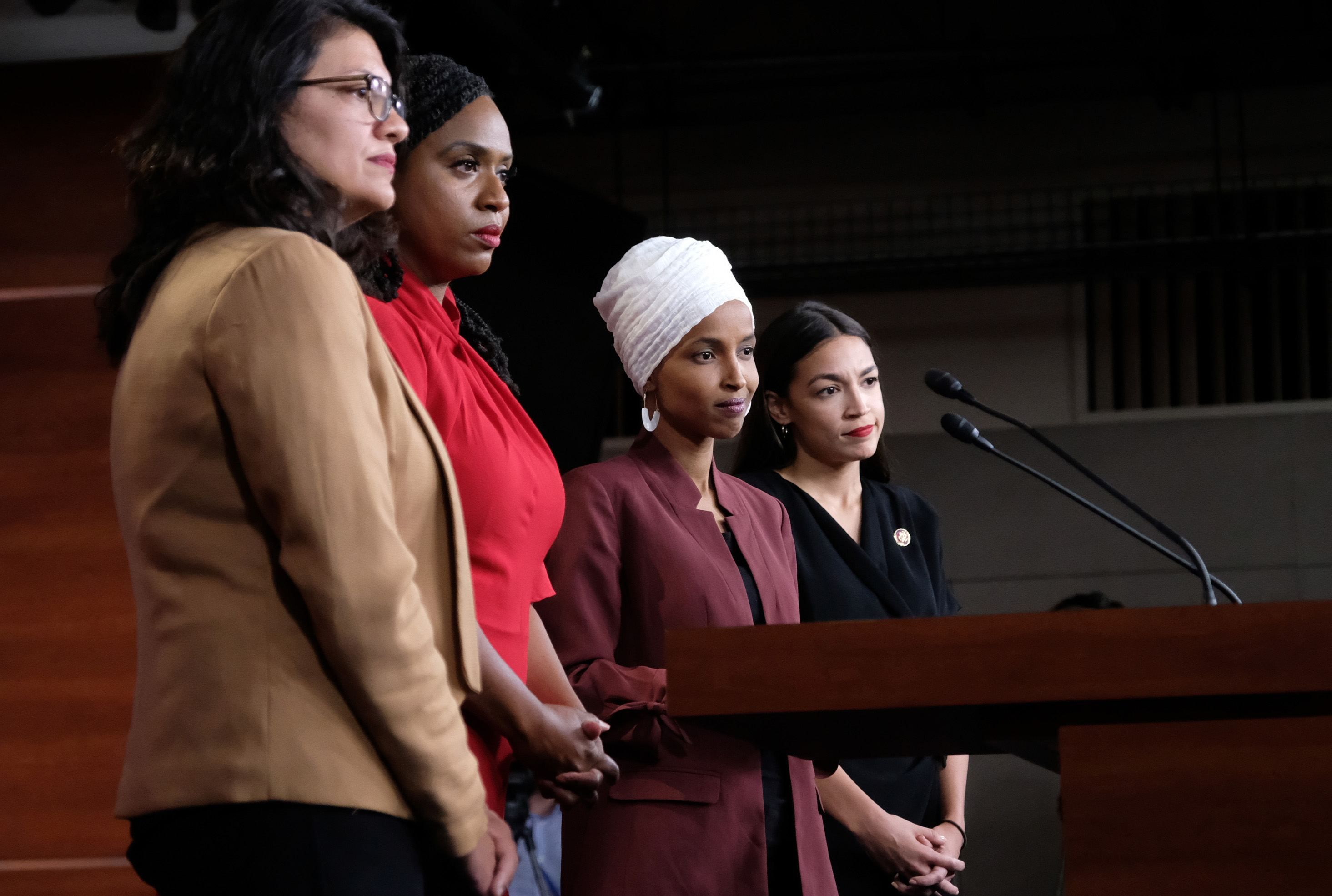
Context: Trump was asked if he thought White nationalism was on the rise around the world. He said that he didn't think so. So AOC concluded that this response meant that he would turn a blind eye to acts of terrorism. I was arrested by her bizarre conclusion, because I myself would have responded pretty much the way Trump did, and that doesn't mean I like terrorism.
This is a big subject. Hard to talk about it without bringing in so many side issues. It's very involved. To get the history, it may be to your advantage to give a listen to my podcast on the American Civil War, but you don't necessarily need to do it first.
Although I have been interested and concerned about this issue since I was a kid reading about the Underground Railroad, the thing that set me off this time was the media reaction to Trump's statement to the "Squad:"
[So interesting to see ‘Progressive’ Democrat Congresswomen, who originally came from countries whose governments are a complete and total catastrophe, the worst, most corrupt and inept anywhere in the world, now loudly and viciously telling the people of the United States, the greatest and most powerful Nation on earth, how our government is to be run. Why don’t they go back and help fix the totally broken and crime infested places from which they came. Then come back and show us how it is done.]Now as I explain in the podcast, Trump applied this statement too broadly. For three of the four people, it doesn't fit. I don't want to elaborate here, because I explain it in detail in the podcast. But for one of them (Ilhan Omar), it fits perfectly. It is not racist, and is entirely appropriate. So let me edit the above statement to make it apply to one person:
[So interesting to see a ‘Progressive’ Democrat Congresswoman, who originally came from a country whose government is a complete and total catastrophe, the worst, most corrupt and inept anywhere in the world, now loudly and viciously telling the people of the United States, the greatest and most powerful Nation on earth, how our government is to be run. Why doesn't she go back and help fix the totally broken and crime infested place from which she came. Then come back and show us how it is done.]As you can see, the only thing I have changed is the reference (from three persons to one person). There is nothing racist about that statement. It is a very appropriate and needed exhortation. I certainly do not deny that Trump has said things with which I do not agree. But I could not agree with this one more. But it happens to be a criticism of a person of color, so to the media, it is automatically regarded as racist. That's stupid and dishonest. When you define racism as disagreeing with a Black person, you have robbed it of any significant meaning.
But, as I mentioned in the podcast, the thing that really set me off was watching a CNN "journalist" who was interviewing some folks about racism. She read a definition of racism from a dictionary, by which definition Trump was clearly not a racist. She then looked triumphantly at them as if she had just proven that Trump was a racist. This made me realize that I had to come up with a definition for racism that is so simple that even a CNN journalist can understand it. So here it is: A racist is someone who believes that moral qualities are genetically derived. That's it. Very simple. Even a CNN journalist could figure it out. I am not a racist. I do not believe it is right to present someone's ethic grouping as being morally inferiur. Genes are morally neutral. But I am a critic of culture. Culture is not morally neutral. As Frances Schaeffer said, "If there are no absolutes by which to judge society, society is absolute." I have been a student of culture since I moved to America when I was thirteen years old. I do believe that people of conscience should stand in judgment of culture when it strays from the moral standard God has written on our hearts--such as Confucius (孔子) in The Analects, which I read from in this podcast. So I guess you could say I am a culturist. Here then are the definitions we are going to be using in our discussion of this subject:
racism the belief that moral qualities are genetically derivedIf you don't like my definitions, you can throw them away when you finish listening to this podcast. But if you listen carefully, I hope you won't want to.culturism the belief that some cultures are morally superior to others, or more precisely, that certain aspects of some cultures are morally superior to certain aspects of other cultures
The video below contains a discussion about Kanye West. In the video, Bakari Sellers says "This is what happens when Negroes don't read." This is a reference to a Chris Rock comedy routine from the nineties. You don't need to watch all of that comedy routine, but if you can manage to endure the first three-and-a-half minutes, you will hear the statement that Bakari Sellers paraphrases in the video below. Clearly, Sellers is saying that Kanye West belongs to the category of Black people to whom Chris Rock is referring. That is unfair and disgusting. Listen yourself and see what you think.
Book List:
The Warmth of Other SunsMovie List:Gone With the Wind
Green BookMississippi Burning
Labels: American Society, Philosophy, Racism
Thursday, May 30, 2019
American Civil War

Click on the image above to view presentation slides. Note that this is a recording of a classroom lecture, so you will not have a prompt to tell you when to adance to the next slide. Pay attention. 😄
Back in the spring of 2016, I gave a lecture at my university on the American Civil War. I thought perhaps I would put it online, but I got busy with other things, so it sorta got put on the back burner. After all, it's not the kind of thing most people are interested in. Then, in the summer of 2017, came the riot in Charlottesville. I was quite taken aback by this, especially all the fuss about tearing down statues of Civil War figures. That and the "Black Lives Matter" controversy has made me begin to think that perhaps there is a value in today's young people having at least a cursory knowledge of the issues.
My own experience with the Civil War goes back to 1960, the 100th anniversary of the Civil War. As we will discuss, the Civil War broke out after the election of 1860. Sometimes in America, a candidate is elected that nobody expected to win, and the losing side gets really mad. That's what happened in 1860. Anyway, I started first grade in the fall of 1960. It was 100 years after the South seceded and it was also an election year. Kennedy was running against Nixon. Dad took Johnny and I down to Woolworth's. I got a blue cap and Johnny got a grey cap. That was all you really needed to play Civil War.
I didn't really know what I was doing at that time, but two or three years later, I read a book about the Underground Railroad that really fascinated me. Then, a couple years later, when I was in sixth or seventh grade, I read a book about the Andrews Raiders.
Throughout the sixties and seventies, the issue of race was kept alive, but partially overshadowed by the Vietnam War. I maintained an interest in the Civil War, but did not study it actively for twenty years or so. Then, in the eighties, I began a ten year study of the Civil War. I have always tended to study history by biography. In other words, instead of reading a book about events, I will study the players on the stage one at a time, and then piece together the events from what I have learned about those events by studying the people who made them happen.
When I began my study of the Civil War, my objective was fairly simple: I wanted to know what a winning general was like, and I wanted to know what a losing general was like. How do losers think? How do winners think? For example, in examining the lives of Grant and Lee, I noticed some interesting contrasts. Lee was brilliant. And he was a very disciplined, perhaps even a bit repressed, human being. In contrast, Grant had a more laid back personality. Lee went through four years of West Point without a single demerit. Grant wasn't at West Point more than a few months when he wrote back to his people, "Every time you turn around they give you one of those little black marks."
Grant came from a very stable, perhaps you could even say boring family. Lee came from a broken home (he was the son of Light Horse Harry). Grant was inclined to believe that keeping the Union together was of paramount importance for the stability of the country. In other words, if you keep the country together, the citizens thereof are better off. Lee was more inclined to think that sometimes division is necessary when two parties find it difficult to get along. Grant fought for the sake of the whole union, not for just his own state. Lee sacrificed the good of the union to defend his own state. The result of Grants victories was that the union was preserved, and the individual states thereof (including his own) were better off. The result of Lee's efforts were that the South was destroyed, and his own beloved Virginia was forever divided, never to be unified again.
You might say thay my observations are a bit amateur, and I would not argue. I am not a professional historian, and perhaps I have made a bit much of Grant's mediocre success in worldly pursuits--his lack of a career, so to speak. I make him sound like a loser, when he was actually a very good man. But the contrast between his lack of success in everything he tried, and his extraordinary success in battle is so profound that it cannot be ignored.
But something happened as I moved through the history of the Civil War. My knowledge of the characters increased, but my objective also altered somewhat. Sometimes, when you examine an event, and try to identify and study the major players, you run into a personality so profound that it eclipses all others. This happened to me. I studied mainly the generals, both North and South, but one personality emerged that could not be ignored, and that stood out as a defining character of the conflict. That personality was Abraham Lincoln.
Lincoln was either loved or hated. Coming from northern culture (North Dakota and Minnesota) we were always taught to admire Lincoln. But there were Southerners who thought of him as a very bad man. Like my friend Bill. Bill was from North Carolina, but he taught in the country schools of North Dakota for many years. That's where I met him. I was teaching Palmer School, and he was at Stoney Creek. In the country schools in North Dakota, the front of the classroom had a standard appearance. There was a flag in the middle above the blackboard, then on one side, a giant picture of George Washington, and on the other, a giant picture of Abraham Lincoln. Later, I stayed at Bill's place in Bismarck during the time I was a lobbyist in the North Dakota State Legislature.
This was during the time that I was actively studying the American Civil War, and I used to bring up the subject from time to time. Every time I mentioned Lincoln, he uttered one static, unchanging statement. He never wavered from it, no matter how hard I tried to shake him loose. He said, "I'm not sorry Lincoln was shot. I'm just sorry he wasn't shot four years earlier."
I hesitate to even tell this, because you might get the impression that Bill was a hard guy. Nothing could be further from the truth. Bill was a poor boy from the old South who would never had much, but always shared what he had. I remember there was some controversy one time about Walmart clothes being made overseas in shops that paid less than a dollar an hour. Bill just could not make sense of it. "I don't know what they're complaining about. I used to mow lawns for twenty-five cents an hour."
I came through Bismarck one time in my truck and he had found a baby rabbit. He was trying to nurse it back to health, but the little critter just would not eat. This is a common problem for wild animals in captivity. So Bill decided let the little rabbit go. We drove to a large park in the city and walked to an open area. Bill set the little thing down, then he took his hat off his head and prayed to God to protect this little rabbit. He was that kind of a guy. But when I brought up the subject of Lincoln, same old answer: "I'm not sorry Lincoln was shot. I'm just sorry he wasn't shot four years earlier."
I'll have more to say about Lincoln later. Much more, because he was such a dynamic figure. But for now, just let me say that the change in Lincoln's thinking was, I have come to believe, the central drama of the American Civil War. He came to believe that God was very angry about slavery, and that if he wanted God to help him win the war, he had to help God put an end to slavery.
The effects of the civil war are pervasive. In this lecture I focus mainly on how it changed the status of the states with respect to the whole union. But later I want to talk about the residual effects of the Civil War on every aspect of American life.
I remember years ago when I was pulling a flatbed for E.W. Wylie out of Fargo, another driver and I were having lunch or something together. He was a Minnesota boy, and he was telling me about one time when he was south of Mason-Dixon and saw a driver with a cap that said, "Lee surrendered. I didn't."
Well, you can't do much truckin' in the old South without seeing that once in awhile. I said, "So?"
He said, "I went up to him and I said, "Grant accepted his surrender. I didn't!"
I laughed. War's over, boys. Give it a rest. But as we have seen from Charlottesville, it hangs on. Feelings run deep, even after all these years. On my father's side, I can get out of it. My grandfather came to North Dakota as a homesteader in the early part of the twentieth century. So my people on my father's side of the family were newcomers, relatively speaking. But my mother's people were from Bergen, and they came earlier. Among them were the brothers or cousins of my great-great grandfather, can't remember which, but they were in the Fourth Minnesota, and fought under Rosecrans in the Battle of Corinth. So even though I myself grew up on Japan, I'm a Minnesota Yankee on my mother's side of the family. I mention that because you need to be aware of it as you listen to me talk about the Civil War. There are so many things--things I am not even aware of it, that are affected by the frame of reference I was given by being born into the family I came from.
The slides can be watched a couple different ways. If you are the type of person who likes to scroll through just like a regular .pdf, you can just click on the picture above and the slides will open up and you can view them online. If you're like me, and you prefer a regular slide show, then download the file first, open it up in Adobe, and then go to the View menu and put it in Full Screen Mode, and then you can watch it just like a regular slide show, using the arrow keys to go back and forth.
Labels: American Civil War, American Society, Racism
Saturday, October 27, 2018
Xingiang
There have been several reports in recent years about repressive policies, such as cutting men's beards so that they don't become terrorists, and restricting access to the Qur'an or the practice of Ramadan (daytime fasting for one month a year). But what has disturbed many human rights groups recently has been the reports of thousands of Uyghurs being taken from their homes and placed in detention camps. It has not been easy to get accurate information about this, because China severely restricts media access to Xinjiang, at first did not acknowledge the camps. But for some reason, they have changed their approach and decided to acknowledge the camps and defend their existance.
There is another problem with news about things like this. In China, the media is strictly controlled/regulated by the government, so government papers are replete with scripted propaganda, or restricted from mentioning the subject at all. But in America, media is controlled by advertising. This means that headlines are structured to get you to click on them, and bad news than good news. So reporting about China tends to be negative. In addition to this, allowing media to be controlled by advertising means that subject matter is controlled by the prevailing appetites and fetishes of the masses rather than a sincere, dogged pursuit of the truth. So with American news outlets, especially online ones, the important stories of the day are often buried in mountains of trivia.
So what is the difference between click-bait and propaganda? Only the intent--they're both garbage, just with different purposes. So I tend to avoid media that is afflicted by either of these problems. Still, I would like to get a source from China, because they would much less likely (obviously) to tell a story that was totally negative. The problem is that news articles in the Global Times and the China Daily are extremely boring and poorly written, and there is little or no in depth discussion of issues, because it isn't politically safe. So, with modern smart phones, where I can sit on the bus or the tram and read the news from any number of international news outlets on my smart phone, I don't read Chinese news nearly as much as I ought to.
Last night one of my students informed me that there was widespread detention of Uyghurs in Xinjiang. She said she got the information from BBC. Interesting. So if local people are just finding out about this now, that must mean that the Chinese media has been pretty quiet about it.
Wednesday, August 29, 2012
The Warmth of Other Suns
I probably shouldn't have bought this book--I'm definitely not short of stuff to read. But I was intrigued by the subject. It concerns the mass migration of Blacks from the South to find a better life in other places. I read The Underground Railroad when I was in elementary school, and that book was very enlightening. But it seemed somewhat remote, because I grew up in Japan, where whites were minorities. But we were not mistreated because of it. After we moved to the States when I was thirteen, I read Black Like Me, and this alerted me to a problem I had not well understood before that, I guess because I spent most of my childhood in Japan. I lived in Williston, North Dakota for four years as a child, but there aren't that many Blacks in that part of the country. I only remember one black kid from my younger years in that town. I do remember Mom telling us that we must never say the word, "nigger." She said we were supposed to call them "colored people." When I was in junior high in the late sixties in Minnesota, I was part of a discussion competition. One of the kids in our group, a bookish kid who was always pontificating about something or the other, said one day, "you know, actually they prefer to be called 'Blacks' now." The other kids ridiculed him, "No they don't! Would you like it if we called you 'whitey?'" But the kid was right.
After Obama was elected four years ago, much was made about him being the first Black president. Nonsense. The whole thing was a complete fraud. Obama does not have anyone in his family who is even remotely connected with Black America. His father was from Kenya. Obama is not descended from Black America, he is descended from white America. Some day there will be an American black guy who becomes president. But probably not anytime soon. Obama is black and he happens to be an American citizen. But he is not a Black American. Obama is an Irish-American politician just like Reagan, Clinton, Tip O'Neil, the Kennedy's, and a whole host of others. If you want to know the truth, the first "Black president" was LBJ. He was the one who pushed through the civil rights legislation of the sixties. Martin Luther King got all the attention. But Martin Luther King would have been nothing more than a blip on the radar of history if anyone else had been president. And he thanked LBJ by castigating him for the Vietnam War! I have never been much of a fan of MLK. But I did like Malcom X. Martin Luther King taught that racism was a result of ignorance, and that the solution lay in education. But Malcom X believed that racism was evil. To be sure, Malcom X was a little extreme. He was a Black Muslim. The Black Muslims were led by Elijah Muhammad, who taught that the White man was descended from Satan. I read The Autobiography of Malcom X during the years I was driving over the road. The book wasn't actually penned by Malcom X. It was written by Alex Haley, the same guy who wrote Roots. Malcom X was probably too crazy to actually sit down and write a book. But reading him was refreshing, because Jesse (I may be well dressed but I'm still oppressed) Jackson was on the scene then, and I always found him to be quite annoying. He always talked about racism, but in fact, racism was his bread and butter, and to make a good living he had to stir it up as much as he could. If racism came to a grinding halt today, Jesse Jackson would have to go out tomorrow and get a job like everyone else.
Not to say that there isn't racism in America. But true racists stand out. They are there, though. I was talking to a driver from Idaho once, and we got into the subject of race. I said, "If you hear a white boy from the old south bad-mouthing Blacks, you can be pretty sure he is doing it because he knows that the average Black man is a good bit more intelligent than he is." Well, this guy's response was immediate. He lived in Idaho, but he was born and raised in Alabama, and he definitely did not like my analysis. But I stand by it. Racism is evil, but I detest all of it--both the southern white boy kind and the Jesse Jackson kind.
This book is called The Warmth of Other Suns. As I mentioned, it concerns the "great migration." I am curious to see if this is anything significantly different from the migration that was a natural part of the depression era. I'll let you know what I find out.
Labels: Racism
