Links
- CV
- Titles
- Topics
- Tickets
- Science
- About Eric
- Book Reviews
- Country Profile
- Modern China
- Contact Eric
- Podcast
- Vision
- Sekai
- John
Archives
RSS

Reflections on a Wandering Life.....
Friday, August 02, 2019
Undercover in Xinjiang

Isobel Yeung, journalist for VICE News (Click photo for bio)
The other day I read a couple reports about the situation in Xinjiang, both of which indicated that the government may be close to closing the concentration camps housing thousands and thousands of Uyghurs and Kazakhs. One of the articles seemed to indicate that this may come soon and may already be happening. The other had more of a "some day if everything works out" feel to it. I'm not holding my breath, but I am going to be watching this very closely. Today I read another report saying that families were demanding proof that their missing relatives were actually free. So I am getting mixed messages. It may be a little time before the dust settles and we find out what changes (if any) have actually taken place.
I have mentioned the Magna Carta before. This is the thirteenth century document that outlines the basic human rights standard re: deprivation of liberty. I previously referred to Article 38, but the English version linked from the Wikipedia article identifies the same paragraph as Article 39. To avoid any confusion I will quote it here:
No free man shall be seized or imprisoned, or stripped of his rights or possessions, or outlawed or exiled, or deprived of his standing in any other way, nor will we proceed with force against him, or send others to do so, except by the lawful judgement of his equals or by the law of the land.So do the concentration camps in Xinjiang constitute a violation of this principle? I think there is no question about it. But is America right to criticize China for the construction of these camps? No. America is completely hypocritical. Yes, the camps in Xinjiang constitute a violation of this provision from the Magna Carta. But so did Guantanamo. Bush Jr. openly admitted that he had located the camp in Cuba to avoid having to be bound by American rules of due process (which, of course, were based on the Magna Carta). You see, this is what is to frustrating about this whole issue. Jesus said, "He that is without sin among you, let him first cast a stone..."
The problem in today's world is that when countries like China, which do not operate according to accepted standards of human rights, commit massive human rights abuses such as the incarceration of thousands of innocent Chinese citizens in concentration camps, it is getting harder and harder to find a country or countries to confront China that are not in some way guilty themselves.
But there are bright spots. The video below shows the exploits of two young ladies who went to Xinjiang to document the problem with hidden cameras. They went in, got the information they needed and got out. And then, incredibly, they went back in. Watch this. It is as entertaining as it is informative. Pray for the people of Xinjiang. Let us all pray that these dreaded concentration camps will soon be closed down so that these innocent people, who have never been charged with a crime and are decent law-abiding citizens, can return to their homes and families.
This video is important for a couple reasons: First, it is very useful, because it features scenes that an official journalist guided by government "minders" would never see. But it is perhaps more important because it shows that sometimes when we see man's inhumanity to man, we tend to throw up our hands and say "There is nothing I can do." But these two young ladies did something. They did not have political power, but they had the power of information, and in sharing this dark story with the outside world, they have made it harder for the powers that be to continue the injustice.
Labels: Detention, Magna Carta, Turkey, Uyghurs, Xinjiang
Thursday, March 21, 2019
Uyghur Detention Camps in Xinjiang
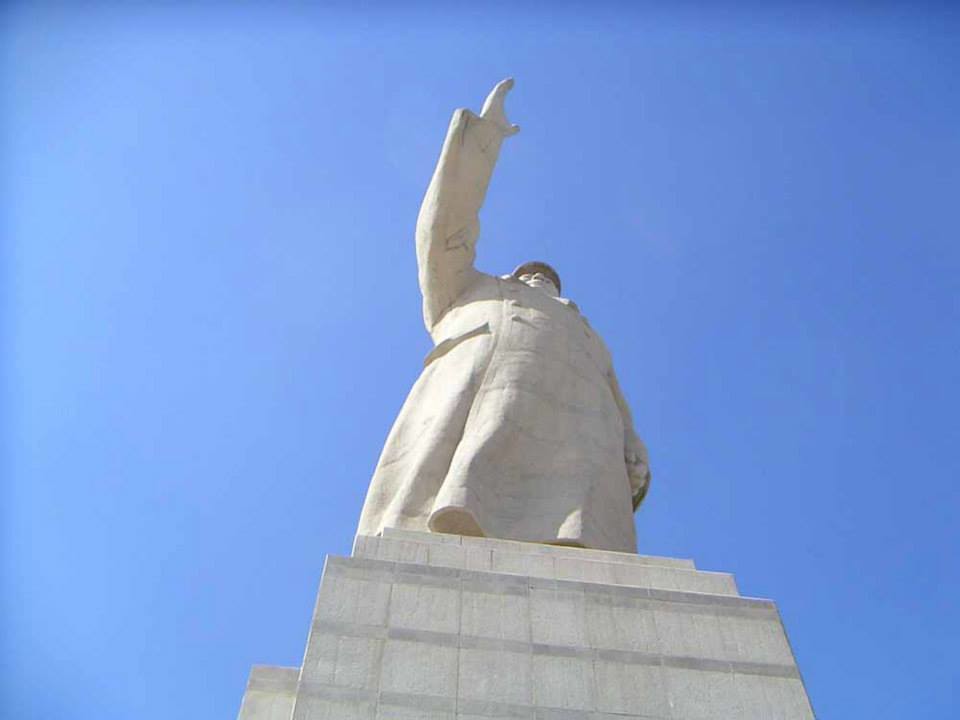
Largest statue of Mao in the world - Kashgar, Xinjiang
Labels: Detention, Individual Liberty, Magna Carta, Uyghurs, Xinjiang
Saturday, October 27, 2018
Xingiang
There have been several reports in recent years about repressive policies, such as cutting men's beards so that they don't become terrorists, and restricting access to the Qur'an or the practice of Ramadan (daytime fasting for one month a year). But what has disturbed many human rights groups recently has been the reports of thousands of Uyghurs being taken from their homes and placed in detention camps. It has not been easy to get accurate information about this, because China severely restricts media access to Xinjiang, at first did not acknowledge the camps. But for some reason, they have changed their approach and decided to acknowledge the camps and defend their existance.
There is another problem with news about things like this. In China, the media is strictly controlled/regulated by the government, so government papers are replete with scripted propaganda, or restricted from mentioning the subject at all. But in America, media is controlled by advertising. This means that headlines are structured to get you to click on them, and bad news than good news. So reporting about China tends to be negative. In addition to this, allowing media to be controlled by advertising means that subject matter is controlled by the prevailing appetites and fetishes of the masses rather than a sincere, dogged pursuit of the truth. So with American news outlets, especially online ones, the important stories of the day are often buried in mountains of trivia.
So what is the difference between click-bait and propaganda? Only the intent--they're both garbage, just with different purposes. So I tend to avoid media that is afflicted by either of these problems. Still, I would like to get a source from China, because they would much less likely (obviously) to tell a story that was totally negative. The problem is that news articles in the Global Times and the China Daily are extremely boring and poorly written, and there is little or no in depth discussion of issues, because it isn't politically safe. So, with modern smart phones, where I can sit on the bus or the tram and read the news from any number of international news outlets on my smart phone, I don't read Chinese news nearly as much as I ought to.
Last night one of my students informed me that there was widespread detention of Uyghurs in Xinjiang. She said she got the information from BBC. Interesting. So if local people are just finding out about this now, that must mean that the Chinese media has been pretty quiet about it.
