Links
- CV
- Titles
- Topics
- Tickets
- Science
- About Eric
- Book Reviews
- Country Profile
- Modern China
- Contact Eric
- Podcast
- Vision
- Sekai
- John
Archives
RSS

Reflections on a Wandering Life.....
Friday, September 04, 2020
China Undercover : Xinjiang Revisited
Technical Note: I have gotten feedback that this video may be blocked in some places in America due to copyright issues. I live in China, so it is very hard to verify that. Please let me know if there are any issues.
Very informative documentary on Xinjiang. Their estimate for the number of Uyghurs interned in concentration camps is two million. I think that number is high, but I think it is safe to say that there have been several hundred thousand. We have been hearing reports that the camps have now been closed (the documentary also mentions this), but I am skeptical, because many of those who had disappeared have still not been heard from. It could be that they have been sent to work camps. I have several times heard reports that some Uyghurs have been transfered to other provinces to be used for labor. Whatever the case may be, there is no question that a massive, horrifying abuse of human rights has gotten the world's attention. I don't think China expected this. I think they thought they were going to get away with it. The world largely ignored the removal of crosses in Wenzhou in the summer of 2014.
But this is very different. This involves locking up many, many innocent people because of their ethnicity. These people have committed no crimes, and most of them have no political involvement. But they either have relatives abroad, or have expressed too much interest in Islam or some such thing.
In my opinion, it was a colossal error in judgment on the part of the Communist Party. There is no question that has been a public relations disaster. When I first came to China, there was some kind of television program or movie where all the bad guys had Henan accents. Lots of people in Henan complained, but it brought up discussion about Henan's reputation. I was intrigued, because I had never heard about this before, and it turns out that I had quite number of friends from Henan province, perhaps mainly because the house church movement is especially strong there. So I asked one of my Henan friends, "What's this about Henan? Why do people think that people from Henan are bad?
She said, "Henan is to China what China is to the rest of the world." That was a signitficant statement about Henan (whether or not it's true), but an equally significant statement about China. There are times when it seems for all the world like the boys at Zhongnanhai want to make sure China doesn't lose that reputation as the "bad boy" of Asia. So China has come under significant criticism for this great injustice toward innocent people.
But I also see a problem with their critics. They often use the term "genocide" when referring to what China is doing to the Uyghur people. I don't like this, because it isn't honest. Words have meanings. Genocide means mass killing. The Communists are putting the Uyghurs in concentration camps. They are not putting them in gas chambers. The problem with using emotionally loaded terms like "genocide," is that you turn the perpetrators of the injustice you are fighting into victims, because you're saying something about them that is not true, so that creates an opportunity for them to deny everything you're saying about them. Then, suddenly, people are saying, "I guess it's not so bad for them to be putting people in concentration camps as long as they are not executing them," and this becomes the new normal.
No. As I have said previously, deprivation of liberty without due process is a violation of human rights. If you house me in a palatial mansion, give me servants who wait on me hand and foot, and server me sumptuous meals on solid gold dinner ware, you are still violating my human rights if you are keeping me there against my will. We must not back down from this. I suspect that the reason the "supporters" of the Uyghurs use emotionally loaded terms like genocide, is because in their heart of hearts they don't really believe that deprivation of liberty is that bad. So how, then, are they any better than the Communists, who are putting people in concentration camps labeled as training centers because they also do not believe deprivation of liberty is that bad as long as you can convince yourself that you are doing it in the best interest of the people?
What about cultural genocide? Yes, that is a legitimate issue, but a lot more research needs to be done about this. I have heard information in the years since the summer of 2005 when I was in Kashgar about destruction of traditional Uyghur communities. And there is some talk that traditional Uyghur activity is being replaced by fake displays. More recently, the government is scaling back the teaching of the Mongolian language in Inner Mongolia. Reports like this are deeply troubling, and if focus is placed on this issue and held there, I am all for that. But too often what happens is that they start out talking about cultural genocide, and then gradually, quietly drop the "cultural" off the term and we're back to genocide. That's wrong both because it takes the focus off cultural genocide, which is a real issue, and puts it on genocide (such as Hitler putting six million Jews in gas chambers) which is a phony issue with respect to Xinjiang, but also because, again, it puts deprivation of liberty on the back burner so to speak, with the implication that it is not really sufficiently unjust to stand alone as a singularly eggregious violation of human rights. We need to go back to the Magna Carta.
The other problem I have with those who claim to be defending the Uyghurs is that they talk about Xinjiang being an independent country as the ideal. I do not agree. The country name that I see mentioned on Twitter is "East Turkestan." But I'm quite certain most of the people who support the idea of Xinjiang as an independent country do not know where that name came from. It was not a name created by Uyghurs to identify their own country. It was invented by the Russians as an attempt to replace the British name, which was "Chinese Turkestan." The British name was no doubt frustrating to the Russians, because in using that name, the Brits were giving it to China to keep it from Russia.
Back in 2005, I traveled to Xinjiang. I flew to Urumqi and took the train 24 hours across the burning hot Taklamakan Desert to Kashgar. In Kashgar, I stayed at a place called the "Seman Binguan." Behind the Seman Binguan was the old Russian Conuslate, looking exactly like it did in 1890. Across town, behind the Chinibagh hotel was the old British Consulate. The Brits and the Russians were in competition for India--what Rudyard Kipling called "The Great Game." It was the "Cold War" of the nineteenth century, and Kashgar was considered "neutral territory." It was clearly in the interest of the Brits for Xinjiang to belong to China. The Brits never had any designs on Xinjiang. Not so with Russia.
Here's the bottom line: Historically, Xinjiang was either going to be part of Cnina or part of Russia. Which would you prefer? Those who advocate independence for that area seem to believe that the world would be a safer place if we just had one more Islamic Repubic. I rather think not. So you see, the solution to the problem is not to make Xinjiang independent. Who's army would defend its independence?
But that having been said, it must be admitted that China's administration of Xinjiang has been clumsy at best. I have always felt that the people of Xinjiang would have been so much better served if the Chinese government had attempted to hear from the Uyghur people about what their concerns were. But the powers that be in China seemed to be determined to forget about the needs of the people and focus on controlling them. And in 2016 they began to move from control to abject cruelty.
The government policy toward Uyghurs is essentially racist. A couple years ago one of my students told me her family was going to take a trip to Xinjiang. I told her to be careful. She assured me that they had nothing to worry about because they were Han people. She said that without batting an eye. This is not to say that all Han people are hostile toward Uyghurs. Not at all. There are many Han people who are very friendly toward Uyghurs. But they don't seem to feel that Uyghurs should enjoy the same rights that they, as the majority people group in China, take for granted.
Labels: Human Rights, Magna Carta, Minorities, Mongolians, Uyghurs, Xinjiang
Friday, August 02, 2019
Undercover in Xinjiang

Isobel Yeung, journalist for VICE News (Click photo for bio)
The other day I read a couple reports about the situation in Xinjiang, both of which indicated that the government may be close to closing the concentration camps housing thousands and thousands of Uyghurs and Kazakhs. One of the articles seemed to indicate that this may come soon and may already be happening. The other had more of a "some day if everything works out" feel to it. I'm not holding my breath, but I am going to be watching this very closely. Today I read another report saying that families were demanding proof that their missing relatives were actually free. So I am getting mixed messages. It may be a little time before the dust settles and we find out what changes (if any) have actually taken place.
I have mentioned the Magna Carta before. This is the thirteenth century document that outlines the basic human rights standard re: deprivation of liberty. I previously referred to Article 38, but the English version linked from the Wikipedia article identifies the same paragraph as Article 39. To avoid any confusion I will quote it here:
No free man shall be seized or imprisoned, or stripped of his rights or possessions, or outlawed or exiled, or deprived of his standing in any other way, nor will we proceed with force against him, or send others to do so, except by the lawful judgement of his equals or by the law of the land.So do the concentration camps in Xinjiang constitute a violation of this principle? I think there is no question about it. But is America right to criticize China for the construction of these camps? No. America is completely hypocritical. Yes, the camps in Xinjiang constitute a violation of this provision from the Magna Carta. But so did Guantanamo. Bush Jr. openly admitted that he had located the camp in Cuba to avoid having to be bound by American rules of due process (which, of course, were based on the Magna Carta). You see, this is what is to frustrating about this whole issue. Jesus said, "He that is without sin among you, let him first cast a stone..."
The problem in today's world is that when countries like China, which do not operate according to accepted standards of human rights, commit massive human rights abuses such as the incarceration of thousands of innocent Chinese citizens in concentration camps, it is getting harder and harder to find a country or countries to confront China that are not in some way guilty themselves.
But there are bright spots. The video below shows the exploits of two young ladies who went to Xinjiang to document the problem with hidden cameras. They went in, got the information they needed and got out. And then, incredibly, they went back in. Watch this. It is as entertaining as it is informative. Pray for the people of Xinjiang. Let us all pray that these dreaded concentration camps will soon be closed down so that these innocent people, who have never been charged with a crime and are decent law-abiding citizens, can return to their homes and families.
This video is important for a couple reasons: First, it is very useful, because it features scenes that an official journalist guided by government "minders" would never see. But it is perhaps more important because it shows that sometimes when we see man's inhumanity to man, we tend to throw up our hands and say "There is nothing I can do." But these two young ladies did something. They did not have political power, but they had the power of information, and in sharing this dark story with the outside world, they have made it harder for the powers that be to continue the injustice.
Labels: Detention, Magna Carta, Turkey, Uyghurs, Xinjiang
Thursday, June 20, 2019
Hong Kong Explained

Demonstrators in Hong Kong protesting the extradition bill,
which has now been suspended.
Over the past days there have been extraordinary demonstrations in Hong Kong. In this podcast episode, I explain the demonstrations and some of the history behind them.
Here are some links for statements I referred to in this episode:
https://mobile.twitter.com/bopinion/status/1140459638594215936
Nisha Gopalan's explanation of the difference between the Occupy
Central demonstrations in 2014 and the current demonstrations.
https://twitter.com/foreignoffice/status/1139192317812903936
Statement by the British Foreign Office on the Joint Declaration.
Here are some resources that might be of use to you in studying this issue:
News Sources:
http://news.rthk.hk/rthk/en/news-programmes/this-episode.htm?cmsid=78
Newswrap on RTHK. This is a nightly radio news program discussing the
events of the day. Very useful in understanding day to day events in
Hong Kong.
https://www.youtube.com/playlist?list=PLuwJy35eAVaIZpCKUpS00uriIRNCUdUHg
The Pulse. Public affairs television from Hong Kong, with Steve Vines
Twitter Accounts to Follow
https://twitter.com/VivienneChow
Vivienne Chow. Some time ago I was doing some research on the flag
issue and I came across an article of hers that was really quite well
written. Also, she is not a politician, so she writes about other stuff.
Highly recommended if you want to keep tabs with what is going on in the
SAR.
https://twitter.com/hkchrislau
Chris Lau. Reporter for SCMP (South China Morning Post). I'm sure I
would not agree with everything he writes, but I do like his twitter posts.
Following him is a little like following Brit Hume--he points me to
informative articles, which saves me a lot of time looking them up myself.
https://twitter.com/joshuawongcf
Joshua Wong, one of the student leaders of the Occupy Central
movement. You have to admire this guy--he does seem sincere, but
sometimes his attitude toward the police annoys me. Also, I wish some
of these student leaders would spend some of their energy trying to
reach out to China--not kissing up to them, but openly and honestly
stating what kinds of changes would help to improve relationship.
Labels: Hong Kong, Magna Carta, Police
Thursday, April 11, 2019
Xinjiang re-education camps
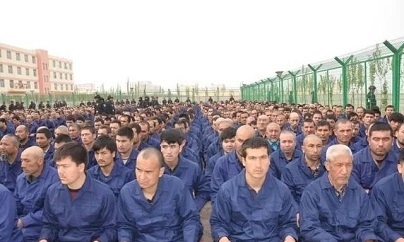
Detainees listening to speeches in a re-education camp.
Lop County, Xinjiang, April 2017.
Labels: Human Rights, Kazakhs, Magna Carta, Uyghurs, Xinjiang
Thursday, March 21, 2019
Uyghur Detention Camps in Xinjiang
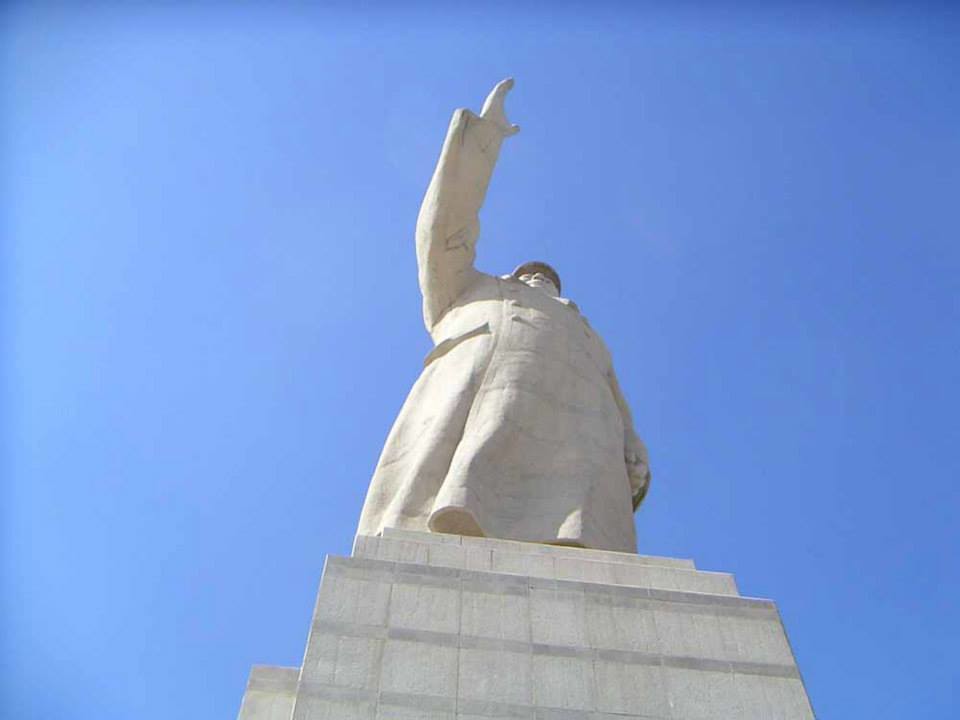
Largest statue of Mao in the world - Kashgar, Xinjiang
Labels: Detention, Individual Liberty, Magna Carta, Uyghurs, Xinjiang
Tuesday, April 14, 2009
Treatment of Detainees
The front page of the China Daily outlines the new human rights action plan relative to treatment of detainees. This is certainly welcome. But more questions need to be asked about how those detainees got there, and whether they should be there at all. The plan does include some provisions for criminal procedure. The problem is that you would have to be accused of a crime to benefit from them. As far as I know, extrajudicial arrests and detainment are not affected by the human rights action plan. So criminals who are accused have a right to a fair trial, but little old ladies who wish to protest expropriation of property by corrupt officials, or some other such injustice, can still be sentenced to re-education through labor.
Americans look at China and measure all reform by how much it increases the right of people to choose their leaders. I have said this before, but I do not believe that democracy should be the objective. Democracy is just a form of government. The objective is personal liberty. An increase in democracy does not necessarily equate to an increase in personal liberty. If the government of China can give people personal freedom (including freedom from confiscation of their homes), it does not owe any explanations to Americans or others who insist that China must copy western style democratic governments. Freedom is ever the watchword when we evaluate political reform.
Labels: Democracy, Human Rights, Language Learning, Magna Carta
