Links
- CV
- Titles
- Topics
- Tickets
- Science
- About Eric
- Book Reviews
- Country Profile
- Modern China
- Contact Eric
- Podcast
- Vision
- Sekai
- John
Archives
RSS

Reflections on a Wandering Life.....
Friday, September 04, 2020
China Undercover : Xinjiang Revisited
Technical Note: I have gotten feedback that this video may be blocked in some places in America due to copyright issues. I live in China, so it is very hard to verify that. Please let me know if there are any issues.
Very informative documentary on Xinjiang. Their estimate for the number of Uyghurs interned in concentration camps is two million. I think that number is high, but I think it is safe to say that there have been several hundred thousand. We have been hearing reports that the camps have now been closed (the documentary also mentions this), but I am skeptical, because many of those who had disappeared have still not been heard from. It could be that they have been sent to work camps. I have several times heard reports that some Uyghurs have been transfered to other provinces to be used for labor. Whatever the case may be, there is no question that a massive, horrifying abuse of human rights has gotten the world's attention. I don't think China expected this. I think they thought they were going to get away with it. The world largely ignored the removal of crosses in Wenzhou in the summer of 2014.
But this is very different. This involves locking up many, many innocent people because of their ethnicity. These people have committed no crimes, and most of them have no political involvement. But they either have relatives abroad, or have expressed too much interest in Islam or some such thing.
In my opinion, it was a colossal error in judgment on the part of the Communist Party. There is no question that has been a public relations disaster. When I first came to China, there was some kind of television program or movie where all the bad guys had Henan accents. Lots of people in Henan complained, but it brought up discussion about Henan's reputation. I was intrigued, because I had never heard about this before, and it turns out that I had quite number of friends from Henan province, perhaps mainly because the house church movement is especially strong there. So I asked one of my Henan friends, "What's this about Henan? Why do people think that people from Henan are bad?
She said, "Henan is to China what China is to the rest of the world." That was a signitficant statement about Henan (whether or not it's true), but an equally significant statement about China. There are times when it seems for all the world like the boys at Zhongnanhai want to make sure China doesn't lose that reputation as the "bad boy" of Asia. So China has come under significant criticism for this great injustice toward innocent people.
But I also see a problem with their critics. They often use the term "genocide" when referring to what China is doing to the Uyghur people. I don't like this, because it isn't honest. Words have meanings. Genocide means mass killing. The Communists are putting the Uyghurs in concentration camps. They are not putting them in gas chambers. The problem with using emotionally loaded terms like "genocide," is that you turn the perpetrators of the injustice you are fighting into victims, because you're saying something about them that is not true, so that creates an opportunity for them to deny everything you're saying about them. Then, suddenly, people are saying, "I guess it's not so bad for them to be putting people in concentration camps as long as they are not executing them," and this becomes the new normal.
No. As I have said previously, deprivation of liberty without due process is a violation of human rights. If you house me in a palatial mansion, give me servants who wait on me hand and foot, and server me sumptuous meals on solid gold dinner ware, you are still violating my human rights if you are keeping me there against my will. We must not back down from this. I suspect that the reason the "supporters" of the Uyghurs use emotionally loaded terms like genocide, is because in their heart of hearts they don't really believe that deprivation of liberty is that bad. So how, then, are they any better than the Communists, who are putting people in concentration camps labeled as training centers because they also do not believe deprivation of liberty is that bad as long as you can convince yourself that you are doing it in the best interest of the people?
What about cultural genocide? Yes, that is a legitimate issue, but a lot more research needs to be done about this. I have heard information in the years since the summer of 2005 when I was in Kashgar about destruction of traditional Uyghur communities. And there is some talk that traditional Uyghur activity is being replaced by fake displays. More recently, the government is scaling back the teaching of the Mongolian language in Inner Mongolia. Reports like this are deeply troubling, and if focus is placed on this issue and held there, I am all for that. But too often what happens is that they start out talking about cultural genocide, and then gradually, quietly drop the "cultural" off the term and we're back to genocide. That's wrong both because it takes the focus off cultural genocide, which is a real issue, and puts it on genocide (such as Hitler putting six million Jews in gas chambers) which is a phony issue with respect to Xinjiang, but also because, again, it puts deprivation of liberty on the back burner so to speak, with the implication that it is not really sufficiently unjust to stand alone as a singularly eggregious violation of human rights. We need to go back to the Magna Carta.
The other problem I have with those who claim to be defending the Uyghurs is that they talk about Xinjiang being an independent country as the ideal. I do not agree. The country name that I see mentioned on Twitter is "East Turkestan." But I'm quite certain most of the people who support the idea of Xinjiang as an independent country do not know where that name came from. It was not a name created by Uyghurs to identify their own country. It was invented by the Russians as an attempt to replace the British name, which was "Chinese Turkestan." The British name was no doubt frustrating to the Russians, because in using that name, the Brits were giving it to China to keep it from Russia.
Back in 2005, I traveled to Xinjiang. I flew to Urumqi and took the train 24 hours across the burning hot Taklamakan Desert to Kashgar. In Kashgar, I stayed at a place called the "Seman Binguan." Behind the Seman Binguan was the old Russian Conuslate, looking exactly like it did in 1890. Across town, behind the Chinibagh hotel was the old British Consulate. The Brits and the Russians were in competition for India--what Rudyard Kipling called "The Great Game." It was the "Cold War" of the nineteenth century, and Kashgar was considered "neutral territory." It was clearly in the interest of the Brits for Xinjiang to belong to China. The Brits never had any designs on Xinjiang. Not so with Russia.
Here's the bottom line: Historically, Xinjiang was either going to be part of Cnina or part of Russia. Which would you prefer? Those who advocate independence for that area seem to believe that the world would be a safer place if we just had one more Islamic Repubic. I rather think not. So you see, the solution to the problem is not to make Xinjiang independent. Who's army would defend its independence?
But that having been said, it must be admitted that China's administration of Xinjiang has been clumsy at best. I have always felt that the people of Xinjiang would have been so much better served if the Chinese government had attempted to hear from the Uyghur people about what their concerns were. But the powers that be in China seemed to be determined to forget about the needs of the people and focus on controlling them. And in 2016 they began to move from control to abject cruelty.
The government policy toward Uyghurs is essentially racist. A couple years ago one of my students told me her family was going to take a trip to Xinjiang. I told her to be careful. She assured me that they had nothing to worry about because they were Han people. She said that without batting an eye. This is not to say that all Han people are hostile toward Uyghurs. Not at all. There are many Han people who are very friendly toward Uyghurs. But they don't seem to feel that Uyghurs should enjoy the same rights that they, as the majority people group in China, take for granted.
Labels: Human Rights, Magna Carta, Minorities, Mongolians, Uyghurs, Xinjiang
Tuesday, May 28, 2019
Islamic communities in China & Kazakhstan
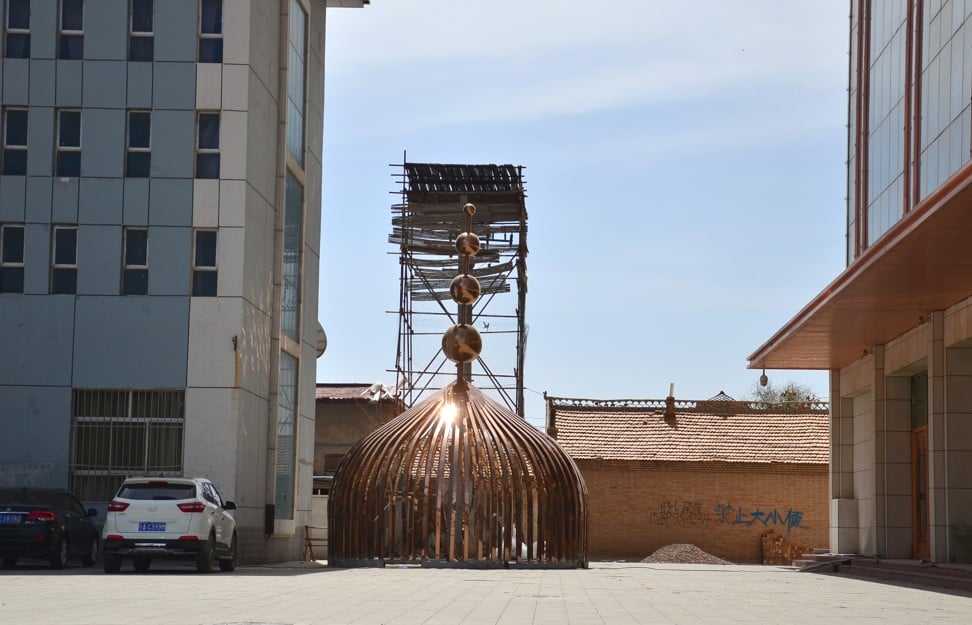
A gold dome is seen on the ground after it was removed from a hotel
in Tongxin county. Photo: Nectar Gan
Much concern has been expressed about the detention of Muslims in Xinjiang. The video below is interesting, because it also addresses the treatment of other Muslim communities in China. As I have noted before, the exact number (or even a reliable approximate number) of people detained is not available. So be aware that when you see or hear numbers mentioned, these are guesses. I don't know it it is true that there are over a million people detained. But I would think that it is at least several hundred thousand. But again, nobody knows.
Of course, as I mentioned in a previous post, the number of people detained is secondary to the question of whether they have been detained against their will without due process. Deprivation of liberty without due process is a violation of human rights regardless of what you do to those people once you have them locked up.
Another issue that is of interest to me is the response of surrounding Muslim countries. To my knowledge, the only country that has publicly taken a stand against the mass detentions is Turkey. That's not surprising, because the Uyghurs in Xinjiang Province are a Turkic people. I am thinking we may hear more about the response of other nations in months to come, but for now, it is significant that most Muslim countries support China's actions, or at least do not feel compelled to challenge them. It is one of the things I am going to be watching. This video is interesting in that regard, because it begins to explore the effect of the detention on neighboring Kazakhstan. More about that in a later post.
One further note about the video: The narration is a bit spotty. For example, they interview a Uyghur guy talking about a camp in a place called, "Kuldzha," without giving you any idea where that is. The nearest I can tell, this is referring to what is now called Yining, in northwest Xinjiang Province.
Labels: Human Rights, Individual Liberty, Justice, Kazakhs, Minorities, Uyghurs, Xinjiang
Thursday, April 11, 2019
Xinjiang re-education camps
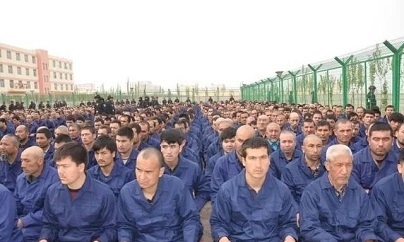
Detainees listening to speeches in a re-education camp.
Lop County, Xinjiang, April 2017.
Labels: Human Rights, Kazakhs, Magna Carta, Uyghurs, Xinjiang
Monday, December 31, 2018
A Brief Look Back at 2018
Labels: Human Rights, South China Sea, Tariffs, Trade, Uyghurs, Xinjiang
Friday, July 03, 2009
Persecution in China
But recently, some of the cases that have come to my attention have had more to do with Christians who are technically violating the government policy, but who are not in any way political. This has caused me to wonder if perhaps it isn't time to have a discussion about the policy itself, especially since it is enforced so unevenly throughout China. I'll tell you what the scoop is, and you can decide. The government policy requires all churches to register. But house churches are expressly exempted from this requirement:
There is no registration requirement for, to quote from Chinese Christians, "house services," which are mainly attended by relatives and friends for religious activities such as praying and Bible reading.The problem, of course, is that if this house church is successful, you will have a few more relatives and a few more friends and pretty soon you are pushing the limits of the policy. A recent case in Henan Province illustrates this situation. The case concerns a house church that was ordered closed by the police in December of 2008. The court judgment does not state why the church was shut down, but one can deduce that it was probably because the church in question, although not large, was clearly more than just "relatives and friends."
So here's the question: When the church was closed by the police in December of 2008, should the house church Christians have accepted this action, and ceased meeting, or were they right to deliberately defy the order? Nothing would have prevented them from continuing to meet in small groups in compliance with the government policy. Yet, while the public meeting they were conducting was clearly more than just "relatives and friends," it really wasn't that large, and certainly not more than many, many informal house churches throughout China. I visited a "house" church just a couple weeks ago that was held in a rented room in the Central Business District here in Beijing. There were fewer than a hundred people there, but the room could have held a couple hundred quite easily. I don't attend house churches very often, because they are not set up to accommodate foreigners (no English translation), and they often meet on Sunday mornings, which takes me away from my home church. But I have been to several, and I can tell you for sure that an informal church meeting with a hundred or so members is not at all unusual in China. Most of the time, the police look the other way. The largest unregistered "house church" I have attended was Samuel Lamb's church in Guangzhou, which accommodates several thousand worshippers a week in four services. When confronted by the police, Samuel Lamb (Lin Xiangao) insisted that he was in full compliance with the government policy ("this is my home; these are my friends").
We have been trying, unsuccessfully, for ten years, to get into Honan [pre Pinyin spelling]. We’ve been beaten, stoned, and turned back time and again. Brother, if you would enter that province, you must go forward on your knees!The year was 1888. As I said, Henan has a reputation.
There is a bright side. The persecution in Henan has produced a rich, vibrant Christianity. There is a peasant woman in Henan who has written more than a thousand hymns--beautiful melodious hymns rich in worship and praise to God. So I do not have fears for the church. The hostility toward Christians in Henan has had the effect of making the church stronger, not weaker. But China is more and more interested in being seen as a normal country within the community of nations, so it remains for us to discuss how this policy could be adapted to effect a more fair and uniform enforcement throughout China. I must confess to having mixed feelings about this. In one sense, it seems very unfair that these Christians are singled out for trouble, when house churches of this size are almost routinely tolerated throughout this country. But it is just as true that the restriction on large meetings has had the effect of building a very strong Christian community in China. I attended a mega-church in Arizona for seven years. Every once in awhile, they would have a big push for development of small groups. The idea would take off for awhile, and then people would gradually lose interest. They would come for one of the big weekend events, but didn't bother to join a small group. Mega-churches in America tend to follow a rock concert motif, where the audience is largely being entertained. And, of course, church discipline is virtually nonexistent (except in the case of church staff). This does not make for a healthy, robust church community. American mega-churches tend to be materially rich and morally feeble.
China is very different. House churches tend to be small, because that keeps them "under the radar," so to speak. Church discipline is intense (sometimes excessively so), and people know each other, so they are less likely to slip through the cracks, as happens so often in large American churches. But much of this would also be true in churches up to say, about 150 or 200. You don't need to be small enough to fit in a living room to be personal. It seems to me that there wouldn't be any harm in allowing house churches to grow to a moderate level. It is quite apparent that the cops in most places agree with me, because, as I said, there are many such churches in China, and they are not shut down, or harassed, and their pastors are not sent to labor camps.
So what would you do? If you were going to write the policy, how would you word it? Remember, China is not a Christian country. There are lots and lots of very "interesting" people in this country. If you get to loose about allowing any group to meet and organize without government supervision, you could be opening a "Pandora's box." Or am I too worried? Just let people do whatever they want? You see, when you put the responsibility on your own shoulders, it does compel you to view the problem a bit more comprehensively. I think China needs to change. But what kind of change? I do think that America, as a (formerly) Christian nation, has taught the world much about the importance of faith in the life of society. But I also fear that American style religious freedom, with all of its excesses, is probably not the best model for China. China needs to find Chinese solutions to Chinese problems.
Labels: Christianity, Church Life, Human Rights, Persecution
Tuesday, April 14, 2009
Treatment of Detainees
The front page of the China Daily outlines the new human rights action plan relative to treatment of detainees. This is certainly welcome. But more questions need to be asked about how those detainees got there, and whether they should be there at all. The plan does include some provisions for criminal procedure. The problem is that you would have to be accused of a crime to benefit from them. As far as I know, extrajudicial arrests and detainment are not affected by the human rights action plan. So criminals who are accused have a right to a fair trial, but little old ladies who wish to protest expropriation of property by corrupt officials, or some other such injustice, can still be sentenced to re-education through labor.
Americans look at China and measure all reform by how much it increases the right of people to choose their leaders. I have said this before, but I do not believe that democracy should be the objective. Democracy is just a form of government. The objective is personal liberty. An increase in democracy does not necessarily equate to an increase in personal liberty. If the government of China can give people personal freedom (including freedom from confiscation of their homes), it does not owe any explanations to Americans or others who insist that China must copy western style democratic governments. Freedom is ever the watchword when we evaluate political reform.
Labels: Democracy, Human Rights, Language Learning, Magna Carta
Sunday, April 05, 2009
Legal Reform in China
The four cases mentioned in the article got a lot of attention, because they died when they did not have a death sentence. The thing about them being beaten is also a bit disingenuous. It is not that unusual for prisoners in custody to be beaten. It happens far too often. Of course, it doesn't only happen in China. The Rodney King beating in the United States got a lot of attention, and although some may counter by saying that the cops who did it were dealt with severely, it must be pointed out that they were only dealt with severely because they were caught on camera by a bystander.
What is the proper safeguard against this type of injustice? It is the rule of law. It is common today to hear various individuals in China pay lip service to the rule of law. I have heard it several times on Dialogue. And, of course, Americans always pride themselves in being governed by the rule of law. But for different reasons, neither China nor America can actually put into practice this noble principle they both claim to espouse. I will start with China.
China is fond of saying that the National People's Congress is the "highest body of state power." As I mentioned in a previous post, some in the West respond to this statement cynically. The Wall Street Journal refers to the NPC as China's "rubber stamp" congress. But the National People's Congress is, in fact, the highest body of state authority. Laws in China emanate from this body, and only after extensive debate, as in other legislative systems. The "catch," in China, is that, as Jiang Jinsong says in his book, The National People's Congress of China, "Under the Westminster model the party in power functions within the state. The Communist Party directs all state institutions from above. It is over the state." Since law emanates from the state, if the party is above the state, the party is above the law. In a system governed by the rule of law, nobody is above the law. Nobody.
This problem in China is manifested in two ways. First, there are several instances in China where judicial decisions are dictated by the party. In local communities, local party bosses will sometimes order the judicial committee to decide a given case in a certain way. It is hard to prove specific cases, but the practice is commonly known. In the case I mentioned earlier, the appeal decision was almost certainly dictated from Beijing. Over and over again, in China, we find that judicial decisions are not based on law. They are based on what the party considers expedient.
Secondly, there are certain cases which are rendered "extra judiciary." If the government determines that a given case has political implications, they can make decisions that are beyond the reach of the judicial system, much as prisoners were sequestered at Guantanamo by the Americans in an attempt to keep them beyond the reach of the American judicial system. The classic case in recent history concerns the two elderly ladies who were sentenced to one year of "re-education through labor" for applying to protest during the 2008 Olympics at officially designated sites. I don't want to wander off into a discussion of the "re-education through labor" system in China, except to state unequivocally that it is fundamentally hypocritical to defend such a system and still talk about "rule of law." You simply cannot have both.
So while it is popular in China today to hear discussions about the rule of law, it cannot be implemented without a fundamental change in the system. But if rule of law is not actually possible under the current Chinese system, neither is it possible under the present American legal system. The reasons are different, but just as profound. In America, the problem is what I refer to as the "tyranny of the judiciary." The Supreme Court has the power to nullify laws they don't like, on the basis that those laws are "unconstitutional." This is a power that is pretty much taken for granted in America today, but it is important to point out that this power was not given to the Court by the Constitution. The Constitution doesn't say a word about this. And there has never been any legislative action giving judges this power (as if there ever could be). In fact, the judges of the Supreme Court gave themselves this power in Marbury v. Madison. This case is both significant and ironic. Significant, because it established the power of the Supreme Court to decide the constitutionality of law. Ironic, because the Supreme Court's decision actually redounded to Jefferson's favor, but he disagreed strongly with the basis for their decision. This is what Jefferson said about the subject of judicial review:
To consider the judges as the ultimate arbiters of all constitutional questions [is] a very dangerous doctrine indeed, and one which would place us under the despotism of an oligarchy. Our judges are as honest as other men and not more so. They have with others the same passions for party, for power, and the privilege of their corps. Their maxim is boni judicis est ampliare jurisdictionem [good justice is broad jurisdiction], and their power the more dangerous as they are in office for life and not responsible, as the other functionaries are, to the elective control. The Constitution has erected no such single tribunal, knowing that to whatever hands confided, with the corruptions of time and party, its members would become despots. It has more wisely made all the departments co-equal and co-sovereign within themselves.Jefferson's distrust of the judiciary (especially in his later writings) is well known. But in my opinion, Jefferson's worst fears have come to full fruition in the modern American body politic. In a previous post, I referred to the New Jersey case mandating the state legislature to pass a law allowing for same sex marriage on the basis that the current status quo could "no longer" be tolerated. The term "no longer" is significant, because it implies that the prohibition of same sex marriage was acceptable at one time, but is now to be found unacceptable for reasons the judges did not feel obligated to state even though, by their own admission, there was no inherent right to same sex marriage in existing New Jersey law.
Perhaps the most important example of this problem in American history is the Roe v. Wade decision of 1973. This decision was remarkable in that it arbitrarily defined the first trimester as a time when the fetus was not viable, and thus could be aborted. Regardless of what you believe about abortion, for the purposes of present discussion, the important issue is that the Supreme Court did not merely allow for abortion, they actually ruled that States could not prohibit it. Thus, the laws duly enacted by the several states were nullified by a few men on the basis of arbitrary definitions of life (or the viability thereof). This is extraordinary, and illustrates, better than any example I can think of, why the rule of law can never be more than an ideal in the American legal structure. Some would counter that the rule of law is preserved by the possibility of a constitutional amendment. But requiring a state to obtain approval from a majority of the other states in order to enforce their own laws creates an unusual and prohibitive burden. Thus we see that, while both China and the United States tend to pay lip service to the rule of law, in fact, neither of them really believe in it.
So what is the solution? Again, I will start with China. Concerning the issue of re-education through labor, there is need for fundamental reform. It is only fair to point out that the two elderly ladies were not actually sent to a labor camp. I don't know if they are under house arrest, or just allowed to go home. But they were sentenced to a labor camp, and this sentence was changed only after intense international pressure. The feeling in China seems to be, "We don't need to worry about human rights, because the Americans will always remind us if we do something that is not appropriate." This is not good. China needs to grow up. It should not take international pressure to let China know that it's not appropriate to lock up little old ladies who have taken it upon themselves to petition for redress of legitimate grievances against corrupt party bosses, or whoever else is causing them trouble. Such people should be given all due assistance, not sent to a labor camp because they have embarrassed China.
Now concerning judicial independence, I am less worried. This issue is openly debated in China. The professor at Peking University who is raising this issue has not been arrested. He is quoted in government media. It's going to take some time, but I do believe that change is in the works. So I have a "wait and see" attitude on the issue of judicial independence.
America. I am much more pessimistic about America. The system of judicial review is entrenched. Quite often you will hear talk of a constitutional amendment for one issue or another. But there is little talk of overturning the judicial review system that makes such amendments necessary. John Roberts was seen by some as a friend of reform, and his nomination as a victory. I don't see it that way. In order to get nominated, he felt compelled to state that Row v. Wade was "settled law." This was a statement of support not only for the specific ruling, but for the whole process of Supreme Court review that has created the judicial tyranny from which Americans seem helpless to free themselves. Rule of law is a very American ideal. But it is destined to remain an ideal. It can never be implemented in a system where laws can be summarily overthrown by judicial fiat.
Labels: Criminal Law, Human Rights
Tuesday, November 07, 2006
Chen Guangcheng : Update
China's Political CourtsAs you can see from this article, the sentence handed out to Chen Guangcheng was overturned by the appeals court, which is good news, but the manner in which it was done is more than a little disconcerting. Ordinarily, appeals courts are supposed to hear arguments from the defendant's lawyers relative to the propriety of the original trial. But the appeals court made the ruling without hearing any arguments! Clearly, this ruling was dictated, which affirms what critics of China's legal process have been saying for a long time. Judicial decisions in China are not independent. Judges are not allowed to make decisions based on the law. They can actually be ordered by the party to rule one way or the other. Perhaps one could argue that the actions of the lower court were so egregious that the appeals court's decision was foregone. Nevertheless, a court decision without argument does not give much assurance to those who want to believe that blind justice is the only determinant of judgment.By Teng Biao
And Zhang ZuhuaBEIJING--In China, legal decisions in politically sensitive cases aren't subject to public accountability. The process, hidden behind closed doors, is steered by political--not judicial--authorities. This has been true for decades, and was proven true again this week in the appellate case of Chen Guangcheng, China's blind, "barefoot" lawyer.
On Monday, the Linyi City Intermediate People's Court in Shandong province overturned Mr. Chen's four-year prison sentence, and remanded his case for retrial at the local court in Yinan county, where Mr. Chen was originally convicted.
That first trial, held in August, was a sham. Mr. Chen had angered local officials in 2005 by documenting forced abortions and sterilizations. After putting him under house arrest and then detaining him for a total of nine months, local Party officials arrested him on trumped-up charges of "international destruction of property" and "gathering crowds to obstruct traffic."
Mr. Chen's initial, two hour closed-door hearing was barred to all but his three brothers. His legal team, of which I was a member, was replaced by two government-appointed lawyers, against Mr. Chen's wishes. The two new lawyers never met Mr. Chen before the trail, read any of his case files, nor offered a credible defense. They only parroted the prosecution's case. Unsurprisingly, Mr. Chen was sentenced to four years and three months in prison.
The appeals process was similarly secretive. This time, our defense team was armed with extensive supporting testimony from hundreds of eyewitnesses. But in mid-October, while awaiting notice of a court date, we suddenly learned that the court had already finalized a ruling without releasing its decision to the public. Mr. Chen's family had been kept in the dark, too.
While we were relieved that this latest decision favored Mr. Chen, China's judicial process remains as opaque as ever. Reversals of verdict in politically charged cases are rare. Last year, when the Hunan Intermediate Court upheld a 10-year sentence against journalist Shi Tao, its decision was likewise shrouded in secrecy. In that case, as well, the decision was rendered without hearing arguments from Mr. Shi's lawyers. Countless other cases in China have followed a similar pattern.
Why, then, was the decision in Mr. Chen's case different? One can only guess, as Liyunyi court officials have explained nothing. But it seems implausible that any professional legal review was involved.
We know that local authorities in Yinan County were angry at Mr. Chen for exposing their abusive birth-control methods. When the travesty of the subsequent arrest and conviction of Mr. Chen drew international attention, political considerations at higher levels—most likely from Beijing—may have come into play. The remanding of Mr. Chen's case thus seems to be the fruit of his courageous supporters inside China, as well as their friends in international human-rights groups.
Cynics might object that only those who are individually noticed and championed seem to receive any justice in China. A vast, silent majority of victims languish without attention or justice. Indeed, it could be argued that a frightened and paranoid government might even double its abusive efforts to stifle this growing opposition.
Still, the fight remains worthwhile. The Yinan County court now has, according to the law, six weeks within which to conduct a new trial based on the existing evidence, or to order an entirely new investigation. For Mr. Chen personally, it means a chance to avoid imprisonment in squalor. And for China as a whole, one can only hope that the continued pressure brought on by rights defenders against legal abuse might bring about long-term change.
Vaclav Havel, during similar struggles in communist Czechoslovakia in the 1970s, wrote that "demanding that the laws be upheld is thus an act of ‘living in truth,' which threatens the whole mendacious structure of its point of maximum mendacity." If China has an independent judiciary three decades from now, we might look back on the Chen Guangcheng case as having played a role. (Teng Biao is one of Mr. Chen's lawyers, and Zhang Zuhua is a pro-democracy activist.)
 In America, the opposite problem prevails. Recently, the New Jersey supreme court ruled that the legislature must pass laws accommodating same-sex relationships. Here is their decision:
Although we cannot find that a fundamental right to same-sex marriage exists in this state, the unequal dispensation of rights and benefits to committed same-sex partners can no longer be tolerated under our state Constitution.No longer?? If there current law is unconstitutional, it has been unconstitutional from the time it was written. Such decisions are supposed to correct the injustice created by the very writing of the unconstitutional law. Laws do not somehow slowly become unconstitutional over time. This business of Supreme Court judges changing law by reinterpreting constitutions is an abuse and completely unlawful extension of their authority. A very similar trend is developing in Japan, where, in the wake of North Korea's saber rattling, there is talk of changing the constitution to allow Japan to build up its military. But the issue is politically charged, and some feel that the process of amending the constitution would be too lengthy and troublesome, so there is some suggestion that the courts may have to "reinterpret" the constitution. This is China's problem in reverse. In China, we see the lack of independence of the judiciary, while in the West, we see the tyranny of the judiciary. Laws are not made by elected representatives; they are made by unelected judicial tyrants.
Labels: Chen Guangcheng, Human Rights, Samesexuality
Tuesday, September 19, 2006
The Case of Chen Guangcheng
There are two sides to every story. I do not want to be counted among those who always assume that the government is bad, and that those who take a stand against the government are heroes. Many times they are trouble makers. I always want to hear both sides of the story, and I try to grant equal credibility to both sides until I have heard all the "facts." But this time the government does not deserve to be believed, because they have intimidated and harassed the accused man's lawyers and prevented him from having a fair hearing. I am certainly not among those who jump to lash out at China, and, in fact, I think that many negative stories about China are unfairly slanted. China is getting better. Tort law is improving, and the grievances of those who have been maligned by the system are being redressed more than they used to be. But I am still hearing far too many stories about lawyers being beaten, harassed, threatened, and even incarcerated for defending their clients too aggressively. This really does need to stop, and it needs to stop now. If it does not, China will be heaped with a scorn and ridicule that will far outweigh any perceived benefit the Olympics promises to provide.
I have often said that the right to aggressive defense is the key to reform in China's legal system. My friend who was a judge in the countryside told me that he was more concerned about the independence of the judiciary. That got me thinking, because that is a problem that is not always easy to see from the outside. How does anyone know whether a judges decision is based on blind justice or the arbitrary order of an intimidating party boss? So I will put the two together--the right to aggressive defense and the independence of the judiciary.
How does one hope to implement needed reforms? It really comes down to an examination of values. The Chinese need to ask, "Do we really believe in the presumption of innocence, and encourage a system that protects the right of the accused to be presumed innocent until proven guilty, or do we tolerate a system where an individual the 'system' believes to be guilty is coerced into providing the testimony that the government needs to convict him?" China has made many changes, and is to be commended for this. But now it is time to make the changes that are needed to construct a legal system whereby those who are maligned by a corrupt system have lawful redress.
I would issue one caution when examining this case. Remember, this is a local court decision and the case is on appeal. Some in the West are inclined to conclude too quickly that everything bad that happens in China is personally ordered from Beijing. This is far from true. China is a huge country, and very difficult to govern. We must be patient. We can hope that the higher court will do justice and emphatically repudiate the unconscionable actions of the lower court. Here, then, is the full text of the statement of Chen Guangcheng's five Beijing lawyers as it appeared in the Asia Wall Street Journal:
Chen Guangcheng, a blind advocate for the rights of Chinese villagers, recently made headlines around the world when he was sentenced to four years and three months in prison. But, as his chosen lawyers, we were prevented from presenting a fair defense by obstacles erected by Chinese authorities. A local court imposed unacceptable terms on us defending our client at his Aug. 18 trial. Before the trial, we had been detained by the police, intimidated, and one lawyer was not freed until the trial was over. Except for Mr. Chen's three brothers, no other member of the public--not even his wife and mother--were allowed to attend the two-hour hearing.That's why we are using these columns to outline the defense that was never presented in court, and explain how our client was convicted of crimes he did not commit. In those closed-door proceedings, Chinese officials punished Mr. Chen for exposing their own criminal activities--forcing villagers to undergo sterilizations and forced abortions, even though these are officially illegal under Chinese law.
Had we not been barred from the courtroom, we would have argued that the trial was unlawful. The two government-appointed lawyers, whom Mr. Chen refused to accept, had never met him before the trial nor read any of the files on his case. They did not offer any defense during the hearing, but merely repeated everything the prosecutors said.
The pretrial process also violated Chinese law and infringed basic human-rights principles. A self-taught lawyer, Mr. Chen has long helped the disabled and peasants fight illegal taxes and environmental pollution. In June 2005, he filed a class-action lawsuit accusing local officials in Yinan County, in northeastern Shandong province, of forcing peasants to undergo abortions or sterilizations in order to meet birth control quotas. Two officials placed Mr. Chen under house arrest. Then in March this year he was taken away by the police. When we were finally allowed to meet Mr. Chen in June, he told us that police had verbally abused him, threatened his life, and once deprived him of sleep for three days.
Ever since the first of us took on Chen's case in September last year, we have been pressured by local authorities to drop it. When we refused to do so, we were beaten and intercepted by government officials as we tried to carry out investigations and collect evidence.
Both of the charges on which Mr. Chen was convicted are groundless. The first, "intentional destruction of property," is based on a clash on Feb. 15 this year between villagers and police, who had beaten another villager protesting Mr. Chen's illegal house arrest. But it was local officials, rather than Mr. Chen, who were responsible for inciting this incident by carrying out that beating. People we interviewed said the villagers did no more than push police vehicles into a roadside ditch, and that they only acted in this way because police refused to take the victimÂs grandmother to hospital after she passed out upon hearing of the beating.
As for the second charge of "gathering crowds to obstruct traffic," once again it was the police, not Mr. Chen, who were responsible for this. On March 11, guards used by the local authorities to enforce the house arrest beat up another villager trying to meet Mr. Chen. Angry villagers then clashed with the guards and succeeded in getting Mr. Chen out of his house so that he could accompany them to the local government office to protest. As they tried to get rides into town, police and guards surrounded them and temporarily stopped traffic until they could wrestle Mr. Chen and two other villagers into police cars and take them into custody.
The prosecutors introduced testimony from other detained villagers, accusing Mr. Chen of inciting property destruction. But lawyers representing these villagers were similarly never allowed to meet with them. Nor were they allowed to cross-examine these "witnesses." Family members of these villagers, who were detained for supporting Mr. Chen, said that they were mistreated in jail and forced to testify against Mr. Chen.
The real criminal suspects in this case are the officials responsible for obstructing justice and undermining the countryÂs legal reform. These local officials could hardly have acted with such contempt and disregard for the law unless they had been given the green light by authorities higher up in the government. Nonetheless, in appealing Mr. ChenÂs case to a higher court, we will act on the assumption that the country's legal system can, without official interference, deliver a fair verdict and remedy wrongs. This may prove to be too optimistic. But we can only find out by fighting for justice, case by case, one client at a time.
Li Jinsong
Zhang Lihui
Li Fangping
Teng Biao
Xu Ziyong
Labels: Abortion, Chen Guangcheng, Human Rights
Thursday, September 22, 2005
Democracy
We say that democracy began with the Greeks, but the democracy of the Greeks was pretty restrictive by modern standards. Certainly there have been experiements with various levels of democracy down through the centuries. But what we understand as "democracy" really began with America. Before the dawn of the great American civilization, nothing like what we take for granted had ever been implemented in any society ever. As I said, there were certain elements of democracy and democratic rule, but America truly is the first of the modern democracies.
How, then, did democracy, this most dangerous of social experiments--this first-cousin to mob rule, come to be viewed as the supreme virtue to which all men and nations ought to aspire? The answer to this question can only be found by understanding where American freedom came from. Americans were blessed with a very unusual measure of freedom, because America was founded by people who went to America because they wanted to be able to worship God freely. A number of years ago, I took my children to the Mayflower (a complete replica), and the Plymouth Plantation (a living history community, where historians dress in period costumes, and play the roles of the original pilgrims). As I was standing there in that community with my children, I saw some soldiers in period costumes, marching back toward the village. I watched for awhile, and it became evident that this was a militia made up of men from the community. I picked out one of them, who was playing the role of a blacksmith. I followed him into his blacksmith shop, and watched him take off his armour,
"I saw you marching out there. Who are you defending yourselves from?"
"The Spaniards."
"Why are you worried about the Spaniards?"
"Because they are Papists, and we fear and hate them."
"But you don't get along very well with the Church of England, either, and they're not Papists."
"They might as well be."
The Pilgrims were separatists. They were extremely independent, and isolationist. When they first landed, they were obliged, by the circumstances, to tolerate among them the presence of the ship's crew, who could not return immediately to England. They hated this. Ordinarily they would not have anything to do with "strangers." But in this situation, they had no choice, so they drew up an agreement called the Mayflower Compact, which was basically, in their minds, a written agreement between the saved and the damned. You can read any number of copies of the Mayflower Compact on the Internet, but what is missing from all of them is what you see if you actually go to the Plymouth Plantation, which is the statement that this is a covenant between the "Saints and Strangers." The "Saints," of course, are the saved. The "Strangers" are the damned. The Pilgrims were not missionaries. They were hyper-Calvinists. But they changed their world because of their determination to be themselves, and to honor God above all things.
I said all this to say that America became a great nation, and a great civilization precisely because of people like this. God blessed America because of people who were determined to honor His name. Becuase they feared Him, he could risk letting them have democracy. But democracy in and of itself is not good government. Democracy just means "rule of the people." If the people are good, you have good government. If the people are evil, you have evil government. There is nothing about democracy that is inherently better than a monarchy. If you have a good king,you have good government. If you have a bad king, you have bad government. Now, it is true that a democracy is very good if the people have a standard of righteousness. But it is the right living of the people that makes a nation great, not democracy per se.
This is where America has fallen. When once the Americans gave glory to God, they were, in turn, given a great measure of freedom, a freedom so great and so profound, that they were able to implement something as risky as democracy without harm. But now, instead of giving glory to God for their freedom, they give glory to democracy. And instead of bringing to the nations their message of hope through sound Christian principles (as MacArthur sought to do in Japan), they are exporting democracy. The Americans believe that democracy exalts a nation, and that tyranny is a reproach to any people. But the Bible says, righteousness exalts a nation, and sin is a reproach to any people. The Biblical value does not set well with most Americans, because Americans tend to prefer a sinful democracy. So they strive to make America (and every other country) more democratic, but in the process, they have had to sacrifice freedom, because freedom comes from God, not from democracy.
America is getting more democratic. There's no question about that. A few days after I finished high school, I hitchhiked across the country from Oregon to Florida. In Florida, I got involved with a project by the Miami Baptist Association, where we were sharing the Gospel with demonstrators in the streets during the Democratic Convention. At the time, although I was certainly interested in current events, I was not that interested in politics, because I did not believe that political systems had the answer to the basic problem of man, which is alienation from God. There was a lot of talk about revolution in those days, but what I was most interested in was spiritual revolution. It was 1972, and Hubert Humphrey showed up at the convention without having run in the primaries, hoping to be drafted by the convention. He was a generation too late. That's how they used to do things in the old days, but things had changed by 1972. And after 1972, the rules were changed even more, so that the selection of party candidates has gotten more and more democratic all the time. There is nothing in the Constitution that mandates this. All parties have a right to select their own candidates their own way. But the parties have chosen to "democratize" to the extent that now the candidate of the party is pretty much a foregone conclusion by the time of the party convention. No more floor fights. No second or third or fourth ballots. It's all a done deal before the convention even starts. So America is significantly more democratic in the way presidential canditates are selected. But does this mean that America is more free?
Prior to the eighties, when the equal time provision was lifted, a phenomenon like Rush Limbaugh would not have been possible. Radio stations that aired a program which could be identified as having a political position, were obliged, by law, to give equal time to the opposing position. Since Rush Limbaugh's program is three hours long, the cost of finding enough people to fill that much time with stuff that advertisers would not be willing to pay for would be prohibitive. But things changed. After the equal time provision was lifted, stations didn't have to fill that requirement. They could air any opinions they liked. This, of course, made people like Limbaugh wealthy, but tended to frustrate those from the other end of the political spectrum, who felt that Rush Limbaugh's viewpoints should be balanced with equal time. Limbaugh's response to all this was vintage Rush, "Wrong. I am equal time!"
But it started before Rush. It was Ted Turner, really, who opened things up. Before he came along, there was a mainstream position in the press (at least the television press) that was decidedly liberal. So when you watched a show like Washington Week in Review, which contained political commentary, what you got was several different versions of the standard, politically correct position. Ted Turner changed all that. The show was called "Crossfire." I first saw it in 1981. Pat Buchanan on the right and Tom (Eight is Enough) Braden on the left. I was astounded. Journalists who would actually admit that their viewpoints were either "left" or "right?" TV journalism was never the same after that. It never used to be that way when I was a kid. Clearly the people have more choices now.
But do they really have more freedom? I don't think so. I believe that freedom has been steadily eroded for most Americans. It started with the Supreme Court decision which many believe outlawed prayer in school. In fact, the Supreme Court ruling did not actually outlaw prayer. It merely said that the State of New York could not dictate prayers which students would be required to pray. Well, this provision was widely interpreted to mean that, in order to avoid lawsuits, a school would be better off just not having any prayer at all. I was a country school teacher in North Dakota during the eighties, and I had prayer with my students quite often. But I was particular. I never forced anyone to pray, and I never, never suggested a prayer that students should pray. I always made it optional. You see, prayer in school is actually not illegal. But because of the Supreme Court, and the role it plays in American society, freedom was effectively restricted for most Americans.
The second major restriction of freedom came with the Supreme Court decision in 1973, when a lady in Texas (who now admits she was lying) said she had been raped and needed to have an abortion. The Supreme court not only allowed the abortion, they said that individual states no longer had the freedom to pass laws restricting abortion rights. This ruling spawned a whole host of other provisions, such as the common practice of providing abortions to high school students without the consent or even knowledge of their parents. The freedom and independence of families has been sacrificed on the altar of democracy and individuality. How could this happen in America? Because America is a democracy ruled by a people who have forgotten God.
The third major restriction in freedom came in the decade of the seventies. Between 1970 and 1980, 48 states out of 50 passed "no fault" divorce laws. These laws were supposed to make divorce less acrimonious, because neither spouse would be tempted to "invent" accusations of adultry in order to get out of an unwanted marriage. But the "no fault" divorce actually exacerbated the problem considerably, because it made divorce easier, and the presence of children in the conflict ensured that there would still be plenty of animostiy. Children are now basically viewed as wards of the State, and the State decides whether or not you get to keep your family together.
The fourth and most recent restriction in freedom has to do with the most "sacred" of rights in a market economy, and that is the right to private property. In the case of Kelo v. City of New London last June, the Supreme Court allowed the City of New London, Connecticut to seize property from individuals who did not want to sell it, for the purpose of creating a new large business development. This case is controversial, and perhaps a bit confusing to some, because most Americans are familiar with the concept of eminent domain. It is widely understood that governments have the right and authority to take land (with compensation) from private individuals for public use. Some naturally wonder why this case should be any different, or how the case could even be argued. But this case is very different. One of the most basic tenets of English Common Law is that the government may not take private property from one person, and give it to another person. In Kelo v. City of New London, the Supreme Court basically forced private individuals to yield their private property to other individuals to be owned by them as private property. The court's reason was that this was going to be used for business which would benefit the public, and help the economy. But this is tortured logic. Private property is private property, and either we respect it or we don't. The point is that for the first time in American history, the government was allowed to violate one of the most fundamental principles of a free society.
How then, came this great democratic civilization to voluntariy surrender it's freedoms one by one? The reason, of course, is that a democracy ruled by a people who do not value freedom, will not, ultimately, be a free society. Freedom, then, does not come from democracy. It comes from God, as a gift to a righteous people. America is clearly a civilization in decline. I believe this is because America has turned from God. And because of this, certain forms of unrighteousness have been institutionalized. Every time there is a vacancy on the Supreme Court, we begin to hear a lot of discussion about about whether a given candidate is "liberal" or "conservative." But when it comes to an issue like abortion, the discussion is largely irrelevant, because we seem to have evolved a status quo such that no candidate can be approved without giving assurance the he or she will not make any decisions that might encroach upon the institutionalized slaughter of innocent unborn children. On the plane flying down from Beijing last Friday, I was listening to the NPR podcast of the Roberts confirmation hearings. It was both amusing and pathetic to hear the kind of causuistry that a candidate is "forced" to engage in to get through one of these confirmations. Roberts reaffirmed his commitment, made when he became a federal judge, to the principle that Roe v. Wade was "settled law." But he stopped short of promising not to overturn it. His statements were made in such a way that organizations like Planned Parenthood do not have confidence that he will protect their "reproductive freedom,” and thus oppose his nomination. But if he ever does vote to overturn Roe v. Wade, those same groups will probably say, with some justification, that he dissembled during the hearings. How could the discussion of such basic principles as the sanctity of human life be turned into such a circus in a Christian society? The answer is simple. America is not a Christian society. America is a democracy. A democracy ruled by people who no longer believe in the sanctity of human life.
But what does this have to do with China? Quite a bit, actually, because so much of the talk about China coming from the West centers around human rights and the need for democracy. But democracy is not the answer for China. The best description of the spiritual condition of China is found in Luke 11:24-26:
"When the unclean spirit is gone out of a man, he walketh through dry places, seeking rest; and finding none, he saith, I will return unto my house whence I came out. And when he cometh, he findeth it swept and garnished. Then goeth he, and taketh to him seven other spirits more wicked than himself; and they enter in, and dwell there: and the last state of that man is worse than the first."
Clearly, the demon has been cast out. The Cultural Revolution is over. During the three year period before I came to China, I read a lot of books about the Cultural Revolution. Most of them were personal narratives. Of course everyone's story is different, but there was one thing they all seemed to have in common. At the beginning, the authors of these narratives were believers in the system, but they all became disillusioned with the god they had worshiped. And in every one of these books, I could identify the point where they stopped believing. A graduate student at Arizona State University once told me, "In China, we have lost our religion." So many times since I have come to China, I have heard someone say, "We Chinese don't believe in anything," or "We Chinese have nothing to believe in. This is our problem." Never before have I heard so many people express such sentiments.
Many people here ask me how I feel about China, and especially about the future of China. I always tell them that I believe China is at a critical crossroads. It is as if God has given China a second chance. If China turns toward God, and follows after truth and justice and right living, then this country will be blessed as never before. But if the people are thinking only about making money, then the future for China will be very dark. There is a tremendous spiritual vacuum on this country. The only question is who or what will fill it.
I love freedom. I thank God for freedom. But I don't thank God for democracy, because I can't. I don't live in a democratic country. I don't have democracy. But I do have freedom. Freedom to live and work and worship God. Religion is regulated in China, but this does not mean that China does not have freedom. And there is much talk about websites being blocked, but I listen to Christian radio every day, and I have never had trouble getting through.
So what about China and democracy? As I said before, it is righteousness that exalts a nation, not democracy. If China has righteousness with or without democracy, China will be blessed. But democracy without righteousness would be devastating. I cannot imagine a worse fate for this country. And what about America? In many ways, the case of America is more precarious, because America is a civilization that once had the light and is now in the process of turning from it. It has happened before. Having been delivered by God from the bondage of Egypt "with a strong hand, and with a stretched out arm," the Children of Israel, instead of giving glory to God, built a golden calf and offered their thanks to this idol. Democracy is the "golden calf" of the Americans.
During the sixties, we used to watch a program called, "Slattery's People," which always opened with the following line (obviously a paraphrase of Churchill):
"Democracy is a very bad form of government, but I ask you never to forget it; all the others are so much worse!"
The first part of that statement is still true. But we can no longer be sure about the second part. Why is this? It is because America has turned from the light. The money still says, "In God We Trust," but if it were expressing the sentiment of the American people today, it would say, "In Democracy We Trust." But God is not mocked. "Whatsoever a man soweth, that shall he also reap." Because the Americans refuse to give glory to God for their freedom, because the Americans persist in their unbelief, and in the mindless slaughter of the innocent, with no sense of accountability except to the democratic process, God, in His infinite wisdom, has allowed that the Americans should experience greater and greater democracy, all the while enjoying less and less freedom.
Labels: Democracy, Freedom, Human Rights, Individual Liberty
