Links
- CV
- Titles
- Topics
- Tickets
- Science
- About Eric
- Book Reviews
- Country Profile
- Modern China
- Contact Eric
- Podcast
- Vision
- Sekai
- John
Archives
RSS

Reflections on a Wandering Life.....
Friday, September 04, 2020
China Undercover : Xinjiang Revisited
Technical Note: I have gotten feedback that this video may be blocked in some places in America due to copyright issues. I live in China, so it is very hard to verify that. Please let me know if there are any issues.
Very informative documentary on Xinjiang. Their estimate for the number of Uyghurs interned in concentration camps is two million. I think that number is high, but I think it is safe to say that there have been several hundred thousand. We have been hearing reports that the camps have now been closed (the documentary also mentions this), but I am skeptical, because many of those who had disappeared have still not been heard from. It could be that they have been sent to work camps. I have several times heard reports that some Uyghurs have been transfered to other provinces to be used for labor. Whatever the case may be, there is no question that a massive, horrifying abuse of human rights has gotten the world's attention. I don't think China expected this. I think they thought they were going to get away with it. The world largely ignored the removal of crosses in Wenzhou in the summer of 2014.
But this is very different. This involves locking up many, many innocent people because of their ethnicity. These people have committed no crimes, and most of them have no political involvement. But they either have relatives abroad, or have expressed too much interest in Islam or some such thing.
In my opinion, it was a colossal error in judgment on the part of the Communist Party. There is no question that has been a public relations disaster. When I first came to China, there was some kind of television program or movie where all the bad guys had Henan accents. Lots of people in Henan complained, but it brought up discussion about Henan's reputation. I was intrigued, because I had never heard about this before, and it turns out that I had quite number of friends from Henan province, perhaps mainly because the house church movement is especially strong there. So I asked one of my Henan friends, "What's this about Henan? Why do people think that people from Henan are bad?
She said, "Henan is to China what China is to the rest of the world." That was a signitficant statement about Henan (whether or not it's true), but an equally significant statement about China. There are times when it seems for all the world like the boys at Zhongnanhai want to make sure China doesn't lose that reputation as the "bad boy" of Asia. So China has come under significant criticism for this great injustice toward innocent people.
But I also see a problem with their critics. They often use the term "genocide" when referring to what China is doing to the Uyghur people. I don't like this, because it isn't honest. Words have meanings. Genocide means mass killing. The Communists are putting the Uyghurs in concentration camps. They are not putting them in gas chambers. The problem with using emotionally loaded terms like "genocide," is that you turn the perpetrators of the injustice you are fighting into victims, because you're saying something about them that is not true, so that creates an opportunity for them to deny everything you're saying about them. Then, suddenly, people are saying, "I guess it's not so bad for them to be putting people in concentration camps as long as they are not executing them," and this becomes the new normal.
No. As I have said previously, deprivation of liberty without due process is a violation of human rights. If you house me in a palatial mansion, give me servants who wait on me hand and foot, and server me sumptuous meals on solid gold dinner ware, you are still violating my human rights if you are keeping me there against my will. We must not back down from this. I suspect that the reason the "supporters" of the Uyghurs use emotionally loaded terms like genocide, is because in their heart of hearts they don't really believe that deprivation of liberty is that bad. So how, then, are they any better than the Communists, who are putting people in concentration camps labeled as training centers because they also do not believe deprivation of liberty is that bad as long as you can convince yourself that you are doing it in the best interest of the people?
What about cultural genocide? Yes, that is a legitimate issue, but a lot more research needs to be done about this. I have heard information in the years since the summer of 2005 when I was in Kashgar about destruction of traditional Uyghur communities. And there is some talk that traditional Uyghur activity is being replaced by fake displays. More recently, the government is scaling back the teaching of the Mongolian language in Inner Mongolia. Reports like this are deeply troubling, and if focus is placed on this issue and held there, I am all for that. But too often what happens is that they start out talking about cultural genocide, and then gradually, quietly drop the "cultural" off the term and we're back to genocide. That's wrong both because it takes the focus off cultural genocide, which is a real issue, and puts it on genocide (such as Hitler putting six million Jews in gas chambers) which is a phony issue with respect to Xinjiang, but also because, again, it puts deprivation of liberty on the back burner so to speak, with the implication that it is not really sufficiently unjust to stand alone as a singularly eggregious violation of human rights. We need to go back to the Magna Carta.
The other problem I have with those who claim to be defending the Uyghurs is that they talk about Xinjiang being an independent country as the ideal. I do not agree. The country name that I see mentioned on Twitter is "East Turkestan." But I'm quite certain most of the people who support the idea of Xinjiang as an independent country do not know where that name came from. It was not a name created by Uyghurs to identify their own country. It was invented by the Russians as an attempt to replace the British name, which was "Chinese Turkestan." The British name was no doubt frustrating to the Russians, because in using that name, the Brits were giving it to China to keep it from Russia.
Back in 2005, I traveled to Xinjiang. I flew to Urumqi and took the train 24 hours across the burning hot Taklamakan Desert to Kashgar. In Kashgar, I stayed at a place called the "Seman Binguan." Behind the Seman Binguan was the old Russian Conuslate, looking exactly like it did in 1890. Across town, behind the Chinibagh hotel was the old British Consulate. The Brits and the Russians were in competition for India--what Rudyard Kipling called "The Great Game." It was the "Cold War" of the nineteenth century, and Kashgar was considered "neutral territory." It was clearly in the interest of the Brits for Xinjiang to belong to China. The Brits never had any designs on Xinjiang. Not so with Russia.
Here's the bottom line: Historically, Xinjiang was either going to be part of Cnina or part of Russia. Which would you prefer? Those who advocate independence for that area seem to believe that the world would be a safer place if we just had one more Islamic Repubic. I rather think not. So you see, the solution to the problem is not to make Xinjiang independent. Who's army would defend its independence?
But that having been said, it must be admitted that China's administration of Xinjiang has been clumsy at best. I have always felt that the people of Xinjiang would have been so much better served if the Chinese government had attempted to hear from the Uyghur people about what their concerns were. But the powers that be in China seemed to be determined to forget about the needs of the people and focus on controlling them. And in 2016 they began to move from control to abject cruelty.
The government policy toward Uyghurs is essentially racist. A couple years ago one of my students told me her family was going to take a trip to Xinjiang. I told her to be careful. She assured me that they had nothing to worry about because they were Han people. She said that without batting an eye. This is not to say that all Han people are hostile toward Uyghurs. Not at all. There are many Han people who are very friendly toward Uyghurs. But they don't seem to feel that Uyghurs should enjoy the same rights that they, as the majority people group in China, take for granted.
Labels: Human Rights, Magna Carta, Minorities, Mongolians, Uyghurs, Xinjiang
Friday, August 02, 2019
Undercover in Xinjiang

Isobel Yeung, journalist for VICE News (Click photo for bio)
The other day I read a couple reports about the situation in Xinjiang, both of which indicated that the government may be close to closing the concentration camps housing thousands and thousands of Uyghurs and Kazakhs. One of the articles seemed to indicate that this may come soon and may already be happening. The other had more of a "some day if everything works out" feel to it. I'm not holding my breath, but I am going to be watching this very closely. Today I read another report saying that families were demanding proof that their missing relatives were actually free. So I am getting mixed messages. It may be a little time before the dust settles and we find out what changes (if any) have actually taken place.
I have mentioned the Magna Carta before. This is the thirteenth century document that outlines the basic human rights standard re: deprivation of liberty. I previously referred to Article 38, but the English version linked from the Wikipedia article identifies the same paragraph as Article 39. To avoid any confusion I will quote it here:
No free man shall be seized or imprisoned, or stripped of his rights or possessions, or outlawed or exiled, or deprived of his standing in any other way, nor will we proceed with force against him, or send others to do so, except by the lawful judgement of his equals or by the law of the land.So do the concentration camps in Xinjiang constitute a violation of this principle? I think there is no question about it. But is America right to criticize China for the construction of these camps? No. America is completely hypocritical. Yes, the camps in Xinjiang constitute a violation of this provision from the Magna Carta. But so did Guantanamo. Bush Jr. openly admitted that he had located the camp in Cuba to avoid having to be bound by American rules of due process (which, of course, were based on the Magna Carta). You see, this is what is to frustrating about this whole issue. Jesus said, "He that is without sin among you, let him first cast a stone..."
The problem in today's world is that when countries like China, which do not operate according to accepted standards of human rights, commit massive human rights abuses such as the incarceration of thousands of innocent Chinese citizens in concentration camps, it is getting harder and harder to find a country or countries to confront China that are not in some way guilty themselves.
But there are bright spots. The video below shows the exploits of two young ladies who went to Xinjiang to document the problem with hidden cameras. They went in, got the information they needed and got out. And then, incredibly, they went back in. Watch this. It is as entertaining as it is informative. Pray for the people of Xinjiang. Let us all pray that these dreaded concentration camps will soon be closed down so that these innocent people, who have never been charged with a crime and are decent law-abiding citizens, can return to their homes and families.
This video is important for a couple reasons: First, it is very useful, because it features scenes that an official journalist guided by government "minders" would never see. But it is perhaps more important because it shows that sometimes when we see man's inhumanity to man, we tend to throw up our hands and say "There is nothing I can do." But these two young ladies did something. They did not have political power, but they had the power of information, and in sharing this dark story with the outside world, they have made it harder for the powers that be to continue the injustice.
Labels: Detention, Magna Carta, Turkey, Uyghurs, Xinjiang
Friday, July 19, 2019
Blowin' in the Wind

The video below is the third part of what appears to be a three-part treatment by The Pulse on the problem in Xinjiang, China's far western province, where at least hundreds of thousands of Uyghurs and Kazakhs have been detained in re-education camps. The first segment talked about the way Muslims are being treated in China. The second segment pointed out that many Kazakhs are also being detained. This problem does not only affect Uyghurs. This final segment (below) focuses on the fact that many of those who are detained are not in need of vocational training, but are detained because of their relationship with those outside of China. In one case, a man was detained because his daughter, who was living in Kazahkstan applied for citizenship there. In another case, a woman was detained supposedly because she had WhatsApp on her phone. It is a big problem for citizens of China to have a non-Chinese commmunications app on their phones. The first part of this video is about a completely non-related Hong Kong issue, so I have configured this video to start at Part 2. So the segment takes up half of a twenty-minute program.
Every country has internal matters dealing with its people that outsiders don't necessarily need to be involved in. But as I have said before, cruelty to innocent people is always everybody's business.
Those of you who lived through the Vietnam period perhaps remember Bob Dylan's song "Blowin' in the Wind." It is often associated with the Vietnam War, but Bob Dylan actually wrote it in 1962, before the Americans really got involved (in 1964). So it is really an anthem for how we view any injustice. These lines from that that song come to mind when I consider the current problem in Xinjiang:
How many times can a man turn his head, pretending he just doesn't see?
The answer, my friend, is blowin' in the wind,
The answer is blowin' in the wind.
Tuesday, May 28, 2019
Islamic communities in China & Kazakhstan
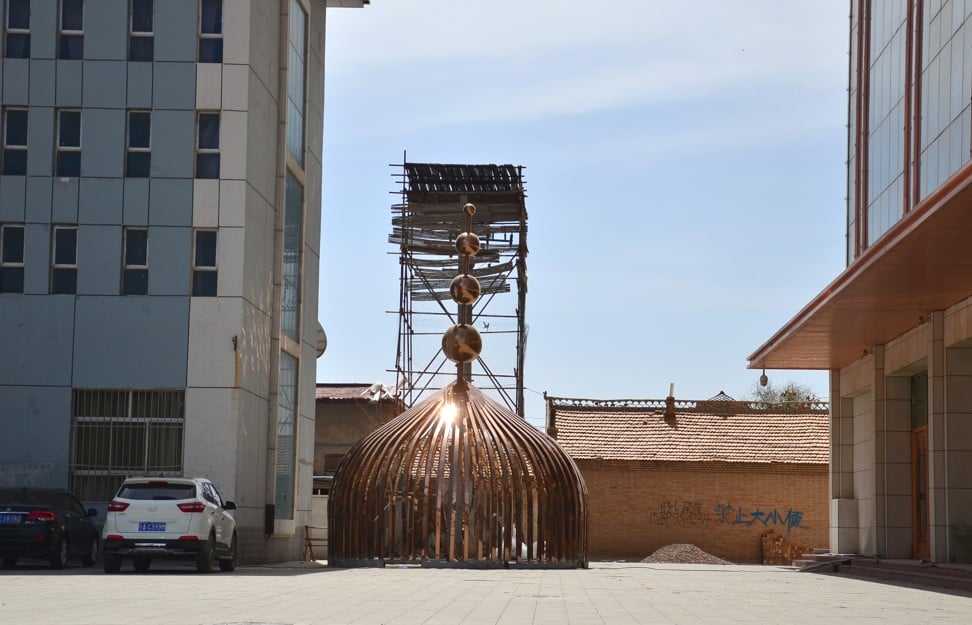
A gold dome is seen on the ground after it was removed from a hotel
in Tongxin county. Photo: Nectar Gan
Much concern has been expressed about the detention of Muslims in Xinjiang. The video below is interesting, because it also addresses the treatment of other Muslim communities in China. As I have noted before, the exact number (or even a reliable approximate number) of people detained is not available. So be aware that when you see or hear numbers mentioned, these are guesses. I don't know it it is true that there are over a million people detained. But I would think that it is at least several hundred thousand. But again, nobody knows.
Of course, as I mentioned in a previous post, the number of people detained is secondary to the question of whether they have been detained against their will without due process. Deprivation of liberty without due process is a violation of human rights regardless of what you do to those people once you have them locked up.
Another issue that is of interest to me is the response of surrounding Muslim countries. To my knowledge, the only country that has publicly taken a stand against the mass detentions is Turkey. That's not surprising, because the Uyghurs in Xinjiang Province are a Turkic people. I am thinking we may hear more about the response of other nations in months to come, but for now, it is significant that most Muslim countries support China's actions, or at least do not feel compelled to challenge them. It is one of the things I am going to be watching. This video is interesting in that regard, because it begins to explore the effect of the detention on neighboring Kazakhstan. More about that in a later post.
One further note about the video: The narration is a bit spotty. For example, they interview a Uyghur guy talking about a camp in a place called, "Kuldzha," without giving you any idea where that is. The nearest I can tell, this is referring to what is now called Yining, in northwest Xinjiang Province.
Labels: Human Rights, Individual Liberty, Justice, Kazakhs, Minorities, Uyghurs, Xinjiang
Thursday, April 11, 2019
Xinjiang re-education camps
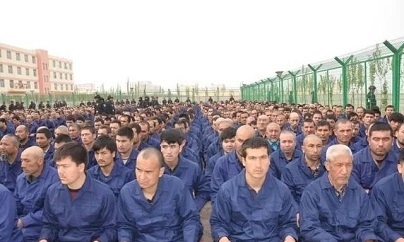
Detainees listening to speeches in a re-education camp.
Lop County, Xinjiang, April 2017.
Labels: Human Rights, Kazakhs, Magna Carta, Uyghurs, Xinjiang
Thursday, March 21, 2019
Uyghur Detention Camps in Xinjiang
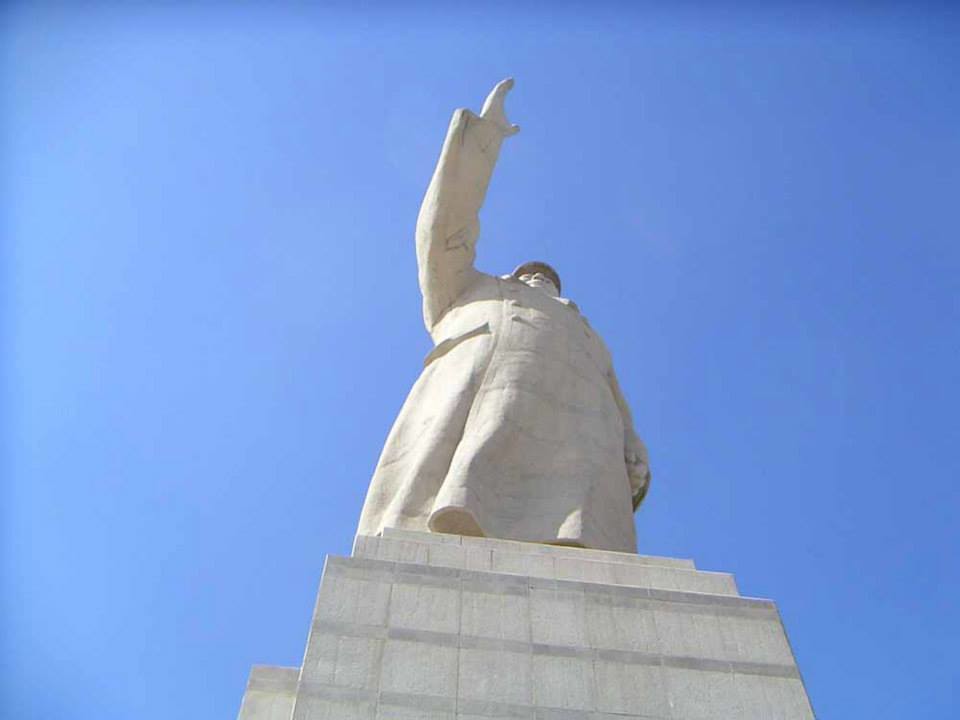
Largest statue of Mao in the world - Kashgar, Xinjiang
Labels: Detention, Individual Liberty, Magna Carta, Uyghurs, Xinjiang
Monday, January 28, 2019
Blaming China

Interesting discussion on the Sinica Podcast about attitudes toward China. Listen to this in the background while you're doing something else. I listened to it twice that way, and I found it to be very informative.
This podcast features a book by Benjamin Shobert called Blaming China. I don't know anything about him. I had never heard of him before I listened to this podcast. But the other two guys have both spent a lot of time in China.
Basically, they juxtapose two attitudes reflecting two kinds of people: the "panda huggers" and the "dragon slayers." For those of you who are not familiar with the terms, they are pretty self-explanatory, I think. The panda huggers tend to see everything China does in a positive light. They make excuses for actions taken that others would be inclined to criticize, and they articulate a defense that puts the best light on the actions of the Chinese government. The dragon slayers, on the other hand, tend to view every action of China with suspicion. They are the pessimists in this game, and they are often holdovers from the Cold War. The person who immediately comes to mind when I think of the dragon slayers is Peter Navarro. In the introduction to his documentary "Death by China," he says "Don't buy 'made in china.'" That seems to me to be a ridiculous statement. The American middle class has lived on China-made products, because it makes their lives more affordable. Can anybody reasonably expect them to buy more expensive products and lower their own standard of living just so they can say that everything they own is made in America?
But I don't want to get sidetracked. Every time I read or listen to something by Navarro, I can't seem to get more than an inch into it without detecting language that is designed to sell books. Navarro is a sensationalist. I have no time for that kind of thing because it doesn't educate me.
But who would I list as a panda hugger? Here comes the problem. Nobody wants to be called a panda hugger. This is interesting to me. All three of these guys in this podcast criticize the dragon slayers, but they don't think of themselves as panda huggers. But can you really have it both ways?
The way I have it both ways is to define it in terms of the issues, rather than just signing on to one category or the other. If you ask me, "Which one are you?" I would not say, "I'm a panda hugger" or "I'm a dragon slayer." I would say, "It depends on the issue.
For example, I am a churchman. I go to church every Sunday in Beijing at a Chinese church. When it comes to Christianity in China, I tend to be a panda hugger. Christians have it pretty good in China. American Christians complain a lot about "persecution" in China, but I personally think Chinese Christians have a lot of freedom. Most Protestant Christians worship in "family" churches that are technically illegal. But they are largely left alone. The Three-Self churches are regulated by the government, but that does not mean that they are totally controlled by the government. The idea some foreigners (even Christian foreigners) have of Christian pastors standing up every Sunday and spouting Communist propaganda is nonsense. I read a report like that one time in the Wall Street Journal. It was nauseating. Basically, Christian pastors in Three-Self churches say what they think they can get by with, and most of the time, it's more than enough to get the job done.
Sure, there are problems. In the summer of 2014, the party boss of Zhejiang Province pulled the crosses off of more than a thousand churches in the city of Wenzhou (a Wenzhou family church pastor told me it was 1400). That was very rude. But it was as noteable for what they did not do as for what they did do. They did not arrest a bunch of pastors. They did not tear down the church buildings (except for the huge, five million dollar mega-church they demolished).
They just took the crosses off the buildings. Not very nice, but the effect was positive. Christians started asking themselves, "Why did God allow this to happen? Were we allowing the symbol of the cross to become more important than the cross itself?" So it had a purifying effect. Christianity in China is much more pure than Christianity in America.
Another area where I tend to be a panda hugger is when it comes to China's determined independence regarding the currency issue. Every four years American politicians talk about China being a "currency manipulator." But such talk is disingenuous. Hong Kong has had their currency pegged to the dollar for many years. Why don't the politicians ever complain about Hong Kong? And Ecuador doesn't even have their own currency. They use the US dollar. How can you have more of a peg than that? Yet, I have never heard a whisper about Ecuador's "currency manipulation" from American politicians. This is one area where I agree with the Wall Street Journal. They have said that countries like China and Hong Kong and Ecuador are merely outsourcing their currency to the US Federal Reserve. Simply true.
But when it comes to Human rights, I tend to be a dragon slayer.
So let's take a look at this. First of all, they all seem to be situated toward the left end of the political spectrum. I know that's true for Jeremy Goldkorn and Kaiser Kuo. And it seems to be true for the other guy too. So they start out talking about Trump as a dragon slayer. That's not true. If he was only hard on China, they would have an argument. But he is not. Trump has shown himself willing to ax America's closest allies if he thinks they are getting the better end of a trade arrangement. Trump is a deal maker. But if you remove trade issues from the equation, Trump is in some ways more pro-China than any president in my memory. He responded very favorably to the idea of Xi Jin-ping being president for life. I can't imagine Obama doing that. Or Clinton or either of the Bushes.
So I disagree with them on that issue. But I was very glad to hear them speak out about the detention of Uyghurs in Xinjiang. As I said before, I have had a "wait and see" attitude about this situation, because it is very hard to get accurate numbers, and I don't like to make cheap conclusions. But the information coming out is more and more concerning. So I was glad to hear them express that concern. Hopefully, that situation will move in a different direction very soon. I am going to be watching it closely.
Labels: Christianity, Uyghurs, Xinjiang
Monday, December 31, 2018
A Brief Look Back at 2018
Labels: Human Rights, South China Sea, Tariffs, Trade, Uyghurs, Xinjiang
Saturday, October 27, 2018
Xingiang
There have been several reports in recent years about repressive policies, such as cutting men's beards so that they don't become terrorists, and restricting access to the Qur'an or the practice of Ramadan (daytime fasting for one month a year). But what has disturbed many human rights groups recently has been the reports of thousands of Uyghurs being taken from their homes and placed in detention camps. It has not been easy to get accurate information about this, because China severely restricts media access to Xinjiang, at first did not acknowledge the camps. But for some reason, they have changed their approach and decided to acknowledge the camps and defend their existance.
There is another problem with news about things like this. In China, the media is strictly controlled/regulated by the government, so government papers are replete with scripted propaganda, or restricted from mentioning the subject at all. But in America, media is controlled by advertising. This means that headlines are structured to get you to click on them, and bad news than good news. So reporting about China tends to be negative. In addition to this, allowing media to be controlled by advertising means that subject matter is controlled by the prevailing appetites and fetishes of the masses rather than a sincere, dogged pursuit of the truth. So with American news outlets, especially online ones, the important stories of the day are often buried in mountains of trivia.
So what is the difference between click-bait and propaganda? Only the intent--they're both garbage, just with different purposes. So I tend to avoid media that is afflicted by either of these problems. Still, I would like to get a source from China, because they would much less likely (obviously) to tell a story that was totally negative. The problem is that news articles in the Global Times and the China Daily are extremely boring and poorly written, and there is little or no in depth discussion of issues, because it isn't politically safe. So, with modern smart phones, where I can sit on the bus or the tram and read the news from any number of international news outlets on my smart phone, I don't read Chinese news nearly as much as I ought to.
Last night one of my students informed me that there was widespread detention of Uyghurs in Xinjiang. She said she got the information from BBC. Interesting. So if local people are just finding out about this now, that must mean that the Chinese media has been pretty quiet about it.
Thursday, August 04, 2005
When we were leaving, I was saying "good-bye," and I reached out to shake the hand of our hostess, and thank her. She smiled, kinda embarrassed, but didn't say anything. My young tour guide, Awanisa, quickly told me that Muslim women don't shake hands with another man. I said, "Do you ever shake hands?" She said, "Yes, but I'm not married." Oh. Guess I should have listened to Ann Landers.
