Links
- CV
- Titles
- Topics
- Tickets
- Science
- About Eric
- Book Reviews
- Country Profile
- Modern China
- Contact Eric
- Podcast
- Vision
- Sekai
- John
Archives
RSS

Reflections on a Wandering Life.....
Wednesday, September 25, 2013
Doublespeak
Click for larger image
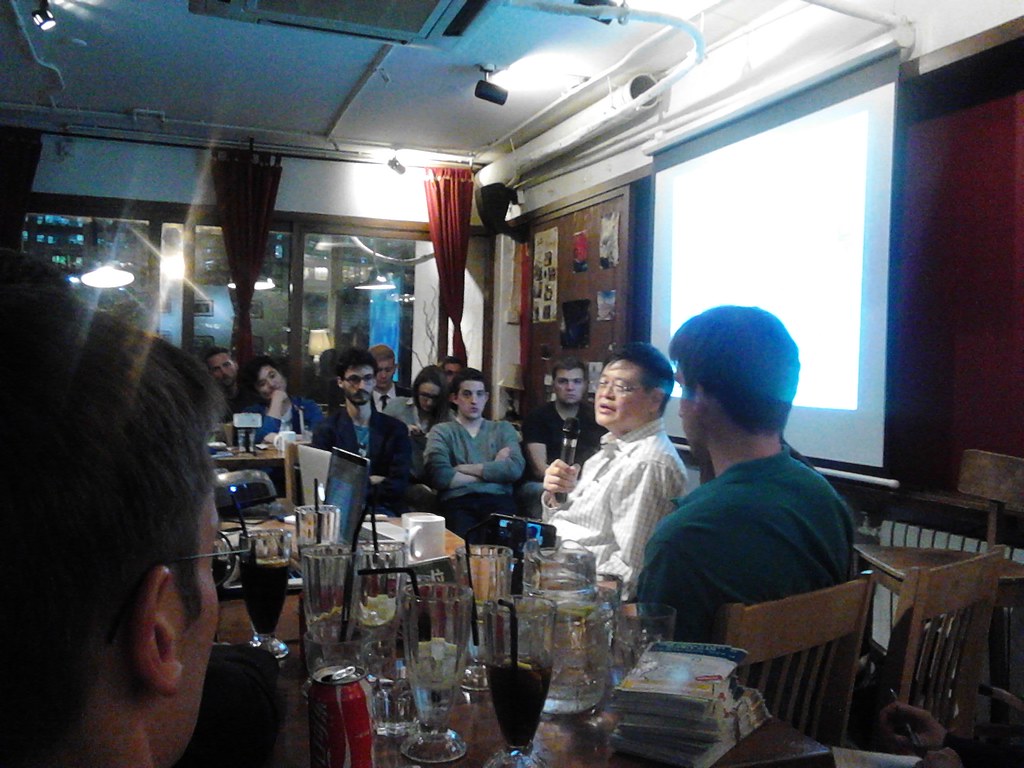
Went to Think in China last night. The professor began his lecture by saying that China is a socialist country. During the question and answer period, I queried him about this. I told him that socialism is a word that has a meaning. That meaning is "public ownership of the means of production."
He said, "When I say socialist, I mean a country that is led by the Communist party. So if the party's approach to socialism changes, we simply change the definition."
So what he seemed to be saying was that socialism was whatever the Party said it was. There is a lot of truth to this. In China, it is not politically correct to spout Marxist philosophy. But it is also not politically correct to publicly admit that we no longer believe what Marx taught. Whatever system is adopted in China, we MUST call it socialism.
A few minutes later, the professor said, "China is a socialist country and America is a capitalist country." What does he mean by that? If I take what he said at face value, I would have to conclude that he was saying, "China is led by the Communist Party and the U.S. is not led by the Communist Party. But that's a meaningless statement. It sounds like what he was actually doing was sliding into the traditional statement that China is a socialist country as opposed to America, which is a capitalist country. That doesn't work. To juxtapose China's system vis-a-vis America's system implies an objective standard against which to measure both of them. But he had just got done saying that there was no objective definition. Socialism is whatever the Party says it is. You can't have it both ways. But in China, they seem determined to have it both ways, and this creates confusion. This morning, I opened up the China Daily and saw the following headline:
"Let the market play its own role"Under that was the subtitle:
"State Council's latest move reduces intervention and facilitates business"Does that sound like Marxism to you? You see, this is the problem with the way this whole issue is being implemented in China. The good professor says that socialism means leadership by the Communist Party. But if you say that, then sliding into old statements about China being socialist as compared to America being capitalist is not really honest. In fact, China is moving away from socialism, and America is moving toward socialism. But don't tell anybody.
Labels: Capitalism vs Socialism, CCP, Doublespeak
Friday, July 01, 2011
Point at a Deer and Call it a Horse
Full two-page spread in the China Daily today giving a timeline, with comment and pictures of the history of the Chinese Communist Party. I was drawn to this statement:
At the crucial juncture of China's reform and opening-up course in January 1992, Deng Xiaoping tours southern China where he delivers speeches aimed at clarifying whether the establishment of special economic zones is capitalist or socialist in nature. After a visit to Shenzhen, he says Shenzhen's achievements are socialist not capitalist in nature, as they have improved productivity and people's livelihoods. His words help push forward China's reform and opening-up in the 1990s.So here's how it goes in China: You implement a socialist system, condemning capitalism as evil. When socialism proves to be a dismal failure, you implement capitalism, but call it socialism. This approach to governance in China goes back to the Qin Dynasty, when an evil minister, in order to test the loyalty of his underlings, brought a deer before them and told them to call it a horse. In China, it has become a standard idiom, that manifests itself in so many ways.
When I first came to China, my freshmen students asked me, "What is the difference between socialism and capitalism?" I would answer by asking them a question:
"If you have a company, do you think you should own it, or would you rather have the government own it and you just work for them?"Their answers were predictable. "I think I should own it." Then I would tell them, "Then you're a capitalist. If you think the government should own it, you're a socialist." I would often tell them to go to Dictionary.com and look up the two words. The definitions are quite simple:
Socialism: Public ownership of the means of productionThe reason for the confusion, of course, is that students look around them and see capitalism, but they are told it is socialism. So naturally, they ask, "If this is socialism, what is capitalism." I had to tell them, "This isn't socialism. Your grandparents had socialism. This is capitalism."Capitalism: Private ownership of the means of production.
This is the irony of today's China. It is not politically correct to actually believe and teach Marxist philosophy. But it is also not politically correct to publicly admit that we no longer believe what Marx taught. So we continue to "point at a deer and call it a horse."
Labels: Capitalism vs Socialism, Doublespeak
Monday, July 05, 2010
China's Crisis of Faith
The Communist Party decided to hold a press conference for the foreign media. I guess it's part of the party's pitch for more openness, or something. A reporter from CNN asked whether it was true that most people join the party to help them get a good job, rather than because of their belief in Communism. The party official responded that only a few applicants "may not have very correct motives for seeking Party membership." As a response to the question asked, it was ludicrous. But viewed in the context of today's China, it was strangely appropriate. I will try to explain.
 I have been in China for over six years now. Several times over the past six years, young people have asked me whether I thought they should join the Party. I always respond with a question:
"Why do you want to join the Communist Party?" Always, without exception, the answer is the same:
"Because I want to get a good job." Never, ever, have I had a young person respond by saying, "I want to uphold the cause of Marxism." So when I read the response, it was all I could do to keep from laughing out loud (I was on the bus). In China, when an official is confronted with an inconvenient reality, an emphatic, face-saving denial is the default answer. So one should not be too surprised by a denial like this in response to such an embarrassing question. Still, this one takes the cake. If joining the party for the purpose of advancing one's career is to be regarded as an ulterior motive, then it is not a small minority of people who join the party with "incorrect motives." It is absolutely everyone. If you ask a hundred young people what would make them want to join the Party, I can assure you that all one hundred of them would list career advancement as their main, if not their only reason. Eating lunch with some friends yesterday after church, I mentioned the Communist Party official's response to the CNN reporter's question. Of course, they all laughed. On the surface, anyone who knows anything about China would agree that his remarks were disingenuous.
But there is another way to look at this. You see, in today's China, joining the party for the sake of advancing one's career is not considered inappropriate. Making money is the goal right now. The party encourages this. In fact, if a young person joining the a party were questioned about his motives for joining, and responded that he wanted to uphold the cause of Marxism and smash the capitalist running dogs, he would probably be viewed as a wacko and rejected. That kind of thinking is not politically correct these days. What is politically correct is making money.
When I first came to China, young freshmen from the countryside would ask me, "Professor Eric, what's the difference between socialism and capitalism?" Interesting. These are the brightest kids in China. They have been all the way through the educational system, and had all the indoctrination the government could give them, and they are asking me, a foreigner, to tell them the difference. Why? Because they don't know. And their teachers don't know. I have talked to their teachers. Here's the problem: In today's China, it is not politically correct to espouse Marxist philosophy. But it is also not politically correct to publicly admit that we no longer follow Marxist teaching. So whatever system we adopt in China, we must call it socialism. That's why Hu Jintao dresses up in a Mao suit on National Day (which he wouldn't be caught dead wearing any other time) and says that "Socialism is the only hope for China." Naturally, the young people are confused. They look around them, and they say, "If this is socialism, what is capitalism?" And I have to tell them, "This isn't socialism. Your grandparents had socialism." I was discussing this problem with a friend of mine some time ago. This is a professional woman with a master's degree, but her response did not surprise me, "Please tell me, what is the difference between socialism and capitalism?"
I told her the same thing I told my students: "If you have a company, do you think you should own the company, or do you think the government should own it, and you just work for them?" My students were quite emphatic. They wanted to own the company. I said, "Then you're a capitalist. If you think the government should own it, then you are a socialist." Socialism has the simplest definition in the dictionary. "Public ownership of the means of production." The reason the issue is confusing is not because the terms are not easy to understand. The issue is confused because China has abandoned socialism, but cannot admit it. So the only alternative is to redefine the terms. So when a young person applies to join the party, their ignorance of the difference between socialism and capitalism is not a problem, because the odds are that the party official examining them doesn't know either.
We were talking about this one time at the English corner, and one guy said, "You're right. But you're not completely right, because in China we have state owned enterprises, and you don't have anything like that in America. Well, I had to concede his point. So perhaps China is more socialist than America. But my point is that if you ask the average person to list the companies they have dealt with during any business day, the bulk of them would be private businesses. A quick stop at a sidewalk restaurant or something like McDonald's (private business) for breakfast, then perhaps taking the subway (public business) to work (most likely at a private company). Lunch at some sort of restaurant or concession (private business), then back to work until quitting time. Maybe stop and pick up some things at a store, which is most certainly going to be a private enterprise--I have never seen a government grocery. Go home and spend time with the family, or go to a movie at a theater, which will most definitely be a private company.
You see, if you examine the companies with which most people have to do during a given day, the majority of them will be private. Why? Because China is not a socialist country, and does not have a socialist economy. True, if you have a car (which you purchased from a private dealer, not the government) and you stop for gas, you would have a couple choices: Sinopec or Petro China, both of which are SOE's. But they are the exception that proves the rule. China actually has a very Republican economy, and economic policy is crafted by government economists who are the cream of the crop from Wharton, MIT, or the Harvard Business School. Since China is not a democracy, economic policy is not burdened by the costly and wasteful pork barrel projects that are so typical in the American legislative process. That sort of corruption (and it is corruption) would never be tolerated here in China. The Chinese prefer bribery, which brings me to my main point:
The newspaper article says, "No 'faith crisis' in CPC." Is there a crisis of faith? In the strictest sense, no, there isn't. Young people who join the party definitely do not believe in Marxism. But the party doesn't either, so where is the crisis of faith? There is no crisis of faith in the party. Young people I talk to do not believe in Marxism, but they generally seem to be satisfied with the job the party is doing. The party does bring a measure of stability. I know, we can argue all day about "stability at what cost," but nevertheless, China is a reasonably stable place to live and work.
So I don't see a crisis of faith in the party. But there is definitely a crisis of faith in the society proper. Many, many times over the past six and a half years that I have been in China, people have said to me, "We Chinese don't believe in anything. We have no belief." I lived in America for forty years, and I never once heard anyone say that. Chinese people don't know what they believe, and they are not exactly certain what the party believes, because the party is never straightforward about this (as the official's response illustrates so beautifully).
I was talking to a PLA officer one time. I said, "The Communist Party doesn't believe in Marxism anymore. You know that. I know that. Why don't they just say it? Why don't they just come out and admit that they no longer believe in Marxism?" He said, "The Communist Party came to power under the banner of Marxism. If they say that they no longer believe in Marxism, what is their basis for power?"
A friend of mine studied political theory in university. Then she became a Christian. I put this question to her. She said, "If the Communist Party admits that they no longer believe in Marxism, the next logical question is, 'Then what do you believe?' and they don't have an answer to that question."
I believe that these two thoughtful observations frame the context which defines the crisis of faith in this country. It is hard for the general populace to develop a deep sense of loyalty to the values of their country, because nobody knows for sure what those values are. Freedom? No. Democracy? Definitely not. The belief that all men are created equal? No, not that either. The cause of the proletariat? No. The common people routinely have their property confiscated so that corrupt officials can make money on development. So what do Chinese people believe in? I went to the English Corner once and asked a bunch of people that question. The answers were insightful. Listen to the podcast of that interview and see what you think. Toward the end of my interview, I turned to a young lady, and said, "What do you believe?" She said, "I believe in myself." This is the crisis of faith in China. It is every man for himself. Get what you can for yourself and your family. If you can do it legally, fine. If not, just be sure you don't get caught, but don't worry about anything else, because there is no God to whom you might ultimately be accountable.
What hope is there for such a morally ambivalent society? Fortunately there is one presence in society that is very encouraging. Christian young people in China are barred from government service in China (because they cannot join the Party), so they are free to give themselves wholeheartedly to the church. There is a growing body of very bright, intelligent young people in this country who hold themselves to high moral standards, and refuse to be part of the corrupt system around them. They love God, and they love China. In China, the Party has power. Church people have no power, and are not interested in power. I never met a more apolitical group of people than Chinese Christians. They don't know anything about politics and power, and don't want to. But the Christian Church is a strong and growing influence in society, because Christians are the one group of people in this country who know for sure what they believe.
Labels: Capitalism vs Socialism, Religion, The Party
Thursday, October 01, 2009
National Day
Kai Kai invited me to have lunch with her and her friend. I took the subway to Liufang and met them. They asked me where I would like to eat. I suggested we head down to Dongzhimen, because there is a street there that is famous for its restaurants. Her friend had a Honda minivan, so we all got in and found a restaurant built according the pattern of a classic Siheyuan.
After we ate, they were going to take me back, but I noticed a subway station, so I told them to just drop me off. It happened to be one of the stops on Line 5. Not that it matters. Anytime you see a subway station in Beijing, you just head down under and it's pretty easy to figure out where you are. I was just ready to do that, but I decided to stop at a coffee bar and do some reading first. I started asking around for a coffee bar, and ended walking right by the old Confucian temple. I was interested in this, becuase Chinese people are fond of saying that Confucianism is not a religion, but a philosophy. But this temple was very religious. And it was built in the early 14th Century. Yuan Dynasty. That's going back a ways. When they built the temple, they planted a Cyprus tree. It's still there. Ever seen a 700 year old Cyprus tree? Pretty impressive.
After going through the temple, I walked around and finally found a little sidewalk cafe. I decided that this was a better way to spend the afternoon that standing in the crowds down at Tienanmen. I was ready to forget about National Day and get lost in a good book. But it was not to be. Right up on the wall was a flat screen playing the events of the day, and Hu Jintao was just getting ready to speak. I listened for awhile to him repeating the old line about how there is no hope for China except the pathway of Socialism. Rubbish, of course, and nobody believes it. Well, I guess somebody must, because there has to be some reason he feels compelled to put on a Mao Jacket and recite Marxist pablum. This is the dilemma of Modern China. It is no longer politically correct to take a Marxist position. But it is also not politically correct to publicly acknowledge that we no longer follow what Marx teaches. So whatever political system China employs, we must call it socialism. This is why the young people are so confused. They say, "Professor Eric, what's the difference between capitalism and socialism?" These are the brightest kids in China. They have taken all the required Marxism classes to get to where they are at a National Key University. But they don't know the difference between capitalism and socialism. And the reason is plain. They look around them, and think, "If this is socialism, what is capitalism." And I have to tell them, "This is not socialism. Your grandparents had socialism."
I was debating this issue at the English corner at Renmin University once, and one guy told me that the reason for the confusion is that this is a very complex issue. Not true. Socialism has the simplest definition in the dictionary: "Public ownership of the means of production." In today's China, most of the businesses that an average citizen encounters are not publicly owned. There are exceptions, of course. Raymond is a Beijinger, and he takes me to the traditional Beijing eateries. One time he took me to a little place in Old Beijing that was kinda little dark and dingy (although the food was good). It was about 7:30 or so, and Raymond told me that we had to hurry, because they were getting ready to close. I was surprised. So early? Then Raymond told me that this was a State owned cafeteria.
I have been in Beijing for almost six years, and in all that time, I have been in one state owned restaurant. Most of them are private businesses. I guess I should mention that I have eaten in campus cafeterias, so perhaps that would put a few more marks in the socialism column. But my point is that today's China is not really socialist. China actually has a very Republican economy. Low taxes, and lots of emphasis on business development and market economy. Anything but socialism. But the ancient tendency for leaders to "point to a deer and call it a horse" prevails. So we cannot say "capitalism." We must call it, "socialism with Chinese characteristics."
Labels: Capitalism vs Socialism, Confucius, National Day
