Links
- CV
- Titles
- Topics
- Tickets
- Science
- About Eric
- Book Reviews
- Country Profile
- Modern China
- Contact Eric
- Podcast
- Vision
- Sekai
- John
Archives
RSS

Reflections on a Wandering Life.....
Friday, October 12, 2018
Interview with Bill Porter
Labels: Bill Porter, Buddhism, Religion, Zen
Thursday, October 11, 2018
Money and Power
Labels: Buddhism, Corruption, Religion, Shaolin Temple
Monday, October 08, 2018
The Search for Meaning Among Chinese Young People
Monday, July 05, 2010
China's Crisis of Faith
The Communist Party decided to hold a press conference for the foreign media. I guess it's part of the party's pitch for more openness, or something. A reporter from CNN asked whether it was true that most people join the party to help them get a good job, rather than because of their belief in Communism. The party official responded that only a few applicants "may not have very correct motives for seeking Party membership." As a response to the question asked, it was ludicrous. But viewed in the context of today's China, it was strangely appropriate. I will try to explain.
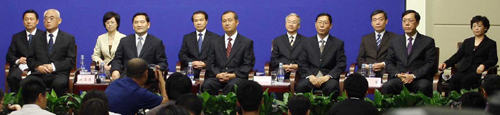 I have been in China for over six years now. Several times over the past six years, young people have asked me whether I thought they should join the Party. I always respond with a question:
"Why do you want to join the Communist Party?" Always, without exception, the answer is the same:
"Because I want to get a good job." Never, ever, have I had a young person respond by saying, "I want to uphold the cause of Marxism." So when I read the response, it was all I could do to keep from laughing out loud (I was on the bus). In China, when an official is confronted with an inconvenient reality, an emphatic, face-saving denial is the default answer. So one should not be too surprised by a denial like this in response to such an embarrassing question. Still, this one takes the cake. If joining the party for the purpose of advancing one's career is to be regarded as an ulterior motive, then it is not a small minority of people who join the party with "incorrect motives." It is absolutely everyone. If you ask a hundred young people what would make them want to join the Party, I can assure you that all one hundred of them would list career advancement as their main, if not their only reason. Eating lunch with some friends yesterday after church, I mentioned the Communist Party official's response to the CNN reporter's question. Of course, they all laughed. On the surface, anyone who knows anything about China would agree that his remarks were disingenuous.
But there is another way to look at this. You see, in today's China, joining the party for the sake of advancing one's career is not considered inappropriate. Making money is the goal right now. The party encourages this. In fact, if a young person joining the a party were questioned about his motives for joining, and responded that he wanted to uphold the cause of Marxism and smash the capitalist running dogs, he would probably be viewed as a wacko and rejected. That kind of thinking is not politically correct these days. What is politically correct is making money.
When I first came to China, young freshmen from the countryside would ask me, "Professor Eric, what's the difference between socialism and capitalism?" Interesting. These are the brightest kids in China. They have been all the way through the educational system, and had all the indoctrination the government could give them, and they are asking me, a foreigner, to tell them the difference. Why? Because they don't know. And their teachers don't know. I have talked to their teachers. Here's the problem: In today's China, it is not politically correct to espouse Marxist philosophy. But it is also not politically correct to publicly admit that we no longer follow Marxist teaching. So whatever system we adopt in China, we must call it socialism. That's why Hu Jintao dresses up in a Mao suit on National Day (which he wouldn't be caught dead wearing any other time) and says that "Socialism is the only hope for China." Naturally, the young people are confused. They look around them, and they say, "If this is socialism, what is capitalism?" And I have to tell them, "This isn't socialism. Your grandparents had socialism." I was discussing this problem with a friend of mine some time ago. This is a professional woman with a master's degree, but her response did not surprise me, "Please tell me, what is the difference between socialism and capitalism?"
I told her the same thing I told my students: "If you have a company, do you think you should own the company, or do you think the government should own it, and you just work for them?" My students were quite emphatic. They wanted to own the company. I said, "Then you're a capitalist. If you think the government should own it, then you are a socialist." Socialism has the simplest definition in the dictionary. "Public ownership of the means of production." The reason the issue is confusing is not because the terms are not easy to understand. The issue is confused because China has abandoned socialism, but cannot admit it. So the only alternative is to redefine the terms. So when a young person applies to join the party, their ignorance of the difference between socialism and capitalism is not a problem, because the odds are that the party official examining them doesn't know either.
We were talking about this one time at the English corner, and one guy said, "You're right. But you're not completely right, because in China we have state owned enterprises, and you don't have anything like that in America. Well, I had to concede his point. So perhaps China is more socialist than America. But my point is that if you ask the average person to list the companies they have dealt with during any business day, the bulk of them would be private businesses. A quick stop at a sidewalk restaurant or something like McDonald's (private business) for breakfast, then perhaps taking the subway (public business) to work (most likely at a private company). Lunch at some sort of restaurant or concession (private business), then back to work until quitting time. Maybe stop and pick up some things at a store, which is most certainly going to be a private enterprise--I have never seen a government grocery. Go home and spend time with the family, or go to a movie at a theater, which will most definitely be a private company.
You see, if you examine the companies with which most people have to do during a given day, the majority of them will be private. Why? Because China is not a socialist country, and does not have a socialist economy. True, if you have a car (which you purchased from a private dealer, not the government) and you stop for gas, you would have a couple choices: Sinopec or Petro China, both of which are SOE's. But they are the exception that proves the rule. China actually has a very Republican economy, and economic policy is crafted by government economists who are the cream of the crop from Wharton, MIT, or the Harvard Business School. Since China is not a democracy, economic policy is not burdened by the costly and wasteful pork barrel projects that are so typical in the American legislative process. That sort of corruption (and it is corruption) would never be tolerated here in China. The Chinese prefer bribery, which brings me to my main point:
The newspaper article says, "No 'faith crisis' in CPC." Is there a crisis of faith? In the strictest sense, no, there isn't. Young people who join the party definitely do not believe in Marxism. But the party doesn't either, so where is the crisis of faith? There is no crisis of faith in the party. Young people I talk to do not believe in Marxism, but they generally seem to be satisfied with the job the party is doing. The party does bring a measure of stability. I know, we can argue all day about "stability at what cost," but nevertheless, China is a reasonably stable place to live and work.
So I don't see a crisis of faith in the party. But there is definitely a crisis of faith in the society proper. Many, many times over the past six and a half years that I have been in China, people have said to me, "We Chinese don't believe in anything. We have no belief." I lived in America for forty years, and I never once heard anyone say that. Chinese people don't know what they believe, and they are not exactly certain what the party believes, because the party is never straightforward about this (as the official's response illustrates so beautifully).
I was talking to a PLA officer one time. I said, "The Communist Party doesn't believe in Marxism anymore. You know that. I know that. Why don't they just say it? Why don't they just come out and admit that they no longer believe in Marxism?" He said, "The Communist Party came to power under the banner of Marxism. If they say that they no longer believe in Marxism, what is their basis for power?"
A friend of mine studied political theory in university. Then she became a Christian. I put this question to her. She said, "If the Communist Party admits that they no longer believe in Marxism, the next logical question is, 'Then what do you believe?' and they don't have an answer to that question."
I believe that these two thoughtful observations frame the context which defines the crisis of faith in this country. It is hard for the general populace to develop a deep sense of loyalty to the values of their country, because nobody knows for sure what those values are. Freedom? No. Democracy? Definitely not. The belief that all men are created equal? No, not that either. The cause of the proletariat? No. The common people routinely have their property confiscated so that corrupt officials can make money on development. So what do Chinese people believe in? I went to the English Corner once and asked a bunch of people that question. The answers were insightful. Listen to the podcast of that interview and see what you think. Toward the end of my interview, I turned to a young lady, and said, "What do you believe?" She said, "I believe in myself." This is the crisis of faith in China. It is every man for himself. Get what you can for yourself and your family. If you can do it legally, fine. If not, just be sure you don't get caught, but don't worry about anything else, because there is no God to whom you might ultimately be accountable.
What hope is there for such a morally ambivalent society? Fortunately there is one presence in society that is very encouraging. Christian young people in China are barred from government service in China (because they cannot join the Party), so they are free to give themselves wholeheartedly to the church. There is a growing body of very bright, intelligent young people in this country who hold themselves to high moral standards, and refuse to be part of the corrupt system around them. They love God, and they love China. In China, the Party has power. Church people have no power, and are not interested in power. I never met a more apolitical group of people than Chinese Christians. They don't know anything about politics and power, and don't want to. But the Christian Church is a strong and growing influence in society, because Christians are the one group of people in this country who know for sure what they believe.
Labels: Capitalism vs Socialism, Religion, The Party
Monday, April 02, 2007
What Do Chinese People Believe?
 Back in Beihai. Flew in last night from Beijing. Don't tell anyone, but I accidentally stole the safety instructions from the Airbuss 320 when we changed planes in Changsha. It somehow got stuck between the pages of the International Herald Tribune that I had stuffed in the chair pocket and grabbed quickly as I was leaving. I don't feel to bad, though. Last year, someone from the airline stole my paper. It was one of those deals where we didn't actually change planes--we just landed in Changsha to drop off and pick up passengers. I had gotten off the plane for a few minutes, and when I got back, my paper was gone. Some over-zealous clean freak had thrown it away.
 The rest of the trip was uneventful, except that when I got to Beihai, I forgot to pick up my checked baggage. It was kinda embarrassing, because it is quite a drive from the airport out to the college, and I didn't discover I had left it until we were carrying my stuff into my apartment. The guy who picked me up was very cheerful about it. He immediately took me back to the airport, which, unfortunately, was closed by that time. So, we had to go out there this morning and get it. Disgusting. If I added up all the time I have wasted in my life going back to get something that I have forgotten the first time...I don't even want to think about it.
In other news, I started a podcast. The first program features some friendly folks from the English Corner discussing the question, "What do Chinese people believe?"
For those of you who may not be too familiar with podcasting, there are three ways to deal with podcasts:
1. You can listen online directly.
2. You can download the .mp3 file to your hard drive.
3. You can install free podcasting software which will manage the download(s) for you.

Labels: Christianity, Confucius, Religion
Saturday, August 26, 2006
The Conclusion of the Matter
As I look back over the summer, and try to put together the things I have seen, the places I have been, and the people I have met, one things stands out above the rest: While it is certainly good for us to make plans and prepare ourselves, I have always found that I have the best experiences when I take pains to make the point with God that I want Him to lead me. Listen to me, if you put your life in God's hands, and trust Him to show you what to do and where to go, He will lead you. I have proven this principle many times over. So that's the first point. I am a Christian. I believe in God, and I believe that He is actively involved in the affairs of men.
The second thing I would say is that, while I am interested in some of the sights one sees traveling around the country, I am far more interested in people, and in understanding how they think. The question of what people believe and why they believe it has always been a matter of great interest to me. So let's take a look at the beliefs. The two main religious groups I encountered this summer were the Tibetan Buddhists and the Hui Muslims.
Buddhists. The first thing you notice when you visit any kind of Buddhist site in China, is the extent to which Buddhism has been commercialized. I have seen a fair amount of this in my travels throughout China, but every time I see it, I am repulsed anew. When I visited the monastery on the Sichuan side of Langmusi, there was no instruction, no map, no brochure, no direction. Just a couple monks in a guard shack who would grab anyone with a white face and collect money. Modern Buddhism in China has found it's Nirvana. It is tourism. They're not very good at it right now, but they're going to get better, especially with the huge number of spiritually exhausted westerners who are so hopelessly overawed by the "beauty of Buddhism." Perhaps my view is a bit jaded, because I grew up next to a Buddhist temple, and I have seen how Buddhism tends to keep people in religious bondage, rather than setting them free. I saw it again this summer--the somber man who kept prostrating endlessly at the temple in Xiahe. He was there when we went in, and he was still prostrating himself over and over again when we came out. Others may have been struck by his faithfulness. I was saddened by the look of complete futility on his face.
But Buddhism is the predominate folk religion in Asia. It's not going anywhere for the moment. An altar with food offerings is a common site in restaurants throughout China. And even people who claim not to believe in anything will politely bow ("for good luck") when they happen to pass some Buddhist religious site. Again, though, Buddhism has become thoroughly commercialized, so I would say that its days are numbered. Nothing destroys a belief system quicker than financial prosperity. And this prosperity tends to generate cynicism in the minds of the people. One Tibetan in Langmusi was complaining to me how detached the monastery was from the local community. He said that they would expect local people to contribute to the sustenance of the monastery, but they did not contribute anything to the community. I asked him if the Tibetan monasteries had schools. He said, "Yes, but only for themselves."
Well, I don't live in his community, so, as a visitor, I am a bit limited in my ability to analyze the specific local situation. But one has to wonder what the chief lama at the monastery is doing building a resort hotel. Did he build this "for profit" hotel with money that was collected for charitable purposes? And does he hold title to the property, or has he turned it over to the monastery? Is there an independent audit of monastery accounts, or are they beyond scrutiny? Is anyone asking these questions? Buddhism suffered terribly during the Cultural Revolution, when there was a concerted attack on Buddhism, as well as other religions. Today, the scene is very different. Although the government wants to be seen as treating all religions fairly, Buddhism gets a boost because it is seen as a Chinese religion (which, of course, it is not), and a balance to Christianity, which is growing like a wildfire in both it's formal and informal variations.
Muslims. Islam in China is not nearly as commercialized as Buddhism. I wouldn't say it is not commercialized at all, because I did have to pay a fee to visit the ancient Tang Dynasty mosque in Xi'an last summer. But there is a huge difference between Islam and Buddhism in China. When I went to the large mosque in Linxia, nobody jumped out and grabbed money from me. It was very much like what walking into a neighborhood church building would be like in America. But Islam differs from Buddhism in other ways. When Chinese people refer to Buddhism as a Chinese religion, I always correct them. Buddhism came from India, not China. Nevertheless, Buddhism in China has been largely sinicized over the centuries since it came from India, just as Buddhism in Japan tends to be a mixture of Buddhism and Shintoism. As I mentioned before, Buddhism is the folk religion of Asia, and thus it feels like a native belief system to Chinese people. Not so with Islam. I have, of course, met many Chinese people who call themselves "Buddhist." But I have never met a Chinese person who identified himself as a Muslim. There are, of course, many Muslims in China. But the Chinese are not Muslims. And the Muslims are not Chinese. I need to be careful not to overstate the case. Before I came to China, I concluded that Islam could never be big in China, because the Muslims do not eat pork, which (as Piano says) is the "default meat" of China. I was wrong. There are many Muslim restaurants in any sizeable Chinese city, and they serve dishes that attract Muslims and non Muslims alike. And the government of China has gone to great lengths to accommodate the Muslim minorities and bring them into the mainstream of Chinese society. This has been easier with the Hui (because they do not have a separate language) than it has with the Uygur, but even the Uygur are able to go just about anywhere in China and find a restaurant that is "Kosher" (pardon the term). Nevertheless, the Muslim minorities in China are just that--minorities. Largely for this reason, I think, Islam seems to be more removed, as a religion, from the mainstream than is Buddhism. Recent world events linking Islam to terrorism have not helped matters either. I need to be careful, here, because there is, even in modern Islamic countries, a growing distinction between the religious Islam that all Muslims accept, and Islamism, which is viewed with suspicion by Muslims in very much the same way that Protestant Christian organizations like the Ku Klux Klan are viewed negatively by Christians in a "Christian" country like America. But is there something about Islam that is characterized by, if not endorsement, a tacit complicity with the more violent aspects of Islamism? Roger Scruton, in a fascinating piece in the Wall Street Journal, postulates that Islam suffers from a lack of irony. That while most Muslims would not openly condone the violence often associated with Muslim extremists, they have been woefully silent in condemning them. This question needs some thought and discussion.
And there is the question of the holy book. Last night at the English corner, a guy asked me, "Which book is better, the King James (not sure why he chose that version) Bible, or the Muslim book (he didn't know what to call it)? I said, "Take a look at history. Societies that have followed the principles in the Bible have become prosperous and advanced. Societies that have been built on the Koran have remained backward and undeveloped." There is no questioning the profound effect of the Bible on the eventual progression of a given society. Horace Greely said, "It is impossible to enslave mentally or socially a Bible-reading people. The principles of the Bible are the groundwork of human freedom."
Getting back to the Hui Muslims, though, I should hasten to point out that Islam is as much a cultural thing as it is a religious belief. That is why we refer to them as "Hui Muslims." It's a precarious term, because the word "Hui" denotes the ethnic minority, while "Muslim" denotes (or is supposed to denote) religious affiliation. Theoretically, then, it should be possible for a Hui to be a member of some other religion, just as there are Jews who are not necessarily Jewish. But you just don't meet Hui people in China who are not Muslim, except in the case of mixed marriages. For the Hui, Islam is very closely tied to their ethnicity.
Secularism. This is really the new religion of China. I suppose it is a natural result of economic prosperity, but also strongly influenced by the complete vacuum of belief during the Communist era. Most Chinese people I interact with are singularly secular. This is one very noticeable contrast when you emerge from a visit to communities like Langmusi or Linxia. The secularism in China is interesting, because it is not, as in America, a slow backsliding from previously held beliefs, but is rather a disillusionment with a previously believed cult religion (Maoism) that became cruel and brutal. But many Chinese people still struggle with this. It never ceases to amaze me how many Chinese intellectuals still try to tell me that the business oriented atmosphere so prevalent in China today is actually a modification (improvement?) of Marxism. Nonsense. A more common attitude I see in China, is a sort of macabre fascination with the excesses of the Maoist period. Traveling this summer, I saw a guy with a T-shirt that said, "ASSUME THE POSITION." I had to wonder if he had any idea what that meant. The last day I was in Lanzhou, I was having lunch with Inga's family, and her uncle got a phone call. The ring tone on his cell phone was the voice of a red guard yelling through a megaphone to heed the sayings of Chairman Mao. And there is a nightclub here in Beijing where the waitresses all wear Red Army uniforms and yell Marxist exhortations at you instead of smiling when you enter.
What, then, do the Chinese people believe? It seems to me that many of them are still trying to decide this question, and the future of this country will be powerfully influenced by that decision. And there is another question that I always have to ask myself. What do I believe, and how does that influence my attitude toward other belief systems. I need to address this issue because while I like to think of myself as an objective person, I cannot really be called "disinterested." I am not neutral. So I cannot claim to be looking at the issue from a purely scholarly perspective. Much to the contrary, I, myself, have deep beliefs about these things, and that affects how I view others. But I think some would too quickly call this a disadvantage; others would completely disqualify me as an analyst of others beliefs. I would say, in my defense, that because of my own beliefs about these questions, I tend to relate well to people with strongly held beliefs. I have always gotten along better with atheists than with agnostics or nominal (I sometimes say 'political') Christians. So, for what it's worth, let me tell you where I stand on the matter.
I believe that the universe is ruled by a personal God who is very concerned about the affairs of men. I believe that we are all going to die someday. But I believe that this fact is proof that somehow, somewhere, sometime, something went terribly wrong. You just cannot convince me that man was made to die. It wasn't supposed to happen that way. Somebody blew it. So sin entered the human sphere, and man is destined to die as a consequence. But man's failure is not God's failure. God did not become less God because of man's fall. So God's standard is still perfection, but no man can live up to it. Our solution to this, is to expect God to lower His standards a bit out of recognition for our limitations. But God is not willing to be less holy to compensate for our imperfections. So what does He do? God is a God of justice. To satisfy justice, all He has to do is destroy us. But God is also a God of love. Because He is a God of perfect justice, he cannot lower His standard, but because He is also a God of love, He wants to redeem us. God's solution to this, was to send His own Son to live a perfect life. Jesus lived a perfect life, and then preceded to take the punishment for all of our sin. He became guilty of our sin so that we could inherit his righteousness. So we all have a choice. We can live a perfect life, and then stand before God in our righteousness and be judged on the kind of life we have lived, or we can stand before God clothed in Christ's righteousness, and be judged on the kind of life Christ lived. But remember, God's standard is absolute perfection. In my case, the choice is quite simple, because I have already blown the first option. But that's the point. The Bible says that all have sinned and come short of God's glory. So we're all in the same boat. There is nothing we can do to be good enough for God. Without His mercy, we are sunk. This, then, is why I am so troubled when I see sincere people prostrating themselves over and over again in hopes that God will love them. God's love is always given freely. We don't need to do anything (indeed we can't do anything) to earn his love and mercy. It is only available as a free gift. This is the essence of the Christian gospel. I hope you can see that, when viewed from this perspective, all religions come up short, because all religion is about man reaching up to find God, and God is unreachable. Not only is God unreachable, but he is absolutely unreachable. But while we cannot reach God, God can reach us. So it is of the Lord's mercy that we are not consumed. The whole purpose of religion is to keep us so busy trying to be good enough for God, that we cannot see his hand of mercy reaching out to us.
In lovingkindness Jesus came
My soul in mercy to reclaim,
And from the depths of sin and shame
Through grace He lifted me.
From sinking sand He lifted me,
With tender hand He lifted me,
From shades of night to plains of light,
O praise His Name, He lifted me!
Labels: Buddhism, Islam, Religion, Secularism
