Links
- CV
- Titles
- Topics
- Tickets
- Science
- About Eric
- Book Reviews
- Country Profile
- Modern China
- Contact Eric
- Podcast
- Vision
- Sekai
- John
Archives
RSS

Reflections on a Wandering Life.....
Friday, March 31, 2023
Book Review : A Concise History of the Middle East
Let’s start with the Jews. Technically they don’t come first chronologically if we see the Jews as descendents of Isaac, and the Arabs as descendents of Ishamael, because Ishmael was born first. But they do come first as to promise. Abraham was promised a son, and while he waited, Sarah talked him into sleeping with her slave Hagar.
You may not have heard the expression if you did not come from an Evangelical Christian background, but it’s called, “creating an Ishmael,” and refers to a situation where you do things on your own to “help God out,” instead of waiting for God to do things his way. So the current Arab-Israeli conflict is actually used as an illustration of what happens when we don’t rely on God.
But is it really that simple? Are all Arab s descendents of Ishmael?
But I’m getting ahead of myself. I said I was going to talk about the Jews first. So I will leave the Arabs for now, but don’t worry—I’ll be back soon.

In the beginning of this book is this statement:
Israel’s Jews are divided between those of European origin, called Ashkenazim, and those who came from Asian or African countries, called Mizrachim, or Orientals.This statement is puzzling at first glance. What about the Sephardic Jews? The puzzlement is cleaned up if you go to the glossary at the end of the book.
Mizrachim (miz-ra-KHEEM): Jews whose ancestors came from Spain, Portugal, or the Muslim world; sometimes called SephardimBut I still think the Mizarchim and Sephardim should be separate classifications even though there are similarities.
Here is what Wikipedia says about the matter:
The term Sephardim, derived from Hebrew Sefarad (lit. 'Spain'), also sometimes refers to the Mizrahi Jews of Western Asia and North Africa. Although the millennia-long established latter groups did not originally have ancestry from the Jewish communities of Iberia, the majority of them were influenced by the Sephardi style of liturgy, law, and customs from the influence of Maimonides; many Iberian Jewish exiles later sought refuge in those pre-existing Jewish communities over the course of the last few centuries, resulting in a conflation of terms.Although the study of different Jewish groups is interesting from an anthropological point of view, the important thing to remember is what these variations tell us about the Jews as a people: Although they developed several varieties, they were all Jews. And they were all members of the original people group that marched from Egypt to the promised land—the same people who wrote the Bible. As such, they have a right and interest in returning to that Promised Land from which they were scattered. So to disregard their history by merely viewing them as intruders is unhistorical They have a right to be there.
But don’t the Palestinians have a right to be there too? Yes. Their right is more recent (in my opinion), but it is still a right. This is what makes the problem so complicated. In America, some people seem to think that if Israel would just behave herself, everyone would get along fine. Not even close to being true. For many people in the Middle East, Israel’s greatest offense is her very presence.
Some years ago, I was talking with a PhD student at Tsinghua University. I said to him, “If I went to the West Bank and asked ten people if they could accept the existence of Israel as a country, how many would say yes?”
He said, “Maybe one.” Our conversation continued for a few minutes, and then he said, “In Jordan it would be zero. The land cannot be shared.”
Some time after that, I was talking to a guy from Egypt. He was a very friendly, outgoing guy. I put pretty much the same question to him, asking him how many people on the streets of Cairo would respond positively if I asked them point blank if they could accept the existence of Israel as a country. He said, “Maybe point 5.” He continued talking, and then stopped to say, “I want you to know I’m from the 9.5, not the point 5.”
I do not say any of this to suggest that Israel has no fault in this situation. In fact, I have been very critical of Israel’s treatment of the Palestinians. But at some point in the discussion it is usually important to point out that the dislike for Israel among the common people of her neighbors is not because of any specific thing Israel has done, but because of her existence as a nation in the region.
Several years ago, I was having coffee with a Muslim friend of mine at a coffee bar in Beijing, and he was telling now the current Israelis were interlopers. They weren’t real Jews. After talking for awhile, we went to another part of the coffee bar, and he saw a friend of his who was a Israeli. He introduced me, so I turned to the Israeli and said, “What percentage of the Jews now living in Israel are biological descendents of Abraham? He looked shocked. He said, “One hundred percent!” You see, sometimes people see things differently.
So let’s get to the Arabs. Who are the Arabs? Christian children are taught in Sunday school that the Jews are the descendents of Isaac and the Arabs are the descendants of Ishmael. But should the six sons of Keturah also be included? Here is what Wikipedia says about it (quoted from the Book of Jubilees):
And Ishmael and his sons, and the sons of Keturah and their sons, went together and dwelt from Paran to the entering in of Babylon in all the land towards the East facing the desert. And these mingled with each other, and their name was called Arabs, and Ishmaelites.At any rate, let me just say that generally speaking, we can say that the Arabs and Jews are both descendants of Abraham and look to him as the father of their people. So why so much conflict between them? You see, the Arab-Israeli conflict is basically a family feud.
And then there is also the conflict between the Palestinians and the Arab nations. I remember watching a documentary on Al Jazeera one time about the Israeli bombing of Gaza (in retaliation for Hamaas rocket attacks), and one local Gaza resident was raging against the Arab nations, saying that they were “worse than Israel.” The Palestinians feel that they have been neglected by the Arab nations. But a few months ago I was sitting outside a coffee bar talking to a guy from Saudi Arabia, and when I mentioned that to him he said, “Yeah, after all we’ve done for them.” Mind you, this was one statement by one Saudi in China, but it does reflect, I think, the growing frustration Arab countries feel with Palestinians they see as incorrigible. Some of them are, of course. But many others are decent people who have been abused by a very unfair system.
The story I have always heard about the Palestinians is that the Arab nations told the Palestians that they should leave their homes and then when the Arab nations finished defeating the Israelis, the Palestinians could come and get their homes back. The authors of this book dispute that story, but not with any real evidence. But the story I heard never had any evidence either, so I, also, am skeptical. My personal belief is that the Palestinians fled because they were terrified. Whatever the case, what is beyond dispute is that they lost their homes. I once saw a sad documentary on Al Jazeera about a Palestinian who went back to visit his childhood home, now occupied by an Israeli family. He just wanted to see it. His family was not paid for that home. It was just taken from them. That’s so unfair. But here is the question: Should Palestinians like this man be entitled to take back the homes that had been in their family before 1948? If you say “no,” I would ask, then why are Israelis allowed to assume that they should be able to take back land that may have been theirs in some sense before 1948? Whatever the decision, both sides should be treated the same, right? What I am trying to get at is that the people we now call “Palestinians” have been treated unfairly. I don’t think anyone can deny that. Of course this does not justify the violent manner in which some Palestinians have responded to this unfairness. But it is unfairness.
But that brings up another point: the term “Palestinian” causes a lot of confusion because it changed it’s meaning after 1948, and people who don’t know that end up making fools of themselves on the internet. It is comical to see someone post a picture of a “Palestine” coin as proof that the Palestinians existed as a nation state before the founding of Israel. They obviously don’t realize that during the British mandate period, the Israelis referred to themselves as “Palestinians,” because there was no nation of Israel. So that Palestine coin was actually an Israeli coin. Pre-Israel Israeli, but Israeli nonetheless. And the Palestine pound note actually had "the land of Israel" written right on it.
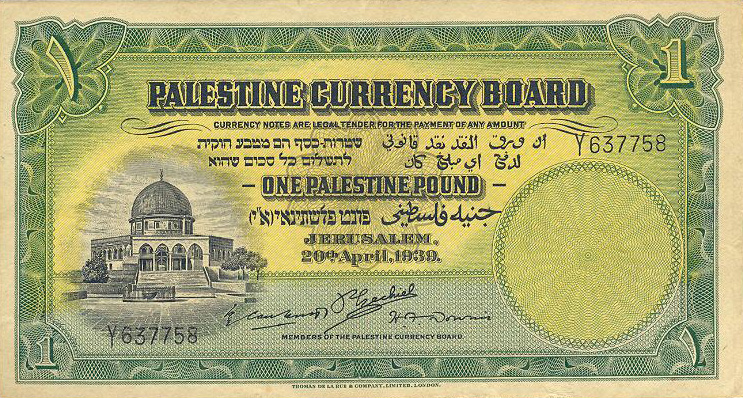
Everything changed after 1948. In 1950, the Palestine Post changed it’s name to The Jerusalem Post. But when that happened, it didn’t suddenly become any more Zionist than it always been. But I don’t want to beat a dead horse. The simple point is that the term “Palestinian” meant very different things at various points during the 20th century. But this does not subtract in any way from the moral imperative to treat all people fairly, whether they are members of a large, respected nation state, or random Bedouins sprinkled across the desert.
So where should Christians stand on this question? It is understandable that the Jews would support Israel (although certainly not all of them do). And it is expected that Arabs would support the Palestinians (though, as I said, the Arab nations seem to be growing impatient with the Palestine State’s intransigence). But Christians have a moral obligation to support both sides in this conflict.
Christians must be unbending in their support of Israel’s right to exist as a nation in the Middle East. But they must also be unflinching in rebuke of Israel’s cruelty to her Palestinian neighbors. Mind you, it hasn't been easy for Israel. Kinda tough to get along with someone who doesn’t even acknowledge your right to exist. But the balance must be maintained. Christians must support Israel’s right to exist. But at the same time, Christians must not turn a blind eye to the suffering of people who are the victims of Israel’s aggressive behavior. It is puzzling to see American Christians adamant in their defense of Israel’s right to exist, but completely silent about Israel’s abuse of her Arab neighbors, including Christian Arabs.
This book was not written by Israelis. It was written by left-wing American Jews. Arthur Goldschmidt taught Middle East history for 35 years at Penn State.
Lawrence Davidson who was one of the founding members of the Students for a Democratic Society when he was a grad student and Georgetown, is also listed as an author, but this book is the ninth edition of a book first published in 1979, and Wikipedia identifies Davidson’s first book as being published in 1990, so this book, at least originally, is clearly Arthur Goldschmidt’s brain child.
But while the book presents a left wing perspective, I do think it is quite useful as a starting point in getting to understand modern Israel. This partly because it is very thorough, but also because you cannot properly understand Israel today without somehow getting a grasp of both the left wing and right wing perspectives on Israel’s problems. Most people who know me would not identify me as left wing, but in fact, when it comes to Israel and the Palestinians, I often find the Israeli left to be more compassionate and sensitive to the plight of the common people than the right wing. When it comes to their visceral hatred for Netanyahu I depart from them. And while he may not succeed in reforming the judiciary the way he would like, he does at least have a point. A strong judiciary does tend to reign in tyranny. But it can also inhibit democracy.
But my point, I guess, is that the best approach to this whole thing is to read some ideas from both sides and then try to frame a perspective that is as fair as possible.
Since this book is a history of the Middle East and not merely a history of Arabs and Jews, it also makes some mention of Christian religions the the area. I did not choose to address that part in this review, because I mention the Nestorians elsewhere (mainly because they came to China), and I will probably deal with the Copts at a later date.
Actually, though, the strongest part of this book is not so much the perspective it shares about the relations between Arabs (including Palestinians and the Arab nations) and Israelis that we all hear so much about on the news. The strongest part of this book for me was the wealth of information it contains on the history of Islam, and of Muhammad as a person. The subject is dealt with delicately, as you can imagine, but is very useful in forming a mental construct of Islam in the modern world, and the nature of it’s origins in the pre-modern world. For that reason alone I would recommend this book as a useful source of information. It shouldn’t be your only source, but it will be helpful to you.
Facebook LinkedIn Book Review Home
Labels: Islam, Israel, Middle East
Saturday, August 26, 2006
The Conclusion of the Matter
As I look back over the summer, and try to put together the things I have seen, the places I have been, and the people I have met, one things stands out above the rest: While it is certainly good for us to make plans and prepare ourselves, I have always found that I have the best experiences when I take pains to make the point with God that I want Him to lead me. Listen to me, if you put your life in God's hands, and trust Him to show you what to do and where to go, He will lead you. I have proven this principle many times over. So that's the first point. I am a Christian. I believe in God, and I believe that He is actively involved in the affairs of men.
The second thing I would say is that, while I am interested in some of the sights one sees traveling around the country, I am far more interested in people, and in understanding how they think. The question of what people believe and why they believe it has always been a matter of great interest to me. So let's take a look at the beliefs. The two main religious groups I encountered this summer were the Tibetan Buddhists and the Hui Muslims.
Buddhists. The first thing you notice when you visit any kind of Buddhist site in China, is the extent to which Buddhism has been commercialized. I have seen a fair amount of this in my travels throughout China, but every time I see it, I am repulsed anew. When I visited the monastery on the Sichuan side of Langmusi, there was no instruction, no map, no brochure, no direction. Just a couple monks in a guard shack who would grab anyone with a white face and collect money. Modern Buddhism in China has found it's Nirvana. It is tourism. They're not very good at it right now, but they're going to get better, especially with the huge number of spiritually exhausted westerners who are so hopelessly overawed by the "beauty of Buddhism." Perhaps my view is a bit jaded, because I grew up next to a Buddhist temple, and I have seen how Buddhism tends to keep people in religious bondage, rather than setting them free. I saw it again this summer--the somber man who kept prostrating endlessly at the temple in Xiahe. He was there when we went in, and he was still prostrating himself over and over again when we came out. Others may have been struck by his faithfulness. I was saddened by the look of complete futility on his face.
But Buddhism is the predominate folk religion in Asia. It's not going anywhere for the moment. An altar with food offerings is a common site in restaurants throughout China. And even people who claim not to believe in anything will politely bow ("for good luck") when they happen to pass some Buddhist religious site. Again, though, Buddhism has become thoroughly commercialized, so I would say that its days are numbered. Nothing destroys a belief system quicker than financial prosperity. And this prosperity tends to generate cynicism in the minds of the people. One Tibetan in Langmusi was complaining to me how detached the monastery was from the local community. He said that they would expect local people to contribute to the sustenance of the monastery, but they did not contribute anything to the community. I asked him if the Tibetan monasteries had schools. He said, "Yes, but only for themselves."
Well, I don't live in his community, so, as a visitor, I am a bit limited in my ability to analyze the specific local situation. But one has to wonder what the chief lama at the monastery is doing building a resort hotel. Did he build this "for profit" hotel with money that was collected for charitable purposes? And does he hold title to the property, or has he turned it over to the monastery? Is there an independent audit of monastery accounts, or are they beyond scrutiny? Is anyone asking these questions? Buddhism suffered terribly during the Cultural Revolution, when there was a concerted attack on Buddhism, as well as other religions. Today, the scene is very different. Although the government wants to be seen as treating all religions fairly, Buddhism gets a boost because it is seen as a Chinese religion (which, of course, it is not), and a balance to Christianity, which is growing like a wildfire in both it's formal and informal variations.
Muslims. Islam in China is not nearly as commercialized as Buddhism. I wouldn't say it is not commercialized at all, because I did have to pay a fee to visit the ancient Tang Dynasty mosque in Xi'an last summer. But there is a huge difference between Islam and Buddhism in China. When I went to the large mosque in Linxia, nobody jumped out and grabbed money from me. It was very much like what walking into a neighborhood church building would be like in America. But Islam differs from Buddhism in other ways. When Chinese people refer to Buddhism as a Chinese religion, I always correct them. Buddhism came from India, not China. Nevertheless, Buddhism in China has been largely sinicized over the centuries since it came from India, just as Buddhism in Japan tends to be a mixture of Buddhism and Shintoism. As I mentioned before, Buddhism is the folk religion of Asia, and thus it feels like a native belief system to Chinese people. Not so with Islam. I have, of course, met many Chinese people who call themselves "Buddhist." But I have never met a Chinese person who identified himself as a Muslim. There are, of course, many Muslims in China. But the Chinese are not Muslims. And the Muslims are not Chinese. I need to be careful not to overstate the case. Before I came to China, I concluded that Islam could never be big in China, because the Muslims do not eat pork, which (as Piano says) is the "default meat" of China. I was wrong. There are many Muslim restaurants in any sizeable Chinese city, and they serve dishes that attract Muslims and non Muslims alike. And the government of China has gone to great lengths to accommodate the Muslim minorities and bring them into the mainstream of Chinese society. This has been easier with the Hui (because they do not have a separate language) than it has with the Uygur, but even the Uygur are able to go just about anywhere in China and find a restaurant that is "Kosher" (pardon the term). Nevertheless, the Muslim minorities in China are just that--minorities. Largely for this reason, I think, Islam seems to be more removed, as a religion, from the mainstream than is Buddhism. Recent world events linking Islam to terrorism have not helped matters either. I need to be careful, here, because there is, even in modern Islamic countries, a growing distinction between the religious Islam that all Muslims accept, and Islamism, which is viewed with suspicion by Muslims in very much the same way that Protestant Christian organizations like the Ku Klux Klan are viewed negatively by Christians in a "Christian" country like America. But is there something about Islam that is characterized by, if not endorsement, a tacit complicity with the more violent aspects of Islamism? Roger Scruton, in a fascinating piece in the Wall Street Journal, postulates that Islam suffers from a lack of irony. That while most Muslims would not openly condone the violence often associated with Muslim extremists, they have been woefully silent in condemning them. This question needs some thought and discussion.
And there is the question of the holy book. Last night at the English corner, a guy asked me, "Which book is better, the King James (not sure why he chose that version) Bible, or the Muslim book (he didn't know what to call it)? I said, "Take a look at history. Societies that have followed the principles in the Bible have become prosperous and advanced. Societies that have been built on the Koran have remained backward and undeveloped." There is no questioning the profound effect of the Bible on the eventual progression of a given society. Horace Greely said, "It is impossible to enslave mentally or socially a Bible-reading people. The principles of the Bible are the groundwork of human freedom."
Getting back to the Hui Muslims, though, I should hasten to point out that Islam is as much a cultural thing as it is a religious belief. That is why we refer to them as "Hui Muslims." It's a precarious term, because the word "Hui" denotes the ethnic minority, while "Muslim" denotes (or is supposed to denote) religious affiliation. Theoretically, then, it should be possible for a Hui to be a member of some other religion, just as there are Jews who are not necessarily Jewish. But you just don't meet Hui people in China who are not Muslim, except in the case of mixed marriages. For the Hui, Islam is very closely tied to their ethnicity.
Secularism. This is really the new religion of China. I suppose it is a natural result of economic prosperity, but also strongly influenced by the complete vacuum of belief during the Communist era. Most Chinese people I interact with are singularly secular. This is one very noticeable contrast when you emerge from a visit to communities like Langmusi or Linxia. The secularism in China is interesting, because it is not, as in America, a slow backsliding from previously held beliefs, but is rather a disillusionment with a previously believed cult religion (Maoism) that became cruel and brutal. But many Chinese people still struggle with this. It never ceases to amaze me how many Chinese intellectuals still try to tell me that the business oriented atmosphere so prevalent in China today is actually a modification (improvement?) of Marxism. Nonsense. A more common attitude I see in China, is a sort of macabre fascination with the excesses of the Maoist period. Traveling this summer, I saw a guy with a T-shirt that said, "ASSUME THE POSITION." I had to wonder if he had any idea what that meant. The last day I was in Lanzhou, I was having lunch with Inga's family, and her uncle got a phone call. The ring tone on his cell phone was the voice of a red guard yelling through a megaphone to heed the sayings of Chairman Mao. And there is a nightclub here in Beijing where the waitresses all wear Red Army uniforms and yell Marxist exhortations at you instead of smiling when you enter.
What, then, do the Chinese people believe? It seems to me that many of them are still trying to decide this question, and the future of this country will be powerfully influenced by that decision. And there is another question that I always have to ask myself. What do I believe, and how does that influence my attitude toward other belief systems. I need to address this issue because while I like to think of myself as an objective person, I cannot really be called "disinterested." I am not neutral. So I cannot claim to be looking at the issue from a purely scholarly perspective. Much to the contrary, I, myself, have deep beliefs about these things, and that affects how I view others. But I think some would too quickly call this a disadvantage; others would completely disqualify me as an analyst of others beliefs. I would say, in my defense, that because of my own beliefs about these questions, I tend to relate well to people with strongly held beliefs. I have always gotten along better with atheists than with agnostics or nominal (I sometimes say 'political') Christians. So, for what it's worth, let me tell you where I stand on the matter.
I believe that the universe is ruled by a personal God who is very concerned about the affairs of men. I believe that we are all going to die someday. But I believe that this fact is proof that somehow, somewhere, sometime, something went terribly wrong. You just cannot convince me that man was made to die. It wasn't supposed to happen that way. Somebody blew it. So sin entered the human sphere, and man is destined to die as a consequence. But man's failure is not God's failure. God did not become less God because of man's fall. So God's standard is still perfection, but no man can live up to it. Our solution to this, is to expect God to lower His standards a bit out of recognition for our limitations. But God is not willing to be less holy to compensate for our imperfections. So what does He do? God is a God of justice. To satisfy justice, all He has to do is destroy us. But God is also a God of love. Because He is a God of perfect justice, he cannot lower His standard, but because He is also a God of love, He wants to redeem us. God's solution to this, was to send His own Son to live a perfect life. Jesus lived a perfect life, and then preceded to take the punishment for all of our sin. He became guilty of our sin so that we could inherit his righteousness. So we all have a choice. We can live a perfect life, and then stand before God in our righteousness and be judged on the kind of life we have lived, or we can stand before God clothed in Christ's righteousness, and be judged on the kind of life Christ lived. But remember, God's standard is absolute perfection. In my case, the choice is quite simple, because I have already blown the first option. But that's the point. The Bible says that all have sinned and come short of God's glory. So we're all in the same boat. There is nothing we can do to be good enough for God. Without His mercy, we are sunk. This, then, is why I am so troubled when I see sincere people prostrating themselves over and over again in hopes that God will love them. God's love is always given freely. We don't need to do anything (indeed we can't do anything) to earn his love and mercy. It is only available as a free gift. This is the essence of the Christian gospel. I hope you can see that, when viewed from this perspective, all religions come up short, because all religion is about man reaching up to find God, and God is unreachable. Not only is God unreachable, but he is absolutely unreachable. But while we cannot reach God, God can reach us. So it is of the Lord's mercy that we are not consumed. The whole purpose of religion is to keep us so busy trying to be good enough for God, that we cannot see his hand of mercy reaching out to us.
In lovingkindness Jesus came
My soul in mercy to reclaim,
And from the depths of sin and shame
Through grace He lifted me.
From sinking sand He lifted me,
With tender hand He lifted me,
From shades of night to plains of light,
O praise His Name, He lifted me!
Labels: Buddhism, Islam, Religion, Secularism
Tuesday, August 02, 2005
The tour guide asked me where I wanted to meet. Since I am not from this community, and am not familiar with various restaurants and tea houses, I really thought they should choose the place, but they wanted to be polite. I recommended John's Cafe, since it is the only place I really know about. The tour guide quickly told me that the official could not enter that place, because it was run by Chinese. This is unfortunate, because the folks who run that place are really very nice people. They're from Qingdao. But isn't a racial thing, really. It's the fact that the Chinese eat pork, which is detestable to the Uygurs. Anyway, they selected a local Uygur place with an outside veranda.
The official was warm and friendly, with a firm handshake. Definitely a politician at heart. But it was clear very early in our conversation, that he is also a devout Muslim. I asked him how Islam functioned in a society where religion is controlled by the party. He said that the association would facilitate negotiation between the party and the religious clerics regarding anything that could be politically sensitive. He seemed to downplay any problem, perhaps because he basically works for the government (probably through the Public Security Bureau), and, of course, would not want to be seen as objecting to the government's position.
I also asked him about the nature of Islam as compared to Christianity. I told him that the Christian gospel teaches that God is a God of Love, but also a God of justice. God's standard is perfection, and He is not willing to compromise His standard, but since He is also a God of love, He sent His Son to fulfill the requirements of God's standard and live a perfect life, and then fulfill the requirements of God's justice by taking the punishment we deserve. The official's response was to talk about the prophets of Islam, of whom Jesus of Nazareth is one.
The official asked me about my family. I told him that I had three children, but that I was divorced. He was upset about this. He told me quickly that divorce was not a good thing. I agreed with him and explained to him that under American divorce law, one does not have a choice in such matters. He told me that if a man in their community was single, they would "force" him to find a wife. There is a very strong family orientation among the Uygur people. The Uygur are exempted from the one-child policy. I don't think they have large families, but I would expect to see very, very few one-child families among the Uygur people.
Friday, July 29, 2005
"There is no God but Allah, and Mohammed is His prophet."
"There is no God but Allah, and Mohammed is His prophet."
"There is no God but Allah, and Mohammed is His prophet."
Over and over it is repeated. But times have changed. The muezzin doesn't climb to the minaret anymore. His voice is heard over the loudspeaker. I couldn't follow it myself, because the audio was a bit muffled, but mostly because I don't know Arabic. The mosque is open for prayer (and closed to tourists) five times a day. But it is on Friday that the crowds really come. The other days, most Muslims tend to go to a mosque in their own neighborhoods. Kashgar is a city with almost literally a mosque on every street corner.
It is hard for me to convey to you the importance of the mosque in a Muslim community such as this. Everything in "old town" Kashgar seems to be built around it. And even though some prefer to pray at home, a local Muslim told me that it is 27 times better to pray in the mosque than to pray at home.
The Id Kah mosque, built in the 15th Century, is the largest mosque in China. It is open to tourists, but the tourists are shut out during prayer times, which makes me wonder how this religion is propagated. This, of course, is one of the major differences between Islam in Christianity. A big part of Christianity consists of inviting others to worship services.
In some ways, I think the mosque is even more important than the religion itself, although that may be a contradictory statement, becuase the mosque is part of the religion. But I guess what I mean by that is that the mosque is a tangible representation of identity for both the "true believers," and those who really don't seem to be that religious, but still consider themselves Muslims.
Islam is definitely a man's religion. This is most noticeable on Friday, when you can see all the men streaming toward the Mosque for the mid day prayer time, and a group of women sitting outside the mosque. I have been told several times, in answer to my queries, that the women "pray at home." But I cannot help but wonder how many of them actually go through the process of bowing and praying at the same time as their men are praying at the mosque. I don't know.
