Links
- CV
- Titles
- Topics
- Tickets
- Science
- About Eric
- Book Reviews
- Country Profile
- Modern China
- Contact Eric
- Podcast
- Vision
- Sekai
- John
Archives
RSS

Reflections on a Wandering Life.....
Sunday, October 31, 2021
Hong Kong--Where to go from here?
In this video we see the flow of refugees from Communist China. I was born in 1954, and in the Cold War world I grew up in, we always heard how hard it was for people to leave the communist world. The Berlin Wall went up in 1961, and the purpose of that wall (and other walls separating Eastern and Western Europe) was to keep people in, not to keep people out. But in the earliest days of Communist rule both in Eastern Europe and in Asia, the restrictions to people leaving were not so severe. Remember, the communists assumed that the common people would absolutely love them. It took them awhile to realize that their people were less than enthralled with the system they were creating. Of course, Marxism as an economic system was a colossal failure. Between the end of World War II, and 1961 when the wall went up, something like 3 million people migrated from Eastern Europe to Western Europe. Do the math—it comes to about 500 people a day for fifteen years.
So in China, the same type of thing was happening. Not to the same degree, I’m sure, because Hong Kong had been devastated by the war, and did not present the economic contrast that was much more noticeable in Europe. Also, I was talking with another expat here in Kunming the other day who was in Hong Kong in 1960 or 61, and he said there were plenty of people going the other way, too. I think it eventually turned out to be a net gain (of refugees) for Hong Kong, but not as drastically as Eastern Europe.
Nevertheless, Hong Kong became the place of “safety” from “Communist” control. As 1997 drew near, there was concern that Hong was going to be just another city in China after the handover. [That concern was very evident to me, because I was a graduate student in Canada during those pre-1997 years. I used to go to the Chinese Alliance Church in Regina, where there were lots of people who had “escaped” from Hong Kong in anticipation of the handover.] Thus the intense negotiations between Margaret Thatcher and Deng Xiaoping. They each had an ace in the hole, so to speak. Deng Xiaoping’s ace in the hole was that the “New Territories,” that part of Hong Kong that was leased for 99 years by Great Britain in 1898 was due to be returned according to the terms of the lease. There was no way Britain could get out of it.
Margaret Thatcher’s ace in the hole was that the original Hong Kong, which comprised Hong Kong Island, was not leased. It had been ceded to Great Britain by treaty many years earlier. They did not have to return it. It would have made a mess of things if they had held on to it, and it would not have been worth much, because Hong Kong had grown to a size the dwarfed the original colony on the Island. So Margaret Thatcher did not actually want to keep it. But she was using that option to get the best deal possible. Basically, Deng Xiaoping made her an offer she could not refuse. He told her that China would allow Hong Kong to govern itself under the “one country, two systems” rubric for fifty more years. That was half the duration of the original lease.

So how has it been going? Depends on who you ask, of course, but there have been naysayers from the beginning. China executing the national security law and imposing it on Hong Kong was just the latest. But it seemed to sound the death nell for the one country, two systems arrangement in the minds of many observers.
Saturday, September 21, 2019
John Bolton's Departure

John Bolton. Click for larger image.
The ouster of John Bolton as National Security Advisor brings to mind another day and another time, when the National Security Adviser was used by the president as a shadow Secretary of State. I have often wondered how it must have felt to be William Rogers. From the very beginning, Nixon ignored Rogers. It wasn't because William Rogers wasn't a capable professional. He was a skilled lawyer who had argued cases before the Supreme Court. He had been Attorney General under Eisenhower. But Nixon did not trust the State Department. When he wanted to open communication with China, he sent Henry Kissinger, his National Security Adviser, on a secret mission to China via Pakistan. Rogers didn't know anything about it. When it came to actually negotiating with the Chinese, they were highly offended when Nixon said that he did not want the foreign minister in the room. That is, until the translators got everything straightened out. He wasn't saying that he didn't want their foreign minister in the room. He was saying that he didn't want his own foreign minister (Secretary of State) in the room. The Chinese were flabbergasted.
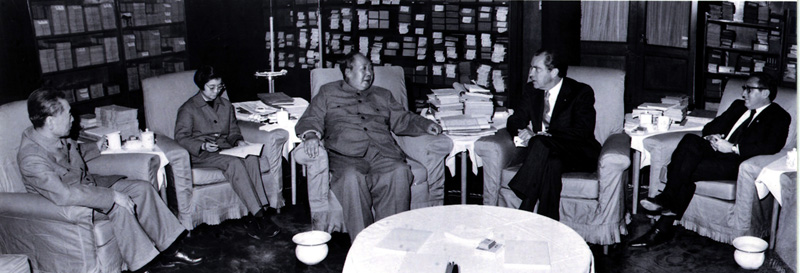
On his trip to China in 1972, Nixon had extensive meetings with Zhou Enlai, but he only met once with Mao. Rogers was not allowed in the room. Only Kissinger and his assistant were there with Nixon. It was felt that Kissinger was one thing, but having Winston Lord there when Rogers was not even invited was a bit much. So Winston Lord (Kissinger's assistant) was cropped out of the photos.
What explains Nixon's attitude toward Rogers? It was not really a snub. In fact, Nixon had nothing against William Rogers, but he distrusted the State Department. Nixon was a secretive person, and it is possible he feared a type of "deep state" such as we talk much about now, but which was never mentioned in those days. At any rate, he picked a Secretary of State who was not a foreign policy wonk and then ignored him. Here is what Kissinger said about it:
Few secretaries of state can have been selected because of their president's confidence in their ignorance of foreign policy.William Rogers resigned in September of 1973. Can you blame him? Kissinger was then appointed to take his place, and for the rest of Nixon's term, and all of Ford's term, Kissinger served as the Secretary of State, which is what he had actually been doing all along.
This is not a healthy state of affairs. The National Security Advisor is only an advisor. As such, he does not require Senate Confirmation. But the Secretary of State is a Cabinet level office, and does require confirmation. Nixon used Kissiner as his Secretary of State, even though he had never been confirmed by the Senate. Would the deal with China have happened if Nixon had done it out in the open, using his legitimate foreign minister (Secretary of State)? It's a question worth asking. Under Trump, the "CEO" of foreign policy is definitely Mike Pompeo, who is the Secretary of State. That is as it should be, and he has done an excellent job. And he was confirmed by the Senate. But the Democrats tried very hard to derail his nomination. They hate Trump and anyone he picks. So I can understand Nixon's position. The detante between the US and China hung in the balance. Still, in an open democracy, duties normally done by an official who requires Senate confirmation should not be performed by someone who has never gone through that process.
That being said, Kissinger was a very effective diplomat, and formed a close relationship with Zhou Enlai. The United States established diplomatic relations with China, and war was averted, not only between China and the United States, but between China and Taiwan (PRC and ROC).
Henry Kissinger was a colossal figure, and making him the National Security Advisor inevitably blew that role way out of proportion. After Kissinger, the role of National Security Advisor was returned to it's former position--as an adviser to the President.
I don't worry about John Bolton. When people like him get fired, their lives don't get worse, they get better. Or at least easier. Bolton has strong opinions and is very articulate--problematic in his current role, but ideal for television. Still, I am disappointed to see him go. Why did it happen?
Nobody is giving a clear answer to this, but I can imagine Bolton clashed once too often with Trump. Bolton is a pessimist, and he had an aggravating habit of being right most of the time. Bolton felt that for all it's pageantry, Trump's meetings with Kim have not resulted in concrete progress toward denuclearization of the Korean peninsula. Bolton was also very hawkish toward Iran, and I can imagine him going ballistic when he heard about the Taliban being invited to Camp David. Bolton had a bit of a temper, and he may have unloaded on Trump a little too strongly. Whatever the case may be, he offered to resign, and Trump decided to take the opportunity to remove the irritation. Not that big a deal--it is just an advisory role, but as I said, I am sad to see him go. Maybe he was just a little too negative for Trump. Trump has picked a very capable man to replace Bolton. Robert O'brien is the author of While America Slept, which outlines the need to beef up security, and indicates that he is not going to be just a "yes man" to Trump, so I don't worry too much about this change. But I, for one, am going to miss Bolton. Then again, maybe not--we will probably see his face quite a bit on television news shows.
Labels: Cold War, US-China Relations
