Links
- CV
- Titles
- Topics
- Tickets
- Science
- About Eric
- Book Reviews
- Country Profile
- Modern China
- Contact Eric
- Podcast
- Vision
- Sekai
- John
Archives
RSS

Reflections on a Wandering Life.....
Wednesday, January 15, 2020
Ming & Qing : Lessons for a Dying Culture from Two Dynasties in China
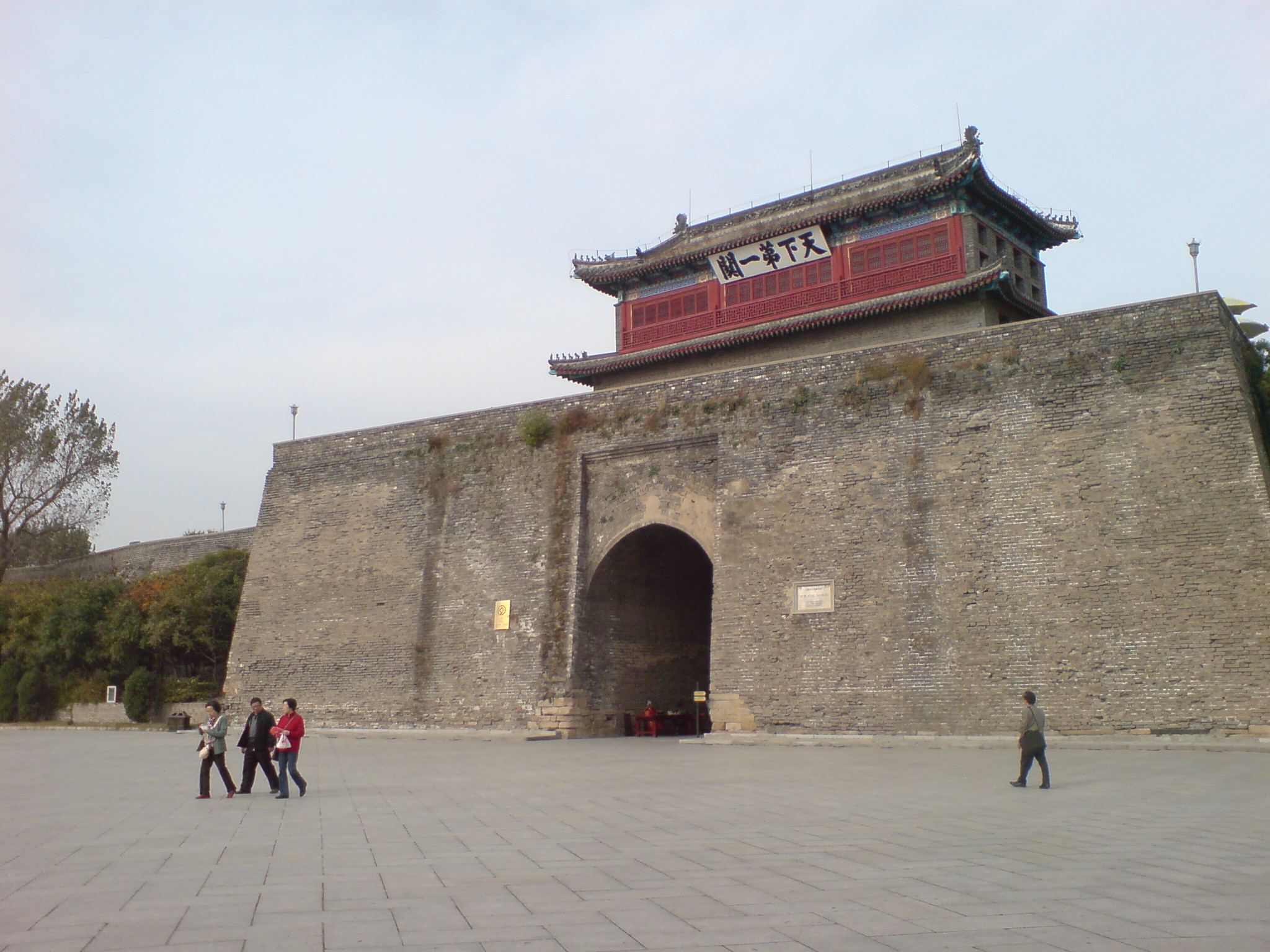
Years ago, the faculty at the Software College (Beihang University) where I was teaching bused us to a retreat near the place where the Qing Dynasty began. It is called "Shanhaiguan" or "Shanhai Pass" (pictured above), and it is very near where the Great Wall meets the sea at Laolongtou (Old Dragon's Head).
The story I was told at the time was that the government minister from the Ming Dynasty opened the gate to let the Manchus in because the Ming had become so corrupted. The real story is a bit more complicated, and there is some dispute about the details, but one thing is beyond dispute: For the entire Qing Dynasty, China was ruled by the very people the Great Wall was built to protect them from. But lest you think that this means "walls don't work," it is important to note that, as one of my students pointed out to me, "you can't say that the Great Wall never worked." He's right. If the Wall had never worked, there would probably not have been a Ming Dynasty, or at least you could safely conclude that it would not have lasted nearly as long:
|
|
Ming Dynasty (1368 ? 1644 A.D.) |
|
|
Qing Dynasty (1644 ? 1911 A.D.) |
You see, the downfall of the Ming was not due to the failure of the wall. It was due to a failure of the culture. The point is that the best wall in the world cannot protect you from yourself. So the Manchus came in and the Ming Dynasty was over. As I said, the Manchus ruled China throughout the Qing Dynasty. But who were they? The Manchus were descendants of the Jurchen people, who ruled the Jin Dynasty. Chinese dynasties can be confusing, because, for example, the Jin Dynasty did not rule all of China, just a portion of it in the Northeast, so it ruled concurrently with the Song Dynasty and therefore is often not listed separately as a dynasty in China. The Jurchen were overthrown by the Mongols, and I guess it can be assumed that there was some intermarriage between the Jurchen and the Mongols. The Manchus were the descendants of the Jurchen, but really the Jurchen just changed their name, although it is true that the people group had changed too, as it became, although predominantly Jurchen, probably a mixture between Jurchen and Mongol. So I guess you could say that the Manchus were essentially Mongolized Jurchens. I say this to emphasize the the Manchus were not irrelevant barbarians who came out of nowhere. Both the Jurchen and the Mongols had been intimately involved with China. The Mongols, you remember ruled all of China under Kublai Khan. Kublai Khan was the first emporer of the Yuan Dynasty. You may not be as familiar with the Jurchen, because their dynasty was actually sort of a sub-dynasty, as I mentioned earlier.
At any rate, after Shanhaiguan, the Manchus were in charge. The corrupted and decrepit Ming had been replaced by the Qing. But was the Qing Dynasty really an improvement? Listen to this lively debate presented by the Sinica Podcast and decide for yourself:
This debate was held at the Beijing Bookworm which is (or was) over in the Sanlitun (expat bar street) area on the east side. It's interesting, but as you might expect, it focuses on the comparison between the two dynasties. I am more interested in the transition. But not just the transition from the Ming to the Qing. The end of the Qing Dynasty is also of interest. So maybe the grand question could be phrased as: "What is the end of a Dynasty like?" or "What makes a dynasty rise and fall?" This is a question most Americans do not understand well, because America has only had one dynasty, and Americans do not read history much, so they tend not to be aware that no dynasty in history has lasted forever. Dynasties rise and fall. If you look at Chinese dynasties (especially the Ming and Qing) you see that they both lasted just under three hundred years. The American dynasty will be 300 years old in 2076. If the American dynasty lasts no longer than either the Ming or the Qing, it has less than fifty years left. Can a dynasty last longer than that? Yes. The Zhou Dynasty lasted longer than 800 years. But the Zhou Dynasty went into decline in the latter half. It's a separate subject for a different time, but I believe that the writings of Confucius may have extended the Zhou Dynasty far beyond what might otherwise have been likely.
Here's my point: I believe that the American dynasty has entered a period of decline. I don't see the American dynasty lasting another fifty years. No way. Because Americans have no conception of what makes dynasties rise and fall, they tend to talk about "eliminating poverty," or "making America great again." But to make America great again, Americans need to understand what makes a dynasty great. Can you guess what it is? If you said, "democracy," that's the wrong answer. The one thing above all others that makes a dynasty great is righteousness:
Righteousness exalteth a nation: but sin is a reproach to any people. (Proverbs 14:34)But as you can see, the statement has two sides to it. Sin..corruption..dishonesty..these things erode the foundation of a culture, making it extremely unstable and vulnerable to attack. So when it comes to the basic inescapable reality that all dynasties governed by sinful man ultimately decay, the Ming Dynasty and the Qing Dynasty are more alike than they are different. The Ming and Qing both had their rise, and tney had their decline and fall.
When a dynasty dies, so much goes with it. One of main casualties is language. Don't get me wrong--when the Qing Dynasty came to an end just over a hundred years ago now, that was the end of Manchu rule, but not the end of the Manchus as a people. I have known several Manchus. There are ten million of them alive today. But there are exactly nineteen native speakers of the Manchu language left in the world. It's gone.
So what about the American Dynasty? Is it more like the Qing or the Ming? I am not sure it matters. They both fell eventually, and the American dynasty will too, perhaps sooner than we think. Is there any way to forestall the decline of the America dynasty? Sure. I just mentioned the Zhou dynasty, but with many dynasties the decline is actually not a straight line. It goes up and down. God has extraordinary forbearance toward a culture and a people who want to turn from the wrong and do the right:
If I shut up the heavens so that there is no rain, or if I command the locust to devour the land, or if I send pestilence among my people; if my people, who are called by my name, shall humble themselves, and pray, and seek my face, and turn from their wicked ways; then will I hear from heaven, and will forgive their sin, and will heal their land. (2nd Chronicles 7:13-14)But when is the last time you entered a church or place where believers gather and found them on their faces before God, begging Him to have mercy on their country? Is there any place in America where you see Christians focused on praying for their country? They seem to be focused on fighting for the right to talk about politics without losing their non-profit status. America is a democracy, so it is understandable that citizens would be thinking about how best to exercise the freedom and responsibility they have been given. But even in the years since I left the United States in the mid-noughties I have seen a moral decline in America beyond what I could have imagined. Politics alone will not address this issue.
And what about China? I am often asked about this. This is perhaps the most frequent question I hear. I always say that China is a country at the crossroads, trying to decide which way it is going to go. If the people follow after truth and justice, then China will become a great country. But if they follow after money and power, then China will become a very dark place. And this direction will be shaped by the masses, not by the ruling elite. It is righteousness that exalts a nation. And it is corruption and dishonesty that bring it down.
Labels: Dynasties, Ming Dynasty, Qing Dynasty
Tuesday, May 14, 2019
How Old is China?

Click for larger image.
Last Thursday I went to the National Museum with some friends and saw this chart on the wall showing the dynasties of China. Studying the history of China is useful in helping to understand what makes a dynasty rise and fall, because China has had so many of them. Before I came to China, and even after I arrived, I found that Chinese people were fond of saying that China had five thousand years of history. So I would ask them, "Who was the first emperor of China?"
Invariably the response was "Qin Shi Huang."
Then I would say, "Ok, if Qin Shi Huang was the first emperor China and the Qin Dynasty was a little over two thousand years ago, what did you guys do for the three thousand years?"
But the problem is that if you make the argument that China began with Qin Shi Huang, and is thus only a little more than two thousand years old, you have a problem. China is nothing if not Confucian, and Confucius lived in the sixth century BC, so that would bring the beginning of China back to at least 2600 years ago. But if you say that China began with Confucius, you also have a problem. Confucius never presented his ideas as new ideas. He always saw himself as restoring the Rites of Zhou established by the Duke of Zhou.
The Zhou Dynasty lasted longer than any other dynasty (790 years). That is remarkable. The chart pictured above is a bit confusing, because it does not explain that the Zhou Dynasty is actually divided into two segments, the Western Zhou and the Eastern Zhou. This chart shows the Western Zhou, but it doesn't tell you that the Eastern Zhou is actually composed of the two sub-parts that are listed here, the Spring and Autumn Period (during which Confucius lived and taught), and the Warring States Period.
Why is the Zhou Dynasty thus divided? My thinking is that the second part of the Zhou Dynasty (the Eastern Zhou, made up of the two sub-periods I mentioned) represents the decline of the Zhou Dynasty. It seems that Confucius saw this decline and tried to correct it by restoring the values of the first part of the Zhou Dynasty (shown here as the Western Zhou), with particular reference to his hero, the Duke of Zhou. The extent to which he succeeded can be measured by the extent to which China as China became an enduring society.
I don't want to go any further in that direction, because the treatment of Confucius and his influence on succeeding dynasties is far too big a subject to be dealt with here. Suffice it to say that, in my opinion, Chinese dynasties have risen as they have stayed true to those values, and have declined as they moved away from them.
One further note: In my opinion, it is a mistake to refer to Qin Shi Huang as the "first emperor of China," although this is a very common practice. It implies that there really was no Chinese society before Qin Shi Huang, and that China was just a disorganized rabble. That may be true politically, but not culturally. In fact, as you can see, there were many rulers of China before Qin Shi Huang, spanning hundreds of years.
So how did this come about--I mean Qin Shi Huang coming to be thought of as the first emperor of China when, in fact, there were many monarchs before him? People in China usually respond that he was the first emperor of the unified China. Maybe. But in my opinion, a big part of it is due to the way he stylized his name:
It is evident that whatever we think of Qin Shi Huang, he thought of himself as the first emperor of China (or at least the first one that mattered), he stylized his name to reflect that, and he managed to convince succeeding generations of Chinese people to view him in that light.
Not me. I think he had an exaggerated view of his own importance. Don't get me wrong. I don't say that Qin Shi Huang was not important. That would be going too far the other way. No study of China's history is complete without a visit to Xi'an to view the Terracotta soldiers--more than eight thousand of them--who were buried with Qin Shi Huang to protect him in the afterlife. His own body has never been exhumed. He had himself buried in a sea of mercury. He was an extraordinary person, and his influence is important to understand particularly in light of the fact that Mao, who did not encourage the reading of ancient history by the masses, was a prodigious student of history himself, and saw himself as the modern version of Qin Shi Huang.
But calling him the first emperor of China is going to far, I think. The roots of Chinese culture precede him by centuries, and endured his attempts to minimize them in much the same way that Confucian ideas have survived the attempts of the early Communists to wipe them out.
So where does this all end? If you want to know how old China as China really is, you must go back before Qin Shi Huang. Confucius? No, keep going, all the way back to the first half of the Zhou Dynasty. Search there and you will find what makes China China.
Labels: Confucius, Dynasties, Qin Shi Huang
Wednesday, August 29, 2007
Shanhaiguan
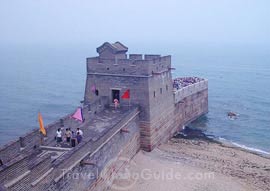
Beidaihe, on the Bohai Sea, used to be the favorite summer resort area for high-level communist officials. I had planned to make a side trip to Beidaihe after my trip to the West this summer, but I discovered just before I left that the Software College was planning a faculty retreat to Nandaihe at the end of August, so I cancelled my plans and decided to go with the flow. We holed up at a small resort hotel about a ten minute walk from the beach. In China, usually if there is a beach that is swimmable, it is very crowded. But this one was actually quite nice. Yesterday, we took a bus to Shanhaiguan, where Wu Sangui, the Chinese general opened the gate and let the Manchu's through the Great Wall, putting an end to the Ming Dynasty. The Manchu's (Qing Dynasty) ruled China until the Revolution in 1911. Near Shanghaiguan, is the place where the very tip of the wall meets the Bohai Sea. All of these places are in the vicinity of Beidaihe, which, as I said, is the former favorite summer get away for Party leaders. During Mao's time, there was a special Friendship house for visiting Russian diplomats. Because of this, there are still a number of Russians who come here every year, and you can still see lots of signs in Russian.
Labels: Dynasties
Thursday, February 05, 2004
Orthodox Thinking in China
Had an interesting talk with Adam this evening. I ran into him at the Lush. I had gone there to study, but they had scheduled a dance, so it was not condusive to study. So I gave up studying and spent some time talking with him and an American economics professor. Adam is from Sichuan Province in the western part of China. He has never been to the United States, but would like to go there to study. He noticed my interest in Chinese history, and particularly commented on a book I had by Lin Yutang. Lin Yutang is actually more of a philosopher than an historian. I told him that I thought Lin Yutang was a very talented writer, but that his western education had influenced his philosophy considerably. To be sure, he is Chinese, and he is widely regarded as the person who, more than anyone else, helped to explain Chinese thinking to the West. He was educated in the West, he spent many years in the West, and he writes in English for a Western audience. But, as I told Adam, my frustration with Lin Yutang is that his education was so western that he sometimes sounds like a run-of-the-mill American professor.
Both Adam and I agreed that "orthodox" thinking in China is essentially Confucian. During the cold war, many in the west came to believe that the key to understanding China (and other eastern countries) was to understand Marxism). But that was a mistake. Mao himself patterned himself after the Qin emperor, and all the rage and fury of the Cultural Revolution did not put as much as a dent in the pervasiveness of Confucian thinking. I expressed my frustration that in America, it is very easy to study the history of China for the last 200 years, but very, very hard to find books (in English) on the dynasties which proceded what we commonly know as "Modern China." Adam agreed, but he said that in many ways the history of Modern China is more important. Perhaps, but I still believe that understanding the history of transition from one dynasty to another throughout the thousands of years of Chinese history is critical to understanding how Modern China came to be what it is. From an historical perspective, the end of a dynasty is seen as a tragedy. The Qing dynasty is a good example of this. During the Qing dynasty, China was ruled by the Manchus. They were essentially foreigners, not Han Chinese. But there is really nothing unusual about that. The Han people have not historically conquered their foes by fighting them off, but by absorbing them. Beijing is actually a good place to study history, since Beijing has ruled China for six dynasties. The only city which exceeds this is Xian, which was the seat of power for twelve dyanasties. It's just really hard, with such a long history, to get a grasp on consistant patterns of history without doing a tremendous amount of reading. Part of this can be circumvented by reading the four classic novels. I have read "Outlaws of the Marsh" (actually about three-fourths of it--I got kinda bored after the vigilantes made up with the Emperor), and now I am reading "The Three Kingdoms." But in addition to this, I am reading a biography of Deng Xiaoping by his daughter. Adam noticed a quote I had underlined. Deng's daughter says,
"Happiness always contains some hardship;
within hardship there is always a little joy.
As long as you do your best to adjust to your
environment, life will provide you with compensation."
She is talking about the Cultural Revolution, when her father was placed under house arrest by Mao. Her book is a fasinating portrait of the one man who, perhaps more than any other, gives credibility to Adam's statement about the importance of modern history. Fortunately (both for him and for China), Deng was spared the fate of Liu Xiaoqi. Nevertheless, the man who would change the face of China--whose economic reforms would one day lift more than 250 million people out of poverty--was forced to live under very spartan conditions. He was confined to his home except in the morning, when he worked in a local factory as a fitter. It is an enlightening thing to watch how he handled his period of disfavor. Gives new meaning to what Solomon said twice in the Book of Proverbs, "before honour is humility."
Labels: Confucius, Deng Xiaoping, Dynasties, Qing Dynasty
