Links
- CV
- Titles
- Topics
- Tickets
- Science
- About Eric
- Book Reviews
- Country Profile
- Modern China
- Contact Eric
- Podcast
- Vision
- Sekai
- John
Archives
RSS

Reflections on a Wandering Life.....
Monday, January 30, 2006
Yasukuni Shrine. It's located in Kudanshita, just a stone's throw from the subway station. I wouldn't doubt if the Yasukuni Shrine is better known in China than it is in Japan. This is because the controversial visits to the shrine by Koizumi, the Japanese prime minister.
But I wasn't interested in the shrine. I don't know... maybe I'm getting a bit cynical, but somehow, when you've seen one pagan religious site, you've seen them all. So I walked past the shrine to the war museum. The war museum at the Yasakuni Shrine is something everyone should see. It is very well laid out and contains lots and lots of information. The videos were all in Japanese, and my Japanese is pretty rusty, because I haven't lived in Japan since I was thirteen years old. So I can't say a lot for the video portion, but the text descriptions for the displays were less offensive than I expected for all the attention the Yasukuni Shrine has gotten. Having said that, the presentations are not objective. They do contain a lot of useful information, but they also present the historical events in a manner that attaches an inevitability to those events that is just not justifiable. I was primarily interested in two events. The first is what has come to be called the "Rape of Nanking." The other is the bombing of Pearl Harbor. In discussing the Rape of Nanking, the presentation doesn't come right out and say that it was inevitable, but the atrocities with which any historian worth his salt is familiar are not even mentioned, and the presentation suggests that any bloodshed was the fault of the commander who refused to surrender. What the presentation doesn't mention is that the local commander sought permission from Chiang Kai-shek to surrender to avoid what he foresaw as a major conflict, which, being unwinnable, would result in massive, needless loss of life. I know hindsight is 20-20, but I think he was right, and that Nanking should have been made an open city. But Chiang Kai-shek felt that it would be politically unacceptable to surrender, issued the order from his mountain retreat that the commander on the scene should fight it out. When this led to disaster, he then ordered a retreat after it was too late to implement. But again, the most serious omission is the horror of the atrocities committed against women and children by members of the Japanese military. Not a word is said about it.
Regarding the bombing of Pearl Harbor, the presentation says quite forcefully that Roosevelt was determined to manipulate the situation so as to force Japan to take the first step. In other words, Japan's bombing of Pearl Harbor was inevitable. Nonsense. But I won't go there--it's a waste of time.
Interestingly enough, the War Museum has generated far less controversy than the Shrine itself, because of the frequent visits by the current prime minister of Japan, Junichiro Kuizumi. These visits are an offense primarily to Korea and China. So how do we resolve this issue? Is it appropriate for the Japanese prime minister to visit the Yasukuni Shrine? The short answer is simple. I am a Christian. I don't think anyone should worship at a Shinto Shrine. But the larger political issue is really not related to religion. Some have suggested that Japan should establish a national cemetery like Arlington, to resolve the separation of church and state issue. But the church/state issue is secondary. The problem for Korea and China is that the Yasukuni Shrine is a memorial to all soldiers, including war criminals. China especially objects strenuously to the Japanese prime minister memorializing war criminals and treating them like heros. So how do we resolve this? Who gets to decide what constitutes a war criminal, and what should be done with their memory? War criminals are determined by war crimes trials, and war crimes trials are prosecuted by the victors. So America, having always been a victor (until the Korean War), has no war criminals. Is this fair? Is this historically accurate? I don't think so. There are many, many examples in US history, especially if you consider the Indian Wars. One that comes to mind is the Sand Creek Massacre, where a group of Indians who were peaceful, and had already surrendered, were slaughtered by the Cavalry under Colonel Chivington, an ordained Methodist minister. When Chivington was asked why he killed everyone, including women and children, a soldier in his army quoted him as saying, "Nits grow into lice." There is no question in my mind that Chivington was a war criminal. But the Indians were the losers in that great struggle, so they did not get to decide who the war criminals were. So American presidents can go to Arlington Cemetary without being accused of memorializing war criminals because there are no American war criminals.
It's a complicated issue, but I don't think it works for countries like Korea and China to tell the Japanese what do to about their war dead. The museum is another thing. I think perhaps a bigger issue could be made about how the history is presented (or omitted). At any rate, I do recommend the tour. I had never seen the human torpedo (basically a suicide bomb) before, and there was also a very good Mitsubishi Zero that had been recovered from a pacific island. In its time, the Zero was the best carrier based fighter in the world.
Before going to the museum, I had stopped for lunch at a little roadside restaurant. But when I noticed the prices, I had second thoughts. One thousand yen for a bowl of katsu (fried pork). Oyako was a little cheaper, but not much. When I was a kid, dishes like oyako and katsu were "everyman's" food. Can't remember exactly what we paid for it in those days, but one thousand yen would be unthinkable. I just couldn't bring myself to do it. Right next to this little restaurant was another little place. McDonald's. Big Mac, chocolate shake and a cup of coffee for 450 yen. Less than half the price. As I sat there eating my hamburger, I pondered the irony of being in the middle of Tokyo, condemned to a mundane American lunch because I was too cheap to pay for the common man's lunch in Japan. How times have changed!
Labels: Japan
Sunday, January 29, 2006
This afternoon Mark and I took the commuter train to the center of Tokyo to an international church. Tokyo, of course, has a sizable international community, and religion is not regulated here like it is in China, so the international fellowships include both Japanese people and foreigners. A young lady asked me if I had ever been to Beijing. Turns out she had seen me on the BICF bus during the time she was living in Beijing. Must have been some time ago, because I only went to BICF for about three months after I first came to China. In China, international churches are restricted to foreigners, and you need a passport to get in the door. I got really tired of that, and the sterile atmosphere it tends to create. The privileged and the unprivileged. The lucky and the unlucky. Church is for everyone. At least for everyone who wants to come. So I quit going to the international church, and began attending a local Chinese church that provides English translation. These Three-Self churches in are the new international churches of China. Here in Japan, the international churches are largely transplants from America.
Saturday, January 28, 2006
Took the train to Shinjuku and had lunch with some of my students who are doing internships here in Japan. After a sukiyaki lunch, we went to a coffee bar and talked the day away. I was telling the students today about some of the students I worked with at the university I taught at in Arizona. They were fascinated with Japanese computer games, and their dream was to go to Japan and work for a Japanese software company. At one point the university even hired a Japanese teacher to teach Japanese language as an elective, because so many students wanted to study Japanese, in hopes of being able to work there.
But I don't know a single one of those students who actually fulfilled his dream. The students I visited with today, on the other hand, are given extensive Japanese language training at the Beijing campus, then lined up with internships at Japanese companies in Tokyo. I reminded these kids today how fortunate they are to have this kind of opportunity. I had students in Arizona who would do almost anything for such a unique option.
But I don't know a single one of those students who actually fulfilled his dream. The students I visited with today, on the other hand, are given extensive Japanese language training at the Beijing campus, then lined up with internships at Japanese companies in Tokyo. I reminded these kids today how fortunate they are to have this kind of opportunity. I had students in Arizona who would do almost anything for such a unique option.
Friday, January 27, 2006
Bulu met me at the West Exit of the Shinjuku station last night, and we went to a local restaurant to get a bite to eat. As we were ordering, I noticed that Bulu was talking quite comfortably with the server, a young man who looked to be in his early twenties. I was surprised to see that Bulu's Japanese had increased so well, since he just started studying shortly before he came here last spring. Bulu told me that the server was Chinese. He has met quite a few Chinese people working in restaurants and other places. It seems that they are able to get jobs, because they will work for less than what the average Japanese will accept. Makes me wonder if they are here legally, or functioning somewhat like the Mexicans in the US. And you might wonder why Chinese workers are drawn to Japan when China's own economy is doing so well. But it makes sense, really. Whatever they can save here would be worth quite a bit more when they get back to China.
Tuesday, January 24, 2006
Boy, I have really been miserable the past week. Got a ferocious cold after I got back from Jilin. Actually, I think the problem was that I forgot to tell them to get me a soft sleeper ticket for the return train. The hard sleeper isn't really that hard physically, it's just very, very narrow. So it is hard to get consistent sleep. I was pretty tired coming back, and I think I just got run down. Anyway, I didn' get a whole lot done last week, because I was so wiped out.
You know, I've been thinking about it...when I was a kid, it somehow never even registered with me that "cold" was a sickness. I guess it's because I had allergies, so I could never tell whether my congestion came from a cold or from my allergies. But the idea of being sick in bed with a cold was just unknown to me. For some reason, colds hit me a lot harder now. I don't always end up in bed, but it does happen (like last week), and the sense of weakness and achiness is just much more noticable than when I was young. Does that mean I'm getting old?
Yesterday, I left Beijing in the morning and got to Narita at about 2 pm. Narita is known the world over as the main Tokyo airport for international flights, but actually it is quite a distance from Tokyo. There are several ways to solve that problem, but the simplest is the Narita Express, and I like simple. The Narita Express is a very fast train. Take the Narita Express to Shinjuku, hold on to your ticket, and you can take any connecting train on the JR lines without buying an additional ticket. Tokyo is pretty easy that way. But be sure to ask for a map of the JR lines when you buy your ticket at Narita.
You know, I've been thinking about it...when I was a kid, it somehow never even registered with me that "cold" was a sickness. I guess it's because I had allergies, so I could never tell whether my congestion came from a cold or from my allergies. But the idea of being sick in bed with a cold was just unknown to me. For some reason, colds hit me a lot harder now. I don't always end up in bed, but it does happen (like last week), and the sense of weakness and achiness is just much more noticable than when I was young. Does that mean I'm getting old?
Yesterday, I left Beijing in the morning and got to Narita at about 2 pm. Narita is known the world over as the main Tokyo airport for international flights, but actually it is quite a distance from Tokyo. There are several ways to solve that problem, but the simplest is the Narita Express, and I like simple. The Narita Express is a very fast train. Take the Narita Express to Shinjuku, hold on to your ticket, and you can take any connecting train on the JR lines without buying an additional ticket. Tokyo is pretty easy that way. But be sure to ask for a map of the JR lines when you buy your ticket at Narita.
Friday, January 20, 2006
Interesting interview the other day on Dialogue. Yang Rui was talking with a Swedish Pentecostal missionary who has been working with farmers in North Korea for the past six years. I was particularly interested in hearing what he had to say about the changes he has noticed since he has been there. He said that he had noticed people taking home a lot more home electronics. And there were more markets opening up all the time. He also said that he had noticed quite a few more cars and bicycles.
North Korea is a puzzle. It's a lot like China used to be. This is an observation made by a lot of people I talk to in China. They tell me that North Korea reminds them of China during the Cultural Revolution. Of course I don't argue, because I think the comparison is apt. But it does appear that North Korea is adopting some of the market reforms that have so obviously benefited China.
North Korea is still a pretty closed society, so the picture is not bright. But the irony of the situation is that when a society is that closed, sometimes the result is that good news as well as bad news is kept from the wondering world. So things could be significantly better than the way everyone assumes they are going.
Yang Rui asked the missionary how his religious affiliation affected his ability to function in North Korea. The Swedish missionary responded that for him, the Bible was not just something he used to help people believe. It was something very personal, which he used to guide him in his daily life.
North Korea is a puzzle. It's a lot like China used to be. This is an observation made by a lot of people I talk to in China. They tell me that North Korea reminds them of China during the Cultural Revolution. Of course I don't argue, because I think the comparison is apt. But it does appear that North Korea is adopting some of the market reforms that have so obviously benefited China.
North Korea is still a pretty closed society, so the picture is not bright. But the irony of the situation is that when a society is that closed, sometimes the result is that good news as well as bad news is kept from the wondering world. So things could be significantly better than the way everyone assumes they are going.
Yang Rui asked the missionary how his religious affiliation affected his ability to function in North Korea. The Swedish missionary responded that for him, the Bible was not just something he used to help people believe. It was something very personal, which he used to guide him in his daily life.
Monday, January 16, 2006
Jilin Rime
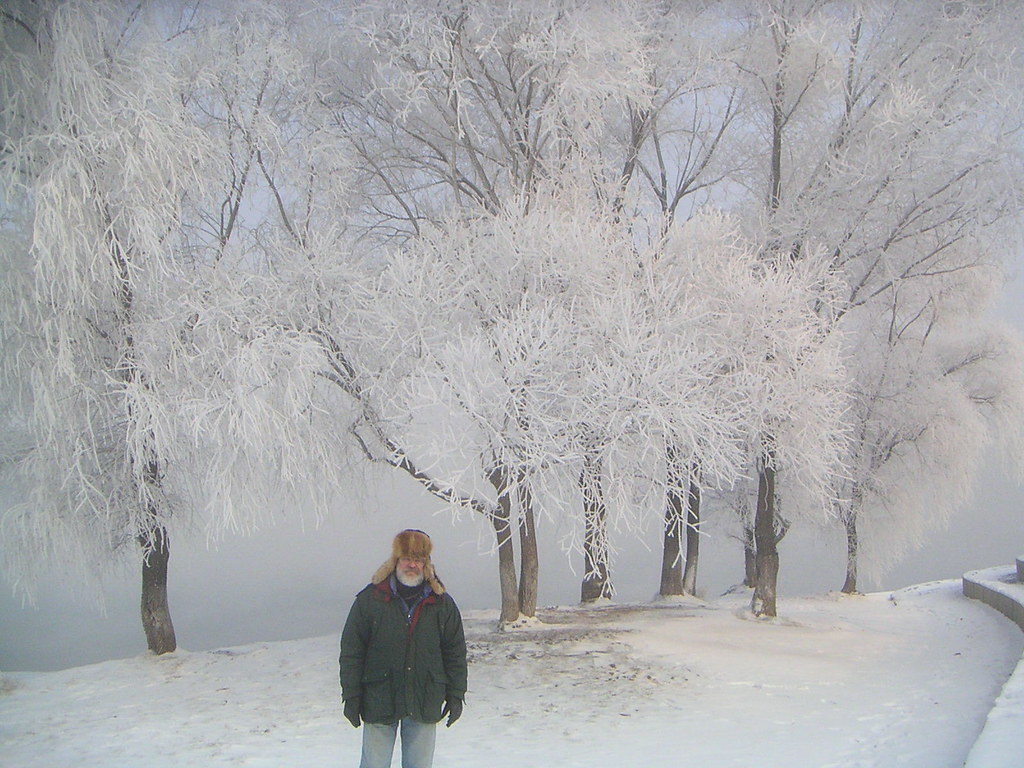 Surprise, surprise, Saturday morning dawned with clear air, so the rime was on the trees. Jenny and I walked down to the river, and hiked along the bank for quite a distance. It struck me as I was walking, that a person really ought to get up before sunrise and do this, to put a little red into the scenery...but I don't know. The mystical white is kinda pretty, too.
After hiking along the river, we went to the museum to meet Jenny's classmate, and take a look at the largest meteorite in the world. 1700 kilograms. The original meteorite from which it came, entered the atmosphere as a huge 15 ton piece of rock, and exploded over Jilin, creating a spectacular meteor shower.
Saturday afternoon, we met with an official from what Grace calls the "Chemical Hospital." The Chemical Hospital is owned by Petro China. Jilin has been much in the news lately, because of an explosion at one of the Petro China plants in November, which released a huge slick of Benzine into the Songhua River. The 100 tons of Benzine floated down the river toward Harbin, slowly dissipating, but not fast enough, shutting down the city water supply in Harbin for four days. Then, it was on to Russia, which is not exactly good for foreign relations.
Anyway, I was aware of the plant because of all the news about it, but I had not known how big the company really is in Jilin. I am not even sure how many plants they have in Jilin, but we saw four or five of them. We then toured the "Chemical Hospital" burn ward, as well as the orthopedic section. Somehow, the sight of some broken bones is not nearly as depressing as seeing patients in the burn ward completely bandaged up, staring morosely into space while the time passes ever so slowly.
After the tour, we went to a traditional Manchurian restaurant and tasted some traditional Manchu cuisine. It is really very delicious food. We washed it down with some rich Manchurian wine, for which I was grateful, because I needed something to settle my stomach. The problem is that we have been having lunch at the hospital cafeteria, and then going to a restaurant in the evening. But for some reason, they have hired a gourmet chef for the hospital who can match any chef in any restaurant in Jilin. So lunch in that place is quite a feast. Still, that Manchurian dinner was really something special. After we had finished eating, I started asking Jenny's mom about her own studies. Madame JinShu, as Grace calls her, grew up during the Cultural Revolution. She started talking about her university experience, which consisted of working in a factory and on a farm. She also talked about covering her books with neat paper covers, so that she could turn the four classics of China (Journey to the West, Outlaws of the Marsh, Dream of the Red Mansion, and The Three Kingdoms) into the "Sayings of Chairman Mao." Finally, in 1977, the examination system was restored, and she was able to go to school.
Madame JinShu is part of the "Lost Generation." I meet them in many parts of China. They grew up during a time when studying was considered "counterrevolutionary," and one's university experience was supposed to have a healthy dose of working with the common people. There are quite a number of accounts of this period, but one of the most informative is Jan Wong's book, because it is written from a North America perspective. I also like that book, because Jan Wong writes with a sense of humor, which is sorely needed when examining that dark period. The members of China's "Lost Generation" roughly parallel the American "Baby Boomers" in their generation. There are similarities, but also notable differences, mainly in that the "Baby Boomers" were born during a time of prosperity in America. Children of the "Lost Generation" were definitely not born to privilege. They were born to hardship. Children growing up in a world gone mad. Many of them, of course, were part of that madness, although I have never met a "Lost Generation" child who identifies him or herself as one of the crazy young people who tore the country apart. Perhaps it's all better forgotten. It's hard, though. There are so many sad stories that keep coming back as reminders of that tragedy. The ones who somehow managed to endure became stronger. The ones (like Deng Xiao-ping's son) who could not seem to cope ended up jumping out of windows.
Yesterday, we drove to Changchun, which was the seat of government during the Japanese occupation of Manchuria. The emperors palace has been turned into a very well presented museum. It is the site of the "Last Emperor's" reign as the puppet emperor under the Japanese. It's kinda depressing in a way, because it is clear that, while at first he dreamed of being able, under the Japanese, to restore the Qing Dynasty, it slowly became clear to him that he was only a puppet. He was basically a prisoner under house arrest. Interesting that he turned his rage on his wife when he discovered that she had had an affair, and kept her as a prisoner inside the palace. She turned inward and spent her days smoking opium, which, of course, is a downward spiral to Hell. The tour is self-guided, but you can rent a device which contains a sensor that detects where you are, and gives you an audio presentation in English of the specific location. It has a few glitches, but it really is very informative. If you haven't seen the movie, "The Last Emperor," it might be a good idea to watch that before you come.
Labels: Manchuria, Travel Jilin
Friday, January 13, 2006
Pulled into Jilin this morning on the night train from Beijing. Grace and Jenny me at the station,and took me to the hospitlal where a guest room was waiting. These folks are very friendly and hospitable. Jenny had sent me an invitation earlier. When I first heard from her, I wasn't sure who she was or why she was writing to me. But I think what happened is that she responded to an email I had sent to Anne Marie when Anne Marie was using her email account to send email. Anyway, she invited me to visit Jilin.
I have been in China two years, now, and this is only my third trip to Dongbei (Manchuria). I have mentioned this before, but the cost of lodging in Dongbei communities tends to be higher, because there isn't the abundance of backpacker type lostels and dormitories that you find in western China. I paid 15 RMB per night in Chengdu, but more commonly 25 RMB for dormitory style housing in Western China. Youth hostels in Guangzhou and Xi'an were higher--50 RMB per night. But I could stay for 10 days in either of those places for the price I paid for one night at the Dalian Binguan, which, by the way is a nice place--no complaints, but it's just a little too expensive.
So the invitation to come here was particularly appreciated, because I am able to stay in a guest room at the hospital where Jenny's mom works. Jenny's mother is a pharmacist, and her father is the architect who designed the hospital where her mother works, and where I stayed. Grace is the administrative assistant/translator.
This afternoon we went to Beishan Park. The view from the top of the mountain (hill) in the park reminded me a lot of Akita, my home town in Japan I had come to Jilin to see the famous Jilin rime, but I left Beijing in a snow storm (which is rare in Beijing), and the storm came with me.
Walking around the park, we came to a skating rink. Grace and Jenny and I decided to do some skating, while Jenny's classmate, and mother watched from the side. I wasn't sure how it would go, since I haven't put on a pair of ice skates in oh, so many years. Nothing to write home about, but I managed to hold my own. Upon leaving the rink, we were acosted by a guy selling horse rides, and another guy selling dogsled rides. Jenny and I got on the horse, and the other three took the dogsled. It was a kiddie ride--they don't let you hold the reins yourself, but it was Jenny's first time on a horse, so that probably was not a bad thing.
I have been in China two years, now, and this is only my third trip to Dongbei (Manchuria). I have mentioned this before, but the cost of lodging in Dongbei communities tends to be higher, because there isn't the abundance of backpacker type lostels and dormitories that you find in western China. I paid 15 RMB per night in Chengdu, but more commonly 25 RMB for dormitory style housing in Western China. Youth hostels in Guangzhou and Xi'an were higher--50 RMB per night. But I could stay for 10 days in either of those places for the price I paid for one night at the Dalian Binguan, which, by the way is a nice place--no complaints, but it's just a little too expensive.
So the invitation to come here was particularly appreciated, because I am able to stay in a guest room at the hospital where Jenny's mom works. Jenny's mother is a pharmacist, and her father is the architect who designed the hospital where her mother works, and where I stayed. Grace is the administrative assistant/translator.
This afternoon we went to Beishan Park. The view from the top of the mountain (hill) in the park reminded me a lot of Akita, my home town in Japan I had come to Jilin to see the famous Jilin rime, but I left Beijing in a snow storm (which is rare in Beijing), and the storm came with me.
Walking around the park, we came to a skating rink. Grace and Jenny and I decided to do some skating, while Jenny's classmate, and mother watched from the side. I wasn't sure how it would go, since I haven't put on a pair of ice skates in oh, so many years. Nothing to write home about, but I managed to hold my own. Upon leaving the rink, we were acosted by a guy selling horse rides, and another guy selling dogsled rides. Jenny and I got on the horse, and the other three took the dogsled. It was a kiddie ride--they don't let you hold the reins yourself, but it was Jenny's first time on a horse, so that probably was not a bad thing.
Tuesday, January 10, 2006
Had dinner with Eric Wu this evening. It was partly to celebrate the second anniversary of my life here in China. Two years ago today, I flew into Beijing from Los Angeles. I didn't know a soul. I had taken the trouble to identify an international church here in Beijing, so the day after I arrived, which was a Saturday evening, I went to the International church, and began to become acquainted with the community.
I don't want to spend a lot of time reiterating stuff that I have already written about extensively in this blog. Briefly, a group of students who could not afford to go home for the winter (Spring Festival) holiday kept in touch with me every day, to make sure I was alright. I sincerely appreciated their kindness (and still do).
So how do I evaluate the last two years in China? I made my decision to move to China in the fall of 2000, so I had three years to prepare. This helped to minimize surprises. In addition, I kept my expectations low, so that most of the surprises I did have were pleasant surprises. In short, it is easier for a single person to live in Beijing than in Tempe, Arizona. I emphasize "single," because I must admit that there are issues that come into play when you have children. Issues that single people don't have to think about. For example, I have been told by several expats that elementary school tuition is quite high for foreigners. But if you don't have children, life in Beijing is just so much simpler than in the average American city. No car payments. No car repairs. No car insurance. No house payment. No rent (my furnished apartment is provided by the college). In Arizona, if you want to take a bus, you may have to walk quite a distance, and the busses don't come very often. If you want to take a taxi, you have to call and wait. Sometimes for quite some time. Here in Beijing, busses run every few minutes, and if you want to take a taxi, just walk out into the street and flag one down.
But most of the time, I just ride my bicycle, which is the other reason for the celebration. Eric took me to a bicycle shop near the West Gate of Qinghua University a little over a year ago, after my first bicycle was stolen. I bought a large frame bike for 320 RMB (about $40 US). Everybody says that is a high price. But it is not that bad for a large frame bicycle. And repair is cheap. Yesterday I was hit by another rider. This minor accident did not affect me at all, but my front tire was turned, and he hit it at full speed, so the rim was bent up pretty badly. I could hardly ride it. I took it to a repair shop. The fix cost me 18 yuan (a little over $2). Today I bought a new basket for 14 RMB (less than $2).
Where will I be two years from now? Hard to tell, because life is always full of changes; I can only hope that I will meet as many nice people in the next two years as I have in the time I have been here.
I don't want to spend a lot of time reiterating stuff that I have already written about extensively in this blog. Briefly, a group of students who could not afford to go home for the winter (Spring Festival) holiday kept in touch with me every day, to make sure I was alright. I sincerely appreciated their kindness (and still do).
So how do I evaluate the last two years in China? I made my decision to move to China in the fall of 2000, so I had three years to prepare. This helped to minimize surprises. In addition, I kept my expectations low, so that most of the surprises I did have were pleasant surprises. In short, it is easier for a single person to live in Beijing than in Tempe, Arizona. I emphasize "single," because I must admit that there are issues that come into play when you have children. Issues that single people don't have to think about. For example, I have been told by several expats that elementary school tuition is quite high for foreigners. But if you don't have children, life in Beijing is just so much simpler than in the average American city. No car payments. No car repairs. No car insurance. No house payment. No rent (my furnished apartment is provided by the college). In Arizona, if you want to take a bus, you may have to walk quite a distance, and the busses don't come very often. If you want to take a taxi, you have to call and wait. Sometimes for quite some time. Here in Beijing, busses run every few minutes, and if you want to take a taxi, just walk out into the street and flag one down.
But most of the time, I just ride my bicycle, which is the other reason for the celebration. Eric took me to a bicycle shop near the West Gate of Qinghua University a little over a year ago, after my first bicycle was stolen. I bought a large frame bike for 320 RMB (about $40 US). Everybody says that is a high price. But it is not that bad for a large frame bicycle. And repair is cheap. Yesterday I was hit by another rider. This minor accident did not affect me at all, but my front tire was turned, and he hit it at full speed, so the rim was bent up pretty badly. I could hardly ride it. I took it to a repair shop. The fix cost me 18 yuan (a little over $2). Today I bought a new basket for 14 RMB (less than $2).
Where will I be two years from now? Hard to tell, because life is always full of changes; I can only hope that I will meet as many nice people in the next two years as I have in the time I have been here.
Monday, January 09, 2006
Welcome to the "Hello Cafe." It's a cafe on the fourth floor of the new cafeteria building. The name doesn't surprise me. It is the one English word that absolutely everyone in China knows how to say. I was here for several hours today with my lab assistants, going over the final exam from the undergraduate class. There are getting to be more and more places like this. Part of the reason is that there is a growing international youth culture in Beijing. The lion's share of these young people live here in the university district on the Upper West Side. But I don't know how easy it will be for this cafe to cash in on that business. Beihang University is a very Chinese university, so there are a few foreign students, but not that many. But there are quite a few universities nearby. It remains to be seen how many of them will be attracted here, but I would expect that it could become popular. The menu offers items that one cannot get at a Chinese restaurant. There are places like TGIF that offer American menus, but you pay through the nose for them. Here at the Hello Cafe, a steak sandwich goes for 25 RMB. The Bar B-Q pork sandwich is 10 RMB. It would be considered an expensive meal by an average student, but it is a lot cheaper than what the same item would cost at a foreign restaurant.
Tuesday, January 03, 2006
Stayed up half the night trying to find the IME (Input Method Editor) for Simplified Chinese. I'm in the process of configuring my new laptop. I run XP in English, with Asian language support. Turns out there is no IME for Office 2003. The configuration is very simple. So simple it stumped me. In the past, I have always had to download an IME specific for Simplified Chinese. So all my searching was a waste of time, except that, in the process, I managed to come across an add-in that allows you to type characters by stroke order rather than by Pinyin. I don't think I'm ready for that yet, because my knowledge of stroke order isn't good enough, but I would like to try it sometime.
The Microsoft website is a nightmare. It never tells you that the IME for Office 2003 does not exist. It keeps trying to direct you to the general area. Out of sympathy for others who may have struggled with the same absurdity that kept me up half the night, I wrote a brief tutorial.
Although there has been significant improvement in language support in recent software versions, I do sometimes run into issues. Before I came to China, I took pains to incorporate Global Language Support into the database creation regimen I have developed for students. I wrote the change into the database creation script, so that the database we create is based on Unicode. We still have some problems, but I am developing scripts to address them as we go.
As an English speaker in China, though, I sometimes encounter a reverse form of the problem. Sometimes, when I am looking for something on the Internet, if I identify my location as China, I am referred to a Chinese language version of the web site. On some occasions, it doesn't even give me a choice. There are times when the website is configured to read my IP address, and assign language by default. But most of the time, there is something in the identifying information, such as my address, that triggers it. I speak English. I live in China. I would strongly prefer to do business with companies that can accommodate those two realities at the same time.
The Microsoft website is a nightmare. It never tells you that the IME for Office 2003 does not exist. It keeps trying to direct you to the general area. Out of sympathy for others who may have struggled with the same absurdity that kept me up half the night, I wrote a brief tutorial.
Although there has been significant improvement in language support in recent software versions, I do sometimes run into issues. Before I came to China, I took pains to incorporate Global Language Support into the database creation regimen I have developed for students. I wrote the change into the database creation script, so that the database we create is based on Unicode. We still have some problems, but I am developing scripts to address them as we go.
As an English speaker in China, though, I sometimes encounter a reverse form of the problem. Sometimes, when I am looking for something on the Internet, if I identify my location as China, I am referred to a Chinese language version of the web site. On some occasions, it doesn't even give me a choice. There are times when the website is configured to read my IP address, and assign language by default. But most of the time, there is something in the identifying information, such as my address, that triggers it. I speak English. I live in China. I would strongly prefer to do business with companies that can accommodate those two realities at the same time.
Sunday, January 01, 2006
I had a New Year's Eve party for some friends here last night. With everyone I invited, and everyone they invited, it got to be quite a crowd. Standing room only. Packed to the gills. As we say in China, "People mountain, people sea."
Somehow I always manage to scrounge up a couple cooks for the party. The chief chef for the evening this time, was Linda, a young lady I met at the English Corner a few weeks ago. I just happened to be talking with her the other day, and asked her if she knew how to cook. Fortunately, she told me she liked cooking, and it turns out she wasn't lying. Saturday, I ran into Rose at the house church, and she agreed to help with cooking. They did a great job. The string beans and pork dish was incredible.
We watched the Jesus film. I have seen many Passion pictures in my time, but that is the one I like best. The reason is that the Jesus film is not just a drama about Christ. It presents a clear gospel message. For several, it was thought of as a nice story, but not something that related to them personally. But for Linda, it was a defining moment. She wanted to start 2006 as a new person. It always strikes me how people can respond so differently to the same story. I must confess that I do not understand the sovereignty of God.
This morning, Claire took me to the church in Chongwenmen. As we were sitting on the subway, I was thinking about last night. I got a text message from another person who watched the movie with us, "I am so touched by last night's movie about Jesus Christ." As I read this message, I was struck by the thought that with all it's simplicity, there is no sweetness like the sweetness of the Gospel.
The Chongwenmen church is known for it's beautiful classic architecture. Today was a particularly beautiful day--cold, but clear. As we entered the old, traditional courtyard, my ears were filled with the sound of parishioners doing the "do re me" music practice before the service. I recognized the melody of an old gospel song. They weren't singing the words, of course, but you know how it is--when you hear the music to a familiar tune, the words have a way of floating through your mind. They seemed to be a confirmation of my earlier musings on the subway:
I would like to know more about the history of this place. It has obviously been standing here for quite some time. It is encouraging to me to see what Chinese Christianity has become in spite of all the trouble of the past 50 years. Or perhaps because of it. Would this sincere fellowship be here in this old place if China had known only bounty and good times? Somehow I don't think so. And the communion service afterwards was particularly reverent and peaceful. As the piano was softly playing "Break Thou the Bread of Life," I lifted my hand in worship to the Lord. I was hoping Claire would not rebuke me for this outward expression of worship. She did. She grabbed my other arm and pushed it upward, "Raise two hands!" She's right. A beautiful morning like this deserves complete and unreserved praise to Him who gives all good things to those who love Him.
Of Jesus' love that sought me, when I was lost in sin;
Of wondrous grace that brought me back to His fold again;
Of heights and depths of mercy, far deeper than the sea,
And higher than the heavens, my theme shall ever be.
Refrain
Sweeter as the years go by, sweeter as the years go by,
Richer, fuller, deeper, Jesus' love is sweeter,
Sweeter as the years go by.
He trod in old Judea life' s pathway long ago;
The people thronged about Him, His saving grace to know;
He healed the broken hearted, and caused the blind to see;
And still His great heart yearneth in love for even me.
Refrain
'Twas wondrous love which led Him for us to suffer loss,
To bear without a murmur the anguish of the cross;
With saints redeemed in glory, let us our voices raise,
Till Heav'n and earth re-echo with our Redeemer' s praise.
Refrain
Somehow I always manage to scrounge up a couple cooks for the party. The chief chef for the evening this time, was Linda, a young lady I met at the English Corner a few weeks ago. I just happened to be talking with her the other day, and asked her if she knew how to cook. Fortunately, she told me she liked cooking, and it turns out she wasn't lying. Saturday, I ran into Rose at the house church, and she agreed to help with cooking. They did a great job. The string beans and pork dish was incredible.
We watched the Jesus film. I have seen many Passion pictures in my time, but that is the one I like best. The reason is that the Jesus film is not just a drama about Christ. It presents a clear gospel message. For several, it was thought of as a nice story, but not something that related to them personally. But for Linda, it was a defining moment. She wanted to start 2006 as a new person. It always strikes me how people can respond so differently to the same story. I must confess that I do not understand the sovereignty of God.
This morning, Claire took me to the church in Chongwenmen. As we were sitting on the subway, I was thinking about last night. I got a text message from another person who watched the movie with us, "I am so touched by last night's movie about Jesus Christ." As I read this message, I was struck by the thought that with all it's simplicity, there is no sweetness like the sweetness of the Gospel.
The Chongwenmen church is known for it's beautiful classic architecture. Today was a particularly beautiful day--cold, but clear. As we entered the old, traditional courtyard, my ears were filled with the sound of parishioners doing the "do re me" music practice before the service. I recognized the melody of an old gospel song. They weren't singing the words, of course, but you know how it is--when you hear the music to a familiar tune, the words have a way of floating through your mind. They seemed to be a confirmation of my earlier musings on the subway:
Sweeter as the years go by, sweeter as the years go by,
Richer, fuller, deeper, Jesus' love is sweeter,
Sweeter as the years go by.
I would like to know more about the history of this place. It has obviously been standing here for quite some time. It is encouraging to me to see what Chinese Christianity has become in spite of all the trouble of the past 50 years. Or perhaps because of it. Would this sincere fellowship be here in this old place if China had known only bounty and good times? Somehow I don't think so. And the communion service afterwards was particularly reverent and peaceful. As the piano was softly playing "Break Thou the Bread of Life," I lifted my hand in worship to the Lord. I was hoping Claire would not rebuke me for this outward expression of worship. She did. She grabbed my other arm and pushed it upward, "Raise two hands!" She's right. A beautiful morning like this deserves complete and unreserved praise to Him who gives all good things to those who love Him.
Of Jesus' love that sought me, when I was lost in sin;
Of wondrous grace that brought me back to His fold again;
Of heights and depths of mercy, far deeper than the sea,
And higher than the heavens, my theme shall ever be.
Refrain
Sweeter as the years go by, sweeter as the years go by,
Richer, fuller, deeper, Jesus' love is sweeter,
Sweeter as the years go by.
He trod in old Judea life' s pathway long ago;
The people thronged about Him, His saving grace to know;
He healed the broken hearted, and caused the blind to see;
And still His great heart yearneth in love for even me.
Refrain
'Twas wondrous love which led Him for us to suffer loss,
To bear without a murmur the anguish of the cross;
With saints redeemed in glory, let us our voices raise,
Till Heav'n and earth re-echo with our Redeemer' s praise.
Refrain

