Links
- CV
- Titles
- Topics
- Tickets
- Science
- About Eric
- Book Reviews
- Country Profile
- Modern China
- Contact Eric
- Podcast
- Vision
- Sekai
- John
Archives
RSS

Reflections on a Wandering Life.....
Wednesday, February 28, 2007
Went to the Bookworm last night for a talk by Adam Williams on the warlord period. Adam Williams chronicles a ten year period beginning in 1918, and ending in 1928. I am not sure why he picks 1918 as the beginning of this period, but the end date coincides, of course, with Chiang Kai-shek's march across the country, which began in 1927, when he moved north from Guandong Province, defeated the warlords, and unified the country. Adam Williams is a novelist. He studies history in order to write historical novels. I am not much of a novel reader, so I don't know if I will ever get around to reading the book. Personally, I think he should try writing straight history, because his presentation was excellent. The Twentieth Century was a turbulent period in this country, to say the least. Historians have long puzzled over this.
This morning, I was doing my Bible reading for the day. I generally read a chapter from Psalms, a chapter from Proverbs, and then a chapter or two from another book. The proverb for today, of course, was Proverbs 28. Verse 2 caught my attention:
"When a land rebels it has many rulers."
Many rulers. Yes, that's it. That's what China was. There was a titular president, but the country was run by regional warlords. Actually the whole 28th chapter of Proverbs is a pretty good description of what China was like during the warlord period. Those who are quick to criticize the current regime would do well to find out what China was like before the country was unified. I certainly have my criticisms of Mao, but it must be admitted that he did unify the country. My primary criticism of Mao is that he often built centralized power at the expense of the common people. He did not seem to have the compassion for the masses that Deng Xiaoping displayed. But knowing the history of this country, particularly in the Mingguo period between the 1911 revolution and the 1949 establishment of the current system, it is hard to imagine another leader who could have brought such a population under rule. Some would argue that Chiang Kai-shek was really the first to unify the country in his move to the north in '27. I don't debate that, but I don't think the job was quite finished. A good part of Chiang Kai-shek's support came from the man they called "Big Eared Du," who controlled the opium trade in Shanghai. He also sold protection, and Chiang Kai-shek, along with everyone else, paid up. He paid up, that is, until he became president. Then he concluded that he should no longer be subject to such requirements, and quit making his payment to the Green Gang. His wife disappeared. Song Mei-ling was nowhere to be found, and Chiang Kai-shek was worried. He was soon notified that his wife was being held "for her safety." He paid up, and she was released. Can you imagine a gang lord kidnapping Mao's wife and demanding payment? Somehow, I just can't picture it.
This morning, I was doing my Bible reading for the day. I generally read a chapter from Psalms, a chapter from Proverbs, and then a chapter or two from another book. The proverb for today, of course, was Proverbs 28. Verse 2 caught my attention:
"When a land rebels it has many rulers."
Many rulers. Yes, that's it. That's what China was. There was a titular president, but the country was run by regional warlords. Actually the whole 28th chapter of Proverbs is a pretty good description of what China was like during the warlord period. Those who are quick to criticize the current regime would do well to find out what China was like before the country was unified. I certainly have my criticisms of Mao, but it must be admitted that he did unify the country. My primary criticism of Mao is that he often built centralized power at the expense of the common people. He did not seem to have the compassion for the masses that Deng Xiaoping displayed. But knowing the history of this country, particularly in the Mingguo period between the 1911 revolution and the 1949 establishment of the current system, it is hard to imagine another leader who could have brought such a population under rule. Some would argue that Chiang Kai-shek was really the first to unify the country in his move to the north in '27. I don't debate that, but I don't think the job was quite finished. A good part of Chiang Kai-shek's support came from the man they called "Big Eared Du," who controlled the opium trade in Shanghai. He also sold protection, and Chiang Kai-shek, along with everyone else, paid up. He paid up, that is, until he became president. Then he concluded that he should no longer be subject to such requirements, and quit making his payment to the Green Gang. His wife disappeared. Song Mei-ling was nowhere to be found, and Chiang Kai-shek was worried. He was soon notified that his wife was being held "for her safety." He paid up, and she was released. Can you imagine a gang lord kidnapping Mao's wife and demanding payment? Somehow, I just can't picture it.
Monday, February 26, 2007
 Who is this man? What are his hopes? His dreams? Laobaixing. The common man. Primary beast of burden for China's exploding economy. To be sure, it's much better than before. Deng Xiaoping's economic policies lifted hundreds of millions of people out of poverty. Still, the bulk of the weight of labor rests on the shoulders of men like this. Their faces seem to be molded with a look of perpetual weariness.
 China's roaring economy has given the world the impression that Chinese people are rich. But 800 million people in this country live on a dollar a day or less. The Chinese are hard working people. Don't get me wrong--there are beggars. I see them every day. And sometimes the beggars in the cities make more money than men like this guy. Farmers in the countryside have actually been known to give up their work to go to the city and beg. But most of the people I meet in China are working. They seem to be imbued with an extraordinary sense of duty.
They work day after seemingly endless day. But once a year, they are allowed to travel to their hometowns. I caught this guy in the train station in Zhenjiang. Who knows where he was going? Perhaps headed back to the big city. During the Spring Festival season, the sale of diapers goes up. I have written before on this blog about the conditions these weary travelers have to live with as a matter of course during their annual sojourn back to their home cities. During my 20 hour ride in the cattle car from Suzhou to Beijing last October, a trip to the bathroom was a major project. You really had to plan for it. I was sitting near the end of the car. Couldn't have been more than 15 to 20 feet from the bathroom. But getting there was not easy. It took time, and then getting in was an ordeal in itself. Sorta like waiting to get into "Star Tours" at Disneyland.
Yet, somehow, these guys don't seem to mind too much. They are tired, but also resigned. But we must watch carefully to see what impact the development of this country has on the ability of people like this to better their situation. What I call the "economic virtue" of a society is a measure of the extent to which a poor person who works hard is able to improve his own situation economically. In the old days in China, if you were born poor, you stayed poor. But gradually we are hearing more and more stories of very wealthy people who started with nothing and built a fortune. It's going to be awhile, though. Statistically, "The Chinese people are very poor." is a more accurate generalization than "The Chinese people are very wealthy."
Sunday, February 25, 2007
Click to see larger image.
 This is Shanghai. I took this picture last night looking toward the buildings on the South side of the Huang Pu river from the 6th floor veranda of the Captain Youth Hostel in an old colonial building right off the Bund. I think you could safely call this a typical Shanghai scene. I talked to a couple guys from Denmark who commented on the contrast between Shanghai and Copenhagen, which has some pretty rigid height restrictions for buildings. I have just been in Tokyo, so this scene doesn't really awe me in that way. What is most impressive to me is the phenomenal change in a country where the kind of business that made this commercial development possible used be regarded as downright immoral. This is the richness of capitalism in a "socialist" society. The next World Exposition (2010) will be here in Shanghai, so one can expect business development to increase.
 This is also Shanghai. I took this picture this morning from my dorm window in the youth hostel. The contrast to last night's scene couldn't be more profound. Yet, this scene also is typical. This is China. Land of contrasts. And perhaps no city in China epitomizes this contrast like Shanghai. A rich and prosperous city fueled by the labor of poor people who come to the city from the countryside looking for any means of bettering their condition.
"No small part of the nocturnal street scene in Shanghai is contributed by the ladies whose commodity is love, cash and carry.
Thibet Road between Avenue Eddie the Seventh and Nanking Road is practically infested with these charming ladies from the earliest sign of twilight until three and four in the morning. From one A.M. on, the region around Kiukiang Road and on over to Peking Road from Nanking Road is the hunting ground of the damsels and hunting ground it is. The weak of resistance are the prey of sometimes two and three of the gals who work in a concerted onslaught, grasping the victim firmly by the clothing and doing their best to work him into a doorway or other place where they can compromise him to the extent that he loses face if he doesn't accede." This is a description of Shanghai from the 1930's. Last night, I took a stroll down Nanjing Road, and was propositioned so many times, I lost count. Nanjing Road surely looks a lot different now than it did then, except along the Bund, where many of the old buildings are still standing. Somehow, though, it seems still to be haunted by the same demons. The bottom line is that China has lots and lots of very poor people, who have little hope of bettering themselves. They resort to means of earning money that most decent people would not approve of. But that's only half the story. For prostitution to thrive, you have to have a customer base. I noticed the same thing when I was in the trucking industry. Prostitution thrives not just because of women, but because of the unprincipled men who keep them in business.
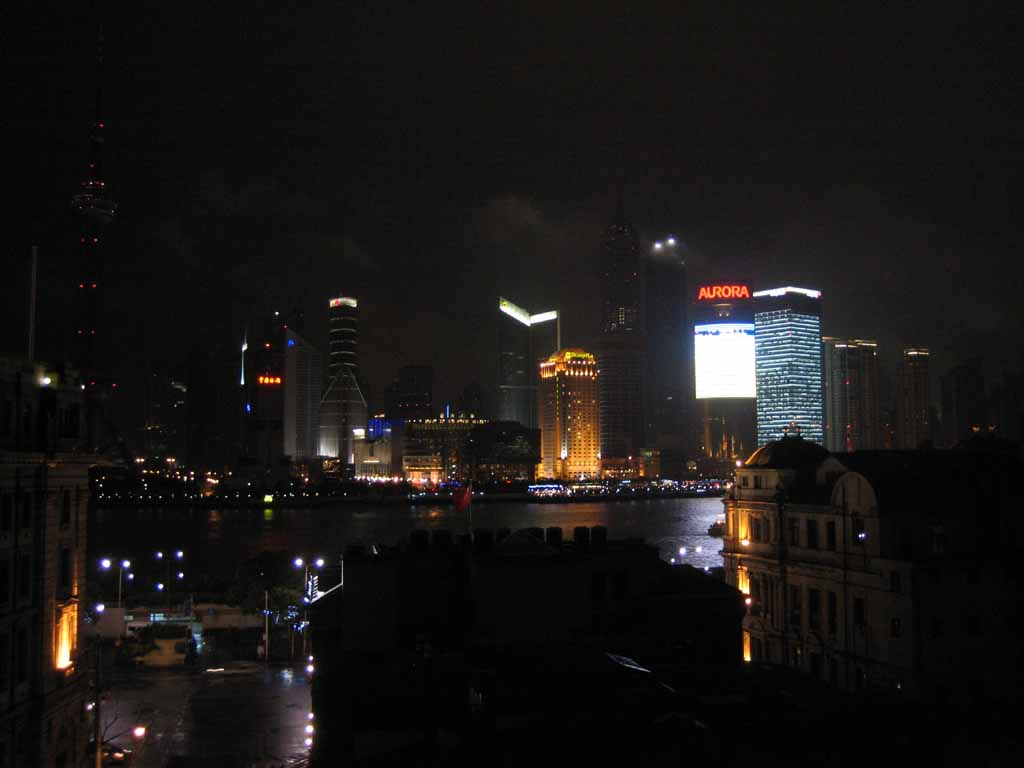 This is Shanghai. I took this picture last night looking toward the buildings on the South side of the Huang Pu river from the 6th floor veranda of the Captain Youth Hostel in an old colonial building right off the Bund. I think you could safely call this a typical Shanghai scene. I talked to a couple guys from Denmark who commented on the contrast between Shanghai and Copenhagen, which has some pretty rigid height restrictions for buildings. I have just been in Tokyo, so this scene doesn't really awe me in that way. What is most impressive to me is the phenomenal change in a country where the kind of business that made this commercial development possible used be regarded as downright immoral. This is the richness of capitalism in a "socialist" society. The next World Exposition (2010) will be here in Shanghai, so one can expect business development to increase.
  This is also Shanghai. I took this picture this morning from my dorm window in the youth hostel. The contrast to last night's scene couldn't be more profound. Yet, this scene also is typical. This is China. Land of contrasts. And perhaps no city in China epitomizes this contrast like Shanghai. A rich and prosperous city fueled by the labor of poor people who come to the city from the countryside looking for any means of bettering their condition.
Thibet Road between Avenue Eddie the Seventh and Nanking Road is practically infested with these charming ladies from the earliest sign of twilight until three and four in the morning. From one A.M. on, the region around Kiukiang Road and on over to Peking Road from Nanking Road is the hunting ground of the damsels and hunting ground it is. The weak of resistance are the prey of sometimes two and three of the gals who work in a concerted onslaught, grasping the victim firmly by the clothing and doing their best to work him into a doorway or other place where they can compromise him to the extent that he loses face if he doesn't accede."
Labels: Shanghai
Saturday, February 24, 2007
Carrie and Summer from the Fuzimiao Youth Hostel
 Fuzimiao Youth Hostel. This is probably the best budget option in Nanjing. My room had 10 beds; the cost: 35 RMB per night. Remember, when I quote costs, I am referring to the dormitory accomodations most backpackers go for. Many people do not realize that most youth hostels in China also have private rooms for those who want to pay for them, and the prices are really quite reasonable, as far as hotel prices go. The cat just had kittens, so they're all over the place, but they're not bad, really. You just have to shoo them off your bed. This place isn't fancy, but the staff are friendly. I was walking out the door, and Carrie asked me where I was going. I told her that I was going to do some studying. She asked me what I was studying, so I started taking my books out one at a time. When she saw my Bible, she pulled her own Bible out from behind the counter.
"I just can't do without it."
I said, "That's right. Every day."
"Every minute! Every second."
What can I say to that? Amen.
I ended up staying here three nights, because I had a little trouble getting tickets. I finally decided to buy a ticket to Shanghai, because it is much easier to get a ticket to Beijing from Shanghai. Last year, I waited until the seven day Spring Festival was over, then traveled to Wuhan in the few days between the end of the national Spring Festival holiday and the beginning of the school semester. I was going to do that this year, too, but I found out that Adam Williams is giving a lecture on the warlord period at the Bookworm on the 27th, so I want to be back for that. The train here to Nanjing from Beijing was almost empty--I had a whole compartment to myself. Not surprising since it was only the third day of the holiday, so no one was traveling. As soon as I got here on Wednesday morning, I crossed my fingers and went to the ticket window to buy a ticket back to Beijing. For those of you who don't know it, crossing your fingers doesn't work. When I got to the youth hostel, they told me there was no chance of getting a ticket back to Beijing. So, as I mentioned, I am going to go to Shanghai and try to buy a ticket there.
 In the States, and in Canada, most youth hostels have a place for young people to do their own cooking. I haven't seen much of that in China, but the youth hostels in China often have something that is much better (for me, at least). They have a small restaurant that offers a few western dishes (especially breakfast) as well as some local stuff. This youth hostel doesn't have a restaurant, but they do have a deal where you can eat with the staff for 5 yuan. Can't beat that price, and the food is good. Last night, they had this pork roast that was really very good. After supper last night, I took a cab to the "1912" development. It is a shopping/restaurant area geared to foreigners that is something like the Sanlitun Bar street in Beijing. There isn't much at those kinds of places that attracts me, but I did go to Starbucks. Got to go, the train to Shanghai leaves at 1:30.
 Fuzimiao Youth Hostel. This is probably the best budget option in Nanjing. My room had 10 beds; the cost: 35 RMB per night. Remember, when I quote costs, I am referring to the dormitory accomodations most backpackers go for. Many people do not realize that most youth hostels in China also have private rooms for those who want to pay for them, and the prices are really quite reasonable, as far as hotel prices go. The cat just had kittens, so they're all over the place, but they're not bad, really. You just have to shoo them off your bed. This place isn't fancy, but the staff are friendly. I was walking out the door, and Carrie asked me where I was going. I told her that I was going to do some studying. She asked me what I was studying, so I started taking my books out one at a time. When she saw my Bible, she pulled her own Bible out from behind the counter.
 "I just can't do without it."
I said, "That's right. Every day."
"Every minute! Every second."
What can I say to that? Amen.
I ended up staying here three nights, because I had a little trouble getting tickets. I finally decided to buy a ticket to Shanghai, because it is much easier to get a ticket to Beijing from Shanghai. Last year, I waited until the seven day Spring Festival was over, then traveled to Wuhan in the few days between the end of the national Spring Festival holiday and the beginning of the school semester. I was going to do that this year, too, but I found out that Adam Williams is giving a lecture on the warlord period at the Bookworm on the 27th, so I want to be back for that. The train here to Nanjing from Beijing was almost empty--I had a whole compartment to myself. Not surprising since it was only the third day of the holiday, so no one was traveling. As soon as I got here on Wednesday morning, I crossed my fingers and went to the ticket window to buy a ticket back to Beijing. For those of you who don't know it, crossing your fingers doesn't work. When I got to the youth hostel, they told me there was no chance of getting a ticket back to Beijing. So, as I mentioned, I am going to go to Shanghai and try to buy a ticket there.
 In the States, and in Canada, most youth hostels have a place for young people to do their own cooking. I haven't seen much of that in China, but the youth hostels in China often have something that is much better (for me, at least). They have a small restaurant that offers a few western dishes (especially breakfast) as well as some local stuff. This youth hostel doesn't have a restaurant, but they do have a deal where you can eat with the staff for 5 yuan. Can't beat that price, and the food is good. Last night, they had this pork roast that was really very good. After supper last night, I took a cab to the "1912" development. It is a shopping/restaurant area geared to foreigners that is something like the Sanlitun Bar street in Beijing. There isn't much at those kinds of places that attracts me, but I did go to Starbucks. Got to go, the train to Shanghai leaves at 1:30.
Labels: Nanjing
Friday, February 23, 2007
Hudson and Maria
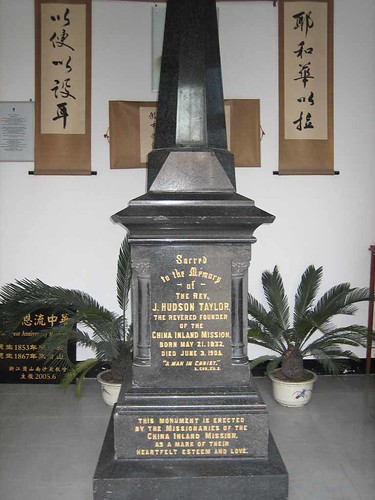 Zhenjiang. It was in a nice, quiet cemetary where he was laid to rest. His first wife had died years earlier. During the Cultural Revolution, the Red Guards vandalized the cemetary. It is now covered over with industrial buildings. A few years ago, Hudson Taylor's tombstone was discovered in an old museum. It is now in a display room at the old Methodist Church in Zhenjiang.
 How do we evaluate someone like Hudson Taylor? By training he was a missionary doctor, but he never really distinguished himself as a physician. I guess he did write a few books, but nothing really earthshaking. He was viewed by many of his contemporaries as a man with off-beat ideas. Those early CIM missionaries were a little strange, you know, walking around with their pigtails and gowns. To the Brits in Shanghai, their behavior was downright scandalous.
He was not a man of great talent or genious. But Hudson Taylor was blessed with an extraordinary gift of faith. He just would not stop believing in God and in God's provision. Taylor was a clear thinker, and built his life on principles well thought out and held to with tenacity, such as:
"God's work done God's way will never lack God's supply."
Hudson Taylor baptized something in the neighborhood of 50,000 Chinese believers. But he was also noted for bringing many missionaries to China. By the end of his life, the CIM had about a thousand missionaries on the field. He expressed his concern for China with deep passion:
"Oh, for eloquence to plead the cause of China, for a pencil dipped in fire to paint the condition of this people."
The list of great missionaries who were developed by Hudson Taylor is long and impressive. Fraser, who developed a Lisu alphabet, and wrote a Lisu hymnbook, Isobel Kuhn, who also went to the Lisu Tribesmen, Jonathan and Rosalind Goforth--all of them were with the China Inland Mission. C.T. Studd, who started the Worldwide Evangelization Crusade is known as a missionary to Africa, but he got his start with the CIM in China.
Hudson Taylor was deeply affected by the death of his first wife Maria Jane, an orphaned MK, who succumbed to cholera in Zhenjiang. After his second wife had died in Switzerland, Taylor returned to China. A few short months later, he died and was laid beside Maria.
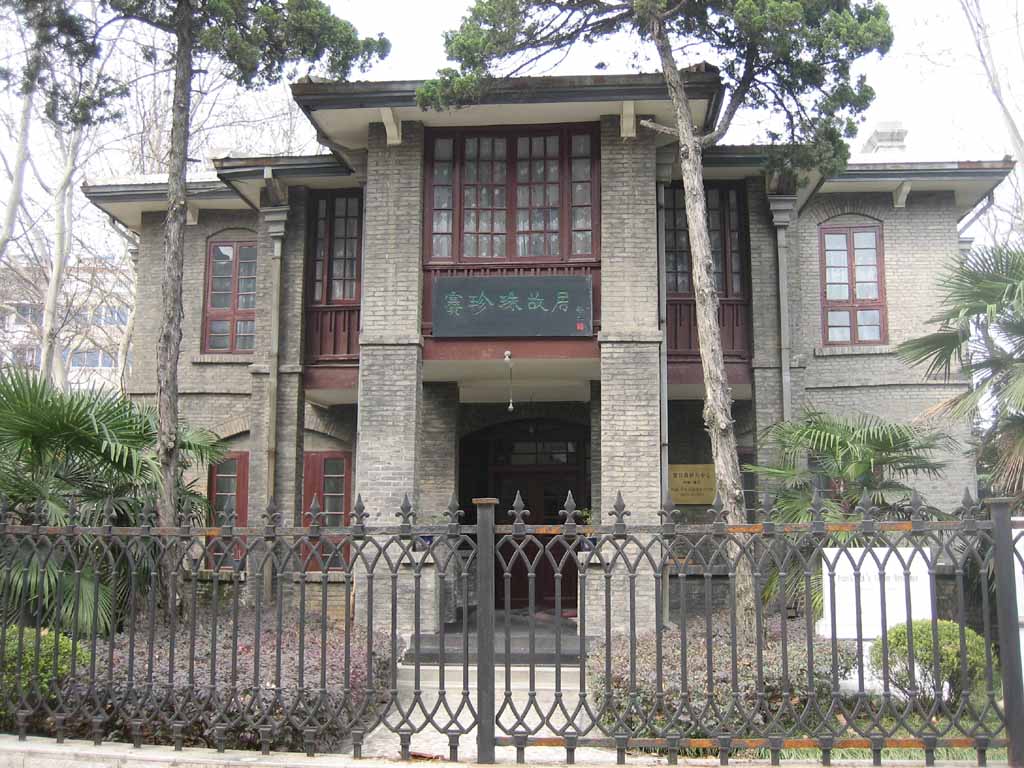 This is the home of Pearl Buck, also in Zhenjiang. The contrast between Pearl Buck and Hudson Taylor could not be more profound. Pearl Buck was a gifted writer, whose literary genius won her the Nobel prize for literature in 1938 mainly, I think, for "The Good Earth." Her talent and creativity were overwhelming and indisputable. She published over a hundred works of literature during her long and prolific life. But although the daughter of missioanries, she seemed to be hopelessly tone deaf when it came to the things of God. Ironically, her spiritual blindness seems to have affected her cultural insight. Her work does show a knowledge of the factual details of how people lived, but is sometimes lacking in genuine understanding of the fundamental differences between Eastern and Western culture. "The fear of God," as Proverbs says, "is the beginning of wisdom."
Labels: China Inland Mission, China Missions
Wednesday, February 21, 2007
 Flew back to Beijing on Monday, then left the next evening (last night) for Nanjing. This morning, I went to see mauseleum of Sun Yat-sen. I don't know what Sun Yat-sen would have thought of this elaborate memorial. Perhaps it would have gone against his populist sentiments. Then again, maybe he would be glad to see that there is some kind of recognition for a life of frustration. The Chinese people seem to really like their leaders once they're dead. Sun Yat-sen has become a powerful symbol of China. But for all the hoopla surrounding the "father of Modern China," he was never actually in charge of anything during his life. He was having breakfast at a cafe in Denver, Colorado when he read in the paper about the revolt against the Qing Dynasty that history credits him with leading. He did lead it, actually. Just as soon as he could get back to China. But it might be more accurate to say that it led itself, and he walked in front. He was the first president of China, but only for a couple months, and that was by prior agreement with General Yuan Shikai, who had worked for the Emress, and really saw himself as the next emperor.
Sun Yat-sen is a symbol, but a very powerful symbol. The reason is that he is regarded highly both here and in Taiwan, because his death preceded the split between the KMT and the Communist Party, and because he symbolized overthrow of the Imperical System, even if he did not have the military clout to rule. Sun Yat-sen was not really a Communist, but he wasn't an anti-communist, either. He tended to view Marx positively, but was also strongly influenced by Christianity, and was really sort of a self-made eclectic.
The mauseleum is built on a hill at the apex of a series of pavilions. When you get to the top, you enter the final pavilion and then a round room where his sarcophagus lies. The sign says, "no pictures," but as soon as I entered the room, a jillion cell phones came out, as well as video cameras. People were taking pictures right and left. I took one picture, then tried to take another from a slightly better angle as we were leaving, but the PLA guard put his hand in front of my camera. I don't blame him, I guess.
George Whitefield, Canaan, Elizabeth, Eloi, Luke and James
 One of the places I have wanted to visit since I came to China is the Nanjing Seminary. Spring Festival is not the best time to visit a seminary, or any institution of higher learning, for that matter. When I got to the campus, it was deserted, except for five students who had not gone home for the vacation, and one who returned early. I told them that I wanted to have dinner with them. We talked about what to have, and decided on shuan yang rou (boiled mutton), one of my favorite meals. I thought we would be going to a restaurant, but don't you suppose they went to decided to cook it themselves. It was good, too.
 But far better for me than the meal was the chance to talk with these very special young people about the church in China. Luke asked me what I thought about Sunday School. I told him that on my first trip to China in 2001, I had understood, both from folks I had talked to, and from what I had read in the official government policy, that teaching religion to youngsters under 16 years old was forbidden, but that this did not seem to be an issue any longer. He told me that in Henan Province where he is from, there are very few Sunday Schools, simply because they don't have teachers.
Nanjing Seminary is the most well known seminary in China, but it is very small. One hundred sixty-six students. That could change, though, since there are currently plans to build a new campus, and that usually means accomodating more students. Officially it dates from 1952, but it has been around much longer than that. Right now, though, it is basically regarded as the national seminary for the Three Self Patriotic Movement and the China Christian Council.
I told the students about my visit to Kaifang to see the Kaifang Jews. They told me about a Messianic Jewess who had come to the seminary from Kaifeng, and is now studying at Hebrew University in Israel. These young people were very friendly, and unpretentious. I don't know how much you can conclude from such a small group, but if the rest of the students are anything like the ones I met, I have high hopes for the future of the church in China.
Labels: Nanjing
Saturday, February 17, 2007
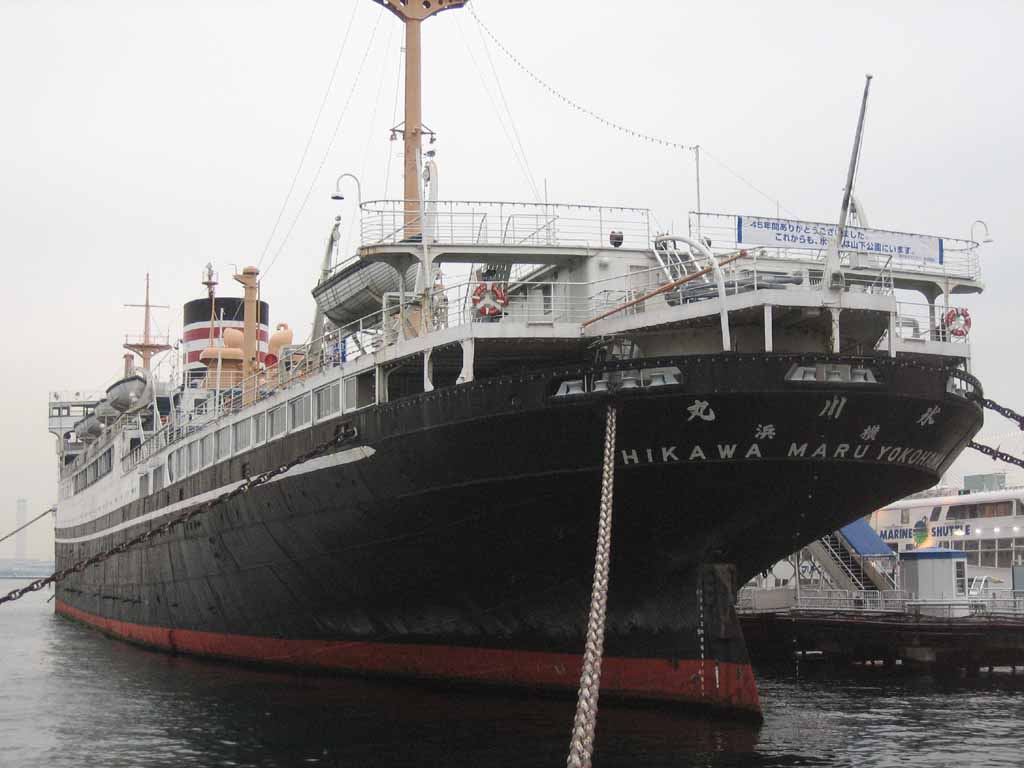 I had asked Piano to help me organize a (Chinese) New Year's party for the Software College interns who are working in the Tokyo area. Piano and I went to Yokohama at about 3pm and met some of the other students, then we all headed for Chinatown. As you may know, Yokohama is a very international city, due in large part to the harbor. Speaking of which, I saw something sitting in the harbor that I had not seen since I was three years old: The Hikawa Maru. I lived on this ship for a couple weeks on my first trip to America a few weeks after my third birthday. I remember getting off the ship in Seattle (at least I think it was Seattle), but for the life of me, I can't remember the rest of the voyage. Don't know why. The ship is basically a tourist attraction, now. It is closed for maintenance, but next time I am here, perhaps I will go there for dinner, or something, if it doesn't cost too much.
 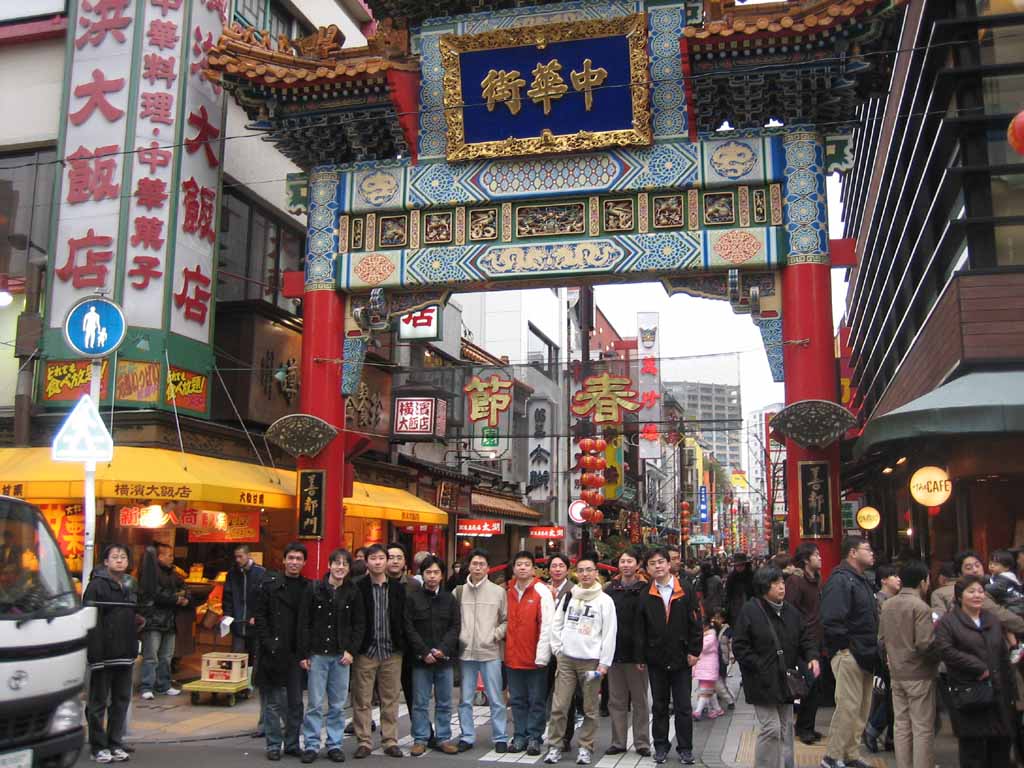 We had a pretty good sized group this year, close to 20 people. The Software College at Beihang University in Beijing has a major called "Japanese Software." Students of this major usually study Japanese for three to four hours a day for a year along with their other classes. This study is followed by one year in Tokyo doing an internship with a Japanese company. Piano did a good job of setting things up. We went to a barbeque type place, where you have a fire and grill in the middle of the table. We would lay the meat strips--lots and lots of meat--on the gril, and then dip them in a special sauce, and...down the hatch. Spring festival is a time of the year when students who are not able to go home could be inclined to get a little homesick, so I wanted to encourage them, and let them know that we are proud of the work they are doing. Japan is experiencing a rather severe shortage of professionals right now. They just imported 500 nurses from the Philippines. One of my undergraduate students at the university had contemplated entering the Japanese Software program as a graduate, but a Japanese company convinced her to give up graduate school for now, and come directly to Japan. She doesn't speak Japanese, but they are going to put her through a three month course this summer. Japan is a very good option for Chinese software engineers right now, because Japan has some of the largest software companies in the world, and it is easier for them to train engineers from China than from other non-kanji cultures.
Thursday, February 15, 2007
Mark and I rode our bikes to the Musashi-sakai station, took the Chuo line to Yotsuya, switched to the Marunouchi line as far as Kasumigaseki, rode the Hibiya line to the Roppongi Hills station, and met Kahori at Starbucks.
The movie was called "An Inconvenient Truth." In my opinion, the most important part of the movie was the first 10 to 15 minutes. I am a skeptic by nature. I am not to sure what to think about global warming. And the discussion about what went on 600,000 years ago must be seen as highly speculative. But the increasing CO2 levels in the atmosphere...that is data that demands an explanation.
I first became alerted to the issue of global warming when John and I visited the Portage Glacier in Alaska back in the summer of 1997, and heard people commenting about how much smaller it was becoming. But after all, temperature trends are cyclical. These things to go up and down. But the steady year-on-year increase in carbon dioxide levels in the atmosphere closely matching rising levels of industrial activity--this is hard to ignore.
The movie was called "An Inconvenient Truth." In my opinion, the most important part of the movie was the first 10 to 15 minutes. I am a skeptic by nature. I am not to sure what to think about global warming. And the discussion about what went on 600,000 years ago must be seen as highly speculative. But the increasing CO2 levels in the atmosphere...that is data that demands an explanation.
I first became alerted to the issue of global warming when John and I visited the Portage Glacier in Alaska back in the summer of 1997, and heard people commenting about how much smaller it was becoming. But after all, temperature trends are cyclical. These things to go up and down. But the steady year-on-year increase in carbon dioxide levels in the atmosphere closely matching rising levels of industrial activity--this is hard to ignore.
Monday, February 12, 2007
Arrived in Tokyo this afternoon. I was going to come the end of last week, but the sisters in Dawanglu had invited me to a music festival at their small community church, so I decided to wait until this morning. The flight from Beijing to Tokyo is always nice, because it begins in the morning, so you have blue sky and sunshine all the way. I got off the plane at Narita with 10,000 yen in my pocket, and 15 minutes later, half of it was gone. Thirty-one hundred for a ticket to Shinjuku on the Narita Express. Coffee and a sandwich at Starbucks ate another thousand. One fifty for the International Herald Tribune, a hundred for a phone call...man! Money really slides through your fingers fast in this country.
I watched part of Marie-Antoinette on the plane from Beijing. Hard to take it seriously, though. That is a very, very American movie. It's supposed to be about the young Marie-Antoinette who is from Austria, and married off the French to improve relationships. But this Marie-Antoinette is not the least bit Austrian. She is American to the core. I don't know if most Americans watching this movie would even notice it, because Americans tend to be pretty ethnocentric, so this movie will probably make a lot of money even though it gives a highly caricatured picture of history. Nevertheless, it would sure be nice to see a movie once in awhile that made at least a casual attempt to depict history the way it actually happened.
I watched part of Marie-Antoinette on the plane from Beijing. Hard to take it seriously, though. That is a very, very American movie. It's supposed to be about the young Marie-Antoinette who is from Austria, and married off the French to improve relationships. But this Marie-Antoinette is not the least bit Austrian. She is American to the core. I don't know if most Americans watching this movie would even notice it, because Americans tend to be pretty ethnocentric, so this movie will probably make a lot of money even though it gives a highly caricatured picture of history. Nevertheless, it would sure be nice to see a movie once in awhile that made at least a casual attempt to depict history the way it actually happened.
Friday, February 09, 2007
It would not be inappropriate to regard analysis of Chinese culture by a foreigner, especially a foreigner who did not grow up in China, with a measure of reserve. Nevertheless, sometimes outside observation can enhance understanding, because outsiders point out to us things that we have assumed to be a part of nature, when, in fact, they are not. They are products of our culture. This is one benefit of studying Math. It helps us to appreciate the difference between that which is arbitrary and that which is absolute. For example, 2+2=4. But we can also express this using the binary number system: 10 = 10 = 100. In the binary number system, 10 does not mean "ten." It means one zero. One in the twos place, and 0 in the ones place. Add 10 plus 10 and you get 100 (one zero zero). One in the fours place, 0 in the twos place, and 0 in the ones place.
I don't want to get distracted--the point is that sometimes there are several ways to express the same reality. And several ways to process the same reality. The means of expression is arbitrary. So is the means of processing. But the reality (2+2=4) is most definitely not arbitrary. It does not change. When I ask students to tell me why we use a Base 10 number system when it is arbitrary, someone usually volunteers that we graviate toward a Base 10 number system because we have 10 fingers. Maybe so. Nobody knows. But whatever the case, if you have two apples, and you get two more, you will have four apples. That doesn't change. That is absolute.
Social science is not nearly as neat as natural science. But if we are patient, we can begin to develop an understanding of basic rules that tend to prevail regardless of how they may be expressed in different cultures. For example, Magaret Mead once said that no matter how many different living styles different people-groups attempt, the famliy always comes creeping back. Family is a universal element in culture. Cultures that nurture the family tend to be strong and resilient, while cultures that dispense with the family tend to fall apart.
As a Christian, and especially as a lover of the Bible, I believe that the Good Book can save us lots and lots of trouble in our attempt to build the kinds of social systems that will support a healthy, free society. The Bible is a time honored guide to what works and what does not work as far as society is concerned. So I tend to judge societies by the extent to which they follow the Biblical maxims regarding the right and honorable way to live.
Now, when I apply all this to China, I look for the values which distinguish this society, and then try to understand how these values hold China back, or help it to move forward.
Bertrand Russel used to say that philosphers are people who find things out by thinking rather than by observing. If we accept this, for the sake of argument, then there are considerable merits to a philosophical approach. But also some limitations. Merits, because I have often tired of reading lightly written stuff that is long on observation but desparately short on thinking. But I have also read analyses which seemed to have a good bit of thought behind it, but which was seriously flawed because it was obviously built on false assumptions--assumptions which would be blown away in an instant if the "philosopher" in question had made even the most casual effort to find out what was really going on. So I am an advocate of thinking. But I also believe in observation.
Let me, then, give my observation of one aspect of Chinese society that I have observed, begging forbearance and inviting criticism from those who may conclude (rightly or wrongly) that my foreigner's perspective is not mature enough to give a true picture of what China is like. This is armchair philosophy, now, so you can throw it out if you want to. But I do believe that my observation has merit, because I have, in fact, given considerable thought to the matter.
There are two kinds of people in China--the lucky and the unlucky. These two groups of people are separated by a "great gulf." They can see each other, but movement between the two groups is very limited. It is very, very hard for the unlucky to become part of the lucky. And the lucky, once lucky, do not seem to want to have anything to do with the unlucky. Perhaps it is because they deeply fear sliding back into the "unlucky" category. Picture a scene. This isn't done any more as far as I know, but it used to be quite common. Walking down the main road of a city, you would see a truck drive by, and in the back of that truck would be a group of prisoners. The prisoners have signs either pinned to them, hanging around their necks, or somehow fastened to the vehicle declaring them to be criminals in need of punishment. Struck by the pathos of the scene, a foreigner standing on the street asks a local person about the people who are standing in the back of the truck with the most desparate, hopeless expressions on their faces. "They were unlucky," is the casual, almost disinterested reply.
Unlucky?? What is this? No, I will never accept this. Either the people in the back of the truck are criminals who have done violence to their fellow citizens and are fully deserving of their impending doom, or they are hapless victims of a justice system which is far too arbitrary in its execution of punishment. You would be amazed how many times I hear this value expressed in this country. I was pickpocketed in Suzhou ("Oh, You were unlucky!"). Or my bicycle gets stolen. Again, "Unlucky!" I refuse to use this word. No, not unlucky. The reason my bicycle got stolen is because the penalty for theft less than 1000RMB is 15 days in the pokey. Not a nice experience, exactly, but a rest and three meals for a short time until one is released to begin again the crime that has brought so much tax free income.
Using a term like "Unlucky" is tempting, because it relieves us of the duty to do something about the problem. But it is flawed, because it tends to thwart development of genuine understanding. But the most important reason I dislike this term is because it tends to attach a mystical quality to this "unluckiness" that rather gives it all the character of a contagious disease. We avoid the "unlucky" because deep inside us is a fear that we might somehow become infected with their condition. So the lucky generally don't associate with the unlucky. There is one very notable exception. "Lucky" people will go to considerable lengths to reach back and give the "unlucky" person a helping hand if that person is a relative, especially a close family member. This sense of family duty is pervasive in Chinese society. Other family members do not benefit as much as parents, but they do benefit. Throughout the entire history of the "New China" since 1949, there have been very poor people who lived considerably above their means because of well-to-do relatives in the West. But this largess generally does not extend beyond family. China is still referred to as a developing country, and one of the areas where China most needs development is in the area of non-profit charity.
All of this helps to explain why it is often easier for a complete stranger to integrate into the local Chinese community than it is for someone who grew up in China. I have been in China three years, and I have never met a Chinese American who attends a local Chinese church. Somehow, they just can't deal with it. It isn't because they are too foreign. Rather, I think it is because, at least for those born in China, they are not quite foreign enough to feel secure in their status as one of the "lucky." Lucky enough, at least, to avoid sliding back into the mystical realm of the "unlucky." They are not entirely unlike me when I "returned" to America at the age of 13. I was actually born in Japan, but I was born to American parents, and I had lived in America for a few years in my earlier childhood. I went to first grade in America. But when I came back at the age of 13, I felt very much out of place. My situation is different from the Chinese Americans, of course, because most Chinese Americans are immigrants, or children of immigrants. They did not merely grow up in America, they grew up in America as Americans. Not so with me. I grew up in Japan as an American who would never be accepted in Japan as anything but a foreigner. Furthermore, America is a dominant culture. You would never, never see an American come to China, become a Chinese citizen, and then go back to America proudly flashing his Chinese passport. But I see it all the time. So there are very significant differences between me and the returnees I meet in China. But there is one very important similarity. It was much harder for me to adjust to America than it was for a new immigrant who had never been to America before. To at least that extent, I think I can identify with the returnees, who have many adavantages because of they language proficiency, but who react very sharply to some of the cultural peculiarities of this country that don't bother me that much.
I don't want to get distracted--the point is that sometimes there are several ways to express the same reality. And several ways to process the same reality. The means of expression is arbitrary. So is the means of processing. But the reality (2+2=4) is most definitely not arbitrary. It does not change. When I ask students to tell me why we use a Base 10 number system when it is arbitrary, someone usually volunteers that we graviate toward a Base 10 number system because we have 10 fingers. Maybe so. Nobody knows. But whatever the case, if you have two apples, and you get two more, you will have four apples. That doesn't change. That is absolute.
Social science is not nearly as neat as natural science. But if we are patient, we can begin to develop an understanding of basic rules that tend to prevail regardless of how they may be expressed in different cultures. For example, Magaret Mead once said that no matter how many different living styles different people-groups attempt, the famliy always comes creeping back. Family is a universal element in culture. Cultures that nurture the family tend to be strong and resilient, while cultures that dispense with the family tend to fall apart.
As a Christian, and especially as a lover of the Bible, I believe that the Good Book can save us lots and lots of trouble in our attempt to build the kinds of social systems that will support a healthy, free society. The Bible is a time honored guide to what works and what does not work as far as society is concerned. So I tend to judge societies by the extent to which they follow the Biblical maxims regarding the right and honorable way to live.
Now, when I apply all this to China, I look for the values which distinguish this society, and then try to understand how these values hold China back, or help it to move forward.
Bertrand Russel used to say that philosphers are people who find things out by thinking rather than by observing. If we accept this, for the sake of argument, then there are considerable merits to a philosophical approach. But also some limitations. Merits, because I have often tired of reading lightly written stuff that is long on observation but desparately short on thinking. But I have also read analyses which seemed to have a good bit of thought behind it, but which was seriously flawed because it was obviously built on false assumptions--assumptions which would be blown away in an instant if the "philosopher" in question had made even the most casual effort to find out what was really going on. So I am an advocate of thinking. But I also believe in observation.
Let me, then, give my observation of one aspect of Chinese society that I have observed, begging forbearance and inviting criticism from those who may conclude (rightly or wrongly) that my foreigner's perspective is not mature enough to give a true picture of what China is like. This is armchair philosophy, now, so you can throw it out if you want to. But I do believe that my observation has merit, because I have, in fact, given considerable thought to the matter.
There are two kinds of people in China--the lucky and the unlucky. These two groups of people are separated by a "great gulf." They can see each other, but movement between the two groups is very limited. It is very, very hard for the unlucky to become part of the lucky. And the lucky, once lucky, do not seem to want to have anything to do with the unlucky. Perhaps it is because they deeply fear sliding back into the "unlucky" category. Picture a scene. This isn't done any more as far as I know, but it used to be quite common. Walking down the main road of a city, you would see a truck drive by, and in the back of that truck would be a group of prisoners. The prisoners have signs either pinned to them, hanging around their necks, or somehow fastened to the vehicle declaring them to be criminals in need of punishment. Struck by the pathos of the scene, a foreigner standing on the street asks a local person about the people who are standing in the back of the truck with the most desparate, hopeless expressions on their faces. "They were unlucky," is the casual, almost disinterested reply.
Unlucky?? What is this? No, I will never accept this. Either the people in the back of the truck are criminals who have done violence to their fellow citizens and are fully deserving of their impending doom, or they are hapless victims of a justice system which is far too arbitrary in its execution of punishment. You would be amazed how many times I hear this value expressed in this country. I was pickpocketed in Suzhou ("Oh, You were unlucky!"). Or my bicycle gets stolen. Again, "Unlucky!" I refuse to use this word. No, not unlucky. The reason my bicycle got stolen is because the penalty for theft less than 1000RMB is 15 days in the pokey. Not a nice experience, exactly, but a rest and three meals for a short time until one is released to begin again the crime that has brought so much tax free income.
Using a term like "Unlucky" is tempting, because it relieves us of the duty to do something about the problem. But it is flawed, because it tends to thwart development of genuine understanding. But the most important reason I dislike this term is because it tends to attach a mystical quality to this "unluckiness" that rather gives it all the character of a contagious disease. We avoid the "unlucky" because deep inside us is a fear that we might somehow become infected with their condition. So the lucky generally don't associate with the unlucky. There is one very notable exception. "Lucky" people will go to considerable lengths to reach back and give the "unlucky" person a helping hand if that person is a relative, especially a close family member. This sense of family duty is pervasive in Chinese society. Other family members do not benefit as much as parents, but they do benefit. Throughout the entire history of the "New China" since 1949, there have been very poor people who lived considerably above their means because of well-to-do relatives in the West. But this largess generally does not extend beyond family. China is still referred to as a developing country, and one of the areas where China most needs development is in the area of non-profit charity.
All of this helps to explain why it is often easier for a complete stranger to integrate into the local Chinese community than it is for someone who grew up in China. I have been in China three years, and I have never met a Chinese American who attends a local Chinese church. Somehow, they just can't deal with it. It isn't because they are too foreign. Rather, I think it is because, at least for those born in China, they are not quite foreign enough to feel secure in their status as one of the "lucky." Lucky enough, at least, to avoid sliding back into the mystical realm of the "unlucky." They are not entirely unlike me when I "returned" to America at the age of 13. I was actually born in Japan, but I was born to American parents, and I had lived in America for a few years in my earlier childhood. I went to first grade in America. But when I came back at the age of 13, I felt very much out of place. My situation is different from the Chinese Americans, of course, because most Chinese Americans are immigrants, or children of immigrants. They did not merely grow up in America, they grew up in America as Americans. Not so with me. I grew up in Japan as an American who would never be accepted in Japan as anything but a foreigner. Furthermore, America is a dominant culture. You would never, never see an American come to China, become a Chinese citizen, and then go back to America proudly flashing his Chinese passport. But I see it all the time. So there are very significant differences between me and the returnees I meet in China. But there is one very important similarity. It was much harder for me to adjust to America than it was for a new immigrant who had never been to America before. To at least that extent, I think I can identify with the returnees, who have many adavantages because of they language proficiency, but who react very sharply to some of the cultural peculiarities of this country that don't bother me that much.
Monday, February 05, 2007
 So I got up at five and took a cab to the Goose and Duck Pub. Super Bowl Monday again. Got there at about 6:30. The coffee wasn't worth much--took forever to get it, and when it came, it was a little bit of lukewarm sugar water in the bottom of the cup. Don't get the coffee. But the breakfast buffet more than made up for it. It was really pretty good. And it was free. Seriously, this was not cafeteria slop you guys, it was a very nice layout. I definitely would have paid 15 kuai for that meal and considered it a bargain. So things have a way of evening out, you know what I mean?
Listen to me--it's a sports bar and I'm complaining about the coffee. People don't go to sports bars to drink coffee. I guess good coffee is a bit much to ask from a sports bar. Like expecting to see the Super Bowl and get a free, all you can eat breakfast at a coffee bar. Anyway, that place is definitely the best place to watch the Super Bowl if you live in Beijing. And you won't go hungry. But do be sure to get there early. Kickoff is at 7 am.
Saturday, February 03, 2007
Well, the Internet is back. Mainly, anyway. I can listen to most audio streams without too much difficulty. Good thing, because Christian Classics has started a biography of Queen Victoria that sounds like it's going to be good.
The most notable improvement is iTunes. For several weeks I couldn't get any podcasts. As I mentioned earlier, I did hove a bunch saved up. And I use an open source program called, "Audacity" to record songs off the Internet, so I could listen to lots of music even though online stations like BBN were virtually impossible to get. I do watch one American TV program a week, called "McLaughlin Group," but all their programs are encapsulated now as 65 MB QuickTime videos, so I could download them with a download manager. (I use Netants, but there are others.) A download manager allows you to download in segments over very erratic connections. If a download crashes, you can pick up where you left off when you restart the download. Awkward and clumsy, but it works.
But it's much better now. I can get streaming video without too much trouble. There are still issues, of course. I was watching "Washington Week in Review" on the PBS website the other day, and it cut out after only 10 minutes. But that's not the Internet's fault. I cut out of it myself because I couldn't stand to listen to it anymore. That show is so boring.
But again, I really get most news and information through iTunes, except for BBC Newshour (see link at top right). So a reasonable functionality allows me to stay informed without constant interruptions. That, of course, is the main benefit of podcasting. Once the podcast is downloaded, you can listen without interruption, because the data is already on your hard drive. The only problem is that since iTunes downloads automatically, you end up downloading many more .mp3 files than you will ever listen too. Information overload. The ever present affliction of the information age.
The most notable improvement is iTunes. For several weeks I couldn't get any podcasts. As I mentioned earlier, I did hove a bunch saved up. And I use an open source program called, "Audacity" to record songs off the Internet, so I could listen to lots of music even though online stations like BBN were virtually impossible to get. I do watch one American TV program a week, called "McLaughlin Group," but all their programs are encapsulated now as 65 MB QuickTime videos, so I could download them with a download manager. (I use Netants, but there are others.) A download manager allows you to download in segments over very erratic connections. If a download crashes, you can pick up where you left off when you restart the download. Awkward and clumsy, but it works.
But it's much better now. I can get streaming video without too much trouble. There are still issues, of course. I was watching "Washington Week in Review" on the PBS website the other day, and it cut out after only 10 minutes. But that's not the Internet's fault. I cut out of it myself because I couldn't stand to listen to it anymore. That show is so boring.
But again, I really get most news and information through iTunes, except for BBC Newshour (see link at top right). So a reasonable functionality allows me to stay informed without constant interruptions. That, of course, is the main benefit of podcasting. Once the podcast is downloaded, you can listen without interruption, because the data is already on your hard drive. The only problem is that since iTunes downloads automatically, you end up downloading many more .mp3 files than you will ever listen too. Information overload. The ever present affliction of the information age.
Friday, February 02, 2007
I went to the English Corner this evening. Fewer people tonight, because of the Spring Festival holiday. So many people are gone. But we had a pleasant conversation anyway. When I was leaving, I decided to try an old Lady Bird Johnson goodbye: "See you next week, Lord be willing and the creek don't rise."
I shouldn't have.
"Sorry?"
"Creek is..."
"What is 'rise?'"
It took awhile, but I think I more or less got it across.
Someone asked, "Does everybody know this?"
"Well, if they are from Texas, they've probably heard it before."
It's tough with stuff like this. These young people are pretty clever, but when you use idiomatic expressions that aren't in their language, they can't quite put it together. I remember when we were in northern Japan for a reunion in 1999, and Uncle Bob told a story about Otto Brustad, who was called upon to speak once at the end of a program, and said, "I feel like a mummy. Pressed for time." Roger Olson was translating for Uncle Bob, and said (in Japanese), "I can't translate this, but just laugh anyway." The problem, of course, is that the idiom "pressed for time" doesn't exist in Japanese. Roger could have translated it. I find that Japanese people are generally quite enamored with American idioms; they like hearing about them. But by the time you translated the idiom, the joke just wouldn't be funny anymore. And if the truth be told, it wasn't that terribly hilarious in the first place. I don't think it was really told for humor, it was mainly told as an anecdote about someone who was known and loved by those present.
But the point is that jokes built on idioms require an understanding of the idiom. And most idioms have a cultural history to them. They strike a chord in the minds and thoughts of those who have more or less grown up with the idiom. Chinese has lots of these kinds of things, too. There are many, many old expressions built on idioms. The China Daily generally publishes one a day.
I shouldn't have.
"Sorry?"
"Creek is..."
"What is 'rise?'"
It took awhile, but I think I more or less got it across.
Someone asked, "Does everybody know this?"
"Well, if they are from Texas, they've probably heard it before."
It's tough with stuff like this. These young people are pretty clever, but when you use idiomatic expressions that aren't in their language, they can't quite put it together. I remember when we were in northern Japan for a reunion in 1999, and Uncle Bob told a story about Otto Brustad, who was called upon to speak once at the end of a program, and said, "I feel like a mummy. Pressed for time." Roger Olson was translating for Uncle Bob, and said (in Japanese), "I can't translate this, but just laugh anyway." The problem, of course, is that the idiom "pressed for time" doesn't exist in Japanese. Roger could have translated it. I find that Japanese people are generally quite enamored with American idioms; they like hearing about them. But by the time you translated the idiom, the joke just wouldn't be funny anymore. And if the truth be told, it wasn't that terribly hilarious in the first place. I don't think it was really told for humor, it was mainly told as an anecdote about someone who was known and loved by those present.
But the point is that jokes built on idioms require an understanding of the idiom. And most idioms have a cultural history to them. They strike a chord in the minds and thoughts of those who have more or less grown up with the idiom. Chinese has lots of these kinds of things, too. There are many, many old expressions built on idioms. The China Daily generally publishes one a day.

