Links
- CV
- Titles
- Topics
- Tickets
- Science
- About Eric
- Book Reviews
- Country Profile
- Modern China
- Contact Eric
- Podcast
- Vision
- Sekai
- John
Archives
RSS

Reflections on a Wandering Life.....
Tuesday, April 29, 2008
Monday, April 28, 2008
 Pretty easy for me to get bacon and eggs or a plate of spaghetti. But Beihai doesn't have many such places. There are a few--Tommy's Bar out on the spit has really good burgers, and the shepherd's pie isn't bad, either. And I had a really nice lamb steak on my birthday. I go to McDonald's, but I really don't like to do that every day. So it's always interesting to see a place that gives some new options. This place is really nice.
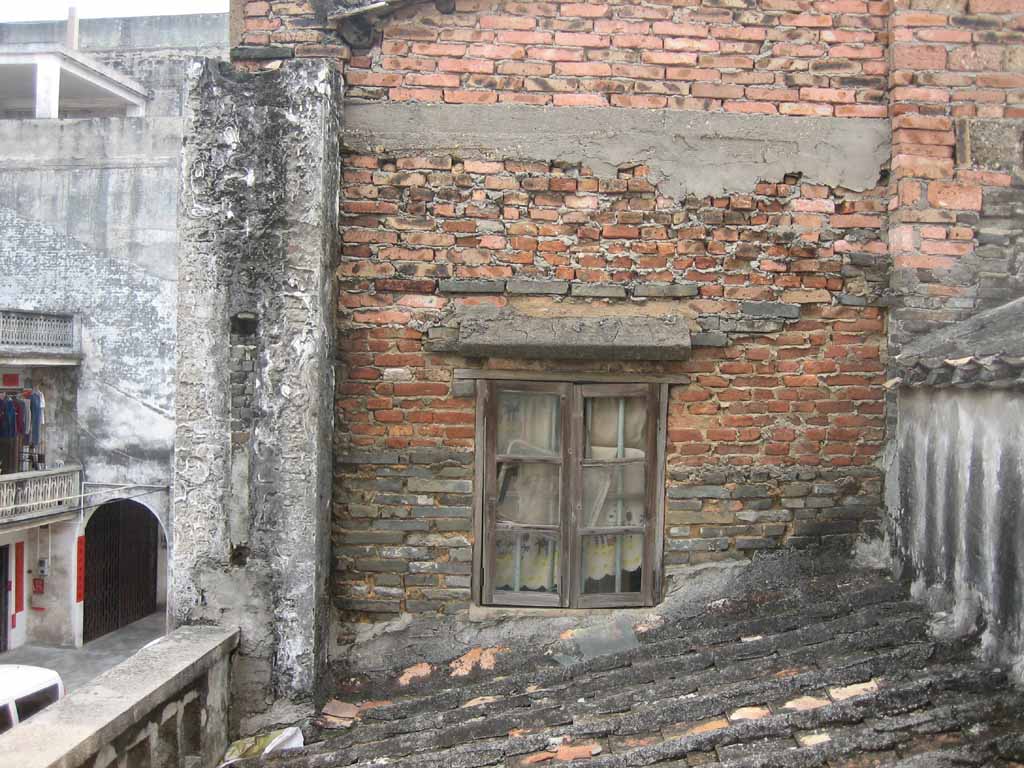
Jeremy knows a lot of praise songs, and he happened to have a book with him, so I sang some songs while he played the keyboard. Good sound system in that place. It's hard to describe this old, old brick building. Beihai was made a treaty port by the Treaty of Yantai in 1876, and the foreigners moved in. The street they lived on is one I have seen many times, because the old village church is located here. But I have never been in one of these old mansions. You really have to see it.
Pretty easy for me to get bacon and eggs or a plate of spaghetti. But Beihai doesn't have many such places. There are a few--Tommy's Bar out on the spit has really good burgers, and the shepherd's pie isn't bad, either. And I had a really nice lamb steak on my birthday. I go to McDonald's, but I really don't like to do that every day. So it's always interesting to see a place that gives some new options. This place is really nice.
Jeremy knows a lot of praise songs, and he happened to have a book with him, so I sang some songs while he played the keyboard. Good sound system in that place. It's hard to describe this old, old brick building. Beihai was made a treaty port by the Treaty of Yantai in 1876, and the foreigners moved in. The street they lived on is one I have seen many times, because the old village church is located here. But I have never been in one of these old mansions. You really have to see it.Labels: Beihai
Friday, April 25, 2008
Thursday, April 24, 2008
Labels: Beihai
Monday, April 21, 2008
Sweater Factory
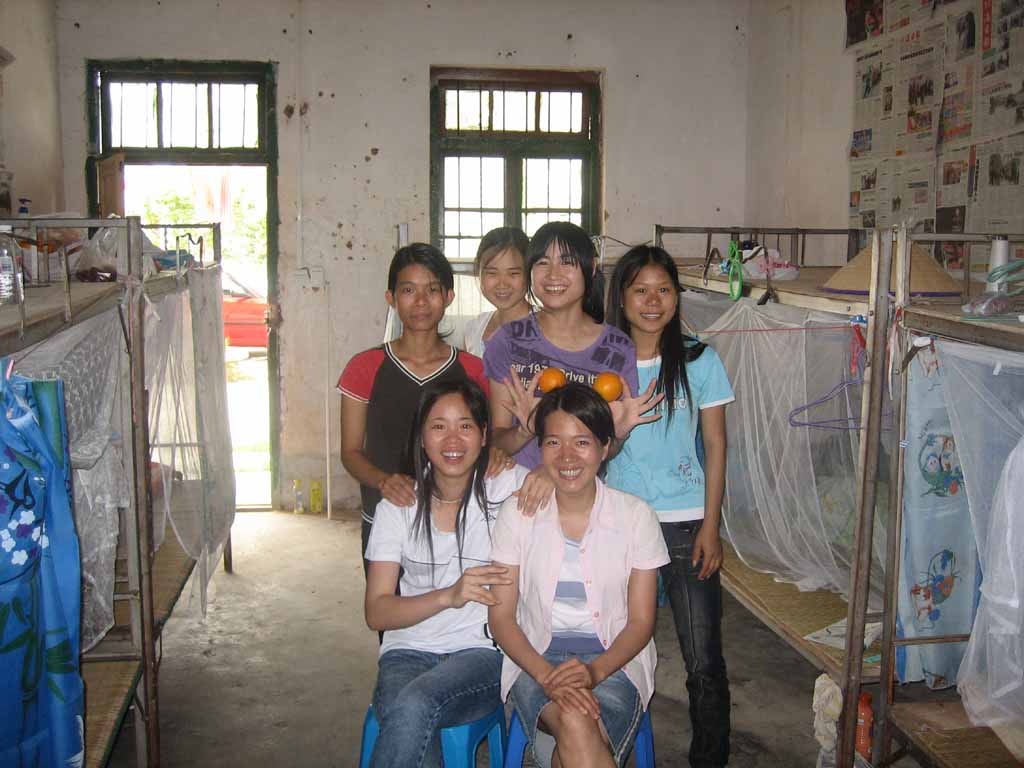
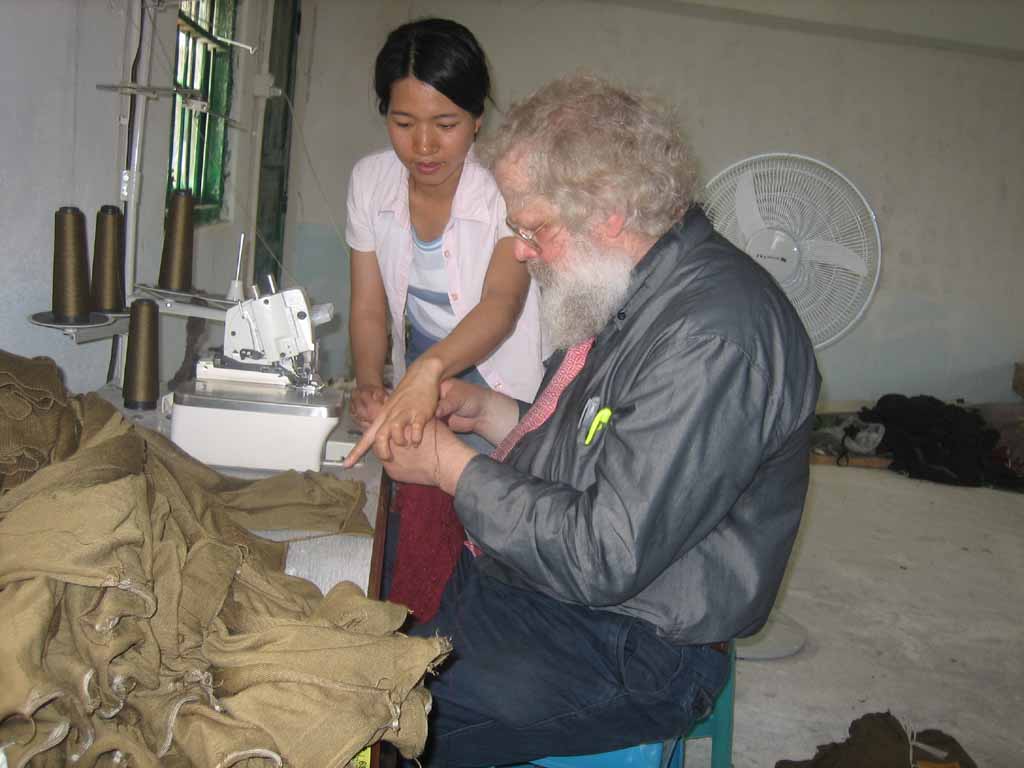
Yesterday Snow (holding the oranges behind her sister's head) took me to a sweater factory in a neighboring town. Her sister and her sister-in-law both work there. The factory is located in a small village in the countryside. I asked the manager why the factory was located here instead of in the Pearl River Delta, which is so well known for its factories. He told me that it was easier to locate closer to where people in the countryside lived, because they would be more willing to leave their farms to work in the factory if it was nearby. Makes sense, really. In a way, it is a repeat of what happened at the time of the return of Hong Kong to China. Prior to 1997, many in Hong Kong were worried about how the transfer of power would affect life in Hong Kong. But in fact, the transition was a boon to the manufacturing industry, because the cost of manufacturing in Hong Kong itself had slowly risen over the years, mainly because the slow, steady increase in the cost of labor. Companies who decided to stay and sweat out the transition actually benefited tremendously from the fact that they could now build their factories in Mainland China and save a lot of money on labor. But now, of course, after all these years, the wages in and around Guangzhou itself have also risen, and manufacturers are tending to move even further out away from the main industrial center, where the cost of labor is lower.
Learning the trade.
The tremendous demand for low cost goods is putting many, many people to work throughout this country. There is a backlash, of course. Many people in the United States decry the loss of jobs to China. It is understandable that they would be upset, but their anger is misplaced. Whatever else you can say about the mass migration of manufacturing to Asia, it is not China's fault. The simple fact is that the cost of labor in the United States is just too high. The unions, which once had a purpose, overplayed their hand.
The recent protest against Walmart notwithstanding, Americans will continue to purchase lower cost goods from Asia, because they need the significant savings that it gives them in their cost of living. And speaking of protest, it is well to point out, I think, that the protest against Walmart was not financed by nickels and dimes from working people. It was funded by the big labor unions, because they see companies like Walmart as a threat to their power. During the current election, the AFL-CIO announced a budget of 53 million dollars to keep the Republican candidate from being elected. Where in the world did the labor unions get that kind of money? That's a rhetorical question; I know the answer. They got it because of states that have laws that force you to pay dues even if you are not a member of the union. When I was a schoolteacher in Oregon, I had to pay union dues every month. During my college days, when I worked in the cannery, I had 30 days to join the union or lose my job. North Dakota and Arizona are both "right to work" states, and I chose to exercise that right, thank-you. But my point is that the labor unions managed to pass laws in many states that gave them far too much power.
Certainly there are differences of opinion about this. I remember once when I was in the trucking industry, I was sitting in a truck stop watching a movie about Jimmy Hoffa (can't remember the name of it). We were talking about the movie a bit, and one guy said, "Every truck driver in America owes that man a debt of gratitude." I was a non-union truck driver, but I had to admit that he had a point. There was a time in America when unions were necessary. But they went too far.
In my opinion, the biggest mistake the American labor unions made was that they consolidated power by encouraging an adversarial relationship between management and labor. In the sixties and seventies, union workers managed to force greater and greater wage increases, particularly in the auto industry, because companies could compensate by raising prices. Unions cultivated loyalty to themselves. Workers got together for union picnics (not company picnics), and they sang their anthem: "The union is behind us, we shall not be moved..." But then the Japanese came in. The Toyota Corolla came to town during the Saudi oil embargo and sold like hotcakes. That started the trend. After China opened up, more and more companies moved their manufacturing to China. Before these companies moved to China, their employees had shown no sense of loyalty to them, so when the crunch came, the companies had no qualms about leaving them to their unions and going to Asia. The unions had forced higher and higher labor costs, and the companies finally got fed up with it. So the jobs left. And they are not coming back.
Certainly I have sympathy for those workers who have lost their jobs in this process. But they don't have to stay unemployed. They just need to become a little more global in their outlook. I remember once when I was living in North Dakota, I was talking to a guy who had a small business. At that time, Japan was the great nemesis. He said, "What are you going to do, if your kids grow up and all the jobs have moved to Japan?" Obviously, this guy didn't know me very well. I said, "I'd tell them to go to Japan and get a job." A couple days later, I saw the same guy driving in his car. Know what he was driving? A Datsun 240Z. Interesting. But I shouldn't judge him. Maybe he bought it the day after I talked to him.
But let's get to the bottom line. In long run, free trade is good for everyone. It is good for companies, because they are able to stay profitable by finding the lowest cost of production. But it helps workers too, because it levels the playing field, and provides more jobs for more people.
I don't say that China doesn't have problems. This is a developing country, and it is going to take some time to find the balance. For example, the workers at the small factory I visited have one day off a month. They work seven days a week except the first of every month. That's not good. Every working person should have one day a week to go to church or be with their families. But this little factory was not a "sweatshop" by any means. These ladies were glad to have the opportunity to make a little extra money. And no one was forcing them to stay. At any time, they can quit and go back to the farm if they want to. I asked Snow if any of them would go to university. She said their families didn't think they needed to go to university, because they would get married. That, of course, is old thinking, because more and more women are working even after they get married. In fact, Snow's sister is married and has a daughter. She is a very bright lady, but has an elementary education. Her daughter is being cared for by her inlaws. So you could say that the factory is taking her from her child. But will refusing to shop at Walmart make her life better? I need someone to explain to me how that works. Here, then, is the bottom line: Every time you shop at places like Walmart, you are taking money from the coffers of the union fat cats, and sending it to the poor working people of Asia. What is wrong with that?
Labels: Work
Saturday, April 19, 2008
I tried to explain to the young lady who asked me, that Cafferty came from a very unstable home where he was not taught the kind of manners that one expects from those who are given respect in society. Both of his parents were alcoholics. His father was married eight times. Concepts like "saving face," i.e. showing at least a modicum of regard for the personal dignity of the one(s) we are talking about, are so foreign to someone like Cafferty that I doubt he could even carry on an intelligent conversation about the subject.
Perhaps it would be better if China did not get quite so upset about gadflies like him. Guys like Cafferty tease China to get exactly the type of reaction China is giving them. So their naughty behaviour is actually being rewarded by China's reaction. But if China's response is a bit overwrought, the response of many in America is downright nauseating. One interviewer commended him for his courage. Courage?? Complete nonsense. Networks like CNN pretend to be barely tolerating clowns like Cafferty to enhance his reputation as unpredictable and just a bit over the edge. In fact, CNN and other networks hire guys like Cafferty precisely because they say stuff in a shocking manner, because they know that their audience has an appetite for this kind of stuff. Believe me, there is absolutely nothing courageous about what guys like Cafferty and Don Imus do for a living.
But let's look at the larger picture. Is there anything China can do to neutralize some of these issues? A couple weeks ago police raided the Tongkor monastery and arrested a couple monks because they had pictures of the Dalai Lama. Is this really necessary? Chinese people don't read about these incidents, but the rest of the world does. Americans shake their heads in disbelief at this kind of thing. I have to confess that I myself find it hard to understand.
I do not suggest for a minute that China should give way to the obnoxious protesters who tried to disrupt the torch relay. Stealing an Olympic torch from a disabled athlete in a wheel chair is unspeakably sick behaviour. But China is being portrayed by the western media as intransigent because of her unwillingness to dialogue, and I am afraid China has, perhaps unwittingly, contributed to this growing perception. Here's how it works, in summary:
Western Media to China:
"Are you willing to talk to the Dalai Lama?"
China to Western Media:
"Yes, we are willing to talk to him, as long as he renounces independence and ceases his secessionist activities."
Western Media to Dalai Lama:
"Are you willing to renounce independence?"
Dalai Lama to Western Media:
"I do not favor independence. I think that autonomy within the Chinese system is better."
Western Media to China:
"The Dalai Lama does not support independence, and is willing to work with you to determine what kind of autonomy is best for Tibet. Are you now willing to talk with him."
China to Western Media:
"He says that, but he doesn't really mean it, so we're not going to talk with him."
To China's eternal consternation the world believes the Dalai Lama, and does not believe China. China's repeated statements that they are willing to talk with the Dalai Lama (Hu Jintao reiterated it just the other day) do not molify anyone, they just serve to underscore the difference between what China says and what China does. China is a sovereign nation. No other country should be able to tell the Chinese who they will talk with. If the Chinese do not wish to negotiate with the Dalai Lama, then they shouldn't. It's their decision. But they shouldn't keep saying they're going to talk with him and then not do it, because it is causing them to lose credibility in the eyes of the watching world, and that is why ill-mannered demonstrators are given far more press than they deserve.
Tuesday, April 15, 2008
For a whole variety of reasons, the Dalai Lama is the perceived spokesman for the disaffected people of Tibet. Everyone seems to contribute to that idea, including the Chinese. They are always talking about how they are more than willing to dialogue with him if he will only renounce independence for Tibet. Why should they talk with him at all if he is just another Buddhist monk? Clearly he is the one everybody recognizes as the "spiritual" leader of the Tibetan people. But just who is he? Obviously, I don't believe he is a living god. He's a cozy bugger, you have to give him that. He has a winsome personality. But that doesn't make him God. When he is asked about it himself, he's pretty cagey on the matter. Between you and me, I don't think he really believes he is a god, either. He would do a service to his people, and to the whole problem, if he would disavow his deity, as Hirohito did after World War II. You know, the whole "god" thing has gotten a little ridiculous. I read a headline recently in the China Daily reminding the world that the government reserves the right to approve all reincarnations. In fairness, this practice goes back to the emperors, but I just can't picture how it would be implemented. "No, stay down! You can't come back from the dead until we get authorization from the Religious Affairs Bureau!" But the Dali Lama isn't any better. During the recent trouble, he said that if the violence continued, he would "resign." How does a living god resign? One apologist for the Dalai Lama said that what he really meant is that he wouldn't reincarnate again. Like it's up to him? The whole thing is foolishness, of course.
But what to do? And how does one get an honest assessment of what is going on, and who is telling the truth? It now appears that the Dalai Lama did order a peaceful demonstration in Lhasa by the members of his sect, and that the demonstration got out of hand. But to what extent is he personally responsible for the violence? Yang Rui posed this question to Mr. Shimatsu. He did not answer the question directly, and part of his answer was edited out, which is both disappointing and curious. There is pretty good information that the recent trouble in Tibet was due, at least in part, to outside influence. But there is no evidence that the Dalai Lama himself countenanced violence. So I don't know. It's an unanswered question. But clearly the Dalai Lama is not a supporter of China. Ordering a demonstration of any kind, violent or nonviolent, cannot be considered cooperation. And even though the Dalai Lama may not have specifically encouraged violence, surely he knew that even a peaceful demonstration at such a sensitive time could become violent. So his statements that he did not encourage violence ring hollow, because even though he may be telling the truth, it doesn't change the fact that the violence would not have taken place if he had not ordered the protests.
The whole world seems to think that China should dialogue with the Dalai Lama, and tends to view China as intransigent because they refuse to. The Chinese have repeatedly said they were willing to talk with him. In saying this, they may have unwittingly contributed to his status as the "spokesman" for Tibet. For example, if the government of suddenly China announced to the world that they were willing to talk with Eric Langager if I would renounce independence, a whole lot of people would suddenly want to know what I thought about the matter. I think there should be some dialogue--some conversation between China and the Tibetan people about what level of autonomy is acceptable to both sides. China needs to decide with whom they are willing to have these conversations, and then just do it, because right now, the Dalai Lama is clearly winning the PR war, and I am not sure he completely deserves to.
Monday, April 14, 2008
Flew in last night from Beijing, and I didn't recognize the place. They've built a new airport since I was here last. No more climbing down from the plane and walking across the tarmac. But where in the world did a small seaside town like Beihai get the money for a big new terminal? China is obviously anticipating the tremendous growth in air traffic predicted for the next few years.
Saturday, April 12, 2008
Funny how gadgets that would have seemed wildly sensational only a few years ago now seem like necessities one cannot live without. If I try to identify what is the primary benefit of each of those systems, I would say that the one thing they all give me is time. Everyone of them in one way or another makes my life more time efficient. When I began to learn Chinese, I used the radical chart in my character dictionary to look up characters. When I first started, it could easily take me 30 minutes to look up a character. After I had done it a lot, I got better at it, and could sometimes find a character in five or ten minutes. With my electronic dictionary, I write a character on the screen with a stylus, and the pinyin and definition shows up. Really speeds up the learning process.
When I was in college, it used to take me about a half-hour to type a page of text. And lots and lots of correction fluid. Needless to say, it goes a lot faster with a computer, and that is without mentioning the ease of making multiple copies. And editing. I mean, moving blocks of text around, restructuring paragraphs, and such. Much, much simpler now. And no need to write out an original draft in long hand. I always had a fountain pen in college, because I used to get writer's cramp so bad if I used a ball point pen.
The ability to listen to or watch news and information programs selectively, without having to build my life around them saves untold hours of time. Sitting in front of the tube for 30 minutes every night to watch the news is just not time efficient. I never do that anymore, except that I do have Dialogue on when I am taking a shower in the morning. Otherwise, I always listen to news programs on my laptop while I am doing my other work.
A digital camera may not be a time saver for everyone, because you do tend to take more pictures when there is no cost to developing them. But for me, it really does save time. It is amusing to me how much trouble it used to take just to get a dozen or so pictures developed. I rarely make paper copies of pictures, so for me, digitalization is really a life saver. It does take a few minutes to pull the jpegs into Photoshop and lighten them up so I can post them online (from 2-3 MB down to under 100 k), but the time is nothing compared to the time it took to deal with photo albums.
The database in my pocket phone has 160 phone numbers stored in it. Cell phone numbers in China are eleven digits long; you would never think of memorizing them, except your own, because you get asked for it all the time. But I don't have to spend any time looking them up, either. Busy Chinese professionals are big on text messages. There is no voicemail in China. At first I thought this was a bit cumbersome, but it really does have some distinct advantages. You can send and receive messages when you are in a meeting without disturbing anybody.
I haven't mentioned email and instant messaging. The ability to carry on several real-time conversations at a time, and then pull people together into one conversation saves a lot of trouble. In today's China, all of the conveniences I mentioned are taken for granted. It's much different in the countryside, of course. People don't use email, and digital cameras are a curiosity. If you think about it, a digital camera isn't worth much if you don't have a computer. But the countryside is changing too, as stuff gets cheaper, and access to broadband Internet pushes farther out into the hinterland.
Friday, April 11, 2008
Labels: Mongolians
Sunday, April 06, 2008
After lunch I decided to take Cute and Melissa to KFC for a sundae, since they hadn't had the pleasure (although I think they must have had something similar at the coffee bar at some time or another). While we were eating our ice cream, Cute asked a question that really threw me. She said, "When you sleep, is your beard inside the blanket or outside the blanket? I was stumped. I said, "You know, there are some questions in life that I just haven't given much thought to."
Thursday, April 03, 2008
The Seats of Power
- Where is the seat (or where are the seats) of power?
- What are the sources of information?
It would be a distraction to talk about both power and information at the same time, so I will focus, for the present, on power, and deal with information later.
So where does power really lie in this country? It's not an easy question to answer. During the recent National Party Congress, the Wall Street Journal referred to the NPC as China's "rubber stamp" congress. In sharp contrast, CCTV-9 referred to the same political organ as the "highest body of state authority." Quite a difference, to say the least. So which description is accurate?
In fact, neither description is completely accurate. yet there is a sense in which they are both right. To explain that, I think perhaps it would be best to see the National People's Congress as one part of a three part constellation. At the risk of oversimplification, I will focus on these three entities as embodying the essence of government in China, at least at the national level.
CPPCC Chinese People's Political Consultative Congress
In some respects, this body is easier to define than the others, because everybody acknowledges that it is an advisory body. The Wall Street Journal and the China Daily would both refer to it that way. The official statement is as follows:
"It is an important organ of multi-party cooperation and political consultation under the leadership of the CPC."
Since no one is claiming that the CPPCC has actual legislative authority, one would think that both Chinese and Westerners would have the same view of it's importance. But while America is essentially a legalistic society, China is a very relational society. So one's status as a member of the CPPCC extends to other areas of Chinese life in ways that an American might not appreciate. Nevertheless, since we are talking about power, we will accept, for purposes of the present discussion, that members of the CPPCC do not actually make laws. Basically, the CPPCC is China's way of bringing in those who would not normally be included in the process of government. This would include members of other parties, and also minorities. In fact, my country lawyer friend told me that the best way for one to advance within the CPPCC is to be a minority woman who is not a member of the Party.
NPC The National People's Congress
This is the highest legislative body in China. Westerners tend to view it merely as a "rubber stamp" for the Party, but that is too strong a statement. If I remember correctly, when I was at the North Dakota State Legislature twenty years ago, there were something in the neighborhood of a thousand bills introduced during the four-month session. Looking at the information from the most recent session (2007) I see that the numbers were about the same. In the 2007 legislative session there were 522 House bills, and 419 Senate bills. And that doesn't include House or Senate resolutions. Of those 900+ bills, 575 made it all the way through both houses of the legislature and were signed into law by the governor. And that's in a small rural state with a population of 600 thousand people. Now, America is arguably the most legalistic society in history, so perhaps it is not fair to compare China with America. But we can at least conclude that building laws for a society the size of China is a huge task, and the idea that a small committee of party elites could write all the laws and merely require the NPC to approve them is not realistic. The National People's Congress is, in fact, a very large and complex organization, with a very big job to do. But if it is too simplistic to refer to the NPC as a "rubber stamp" congress, calling it the "highest body of state power" is also problematic, because that ignores the supervisory role of the Party, which controls every area of Chinese political life.
The Standing Committee of the Political Bureau of the CPC Central Committee
This is the center of power in China. Ordinarily I would have said that it is the center of power in Chinese government. But, of course, the Communist Party is not techically a government entity. This is part of the conundrum of Chinese political life that extends to every segment of society. At every level, there is the party, and there is the official authority. Every state organization has a party chairman. But the party chairman is usually not the designated authority. So who is really in charge in any situation? In every little village, there is a village chief and a party boss. Which one really runs the town? Often it depends on who has the strongest personality. So, too, at the top level, there is the governing body (the NPC) and there is the top party entity (the Politburo Standing Committee). Currently, there are nine men on this committee. It is not realistic to suggest that these nine men write all the laws of China. But they definitely do forge the overall policy of state. So at this level, the party and the state are merged, because even though this committee is not a state entity, it is the highest decision making body. The relationship between the Politburo Standing Committee and the National People's Congress has been evolving for some time, so perhaps it will find a level in the future that is somewhat different from what it is now. But for the present, let it suffice to say that there are areas where the NPC does exercises a check on the Politburo Standing Committee relative to procedural matters. But could there ever be a situation where the National People's Congress openly repudiated a policy submitted by the Politburo Standing Committee? No. I can't imagine such a scenario.
So the Wall Street Journal is a bit behind the time when they refer to the NPC as a "rubber stamp" congress. But CCTV-9 is perhaps a bit ahead of the time when they say (quoting the constitution) that the National People's Congress is the highest body of state authority, since there is not now a facility such as exists in the American system, where the legislative body can, by a two thirds majority, override a presidential veto and thus implement law that the executive does not approve of. Should China move in this direction? In my opinion, it would not be possible without a rewrite of the constitution, and will probably not happen anytime soon. But it would not necessarily mean a weakening of party power, since party control already infuses every part of Chinese government. For example, Wu Bangguo, who is a member of the Standing Committee of the Political Bureau, is also the Chairman of the Standing Committee of the National People's Congress. But I don't want to spend too much time on that question, because China is China and America is America, and neither can be an absolute model for the other. Better it is, I think, to celebrate the increasing openness of the Chinese system, which leads, of course, to the second question I mentioned: What are the sources of information? But we will talk about that later.
Labels: Political Power

