Links
- CV
- Titles
- Topics
- Tickets
- Science
- About Eric
- Book Reviews
- Country Profile
- Modern China
- Contact Eric
- Podcast
- Vision
- Sekai
- John
Archives
RSS

Reflections on a Wandering Life.....
Saturday, August 30, 2008
Last night Jordan and I went to the Bridge Cafe to hear Obama's acceptance speech. There was a lady there to give information on how expats can vote from overseas. She was quite obviously an Obama supporter. She didn't get many takers, because this event attracted several people from different countries who are curious about the American election, but are not US citizens.
I am always a bit amused when I see young Americans blasting Bush for his policies, when, in fact, as expats, they are beneficiaries of policies that have helped make China very rich. When they asked me how I felt, I told them that I do have some criticism of Bush, because it is no small issue when you invade a sovereign state with whom you are not at war, for reasons that turn out to be completely false. But I also reminded them that Bush favors outsourcing, which is China's bread and butter, while the Democrats will almost certainly do everything in their power to curb the number of jobs going to China.
When I made this point awhile ago, a friend reminded me that Bush is president of the United States, not China. I guess I should try to remember that, but I am sure that the Republicans would say that the Bush policies that benefited China have also benefited American businesses, because they have resulted in a greatly lowered cost of production. Anyway, it's going to be interesting.
I am always a bit amused when I see young Americans blasting Bush for his policies, when, in fact, as expats, they are beneficiaries of policies that have helped make China very rich. When they asked me how I felt, I told them that I do have some criticism of Bush, because it is no small issue when you invade a sovereign state with whom you are not at war, for reasons that turn out to be completely false. But I also reminded them that Bush favors outsourcing, which is China's bread and butter, while the Democrats will almost certainly do everything in their power to curb the number of jobs going to China.
When I made this point awhile ago, a friend reminded me that Bush is president of the United States, not China. I guess I should try to remember that, but I am sure that the Republicans would say that the Bush policies that benefited China have also benefited American businesses, because they have resulted in a greatly lowered cost of production. Anyway, it's going to be interesting.
Friday, August 29, 2008
Click here for larger image.
 Took the new Line 10 over to the 798 Art District to have breakfast with Lyanne. Lyanne is a former table tennis champion (Barcelona and Atlanta) from Brazil who had contacted me before the Olympics after reading one of my book reviews on Amazon.
We had a very interesting discussion. Lyanne is Japanese Brazilian. I didn't know this before she told me, but the largest contingent of Japanese outside of Japan is in Brazil. She told me that the 100th anniversary of the migration had been held just recently. Sure enough, when I looked it up, I found that migration began in 1908 with 791 people. That's actually quite a significant number of people for 1908. And you know how it is; one group of migrants attracts others, so there have been many more migrations through the intervening years--more than a hundred thousand in the twenties and thirties.
But what's really interesting now, is that many of these Brazilians have started to migrate back to Japan. Did you know that the largest contingent of Portuguese speaking people in Asia is in Japan? It's because of Japan's immigration laws. I was born in Japan, but it would be tough for me to become a Japanese citizen, because my parents were Norwegian Americans. But the Japanese coming from Brazil are able to become Japanese. At least legally. Socially and culturally it would almost certainly be a whole different matter. Of course I expect to be treated as a foreigner when I go back to Japan, even though it is my home. But I have talked to Japanese people who tell me that even after being away for a few years, they are looked at differently. Henna Nihonjin.
Thanks, Lyanne, for a very pleasant morning.
Took the new Line 10 over to the 798 Art District to have breakfast with Lyanne. Lyanne is a former table tennis champion (Barcelona and Atlanta) from Brazil who had contacted me before the Olympics after reading one of my book reviews on Amazon.
We had a very interesting discussion. Lyanne is Japanese Brazilian. I didn't know this before she told me, but the largest contingent of Japanese outside of Japan is in Brazil. She told me that the 100th anniversary of the migration had been held just recently. Sure enough, when I looked it up, I found that migration began in 1908 with 791 people. That's actually quite a significant number of people for 1908. And you know how it is; one group of migrants attracts others, so there have been many more migrations through the intervening years--more than a hundred thousand in the twenties and thirties.
But what's really interesting now, is that many of these Brazilians have started to migrate back to Japan. Did you know that the largest contingent of Portuguese speaking people in Asia is in Japan? It's because of Japan's immigration laws. I was born in Japan, but it would be tough for me to become a Japanese citizen, because my parents were Norwegian Americans. But the Japanese coming from Brazil are able to become Japanese. At least legally. Socially and culturally it would almost certainly be a whole different matter. Of course I expect to be treated as a foreigner when I go back to Japan, even though it is my home. But I have talked to Japanese people who tell me that even after being away for a few years, they are looked at differently. Henna Nihonjin.
Thanks, Lyanne, for a very pleasant morning.
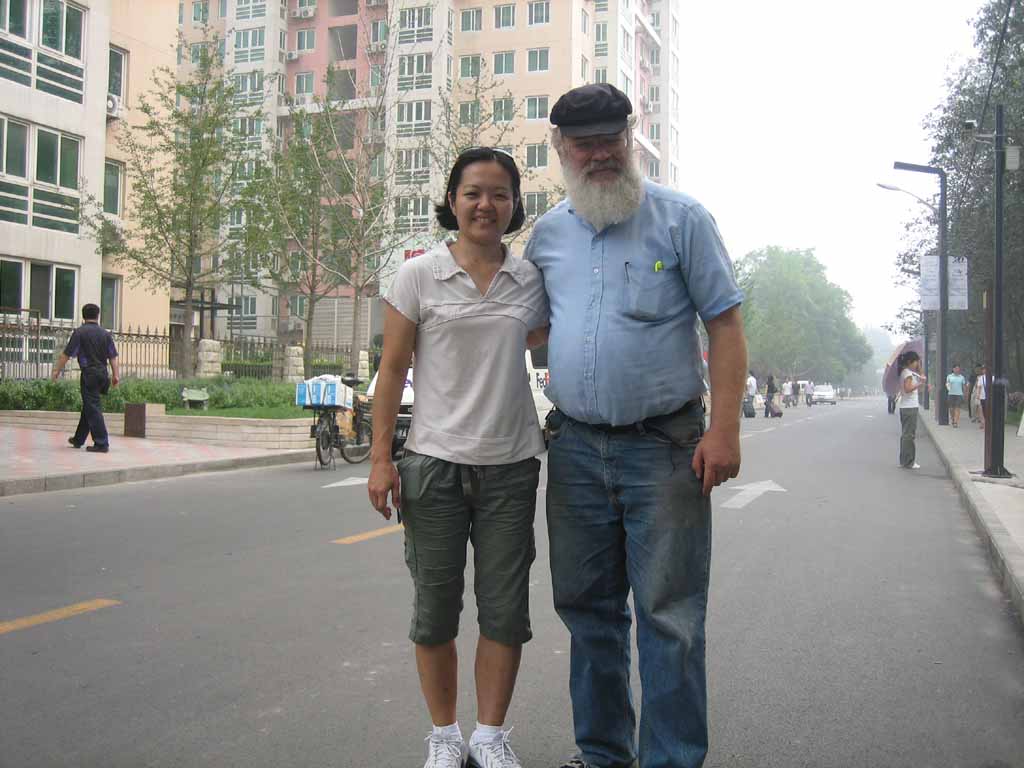 Took the new Line 10 over to the 798 Art District to have breakfast with Lyanne. Lyanne is a former table tennis champion (Barcelona and Atlanta) from Brazil who had contacted me before the Olympics after reading one of my book reviews on Amazon.
We had a very interesting discussion. Lyanne is Japanese Brazilian. I didn't know this before she told me, but the largest contingent of Japanese outside of Japan is in Brazil. She told me that the 100th anniversary of the migration had been held just recently. Sure enough, when I looked it up, I found that migration began in 1908 with 791 people. That's actually quite a significant number of people for 1908. And you know how it is; one group of migrants attracts others, so there have been many more migrations through the intervening years--more than a hundred thousand in the twenties and thirties.
But what's really interesting now, is that many of these Brazilians have started to migrate back to Japan. Did you know that the largest contingent of Portuguese speaking people in Asia is in Japan? It's because of Japan's immigration laws. I was born in Japan, but it would be tough for me to become a Japanese citizen, because my parents were Norwegian Americans. But the Japanese coming from Brazil are able to become Japanese. At least legally. Socially and culturally it would almost certainly be a whole different matter. Of course I expect to be treated as a foreigner when I go back to Japan, even though it is my home. But I have talked to Japanese people who tell me that even after being away for a few years, they are looked at differently. Henna Nihonjin.
Thanks, Lyanne, for a very pleasant morning.
Took the new Line 10 over to the 798 Art District to have breakfast with Lyanne. Lyanne is a former table tennis champion (Barcelona and Atlanta) from Brazil who had contacted me before the Olympics after reading one of my book reviews on Amazon.
We had a very interesting discussion. Lyanne is Japanese Brazilian. I didn't know this before she told me, but the largest contingent of Japanese outside of Japan is in Brazil. She told me that the 100th anniversary of the migration had been held just recently. Sure enough, when I looked it up, I found that migration began in 1908 with 791 people. That's actually quite a significant number of people for 1908. And you know how it is; one group of migrants attracts others, so there have been many more migrations through the intervening years--more than a hundred thousand in the twenties and thirties.
But what's really interesting now, is that many of these Brazilians have started to migrate back to Japan. Did you know that the largest contingent of Portuguese speaking people in Asia is in Japan? It's because of Japan's immigration laws. I was born in Japan, but it would be tough for me to become a Japanese citizen, because my parents were Norwegian Americans. But the Japanese coming from Brazil are able to become Japanese. At least legally. Socially and culturally it would almost certainly be a whole different matter. Of course I expect to be treated as a foreigner when I go back to Japan, even though it is my home. But I have talked to Japanese people who tell me that even after being away for a few years, they are looked at differently. Henna Nihonjin.
Thanks, Lyanne, for a very pleasant morning.Labels: 2008 Olympics, Japan
Tuesday, August 26, 2008
Olympics must be over. The beggars are back. They disappeared for awhile, for some reason. Place feels like normal again. But my favorite sidewalk bicycle mechanic disappeared before the Olympics, and I still haven't seen him. And the sidewalk merchants haven't come back yet. But I have faith in China; they can't stay away forever. Boy, this place was so tidy there for awhile, I almost thought I was in Japan. OK, that was an exaggeration. Anyway, slowly, but surely, China is becoming Cbina again. The Olympics did it's damage. Lots of those dumpy, hometown restaurants were cleaned out. But others keep popping up. There's a Yunnan restaurant down the street toward Peking University on Cheng Fu Lu that has very good food. And countryside prices. You have to look for them, but they're there.
Monday, August 25, 2008
John sent me a message that they had reserved a table at the Goose and Duck Pub for the closing ceremony. The new Goose and Duck Pub is way over on the other side of town, but I decided it might be a little more comfortable than sitting on the grass at the Science and Technology University. They had picked a table right in front of the big screen, and the shepherd's pie is not bad, but it was a little noisy. I am not much of a bar person. I watched most of the ceremony, but Jordan and I both wanted to get back before the crowds started leaving the Bird's Nest, so we left a little early.
You know, all the glitz of a ceremony like that doesn't impress me that much. But I have to say that I have been impressed with the level of preparation China has put into this event. Have to give them credit. The venues were very well designed, and built to perfection. Fengtai field is the best ballpark I have ever seen, and the race course for the canoe and kayak races was exceptional. China really went all out, and it showed.
It has been a tough year for China. Worst winter storms in 50 years, one of the most severe earthquakes in recorded history, severe flooding, worldwide protests, direct physical attacks on the torch relay, protests within China encouraged by enemies without. There has been lots of discussion (and there will continue to be) about how China has responded to each of these issues. I, myself, have had my criticisms of China. I do not speak as someone who believes that China is always right. But I do have to give credit where credit is due. China has done an excellent job of preparing for the Olympics, and it is universally acclaimed as a success.
For those of us who live in Beijing, there are elements of the Olympic infrastructure that will remain and continue to benefit us in the years to come. Perhaps the most significant for me personally is Line 10, the new subway line. Throughout the time that I have lived in Beijing, if I ever wanted to go anywhere on the northeast side, I pretty much had to take a taxi. The only way to get around that would be to take a bus or subway to the town center, and then find a bus back out to that area. You could easily spend half a day getting over there. Two or three hours, anyway. The new Line 10 goes straight east to that area. But the real benefit of Line 10 is that it is an "L" shaped line. It doesn't just go east, it then turns south and goes all the way down. You can run Line 10 all the way from Zhongguancun to the World Trade Center in Guomao without changing. That's pretty handy. The Bird's Nest and the Cube will also be around for years to come. They aren't going anywhere. Not sure I have the same confidence about the ball fields (Fengtai and Wukesong), because baseball and softball are not as popular in China as they are in Taiwan and Japan.
You know, all the glitz of a ceremony like that doesn't impress me that much. But I have to say that I have been impressed with the level of preparation China has put into this event. Have to give them credit. The venues were very well designed, and built to perfection. Fengtai field is the best ballpark I have ever seen, and the race course for the canoe and kayak races was exceptional. China really went all out, and it showed.
It has been a tough year for China. Worst winter storms in 50 years, one of the most severe earthquakes in recorded history, severe flooding, worldwide protests, direct physical attacks on the torch relay, protests within China encouraged by enemies without. There has been lots of discussion (and there will continue to be) about how China has responded to each of these issues. I, myself, have had my criticisms of China. I do not speak as someone who believes that China is always right. But I do have to give credit where credit is due. China has done an excellent job of preparing for the Olympics, and it is universally acclaimed as a success.
For those of us who live in Beijing, there are elements of the Olympic infrastructure that will remain and continue to benefit us in the years to come. Perhaps the most significant for me personally is Line 10, the new subway line. Throughout the time that I have lived in Beijing, if I ever wanted to go anywhere on the northeast side, I pretty much had to take a taxi. The only way to get around that would be to take a bus or subway to the town center, and then find a bus back out to that area. You could easily spend half a day getting over there. Two or three hours, anyway. The new Line 10 goes straight east to that area. But the real benefit of Line 10 is that it is an "L" shaped line. It doesn't just go east, it then turns south and goes all the way down. You can run Line 10 all the way from Zhongguancun to the World Trade Center in Guomao without changing. That's pretty handy. The Bird's Nest and the Cube will also be around for years to come. They aren't going anywhere. Not sure I have the same confidence about the ball fields (Fengtai and Wukesong), because baseball and softball are not as popular in China as they are in Taiwan and Japan.
Sunday, August 24, 2008
Marathon. In my opinion, this is the one that counts. The modern marathon originated with the first modern Olympics in 1896. The distance (about 40 km) is the distance from Athens to Marathon. But the concept really is as old as Greece. Biblical statements like "running with patience the race that is set before us," or "pressing toward the mark" seem to reflect the ancient Greek emphasis on developing personal discipline in preparation for warfare. In the early days of the (modern) Olympics, the final awards were handed out at the end of the marathon track. That has changed now; the marathon race ended earlier in the day, several hours before the closing ceremony in a different location. But it was interesting to note that, in deference to tradition, the medals for the marathon were not handed out at the end of the race, but as the first event of the closing ceremony.
I didn't even attempt to get tickets for this event, because I didn't need to. If you wanted a choice seat near the finish line, then, of course, you would need to purchase tickets. But the marathon course was published in the spectator's handbook, and I noticed that the runners were going to be coming right down Zhichun Lu, which runs east and west across the south end of my campus, so I just picked out a spot along the street near the southwest corner where I had a pretty good view of the race.
The marathon began at Tiananmen Square, so by the time it reached the vicinity of my university, the runners were spread out quite a bit. There is a little bit of distance between the first few Africans and the rest of the pack. But that really is the point of the marathon, I think. It's really a separate race for every runner. Endurance. Determination. Grit. The will to keep going. It really embodies so much of what has slowly been lost to a generation where everything seems to be about winning over competitors instead of personal mastery and discipline.
Friday, August 22, 2008
 John sent me a message this morning that he was going to head out to Shunyi and try to get tickets for the boat races. I have never seen boat races, except on TV, so I decided it was worth a try. We took the subway to the stop near the Olympic Green and caught a bus to Shunyi. There were three of us, and none of us had tickets. A middle European tourist came along and sold us one, so John told me to go ahead and go in. Andy managed to buy one a short time later, and John met someone who gave him one for free. John's pretty good at that.
It was a beautiful day. Blue sky. But the sun was very direct, and it was a hot day. Made me glad that the softball game had been at night. The VIP section on the other side of the "river" was covered, and those guys had the sun behind them. The medals ceremony took place over there, and you would have needed a pretty powerful set of binoculars to see what was happening. I know the Brits and Germans each won a gold, because the because the band played "My Country 'Tis of Thee," and "Glorious Things of Thee are Spoken"
The competition in the event is very intense. But I think this is one event I would rather watch on TV.
Thursday, August 21, 2008
 John contacted me this afternoon and asked if I wanted to head out to the softball field to see if we could get some tickets. Jordan decided to pass, because he didn't want to deal with scalpers. I didn't blame him, but I decided to chance it, because I had just asked John a couple days ago to let me know if he heard of any tickets being available. Besides, the ride out there only cost a few kuai.
 We got there at about 6 for a game that started at 6:30. Not a lot of time to spare when you don't have tickets. Sure enough, a scalper approached us. He wanted 500 RMB for tickets that have a face value of 60. We waved him off, and John kept asking people if they had tickets. We got lucky. An American came along who had a couple extra tickets he had more or less written off as a loss. We paid him the face value and went on in.
Women's fast-pitch softball, and America was playing Japan. What irony; who am I supposed to cheer for?
It was a good game. Women's fast-pitch softball is easier to watch than baseball, because the ball park is smaller. Most of the pitches were clocking in at about 65 mph, and if I remember correctly, a fast pitch in baseball would be closer to 90. So in softball, the action is confined to a smaller space, and everything is closer, even if you have seats in the outfield. You can't really get a bad seat.
As the game started, I thought the Americans were going to finish the Japanese off pretty quickly, because the Japanese were first up to bat, and they struck out three times in a row. But my attitude changed in the bottom of the first, because the Japanese turned out to be excellent fielders. Man, they were good!
But they just could not hit. I sent Jordan a message saying there wasn't much hope for Japan. But I had to take it back in the third inning. A little Japanese lady stepped up to the plate and hit a line drive to center field and managed to take a couple bases. She eventually made it home, and this was followed by a home run.
There will probably be lots of opinions about why the Americans lost. John was born and raised in Mississippi; he knows the game a lot better than I do, so he can tell you exactly what the American coach should have done. As someone who doesn't know that much about sports, my observations are much more simplistic and straightforward.
The Japanese are not very good at batting, but they did have one or two good hitters, and they were very good at keeping the Americans from scoring. The Americans had several good hitters, and a couple very fast runners. They spent a lot more time on base than the Japanese did. But they just could not get home. They did get one home run, but that was it. Three to one, and the Japanese took the gold. Good game. Very good game.
Monday, August 18, 2008
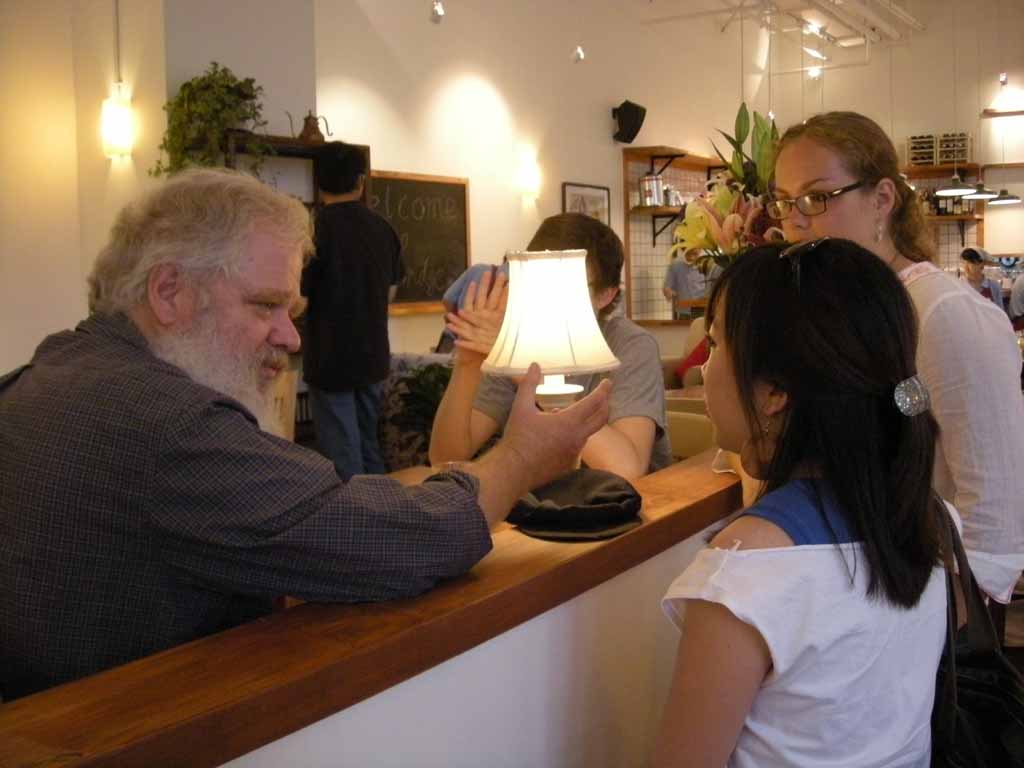 I met Alice on the street last week. She invited me to the pre-opening party last Friday night at the new Bridge Cafe, so I took Jordan with me, and enjoyed some good food, and a little glass of champagne. Nell gave me a few pictures she had taken at the party. Here I am having a discussion about Chinese history with a Malaysian Chinese, and a young lady from Norway--both students at Peking University.
 There are approximately 12,000 foreign students in the University district, the majority of them right in this neighborhood, because BLCU (Beijing Language and Culture University), Qinghua and Beida are all within a stone's throw of Wudaokou.
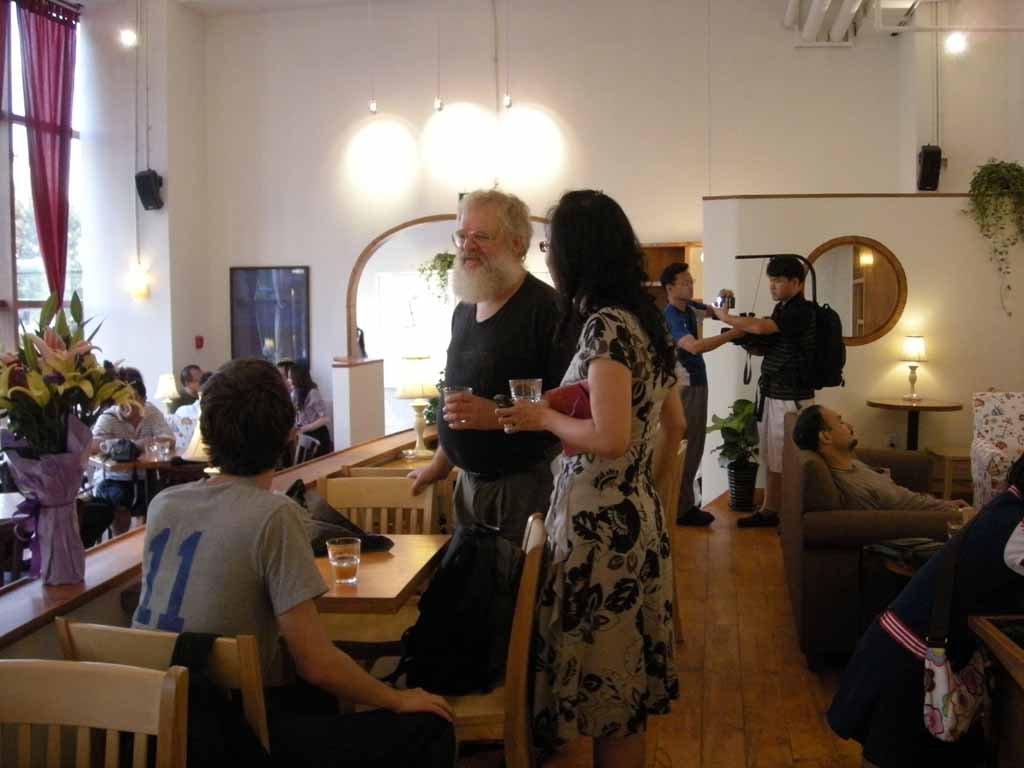 The expat community seems to be growing, mainly, I think, because the value of Mandarin language proficiency is increasing in European countries, but also because countries like Norway (according to the young lady) pay a pretty good stipend to young university students who want to go to China and study Chinese.
 But I should emphasize that there are basically three elements to the expat community in Wudaokou. In addition to the foreign students I mentioned, there are also English teachers, and kids who come to just hang out. The kids who just come to hang out have been cleaned out for the Olympics, because they usually come on fake visas they bought in Hong Kong, and the Chinese government has really tightened up on F visas.
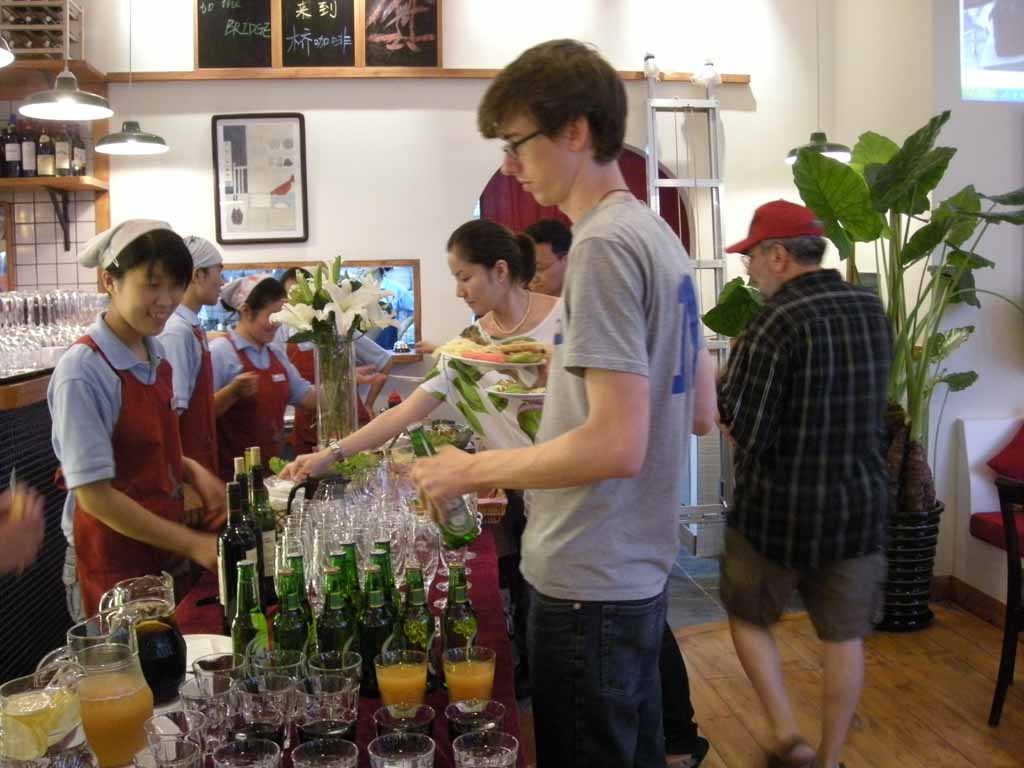 I have heard that some English teachers have also been told to leave the country for the summer. The way China does that is to refuse to renew their visas for the fall. That does the trick, but it could backfire, because it means that the Universities will have to scramble to find English teachers after the Olympics are over.
 You may have noticed that I didn't mentioned business people. That's because the business community has generally been over in the CBC (Central Business District) on the east side. But that is changing a bit, because of the Qinghua Science Park. Google and Microsoft both have big contingents here in Wudaokou, and I would expect more to be coming. So a new coffee bar in the area is welcome, especially if it has good wireless connectivity and good food.
Thursday, August 14, 2008
 Lots of talk the past couple days about the little girl who sang to an appreciative audience at the opening ceremony. Seems we now have confirmation that she was lip-synching. It was the musical director who spilled the beans in a radio interview. Chen Qigang is a French national of Chinese descent, which I suppose, points out one of the risks of using foreigners for this massive project--the Chinese government can't sentence him to education through labor for giving away state secrets.
 Anyway, the story circulating is that the little girl who was chosen to sing the song was deemed "too ugly" by a government official, who demanded that a pretty face be given to the voice.
As in most cases like this, the truth is somewhat more mundane, but the whole story does bring up some questions. First, all the attention is being focused on the little girl who actually sang the song. She is touted as a victim of China's excessive image consciousness. An Australian paper dismissed the whole affair as a result of China's "wrong child policy." But no one seems to be addressing the one thing that catches my attention more than anything else: How is it that decisions regarding a creative production are made by a member of the standing committee of the political bureau of the CCP Central Committee? You know, sometimes I talk to people about how fast China is changing. Other times I find myself wondering, "Will China never change?"
And what about the third little girl? Nobody talks about her. I am referring to the ten-year-old who was originally chosen, and who showed up for all the rehearsals. She was axed at the last minute because she was too old. So which is worse? "You're too old," "You're too ugly," or "Your voice is lousy."?
As I said, the truth is a little more mundane. It now appears that what actually happened is that the oldest girl was removed first, then the decision was made to look first for the cutest kid, and then the best voice. The little girl with the pretty red dress was chosen, because she is already a media personality who has been in several television commercials. But the Politburo member felt that her voice was not good enough, so they decided to have her lip-synch.
The Chinese didn't invent lip-synching. But the phoniness of this situation, where people were told that the little girl in the red dress was singing the song, when, in fact, another child had supplied the voice, is really what has created the international reaction. People don't like to be lied to. Message to China: Be real you guys. The world you're trying to impress will have a lot more respect for you.
Sunday, August 10, 2008
After church today, We walked up toward the West Gate of Peking University. Jordan's friend was quite sure the women's bicycle race would be coming by. He was right. It was the shortest athletic event I have ever witnessed. The riders were all bunched together, and it took about ten seconds to pass the area where we were standing.
Saturday, August 09, 2008
Last night, Jordan and I went to the live site at the University of Science and Technology to watch the opening ceremony. Beijing has set up 26 live sites throughout the city. The one we chose is right up the street from the East Gate of Beihang, so it is very convenient. In addition to that, though, it is situated just north of the Bird's Nest, so when we saw fireworks on the screen, we could see the lights from the same fireworks in the background.
Zhang Yimou did a good job presenting China as China. That really stood out. In the past, so much about China was not really China. Several years ago, I attended a banquet in the Great Hall of the People. I felt like I was in Moscow. I have been told that my own university (Beihang) was patterned after Moscow University. I didn't know that when I came here, but I do remember thinking how Russian it looked.
But the opening exercises definitely looked Chinese. For that, I do think the producers of this presentation deserve credit. It was also quite artistic. I did think it was a little too long, but I suppose it is hard, once you have a bunch of material put together, to decide what gets cut.
During the parade of the athletes, I heard several students groan when the Japanese were introduced. Young people in China are programmed from childhood to hate the Japanese. But the Japanese were clever. Each Japanese athlete had two small flags, one for Japan and one for China, and they carried them together in one hand. That did the trick.
Zhang Yimou did a good job presenting China as China. That really stood out. In the past, so much about China was not really China. Several years ago, I attended a banquet in the Great Hall of the People. I felt like I was in Moscow. I have been told that my own university (Beihang) was patterned after Moscow University. I didn't know that when I came here, but I do remember thinking how Russian it looked.
But the opening exercises definitely looked Chinese. For that, I do think the producers of this presentation deserve credit. It was also quite artistic. I did think it was a little too long, but I suppose it is hard, once you have a bunch of material put together, to decide what gets cut.
During the parade of the athletes, I heard several students groan when the Japanese were introduced. Young people in China are programmed from childhood to hate the Japanese. But the Japanese were clever. Each Japanese athlete had two small flags, one for Japan and one for China, and they carried them together in one hand. That did the trick.
Friday, August 08, 2008
Air is fine, let the Games begin That was the headline to an article on the front page of the China Daily today. We Beijingers are really lucky to have the China Daily to tell us that the air is fine, because we have no other way of getting this information. The article quotes Jacques Rogge, president of the Olympic committee,
"There is a difference between the haze enveloping the city and damaging air pollution. What you see is the result of humidity and heat. It does not mean it is the same as pollution."
Technically, that is a true statement. In the summertime, foreigners often assume pollution when what they are really seeing is heat haze and humidity. Foreign journalists love to take pictures of this haze, because they like to write articles about how bad the air is in Beijing. Heat haze is not pollution. On that point I agree with Mr. Rogge. The problem is that while the humidity itself is not pollution, it does tend to exacerbate pollution, because the muck just sorta hangs there instead of blowing away with the breeze like it often does in the fall and winter. And there is another thing. Heat and humidity may not be the same as pollution, but the combination is still very uncomfortable. The weather in Beijing is actually quite nice most of the time. It is only this time of the year that is particularly disagreeable. The air in Beijing is usually pretty dry. But if that is true, what unearthly insanity would posses them to chose the most miserable time of the year to host the Olympics? The 1964 Summer Olympics in Tokyo were held in October. Japan is pretty nice that time of the year. But Beijing is even nicer. It's just beautiful here then.
According to CCTV, the Chinese had requested to have the Olympics in September. I would have chosen October, but if the heat breaks the end of August, September is really a nice month. But according to CCTV, NBC had spent more than 3 billion dollars to get the broadcast rights, and they had insisted that the Olympics be over before September, because of other items on their schedule. The baseball World Series is probably the big issue, but I'm not sure.
When I first heard that the Olympics would open on August 8, I couldn't believe it. But after thinking about it for awhile, I think it's probably a good thing. If the Olympics were held in September or October, the whole world would want to move here. Then China might get crowded, you know what I mean? When I shared this concern with Heather, she said, "I think you're safe there, Dad." Hope she's right.
"There is a difference between the haze enveloping the city and damaging air pollution. What you see is the result of humidity and heat. It does not mean it is the same as pollution."
Technically, that is a true statement. In the summertime, foreigners often assume pollution when what they are really seeing is heat haze and humidity. Foreign journalists love to take pictures of this haze, because they like to write articles about how bad the air is in Beijing. Heat haze is not pollution. On that point I agree with Mr. Rogge. The problem is that while the humidity itself is not pollution, it does tend to exacerbate pollution, because the muck just sorta hangs there instead of blowing away with the breeze like it often does in the fall and winter. And there is another thing. Heat and humidity may not be the same as pollution, but the combination is still very uncomfortable. The weather in Beijing is actually quite nice most of the time. It is only this time of the year that is particularly disagreeable. The air in Beijing is usually pretty dry. But if that is true, what unearthly insanity would posses them to chose the most miserable time of the year to host the Olympics? The 1964 Summer Olympics in Tokyo were held in October. Japan is pretty nice that time of the year. But Beijing is even nicer. It's just beautiful here then.
According to CCTV, the Chinese had requested to have the Olympics in September. I would have chosen October, but if the heat breaks the end of August, September is really a nice month. But according to CCTV, NBC had spent more than 3 billion dollars to get the broadcast rights, and they had insisted that the Olympics be over before September, because of other items on their schedule. The baseball World Series is probably the big issue, but I'm not sure.
When I first heard that the Olympics would open on August 8, I couldn't believe it. But after thinking about it for awhile, I think it's probably a good thing. If the Olympics were held in September or October, the whole world would want to move here. Then China might get crowded, you know what I mean? When I shared this concern with Heather, she said, "I think you're safe there, Dad." Hope she's right.
Thursday, August 07, 2008
 You be the judge. Does this look like someone who is sleeping, or someone who is pretending to be sleeping? Brian from the Bridge Cafe called me the other day. He wanted to do a photo shoot for a flyer he is printing up to advertise the new coffee bar. Seems he had seen me one time (one time??) reading the Wall Street Journal. I had sorta nodded off, and the waitress was pouring me some coffee. He wanted to recreate the scene.
 I told him I'm not an actor. Sleeping I can do. I'm really good at that. I can fall asleep just about anywhere. Coffee bar, restaurant, church. It comes naturally for me. I remember I was in the Portland State University library one time, and I had nodded off. A lady sitting near me gave me a little nudge. She was very polite, "Sir, you're snoring rather loudly."
But pretending to be sleeping is something else. So I had to sorta get myself in a relaxed position and try to fall asleep so that I would look natural. But you know, things have to look just right for a picture, so the photographer kept adjusting me.
So you tell me. If I hadn't told you this story, would you know that this was staged? If you know me, cheesecake, Perrier and espresso should be a clue. That's probably not a combination I would choose for myself, although I do like all of them. It's more likely to be apple pie. Since they brought that chef over from New York to teach the locals how to cook, their apple pie has gotten pretty good. The carrot cake is pretty good here too, though. The cheesecake is as good here as anywhere else, but cheesecake is just a little too much pure sugar for me. Apple pie or carrot cake. I always try to make sure my diet contains plenty of fruits and vegetables.
Anyway, they are opening a new location over near Peking University. It will be welcome. There are more and more expats coming here to take advantage of the unique learning opportunities (and unique tuition costs) in the University district here on the Upper West Side.
Tuesday, August 05, 2008
Passing of a Prophet
It was thirty years ago this summer that I graduated from college. I remember it like it was yesterday. I remember yawning through a commencement address by a local congressman on the "evils" of inflation. I remember my feeling of frustration at a society that seemed increasingly inclined to throw moral values and foundational principles to the wind with very little regard for what might replace them. The movie of the summer was "Grease." I drove into Salem and watched it one evening. Depressing. It was set in the Fifties (Seventies young people were fascinated by the Fifties), but it definitely expressed a very Seventies message: The supreme virtue is conformity. Dropouts should go back to school, and prudes should cast off their self-righteousness and become as wild and worldly as everyone else.
I was vexed. Finished with school, and preparing to enter upon my new life as a school teacher, I saw a culture which had been founded on religious freedom sliding into a sickening moral relativism, and there didn't seem to be anyone sounding the alarm.
But there was. I discovered it one afternoon when I opened the Portland Oregonian and saw the text of Solzhenitsyn's address to the graduating class of Harvard University. Solzhenitsyn had been in the States for four years at that point, but he summed up the moral anemia of the American civilization better than any preacher or moralist in the cold war era.
 Got a text message from Melissa that the great Russian writer has passed away. I hadn't heard the news. Not exactly an untimely death--he was 89. Still, it is a great loss. Hard to see him go.
Solzhenitsyn's career as a writer was really an outgrowth of his years in the Gulag. Solzhenitsyn was a patriot, and had been decorated for bravery in World War II. But he was sentenced to the Gulag for something he had written in a letter to a friend. Eight years later, he was released and banished to Siberia. This banishment turned out to be a blessing in disguise, because it gave him time to focus on his writing.
But not without some determination on his part to carve out a part of his day and reserve it for himself. He had been given a job of some kind--can't remember right off hand, but I think it was in a factory or something--where he had to work virtually every waking hour. Solzhenitsyn knew that this would never work, so he devised a plan to address the issue head-on. At precisely 5 pm, he politely informed his boss that he was going home, as he had things to do. His boss told him to get back to work, but he repeated (politely, of course) that he really had to leave. And then he walked out. His boss had a fit, but Solzhenitsyn just ignored him. The next day, at precisely 5 pm, he repeated the same simple announcement. Of course his boss exploded, but Solzhenitsyn very calmly told him that he had things to do, and he had to leave. It was unheard of, of course, for a prisoner to tell his boss that he would not work the required hours. But since this was a job for recently released prisoners, he probably wasn't getting paid more than basic subsistence. Anyway, he didn't get sent back to prison, and he was able to continue his writing.
Eventually, he was able to get a regular job. During his university days, he had made the decision to major in Science and Math instead of Literature. This turned out to be a very wise decision. Once Solzhenitsyn was allowed to accept regular employment, he always had a good job. Word got around that he was an excellent Physics teacher, and he never had trouble getting work, especially in Siberia, as you can imagine. This allowed him to continue his writing undisturbed. If he had chosen to major in Literature, he probably never would have become a writer.
Solzhenitsyn had gotten out of prison in 1953, but he did not publish his first book until 1962. A Day in the Life of Ivan Denisovich. It was a novel about a Baptist believer who was in prison for his faith. You couldn't just publish a book like that without official permission, but, ironically, Krushchev was solidifying his power by repudiating Stalin, so this book got approval because it looked like something that would reinforce Krushchev's view. If you haven't read it, you should. Solzhenitsyn himself was not a Baptist. He was always a devout Russian Orthodox. You could call him a "State Church" man, although I doubt that Solzhenitsyn himself would ever use that term to describe himself. It's been a long time since I read the book myself, so I can't give you much of a review, but you can just about imagine the impact of a book about an unregistered Baptist being persecuted for his faith. It was an immediate sensation. It didn't change the world for Baptists. Baptist pastors had gone to prison before this book was published, and they continued to go to prison after this book was published. But the effect on Russia was far greater than those who originally approved the book could ever have imagined. I guess you could call it the "Uncle Tom's Cabin" of the Soviet Union. And coming from Solzhenitsyn, who was a Russian Orthodox, it was an extraordinary statement. Basically, he was saying that these people were decent folks who didn't deserve to go to prison.
As I mentioned earlier, repudiation of Stalin had become politically correct, because of Krushchev. Churchill always used to say that the worst thing that ever happened to the Russian people was the birth of Lenin. And he always added that the second worst thing was the death of Lenin. This, of course, is because Stalin used Lenin's death to seize power. But he was ruthless, and perhaps Krushchev's greatest contribution was his decision to publicly repudiate the Stalinist era. Gradually, though, it became evident to the powers that be that Solzhenitsyn's own repudiation of the Stalinist era was really a repudiation of the Soviet system itself. As the years passed by, Solzhenitsyn became more and more isolated as a writer, because of his refusal to kow tow to the established order. But it didn't seem to bother him much. Not, that is, until the cops overplayed their hand. Can't recall the precise details, but if I remember correctly, they raided his place and confiscated his writing. This is really what tripped the wire for Solzhenitsyn. He gave instructions for The Gulag Archipelago, which had already been smuggled to Paris, to be published.
Well, this really put the big boys in the Kremlin in a tizzy. The Gulag Archipelago was a monumental work. It established Solzhenitsyn as a great writer, in league with Tolstoy and Dostoevsky. They couldn't, I mean they just couldn't put him in prison. So they threw him out. He eventually came to the United States. President Ford was scared to death of offending the Soviet Union, so he refused to see him, but Solzhenitsyn was allowed to settle in Vermont. His children became American citizens; one of them is an accomplished musician, another a writer like his father. But Solzhenitsyn himself remained a Russophile to his dying day. He returned to his homeland as soon as he was allowed to.
History will remember him for what he did for Russia and Russian literature, but I will always remember him most fondly for what he did (or tried to do) for America. I'm not referring to The Gulag Archipelago. Americans don't read thick books like that. But his essays and speeches, especially his address to the graduating class of Harvard in 1978 (A World Split Apart) confronted smug Americans with the sickness in their own society (humanism), which paralleled the dialectical materialism that ruled the Communist world. The key statement in his address is the following:The split in the world is less terrible than the similarity of the disease plaguing its main sections. In other words, the moral decline in America was just another form of the same sickness that plagued the Soviet Union.
Shortly after his speech, Time Magazine published a bunch of reactions from well known Americans. I don't remember all of them, but I did manage to find the article. The comment by George Meany is the one that most caught my attention at the time. For those of you who don't remember George, he was president of the AFL-CIO, and he was troubled by Solzhenitsyn's lament about a society with so much material well being, that had become so impoverished spiritually. Meany said, "I cannot recognize any incompatibility between material and spiritual well being." Typical union man.
During the Cold War, it was popular to see a parallel between the contemporary, repressive Soviet system, and the Czarist systems of the preceding centuries. Richard Nixon, a life-long student of Russian history, held this view (see The Real War). Speaking honestly, I must confess to some sympathy for it myself. But Solzhenitsyn most definitely did not subscribe to this notion. For Solzhenitsyn, the suggestion that the Russian people were inherently totalitarian was deeply offensive. His life-long repudiation of Communism was never a repudiation of things Russian. He loved Russia. His insertion into the American scene at such a critical time might be viewed as an accident of history. I am more inclined to see it as a gift from God. And the fact that the Americans did not respond to his message does not make it any less worthy. "And they, whether they will hear, or whether they will forbear, (for they are a rebellious house,) yet shall know that there hath been a prophet among them." (Ezekiel 2:5)
I was vexed. Finished with school, and preparing to enter upon my new life as a school teacher, I saw a culture which had been founded on religious freedom sliding into a sickening moral relativism, and there didn't seem to be anyone sounding the alarm.
But there was. I discovered it one afternoon when I opened the Portland Oregonian and saw the text of Solzhenitsyn's address to the graduating class of Harvard University. Solzhenitsyn had been in the States for four years at that point, but he summed up the moral anemia of the American civilization better than any preacher or moralist in the cold war era.
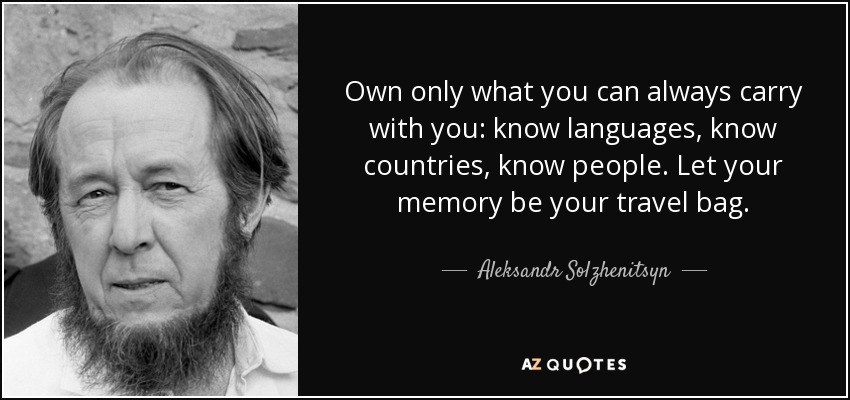 Got a text message from Melissa that the great Russian writer has passed away. I hadn't heard the news. Not exactly an untimely death--he was 89. Still, it is a great loss. Hard to see him go.
 Solzhenitsyn's career as a writer was really an outgrowth of his years in the Gulag. Solzhenitsyn was a patriot, and had been decorated for bravery in World War II. But he was sentenced to the Gulag for something he had written in a letter to a friend. Eight years later, he was released and banished to Siberia. This banishment turned out to be a blessing in disguise, because it gave him time to focus on his writing.
But not without some determination on his part to carve out a part of his day and reserve it for himself. He had been given a job of some kind--can't remember right off hand, but I think it was in a factory or something--where he had to work virtually every waking hour. Solzhenitsyn knew that this would never work, so he devised a plan to address the issue head-on. At precisely 5 pm, he politely informed his boss that he was going home, as he had things to do. His boss told him to get back to work, but he repeated (politely, of course) that he really had to leave. And then he walked out. His boss had a fit, but Solzhenitsyn just ignored him. The next day, at precisely 5 pm, he repeated the same simple announcement. Of course his boss exploded, but Solzhenitsyn very calmly told him that he had things to do, and he had to leave. It was unheard of, of course, for a prisoner to tell his boss that he would not work the required hours. But since this was a job for recently released prisoners, he probably wasn't getting paid more than basic subsistence. Anyway, he didn't get sent back to prison, and he was able to continue his writing.
Eventually, he was able to get a regular job. During his university days, he had made the decision to major in Science and Math instead of Literature. This turned out to be a very wise decision. Once Solzhenitsyn was allowed to accept regular employment, he always had a good job. Word got around that he was an excellent Physics teacher, and he never had trouble getting work, especially in Siberia, as you can imagine. This allowed him to continue his writing undisturbed. If he had chosen to major in Literature, he probably never would have become a writer.
Solzhenitsyn had gotten out of prison in 1953, but he did not publish his first book until 1962. A Day in the Life of Ivan Denisovich. It was a novel about a Baptist believer who was in prison for his faith. You couldn't just publish a book like that without official permission, but, ironically, Krushchev was solidifying his power by repudiating Stalin, so this book got approval because it looked like something that would reinforce Krushchev's view. If you haven't read it, you should. Solzhenitsyn himself was not a Baptist. He was always a devout Russian Orthodox. You could call him a "State Church" man, although I doubt that Solzhenitsyn himself would ever use that term to describe himself. It's been a long time since I read the book myself, so I can't give you much of a review, but you can just about imagine the impact of a book about an unregistered Baptist being persecuted for his faith. It was an immediate sensation. It didn't change the world for Baptists. Baptist pastors had gone to prison before this book was published, and they continued to go to prison after this book was published. But the effect on Russia was far greater than those who originally approved the book could ever have imagined. I guess you could call it the "Uncle Tom's Cabin" of the Soviet Union. And coming from Solzhenitsyn, who was a Russian Orthodox, it was an extraordinary statement. Basically, he was saying that these people were decent folks who didn't deserve to go to prison.
As I mentioned earlier, repudiation of Stalin had become politically correct, because of Krushchev. Churchill always used to say that the worst thing that ever happened to the Russian people was the birth of Lenin. And he always added that the second worst thing was the death of Lenin. This, of course, is because Stalin used Lenin's death to seize power. But he was ruthless, and perhaps Krushchev's greatest contribution was his decision to publicly repudiate the Stalinist era. Gradually, though, it became evident to the powers that be that Solzhenitsyn's own repudiation of the Stalinist era was really a repudiation of the Soviet system itself. As the years passed by, Solzhenitsyn became more and more isolated as a writer, because of his refusal to kow tow to the established order. But it didn't seem to bother him much. Not, that is, until the cops overplayed their hand. Can't recall the precise details, but if I remember correctly, they raided his place and confiscated his writing. This is really what tripped the wire for Solzhenitsyn. He gave instructions for The Gulag Archipelago, which had already been smuggled to Paris, to be published.
Well, this really put the big boys in the Kremlin in a tizzy. The Gulag Archipelago was a monumental work. It established Solzhenitsyn as a great writer, in league with Tolstoy and Dostoevsky. They couldn't, I mean they just couldn't put him in prison. So they threw him out. He eventually came to the United States. President Ford was scared to death of offending the Soviet Union, so he refused to see him, but Solzhenitsyn was allowed to settle in Vermont. His children became American citizens; one of them is an accomplished musician, another a writer like his father. But Solzhenitsyn himself remained a Russophile to his dying day. He returned to his homeland as soon as he was allowed to.
History will remember him for what he did for Russia and Russian literature, but I will always remember him most fondly for what he did (or tried to do) for America. I'm not referring to The Gulag Archipelago. Americans don't read thick books like that. But his essays and speeches, especially his address to the graduating class of Harvard in 1978 (A World Split Apart) confronted smug Americans with the sickness in their own society (humanism), which paralleled the dialectical materialism that ruled the Communist world. The key statement in his address is the following:
Shortly after his speech, Time Magazine published a bunch of reactions from well known Americans. I don't remember all of them, but I did manage to find the article. The comment by George Meany is the one that most caught my attention at the time. For those of you who don't remember George, he was president of the AFL-CIO, and he was troubled by Solzhenitsyn's lament about a society with so much material well being, that had become so impoverished spiritually. Meany said, "I cannot recognize any incompatibility between material and spiritual well being." Typical union man.
During the Cold War, it was popular to see a parallel between the contemporary, repressive Soviet system, and the Czarist systems of the preceding centuries. Richard Nixon, a life-long student of Russian history, held this view (see The Real War). Speaking honestly, I must confess to some sympathy for it myself. But Solzhenitsyn most definitely did not subscribe to this notion. For Solzhenitsyn, the suggestion that the Russian people were inherently totalitarian was deeply offensive. His life-long repudiation of Communism was never a repudiation of things Russian. He loved Russia. His insertion into the American scene at such a critical time might be viewed as an accident of history. I am more inclined to see it as a gift from God. And the fact that the Americans did not respond to his message does not make it any less worthy. "And they, whether they will hear, or whether they will forbear, (for they are a rebellious house,) yet shall know that there hath been a prophet among them." (Ezekiel 2:5)
Labels: A World Split Apart, Materialism, Solzhenitsyn
Monday, August 04, 2008
Took a trip to the pharmacy at Beijing United Hospital this morning. I have been fighting an ear infection off and on since April, and I am more and more convinced that I have developed a fungus infection because it does not seem to be responding to antibiotics.
Going to Beijing United Hospital is out of the question, because I don't have an expat benefits package, and those guys charge American prices. But I have visited the pharmacy, because the pharmacists are nice people and generally bilingual. Usually they will not sell me what I am looking for (which is good, because I would probably be paying American prices for that, too), because they tell me that I have to see a doctor first, which, again, is out of the question. But the pharmacist I spoke with today did me an additional favor. She told me about the international clinic at Peking Union Medical College. I had not heard of this before--don't know, it might have been set up for the Olympics--but she said the prices there would be more manageable for me. I decided to give it a try. The doctor's fee was 200 RMB, which is expensive for China, but reasonable, I think, for a top flight ENT specialist who speaks excellent English.
Going to Beijing United Hospital is out of the question, because I don't have an expat benefits package, and those guys charge American prices. But I have visited the pharmacy, because the pharmacists are nice people and generally bilingual. Usually they will not sell me what I am looking for (which is good, because I would probably be paying American prices for that, too), because they tell me that I have to see a doctor first, which, again, is out of the question. But the pharmacist I spoke with today did me an additional favor. She told me about the international clinic at Peking Union Medical College. I had not heard of this before--don't know, it might have been set up for the Olympics--but she said the prices there would be more manageable for me. I decided to give it a try. The doctor's fee was 200 RMB, which is expensive for China, but reasonable, I think, for a top flight ENT specialist who speaks excellent English.
Friday, August 01, 2008
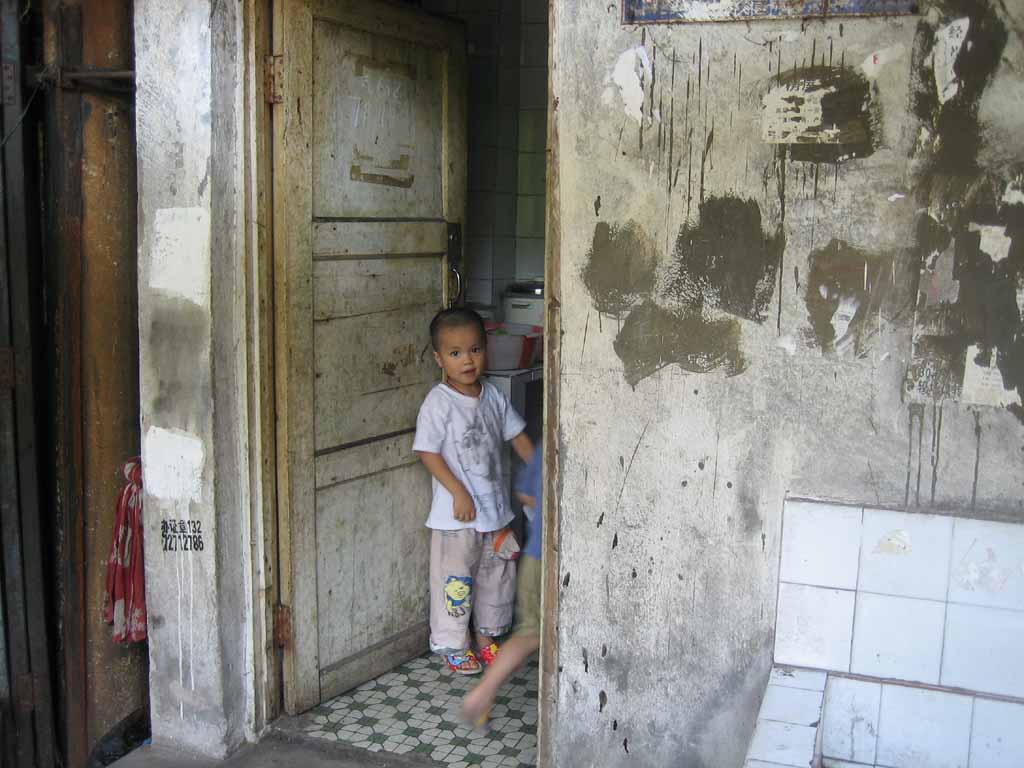 Got back from Chongqing this morning. The campus is secured. Fortunately, I had taken the trouble to get a security badge before I left Beijing, because they were checking every one's ID. It's the Olympics, of course, and I guess it's one of those things you have to put up with. I have never been back to Beijing this early. Beijing is really nice in the fall, winter and spring, but during the middle of the summer, I definitely prefer the Western mountains. Maybe it's a good thing I stopped in Chongqing a few days before coming back. Chongqing is hotter than Beijing in the summertime.
 But you really must see the place. Maybe Chongqing doesn't need to be the first place you see in China. But it does need to be one of the places you see at some time or another. And when you come, don't just go to all the famous places. Chonqing was the wartime capital of China, so it has a lot of interesting historical sites.
 But take a walk through any ordinary neighborhood, and get a picture of what China was like in bygone years. Don't get me wrong. China is changing. But there are some places in Chongqing that seem to be doing just about what they have been doing for generations. Walk through those places and ask yourself, "What was this place like last year? And the year before that. And the year before that, and the year before that, and the year before that?" So much of the city seems frozen in time, even while other parts are seeing tremendous progress. Perhaps it's the gap between rich and poor that everybody talks about. But I think it's also the nature of this city as rivers between the cliffs. What ever the case may be, the ordinary neighborhoods like the one I lived in give you a much better "living history" than the tourist traps that purport to show you "Old China."
 I have wanted to visit Chongqing since I first came to China, and actually stopped through four years ago when I took the ship from Yichang to Chongqing. But I was not in Chongqing more than an hour or so; I boarded a bus for Chengdu as soon as I got off the boat. The reason is that there were no youth hostels in Chongqing at the time. I have discussed this before, but as a foreigner, it is really frustrating to stay in Chinese hotels when you are traveling. First of all, they will often charge you more. Sometimes Chinese people argue with me when I make this complaint, because, after all, the prices are usually posted. But the point is that many times the prices are posted high. If a Chinese person walks in, they will be able to negotiate a lower price, but if someone like me walks in, it's much tougher. At youth hostels, the prices are much more stable, because they are usually rock bottom to begin with, especially if you are staying in a 8 bed or 10 bed room (dormitory, in other words).
  But there is another issue that is almost as important. When you are traveling through Western China, you need to have local travel information. Unless you stay at a very expensive hotel, that can be hard to come by. The employees at small hotels in China are minimum wage workers, some of whom have never been out of their own neighborhoods. The employees at youth hostels are often university students who speak fluent English. They are really savvy when it comes to travel, and very good at getting information quickly. Some better than others, of course. At the youth hostel I stayed at in Chengdu this summer, there was a summer intern who was particularly adept at finding train schedules and prices. Believe it or not, when I left, I talked her into giving me her personal cell phone number. It's a presumptuous thing to do, I know, but I really wanted to be sure I could call her if I got in a pinch. I said, "Look, it's just for information. Maybe I'll call you, and maybe I won't." She said, "Maybe I'll answer you, and maybe I won't."

