Links
- CV
- Titles
- Topics
- Tickets
- Science
- About Eric
- Book Reviews
- Country Profile
- Modern China
- Contact Eric
- Podcast
- Vision
- Sekai
- John
Archives
RSS

Reflections on a Wandering Life.....
Sunday, July 25, 2010
Sunday. Went with Jason and Heather to a small Baptist church that meets in a rented building. The pastor showed a Youtube video of Penn Jillette, where he expresses his appreciation for a Christian who gave him a Gideon Bible after a show. The point the pastor made was that unbelievers are not necessarily offended by Christians sharing their faith, even if they are not sympathetic with the ideas being presented to them.
I guess some folks have interpreted this video to mean that Penn Jillette has become a Christian. They are missing the point. What he is saying is that, while he does not believe, he is not opposed to those who do believe trying to share their faith with others. Interesting perspective. Penn and Teller have been quite vocal in their ridicule of Biblical truth, so it's possible that he felt he should say something positive about people of faith.
I guess some folks have interpreted this video to mean that Penn Jillette has become a Christian. They are missing the point. What he is saying is that, while he does not believe, he is not opposed to those who do believe trying to share their faith with others. Interesting perspective. Penn and Teller have been quite vocal in their ridicule of Biblical truth, so it's possible that he felt he should say something positive about people of faith.
Friday, July 23, 2010
On to Oregon
I am on my way to Oregon. I went to the greyhound bus station yesterday to buy a ticket in advance, since the bus stop is not too far from the youth hostel. But I discovered that I could get a 12 dollar discount if I bought it online. It has been some time since I have ridden a greyhound bus. The advantage of greyhound is that you can buy a ticket at the last minute for a very low cost. Since I was not sure how long it would take to get my visa taken care of, I did not purchase a plane ticket in advance for the trip from San Francisco to Portland.
I have to say, Greyhound has improved considerably since the last time I took it. I boarded a new bus in San Francisco, and changed to another new bus in Sacramento. Greyhound has certainly improved their equipment since the last time I took a Greyhound bus. Maybe the cost of fuel has caused more people to think twice about driving.
I think I'd still rather fly, but since I wasn't sure how long it would take me to get my visa, I hesitated to buy a cheap ticket (which couldn't be refunded).
I have to say, Greyhound has improved considerably since the last time I took it. I boarded a new bus in San Francisco, and changed to another new bus in Sacramento. Greyhound has certainly improved their equipment since the last time I took a Greyhound bus. Maybe the cost of fuel has caused more people to think twice about driving.
I think I'd still rather fly, but since I wasn't sure how long it would take me to get my visa, I hesitated to buy a cheap ticket (which couldn't be refunded).
Golden Gate Bridge
 I first sailed under the Golden Gate Bridge on a British ocean liner called the Himalaya when I was seven years old. We had just left Vancouver, B.C. a few days earlier, and were on our way to Japan.
As I said earlier, just another port of call. The next time I sailed under the Golden Gate was back in the summer of 2002 when my company sent me to San Francisco for training. That time I was on a harbor tour boat. Had to hold on to my hat; it was really windy.
 This time I decided to visit it on the land. Glad I did. Lots of wide open space here, with really nice hiking trails. My only regret is that I have to leave today. Next time I do San Francisco, I am definitely going to spend some time here. I didn't actually go out onto the bridge, because I was more interested in the old military encampments near the Golden Gate. Lots of interesting history. But I think you would want to spend the better part of a day exploring it.
 The Bridge Cafe right near the bridge isn't anything like the one I usually go to in Wudaokou. This one is sort of a fast food type place, not a study bar. But the name caught my attention. Just another tourist place right by the parking lot. But it's handy to have, because these hiking trails out here are quite some distance from the city, so you could grab something in between hikes or something. Wish I had more time. I should have done this the first day.
Thursday, July 22, 2010
Fisherman's Wharf
Picked up my passport this morning, then took the cable car down to the wharf. The cable cars have gotten expensive. When I was here back in 2002, it cost just 2 dollars to hop on and ride.  I guess they have decided to use the cable cars single-handedly to pull California out of its economic slump. They are not designed for that kind of a load. But they can carry a lot of people. The cable cars are a very unique mode of transportation. Don't know of anything like it in the world. They were invented by Andrew Hallidie in 1873. The cable cars have no engines. They are pulled along by cables under the street, which allows them to climb very steep hills--much steeper than what could be navigated by a horse and carriage.
  It just doesn't do to go to San Francisco without riding them. At the beginning of every cable car line is a long line of people waiting to get on. But since I was alone, I just walked up the street a few blocks and hopped on when it came by. One of the benefits of being single, I guess.
Fisherman's Wharf is a popular tourist area, but it is also a docking area for cruise boats, and the final resting place of an old World War II submarine called the Pampanito. Lots of good food down there, but it isn't exactly cheap. Last time I was in San Francisco, I took the cruise out on the bay under the Golden Gate bridge. I have still never been to Alcatraz--I mean actually on the island. But I am going to save that one for next time, I guess. One thing you see more of in the area of Fisherman's Wharf is coffee bars. Found a nice coffee bar in the Borders bookstore at the end of the cable car run. Found a good book, too.
I guess the wharf is interesting to me, because my first trip to San Francisco, I came in on a ship. Just another port of call. So my earliest memory of San Francisco always starts from the water. But it's also a pretty place. San Francisco Bay tends to be a bit breezy, so the air is clear. Blue sky and crisp clear air. Like the fall in Beijing (and not at all like the summer in Beijing). Or like the Tibetan Plateau in the summer time.
I guess they have decided to use the cable cars single-handedly to pull California out of its economic slump. They are not designed for that kind of a load. But they can carry a lot of people. The cable cars are a very unique mode of transportation. Don't know of anything like it in the world. They were invented by Andrew Hallidie in 1873. The cable cars have no engines. They are pulled along by cables under the street, which allows them to climb very steep hills--much steeper than what could be navigated by a horse and carriage. It just doesn't do to go to San Francisco without riding them. At the beginning of every cable car line is a long line of people waiting to get on. But since I was alone, I just walked up the street a few blocks and hopped on when it came by. One of the benefits of being single, I guess. Fisherman's Wharf is a popular tourist area, but it is also a docking area for cruise boats, and the final resting place of an old World War II submarine called the Pampanito. Lots of good food down there, but it isn't exactly cheap. Last time I was in San Francisco, I took the cruise out on the bay under the Golden Gate bridge. I have still never been to Alcatraz--I mean actually on the island. But I am going to save that one for next time, I guess. One thing you see more of in the area of Fisherman's Wharf is coffee bars. Found a nice coffee bar in the Borders bookstore at the end of the cable car run. Found a good book, too.
I guess the wharf is interesting to me, because my first trip to San Francisco, I came in on a ship. Just another port of call. So my earliest memory of San Francisco always starts from the water. But it's also a pretty place. San Francisco Bay tends to be a bit breezy, so the air is clear. Blue sky and crisp clear air. Like the fall in Beijing (and not at all like the summer in Beijing). Or like the Tibetan Plateau in the summer time.
Wednesday, July 21, 2010
The City
San Francisco. There is only one San Francisco, that's for sure. Got into San Francisco yesterday afternoon from Hong Kong. I am stopping in San Francisco for a couple reasons. The first reason is that Northwest Airlines merged with Delta, so their ticket prices have gone sky high, and they don't seem to have the specials they used to. Eason helped me get a reasonably priced ticket on Cathay Pacific, but it ends in San Francisco instead of Portland. It turns out that I needed to get a new visa for China, so I took it, because I could go to the Chinese consulate directly rather than using a visa service. I felt that that is what I should do, given my situation. If I used a visa service and there was a problem, I would have to go to San Francisco anyway.
This morning, I went to the Chinese consulate to apply for a tourist visa. I did this because I have not made a decision yet about what I am going to do, so I want to get a tourist visa, so that I can go back to China legally. They had told me when I called that I could get a one year multiple entry visa with 90 days each stay. But when I showed up at the office, they told me that this provision was only for Chinese people. The best they could do for me was 60 days each stay. I was not happy about this, because that means that I have to leave the country every 60 days. Traveling in China is pretty cheap, but as soon as you cross the border, the cost goes up.
She asked me when I wanted to pick up my visa. I said, "No. I want my passport back. I cannot accept 60 days." She said she would go talk to the consul. When she came back, she started speaking Chinese to me. The consul had apparently pointed out to her that I had work visas on my passport. Somehow, I knew that was going to be a problem. She gave me a piece of paper and told me that I had to write, "I will not work in China." I wrote, "I will not be employed for the duration of this visa." The reason I put it that way is because if I get a job, then of course I will get a Z (working) visa. But you can't get a legal Z visa until you actually have a contract. I don't know.....sometimes I think I should just level with these folks about how easy it is to get a black market Z visa in Beijing. But I don't want to offend them. If I wanted to get an illegal work visa, I wouldn't have to come all the way to San Francisco. I came to San Francisco precisely because I do not want a visa that was obtained with money under the table. She took the paper to the consul. After a few minutes, she came back and said, "You need to write, 'I know I must obey the laws of China.'"
I had thought I might have to wait four days to get my visa (four working days is the standard processing time), but she said there would be no problem getting it the next day. I think she tacked on a 20 or 30 dollar express service fee. I think if you have never been to China before, and are just trying to get a tourist visa, you could probably get by with a visa service. That's what I did the first time I went to China. But this time my ticket was taking me through San Francisco anyway, and the youth hostel was only 30 bucks a night, so I figured I would be best for me to do it myself. My situation is a little unusual, because I have been working in China. If you have already been living and working in China, and you try to get a visa, they tend to think you are going to be working on a tourist visa, which is against the law. So it helped for me to be able to explain to them what I was doing.
Tuesday, July 20, 2010
Hong Kong to San Francisco
 Left Beijing just after 8 this morning. After a brief layover in Hong Kong, we took off into a beautiful blue sky. This is only the third time I have been to Chek Lap Kok Airport. The other two times were on the first trip I took to China back in the fall of 2001. If you live in China, and you want to visit Hong Kong, it is not a good idea to fly to Hong Kong directly for a couple reasons. First, it is an international flight, so it will cost quite a bit more. Much cheaper to fly to Shenzhen and take the bus to the border for 20 kuai. But the other reason is that the airport in Hong Kong is actually quite a ways from the city. Getting into the city from the airport is not free. So it is actually much more convenient to go to Shenzhen, because as soon as you cross the border at Shenzhen, you are at the Metro station. Buy your octopus card for the Metro, and you're good to go.
 But this time I wasn't going to Hong Kong. Just passing through because the ticket on the combined flights (Dragon Air -- Cathay Pacific) was quite a bit cheaper than the flight on Northwest, which has merged with Delta. I haven't figured out how to check the specials on the new Delta Airlines website, and when I called the number on the web site, the lady just said, "These are the cheapest rates." If that's true, I don't think I will be flying Delta much anymore, unless they have a special to Japan sometime or something. It's too bad. That's one merger that did not go well for the consumer. Guess I shouldn't begrudge them their success. Rich people have to fly too.
Monday, July 19, 2010
Tianying Xueyuan
Today was my last day at the language school. I have been studying in China since January on a six month student visa. But, in fact, I had been studying at this language school part time during the fall semester. So I have been going to class every day from 8:00 to 9:30 since September. I'm tired.
When I hired my first Mandarin tutor back in the spring of 2002, after my first trip to China, I was two months shy of my 47th birthday. I met with tutors for about an hour or two a week until I moved to Beijing in January of 2004. The first semester I was in China, I was doing some teaching out in Langfang a couple days a week, so I didn't sign up for a regular class; I hired a couple private tutors. But in the fall of 2004, I enrolled at Global Village in Wudaokou. There are lots of private language schools in Wudaokou, and the good thing about Wudaokou is that it is one of the two "Little Korea's" of Beijing. So while some of the language schools are designed for rich kids from America, there are also some that are designed for working people from Korea. You can guess which ones I prefer. They are not as fancy, but they are a LOT cheaper. There is a problem when most of your classmates are Koreans. Korean students have some problems with pronunciation. But they are always light years ahead of me when it comes to reading characters. So after a year at Diqiucun (Global Village), I dropped out and decided to study on my own. The reason was because I could kinda follow what the teacher was saying, but I could not read the exercises in the book, and that really frustrated me.
It was a good decision. I got a dictionary, and used the radical chart to look up the characters one at a time. I took the book I had planned to study at the school, and began to go through it. There were 40 chapters. I decided to focus strictly on the dialogue, and skip the exercises, because if I could mange to read through the dialogue (two or three paragraphs) for every chapter, I would be prepared to study that book in a classroom setting. At Diqiucun, we usually went through a book in two to three months, but that pace was too fast for me. I planned to just go at my own pace. I figured that even if it took me a week to go through each dialogue, I would finish the book in less than a year. "Best laid plans..." as they say. Took me four months to get through the first two chapters. But I didn't give up. I wasn't even mildly discouraged. Chinese is a stubborn language. But I'm not worried, because I am a little bit more stubborn. I kept up that way for a couple years.
In the Fall of 2007, I took a six week course at Sinoland. It was a little more expensive than the Korean school, but I decided to do it anyway, because it was an intensive program--three hours a day with a maximum of four students, and with emphasis on speaking. By that time, I had gotten to the point where I still trouble reading the exercises, but not as much trouble as before, and at Sinoland, they create their own exercises with lots of explanations. Basically, you're paying extra for an accelerated method.
In the spring of 2008, I was going to go back to Sinoland and take another course, but they had changed all their courses to ten weeks, and I had to go to South China to do some teaching in April, so I only had a couple months between Spring Festival and when I had to leave. I opted for a small school patterned after Diqiucun. Dump of a place, but the classes were small, and that's what I like.
Fall, 2008, I went back to Sinoland and hired a tutor. It cost me 80 RMB an hour, which is more than I had ever paid (in China), but she had been my teacher before, and she was really good. In the Spring of 2009, they jacked the prices up, so I quit and hired May to teach me the Three Kingdoms.
Last Fall, I went back to Sinoland to find my old tutor, but she was busy, so I went back to the small school I had gone to back in the spring of 2008. It wasn't there. Small place--I guessed it had gone belly up due to the currency exchange problem. Recently, the Korean Won fell against the dollar, and rich Koreans were no longer able to afford to send their little darlings to Wudaokou to party and sorta study. Anyway, I asked the people there about the language school, and they just nodded when I asked them if it had closed. I walked toward the elevator a bit befuddled. What to do now? I didn't really want to go to Diqiucun, because it is too well known. The classes are too large. When I got to the elevator, I noticed that someone was following me. He said, "McDonald's. Eighth floor." I went to the building that McDonald's is in, and took the elevator to the eighth floor. Sure enough, there it was. I signed up for an early morning class that had just one or two other students. That's the benefit of going to a small school. And getting out of bed in the morning. Early classes have fewer students. Over the past nine months, there have been many days that I was the only student.
When I hired my first Mandarin tutor back in the spring of 2002, after my first trip to China, I was two months shy of my 47th birthday. I met with tutors for about an hour or two a week until I moved to Beijing in January of 2004. The first semester I was in China, I was doing some teaching out in Langfang a couple days a week, so I didn't sign up for a regular class; I hired a couple private tutors. But in the fall of 2004, I enrolled at Global Village in Wudaokou. There are lots of private language schools in Wudaokou, and the good thing about Wudaokou is that it is one of the two "Little Korea's" of Beijing. So while some of the language schools are designed for rich kids from America, there are also some that are designed for working people from Korea. You can guess which ones I prefer. They are not as fancy, but they are a LOT cheaper. There is a problem when most of your classmates are Koreans. Korean students have some problems with pronunciation. But they are always light years ahead of me when it comes to reading characters. So after a year at Diqiucun (Global Village), I dropped out and decided to study on my own. The reason was because I could kinda follow what the teacher was saying, but I could not read the exercises in the book, and that really frustrated me.
It was a good decision. I got a dictionary, and used the radical chart to look up the characters one at a time. I took the book I had planned to study at the school, and began to go through it. There were 40 chapters. I decided to focus strictly on the dialogue, and skip the exercises, because if I could mange to read through the dialogue (two or three paragraphs) for every chapter, I would be prepared to study that book in a classroom setting. At Diqiucun, we usually went through a book in two to three months, but that pace was too fast for me. I planned to just go at my own pace. I figured that even if it took me a week to go through each dialogue, I would finish the book in less than a year. "Best laid plans..." as they say. Took me four months to get through the first two chapters. But I didn't give up. I wasn't even mildly discouraged. Chinese is a stubborn language. But I'm not worried, because I am a little bit more stubborn. I kept up that way for a couple years.
In the Fall of 2007, I took a six week course at Sinoland. It was a little more expensive than the Korean school, but I decided to do it anyway, because it was an intensive program--three hours a day with a maximum of four students, and with emphasis on speaking. By that time, I had gotten to the point where I still trouble reading the exercises, but not as much trouble as before, and at Sinoland, they create their own exercises with lots of explanations. Basically, you're paying extra for an accelerated method.
In the spring of 2008, I was going to go back to Sinoland and take another course, but they had changed all their courses to ten weeks, and I had to go to South China to do some teaching in April, so I only had a couple months between Spring Festival and when I had to leave. I opted for a small school patterned after Diqiucun. Dump of a place, but the classes were small, and that's what I like.
Fall, 2008, I went back to Sinoland and hired a tutor. It cost me 80 RMB an hour, which is more than I had ever paid (in China), but she had been my teacher before, and she was really good. In the Spring of 2009, they jacked the prices up, so I quit and hired May to teach me the Three Kingdoms.
Last Fall, I went back to Sinoland to find my old tutor, but she was busy, so I went back to the small school I had gone to back in the spring of 2008. It wasn't there. Small place--I guessed it had gone belly up due to the currency exchange problem. Recently, the Korean Won fell against the dollar, and rich Koreans were no longer able to afford to send their little darlings to Wudaokou to party and sorta study. Anyway, I asked the people there about the language school, and they just nodded when I asked them if it had closed. I walked toward the elevator a bit befuddled. What to do now? I didn't really want to go to Diqiucun, because it is too well known. The classes are too large. When I got to the elevator, I noticed that someone was following me. He said, "McDonald's. Eighth floor." I went to the building that McDonald's is in, and took the elevator to the eighth floor. Sure enough, there it was. I signed up for an early morning class that had just one or two other students. That's the benefit of going to a small school. And getting out of bed in the morning. Early classes have fewer students. Over the past nine months, there have been many days that I was the only student.
Thursday, July 15, 2010
"Undercover" Missionaries
Read an article by Eric Fish in the Global Times some time ago about "undercover missionaries." The article presents itself as an expose on teachers who are not what they claim to be, but, in fact, the article itself is not really what it claims to be, and contains a number of inaccuracies.
Mr. Fish starts out by telling a story about an English teacher who shows a Mel Gibson movie to her students. Nothing so unusual about that, but the incident is presented as if it were a subversive act. I am not really a Mel Gibson fan (although I saw him in Man Without a Face, and thought he did a decent job), but I don't see any real harm in showing one of his movies to a group of students. The movie Mr. Fish is talking about is The Passion of the Christ. I also saw that movie, and I admit, the beating scene was a bit overdone, and it might be upsetting to someone who had never heard the story. But, after all, it is a part of American culture that students want to know about.
 Eric Fish then launches into a diatribe about non-profit organizations who are sending "thousands" of teachers to China. He goes on to say that these organizations maintain "huge cash reserves," and that they "pay the teacher's salary directly and only receive a small payment from the university, letting the school spend a fraction of what they would normally pay for a foreign teacher." This, I think, is the real source of Mr. Fish's ire. Eric Fish is an English teacher by profession, and he is understandably miffed by the fact that non-profit organizations are able essentially to offer English teachers in bulk at a significantly reduced cost. Although I am not an English teacher, I have heard this kind of complaint from English teachers several times in the past. I always point out to them that English teachers like Mr. Fish, who prefer to contract independently (presumably because they can make more money), cannot begin to fill the demand for English teachers in China. So these organizations that Eric Fish's article vilifies are actually providing a badly needed service, but in a manner very different from the way he describes.
In the first place, they do not have huge cash reserves. What they do, is to recruit English teachers, and then show those English teachers how to raise their support from churches or civic organizations. This support money will then go to the teacher, but a small percentage will be taken out by the organization to cover their operating costs. So the organization doesn't need huge cash reserves as long as they can continue to recruit teachers. But the part that really upsets English teachers like Eric Fish is that the organization then takes these English teachers they have recruited and offers them at a significantly lower than average cost, in exchange for a commitment from the university to take a specified number of teachers from the organization. Again, given the huge demand for English teachers in China, this is really a win-win situation for both the placement organizations and the universities. The organization can afford to do this, because, contrary to what Eric Fish says in his article, they are not paying the teacher's salaries out of their "huge cash reserves." The teacher is supported by a combination of what the Chinese university pays them, and what they can raise as support themselves. Since the teachers are raising support under the auspices of a non-profit organization, they are able to offer their supporters receipts for tax deduction. This makes it easier for them to raise money. The universities gain, because they are getting teachers for a pittance, whose salaries are being subsidized by American contributors. The only "losers" in this equation, are the independent English teachers like Mr. Fish, who feel that this arrangement makes it harder for them to compete for a living wage.
So we find that what purports to be an expose on "undercover missionaries," is, in fact, a rant by an angry English teacher who is upset by what he views as unfair competition. But what would he prefer? That many, many Chinese students be left without English teachers so that independent English teachers like himself would be able to demand a higher salary? Some of the organizations Mr. Fish refers to specialize in bringing expert teachers at a very low cost to students in remote areas who would not have any foreign teachers at all without the help of these organizations.
But what about Eric Fish's charge that these English teachers are actually "undercover missionaries?" Is there any truth to this? Do foreign teachers who happen to be Christians ever act in a way that is offensive? Do they ever take advantage of their position to "push" their religion on vulnerable students? Eric Fish again:
I am a Christian. I go to a regular Chinese church every Sunday. I always encourage foreign Christians who are living in China to get involved with a local Chinese church, and to work in cooperation with the local Chinese pastor. He will be able to guide them in learning what kinds of behaviors are appropriate for foreign Christians. And since he will have a relationship with the Religious Affairs Bureau, he will be able to ensure that foreign Christians know what is expected of them.
I do not believe I should push my beliefs on Chinese young people, but I also do not believe I need to pretend I am not a Christian. China has freedom of religion. People know I am a Christian. Occasionally students will ask if they can go to church with me, especially since the Three-Self church I go to now has an English service. I think I have seen one or two become regular attenders, but the majority do not. That is their choice. The government does not prohibit students from going to church.
But there is something else about Eric Fish's statement that bothers me. I do not like to hear Chinese students described by a foreigner as "easy prey." Mr. Fish does not seem to have a very high opinion of the thinking ability of Chinese young people. Does he think that he is easy prey? I have been teaching Chinese students in China now for several years. Granted, I am a specialist, so I have been working with a very select group of students. But I have found them to be bright, intelligent young people. They have their own ideas about religion. Sometimes, I get into discussions with Chinese students about religious subjects, especially at the English Corner. I find that Chinese young people are very open minded, but not necessarily interested in becoming Christians. Naturally, when large numbers of Chinese students interact with Christian English teachers, some of them will become Christians. But most of them will not. They will be a little more informed about what other folks believe, and they will become proficient in English. Most English teachers who are sent out by non-profit organizations are given very clear instructions about what is appropriate behavior for them. They have a wholesome influence on Chinese young people. And they are bringing expert English language instruction to remote communities most English teachers would not want to go to. Would China really be a better place if the only foreign teachers Chinese young people ever encountered were the cynical, Godless types who don't believe in anything, and who joke about violating Chinese law, buying illegal CD's, and engaging in unlawful money exchanges? I don't see this as a laudable alternative.
Mr. Fish starts out by telling a story about an English teacher who shows a Mel Gibson movie to her students. Nothing so unusual about that, but the incident is presented as if it were a subversive act. I am not really a Mel Gibson fan (although I saw him in Man Without a Face, and thought he did a decent job), but I don't see any real harm in showing one of his movies to a group of students. The movie Mr. Fish is talking about is The Passion of the Christ. I also saw that movie, and I admit, the beating scene was a bit overdone, and it might be upsetting to someone who had never heard the story. But, after all, it is a part of American culture that students want to know about.
Eric Fish then launches into a diatribe about non-profit organizations who are sending "thousands" of teachers to China. He goes on to say that these organizations maintain "huge cash reserves," and that they "pay the teacher's salary directly and only receive a small payment from the university, letting the school spend a fraction of what they would normally pay for a foreign teacher." This, I think, is the real source of Mr. Fish's ire. Eric Fish is an English teacher by profession, and he is understandably miffed by the fact that non-profit organizations are able essentially to offer English teachers in bulk at a significantly reduced cost. Although I am not an English teacher, I have heard this kind of complaint from English teachers several times in the past. I always point out to them that English teachers like Mr. Fish, who prefer to contract independently (presumably because they can make more money), cannot begin to fill the demand for English teachers in China. So these organizations that Eric Fish's article vilifies are actually providing a badly needed service, but in a manner very different from the way he describes. In the first place, they do not have huge cash reserves. What they do, is to recruit English teachers, and then show those English teachers how to raise their support from churches or civic organizations. This support money will then go to the teacher, but a small percentage will be taken out by the organization to cover their operating costs. So the organization doesn't need huge cash reserves as long as they can continue to recruit teachers. But the part that really upsets English teachers like Eric Fish is that the organization then takes these English teachers they have recruited and offers them at a significantly lower than average cost, in exchange for a commitment from the university to take a specified number of teachers from the organization. Again, given the huge demand for English teachers in China, this is really a win-win situation for both the placement organizations and the universities. The organization can afford to do this, because, contrary to what Eric Fish says in his article, they are not paying the teacher's salaries out of their "huge cash reserves." The teacher is supported by a combination of what the Chinese university pays them, and what they can raise as support themselves. Since the teachers are raising support under the auspices of a non-profit organization, they are able to offer their supporters receipts for tax deduction. This makes it easier for them to raise money. The universities gain, because they are getting teachers for a pittance, whose salaries are being subsidized by American contributors. The only "losers" in this equation, are the independent English teachers like Mr. Fish, who feel that this arrangement makes it harder for them to compete for a living wage.
So we find that what purports to be an expose on "undercover missionaries," is, in fact, a rant by an angry English teacher who is upset by what he views as unfair competition. But what would he prefer? That many, many Chinese students be left without English teachers so that independent English teachers like himself would be able to demand a higher salary? Some of the organizations Mr. Fish refers to specialize in bringing expert teachers at a very low cost to students in remote areas who would not have any foreign teachers at all without the help of these organizations.
But what about Eric Fish's charge that these English teachers are actually "undercover missionaries?" Is there any truth to this? Do foreign teachers who happen to be Christians ever act in a way that is offensive? Do they ever take advantage of their position to "push" their religion on vulnerable students? Eric Fish again:
"A teacher, especially in China, is a highly respected profession [sic] with much influence, and foreign teachers are especially intriguing to many Chinese students. So when unsuspecting and naïve students meet these teachers with ulterior motives, they become easy prey."I have a couple problems with this statement. Mr. Fish seems to be under the impression that these organizations are all operating as mini CIA's, sneaking missionaries into China. No doubt, there are some who do that. But the largest and most successful organizations have very open relationships with the Chinese government. They inform the government that many of their teachers are drawn from churches, because in countries like America, it is much easier to recruit volunteers who are willing to work for limited compensation from Churches than from the general public. Most American teachers would not even think about working for the kinds of salaries Chinese universities usually pay. But these non-profit organizations then ask the Chinese government to tell them what kinds of behaviors are appropriate for a Christian in China, and they have very strict rules for the teachers they recruit, telling them what they can and cannot do. To be sure, there are English teachers who occasionally violate these rules. But characterizing English teachers from non-profit organizations as "predators" is very, very unfair.
I am a Christian. I go to a regular Chinese church every Sunday. I always encourage foreign Christians who are living in China to get involved with a local Chinese church, and to work in cooperation with the local Chinese pastor. He will be able to guide them in learning what kinds of behaviors are appropriate for foreign Christians. And since he will have a relationship with the Religious Affairs Bureau, he will be able to ensure that foreign Christians know what is expected of them.
I do not believe I should push my beliefs on Chinese young people, but I also do not believe I need to pretend I am not a Christian. China has freedom of religion. People know I am a Christian. Occasionally students will ask if they can go to church with me, especially since the Three-Self church I go to now has an English service. I think I have seen one or two become regular attenders, but the majority do not. That is their choice. The government does not prohibit students from going to church.
But there is something else about Eric Fish's statement that bothers me. I do not like to hear Chinese students described by a foreigner as "easy prey." Mr. Fish does not seem to have a very high opinion of the thinking ability of Chinese young people. Does he think that he is easy prey? I have been teaching Chinese students in China now for several years. Granted, I am a specialist, so I have been working with a very select group of students. But I have found them to be bright, intelligent young people. They have their own ideas about religion. Sometimes, I get into discussions with Chinese students about religious subjects, especially at the English Corner. I find that Chinese young people are very open minded, but not necessarily interested in becoming Christians. Naturally, when large numbers of Chinese students interact with Christian English teachers, some of them will become Christians. But most of them will not. They will be a little more informed about what other folks believe, and they will become proficient in English. Most English teachers who are sent out by non-profit organizations are given very clear instructions about what is appropriate behavior for them. They have a wholesome influence on Chinese young people. And they are bringing expert English language instruction to remote communities most English teachers would not want to go to. Would China really be a better place if the only foreign teachers Chinese young people ever encountered were the cynical, Godless types who don't believe in anything, and who joke about violating Chinese law, buying illegal CD's, and engaging in unlawful money exchanges? I don't see this as a laudable alternative.
Tuesday, July 06, 2010
The Bus Yard
Fortunately for me, lots of day tourists like to come to Fragrant Hills. So the village where I live has a transportation system that is considerably better than would be the case if it were not situated right next to Fragrant Hills Park.  The price I pay for that is that this place is crawling with people on weekends. I usually stay away Saturday and Sunday. But also fortunately for me, most people do not want to live here. The commute is too long. So during the week, and especially in the evenings, it is a relatively quiet, peaceful place to live. From the bus yard at Fragrant Hills, which is about a five minute walk from my home, there are buses going to several different parts of the city. Since Fragrant Hills is in the extreme northwest, the bus routes mainly connect with various parts of the Haidian District. But the Xiyuan Transport Hub between here and Zhongguancun allows connections to all parts of Beijing.
There are a few young people living out here who work in Zhongguancun, but for the most part, young people tend to avoid this area (especially foreign young people), because they don't want to give up the night life of the city. I have never been much of a bar person (except for coffee bars), so I don't miss the racket of Wudaokou. But it is probably a good thing that I lived in that area when I first came to Beijing, because it made for a much easier adjustment. There are lots of language schools in Wudaokou. Nothing like that out here. But during all those years that I lived in the university environment, I did not encounter that many people who could not speak English. Here in the village, nobody speaks English, so while there are no schools, learning takes place every day. Frustrating in the extreme if you don't know anything of the language, but very convenient if you have gotten to the place where you can basically communicate. For people who have to show up at a job every day, it isn't that attractive, because the time spent commuting means that you really don't have time to appreciate the location. But if you don't absolutely need to be at the office every day, then it is nice (if a bit inconvenient) to live near the hills.
The price I pay for that is that this place is crawling with people on weekends. I usually stay away Saturday and Sunday. But also fortunately for me, most people do not want to live here. The commute is too long. So during the week, and especially in the evenings, it is a relatively quiet, peaceful place to live. From the bus yard at Fragrant Hills, which is about a five minute walk from my home, there are buses going to several different parts of the city. Since Fragrant Hills is in the extreme northwest, the bus routes mainly connect with various parts of the Haidian District. But the Xiyuan Transport Hub between here and Zhongguancun allows connections to all parts of Beijing. There are a few young people living out here who work in Zhongguancun, but for the most part, young people tend to avoid this area (especially foreign young people), because they don't want to give up the night life of the city. I have never been much of a bar person (except for coffee bars), so I don't miss the racket of Wudaokou. But it is probably a good thing that I lived in that area when I first came to Beijing, because it made for a much easier adjustment. There are lots of language schools in Wudaokou. Nothing like that out here. But during all those years that I lived in the university environment, I did not encounter that many people who could not speak English. Here in the village, nobody speaks English, so while there are no schools, learning takes place every day. Frustrating in the extreme if you don't know anything of the language, but very convenient if you have gotten to the place where you can basically communicate. For people who have to show up at a job every day, it isn't that attractive, because the time spent commuting means that you really don't have time to appreciate the location. But if you don't absolutely need to be at the office every day, then it is nice (if a bit inconvenient) to live near the hills.
Monday, July 05, 2010
China's Crisis of Faith
Just when I thought I'd heard everything...
The Communist Party decided to hold a press conference for the foreign media. I guess it's part of the party's pitch for more openness, or something. A reporter from CNN asked whether it was true that most people join the party to help them get a good job, rather than because of their belief in Communism. The party official responded that only a few applicants "may not have very correct motives for seeking Party membership." As a response to the question asked, it was ludicrous. But viewed in the context of today's China, it was strangely appropriate. I will try to explain.
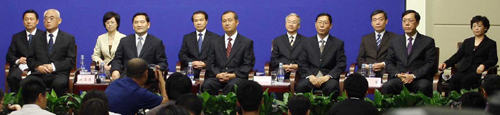 I have been in China for over six years now. Several times over the past six years, young people have asked me whether I thought they should join the Party. I always respond with a question:
"Why do you want to join the Communist Party?" Always, without exception, the answer is the same:
"Because I want to get a good job." Never, ever, have I had a young person respond by saying, "I want to uphold the cause of Marxism." So when I read the response, it was all I could do to keep from laughing out loud (I was on the bus). In China, when an official is confronted with an inconvenient reality, an emphatic, face-saving denial is the default answer. So one should not be too surprised by a denial like this in response to such an embarrassing question. Still, this one takes the cake. If joining the party for the purpose of advancing one's career is to be regarded as an ulterior motive, then it is not a small minority of people who join the party with "incorrect motives." It is absolutely everyone. If you ask a hundred young people what would make them want to join the Party, I can assure you that all one hundred of them would list career advancement as their main, if not their only reason. Eating lunch with some friends yesterday after church, I mentioned the Communist Party official's response to the CNN reporter's question. Of course, they all laughed. On the surface, anyone who knows anything about China would agree that his remarks were disingenuous.
But there is another way to look at this. You see, in today's China, joining the party for the sake of advancing one's career is not considered inappropriate. Making money is the goal right now. The party encourages this. In fact, if a young person joining the a party were questioned about his motives for joining, and responded that he wanted to uphold the cause of Marxism and smash the capitalist running dogs, he would probably be viewed as a wacko and rejected. That kind of thinking is not politically correct these days. What is politically correct is making money.
When I first came to China, young freshmen from the countryside would ask me, "Professor Eric, what's the difference between socialism and capitalism?" Interesting. These are the brightest kids in China. They have been all the way through the educational system, and had all the indoctrination the government could give them, and they are asking me, a foreigner, to tell them the difference. Why? Because they don't know. And their teachers don't know. I have talked to their teachers. Here's the problem: In today's China, it is not politically correct to espouse Marxist philosophy. But it is also not politically correct to publicly admit that we no longer follow Marxist teaching. So whatever system we adopt in China, we must call it socialism. That's why Hu Jintao dresses up in a Mao suit on National Day (which he wouldn't be caught dead wearing any other time) and says that "Socialism is the only hope for China." Naturally, the young people are confused. They look around them, and they say, "If this is socialism, what is capitalism?" And I have to tell them, "This isn't socialism. Your grandparents had socialism." I was discussing this problem with a friend of mine some time ago. This is a professional woman with a master's degree, but her response did not surprise me, "Please tell me, what is the difference between socialism and capitalism?"
I told her the same thing I told my students: "If you have a company, do you think you should own the company, or do you think the government should own it, and you just work for them?" My students were quite emphatic. They wanted to own the company. I said, "Then you're a capitalist. If you think the government should own it, then you are a socialist." Socialism has the simplest definition in the dictionary. "Public ownership of the means of production." The reason the issue is confusing is not because the terms are not easy to understand. The issue is confused because China has abandoned socialism, but cannot admit it. So the only alternative is to redefine the terms. So when a young person applies to join the party, their ignorance of the difference between socialism and capitalism is not a problem, because the odds are that the party official examining them doesn't know either.
We were talking about this one time at the English corner, and one guy said, "You're right. But you're not completely right, because in China we have state owned enterprises, and you don't have anything like that in America. Well, I had to concede his point. So perhaps China is more socialist than America. But my point is that if you ask the average person to list the companies they have dealt with during any business day, the bulk of them would be private businesses. A quick stop at a sidewalk restaurant or something like McDonald's (private business) for breakfast, then perhaps taking the subway (public business) to work (most likely at a private company). Lunch at some sort of restaurant or concession (private business), then back to work until quitting time. Maybe stop and pick up some things at a store, which is most certainly going to be a private enterprise--I have never seen a government grocery. Go home and spend time with the family, or go to a movie at a theater, which will most definitely be a private company.
You see, if you examine the companies with which most people have to do during a given day, the majority of them will be private. Why? Because China is not a socialist country, and does not have a socialist economy. True, if you have a car (which you purchased from a private dealer, not the government) and you stop for gas, you would have a couple choices: Sinopec or Petro China, both of which are SOE's. But they are the exception that proves the rule. China actually has a very Republican economy, and economic policy is crafted by government economists who are the cream of the crop from Wharton, MIT, or the Harvard Business School. Since China is not a democracy, economic policy is not burdened by the costly and wasteful pork barrel projects that are so typical in the American legislative process. That sort of corruption (and it is corruption) would never be tolerated here in China. The Chinese prefer bribery, which brings me to my main point:
The newspaper article says, "No 'faith crisis' in CPC." Is there a crisis of faith? In the strictest sense, no, there isn't. Young people who join the party definitely do not believe in Marxism. But the party doesn't either, so where is the crisis of faith? There is no crisis of faith in the party. Young people I talk to do not believe in Marxism, but they generally seem to be satisfied with the job the party is doing. The party does bring a measure of stability. I know, we can argue all day about "stability at what cost," but nevertheless, China is a reasonably stable place to live and work.
So I don't see a crisis of faith in the party. But there is definitely a crisis of faith in the society proper. Many, many times over the past six and a half years that I have been in China, people have said to me, "We Chinese don't believe in anything. We have no belief." I lived in America for forty years, and I never once heard anyone say that. Chinese people don't know what they believe, and they are not exactly certain what the party believes, because the party is never straightforward about this (as the official's response illustrates so beautifully).
I was talking to a PLA officer one time. I said, "The Communist Party doesn't believe in Marxism anymore. You know that. I know that. Why don't they just say it? Why don't they just come out and admit that they no longer believe in Marxism?" He said, "The Communist Party came to power under the banner of Marxism. If they say that they no longer believe in Marxism, what is their basis for power?"
A friend of mine studied political theory in university. Then she became a Christian. I put this question to her. She said, "If the Communist Party admits that they no longer believe in Marxism, the next logical question is, 'Then what do you believe?' and they don't have an answer to that question."
I believe that these two thoughtful observations frame the context which defines the crisis of faith in this country. It is hard for the general populace to develop a deep sense of loyalty to the values of their country, because nobody knows for sure what those values are. Freedom? No. Democracy? Definitely not. The belief that all men are created equal? No, not that either. The cause of the proletariat? No. The common people routinely have their property confiscated so that corrupt officials can make money on development. So what do Chinese people believe in? I went to the English Corner once and asked a bunch of people that question. The answers were insightful. Listen to the podcast of that interview and see what you think. Toward the end of my interview, I turned to a young lady, and said, "What do you believe?" She said, "I believe in myself." This is the crisis of faith in China. It is every man for himself. Get what you can for yourself and your family. If you can do it legally, fine. If not, just be sure you don't get caught, but don't worry about anything else, because there is no God to whom you might ultimately be accountable.
What hope is there for such a morally ambivalent society? Fortunately there is one presence in society that is very encouraging. Christian young people in China are barred from government service in China (because they cannot join the Party), so they are free to give themselves wholeheartedly to the church. There is a growing body of very bright, intelligent young people in this country who hold themselves to high moral standards, and refuse to be part of the corrupt system around them. They love God, and they love China. In China, the Party has power. Church people have no power, and are not interested in power. I never met a more apolitical group of people than Chinese Christians. They don't know anything about politics and power, and don't want to. But the Christian Church is a strong and growing influence in society, because Christians are the one group of people in this country who know for sure what they believe.
The Communist Party decided to hold a press conference for the foreign media. I guess it's part of the party's pitch for more openness, or something. A reporter from CNN asked whether it was true that most people join the party to help them get a good job, rather than because of their belief in Communism. The party official responded that only a few applicants "may not have very correct motives for seeking Party membership." As a response to the question asked, it was ludicrous. But viewed in the context of today's China, it was strangely appropriate. I will try to explain.
I have been in China for over six years now. Several times over the past six years, young people have asked me whether I thought they should join the Party. I always respond with a question:"Why do you want to join the Communist Party?" Always, without exception, the answer is the same:
"Because I want to get a good job." Never, ever, have I had a young person respond by saying, "I want to uphold the cause of Marxism." So when I read the response, it was all I could do to keep from laughing out loud (I was on the bus). In China, when an official is confronted with an inconvenient reality, an emphatic, face-saving denial is the default answer. So one should not be too surprised by a denial like this in response to such an embarrassing question. Still, this one takes the cake. If joining the party for the purpose of advancing one's career is to be regarded as an ulterior motive, then it is not a small minority of people who join the party with "incorrect motives." It is absolutely everyone. If you ask a hundred young people what would make them want to join the Party, I can assure you that all one hundred of them would list career advancement as their main, if not their only reason. Eating lunch with some friends yesterday after church, I mentioned the Communist Party official's response to the CNN reporter's question. Of course, they all laughed. On the surface, anyone who knows anything about China would agree that his remarks were disingenuous.
But there is another way to look at this. You see, in today's China, joining the party for the sake of advancing one's career is not considered inappropriate. Making money is the goal right now. The party encourages this. In fact, if a young person joining the a party were questioned about his motives for joining, and responded that he wanted to uphold the cause of Marxism and smash the capitalist running dogs, he would probably be viewed as a wacko and rejected. That kind of thinking is not politically correct these days. What is politically correct is making money.
When I first came to China, young freshmen from the countryside would ask me, "Professor Eric, what's the difference between socialism and capitalism?" Interesting. These are the brightest kids in China. They have been all the way through the educational system, and had all the indoctrination the government could give them, and they are asking me, a foreigner, to tell them the difference. Why? Because they don't know. And their teachers don't know. I have talked to their teachers. Here's the problem: In today's China, it is not politically correct to espouse Marxist philosophy. But it is also not politically correct to publicly admit that we no longer follow Marxist teaching. So whatever system we adopt in China, we must call it socialism. That's why Hu Jintao dresses up in a Mao suit on National Day (which he wouldn't be caught dead wearing any other time) and says that "Socialism is the only hope for China." Naturally, the young people are confused. They look around them, and they say, "If this is socialism, what is capitalism?" And I have to tell them, "This isn't socialism. Your grandparents had socialism." I was discussing this problem with a friend of mine some time ago. This is a professional woman with a master's degree, but her response did not surprise me, "Please tell me, what is the difference between socialism and capitalism?"
I told her the same thing I told my students: "If you have a company, do you think you should own the company, or do you think the government should own it, and you just work for them?" My students were quite emphatic. They wanted to own the company. I said, "Then you're a capitalist. If you think the government should own it, then you are a socialist." Socialism has the simplest definition in the dictionary. "Public ownership of the means of production." The reason the issue is confusing is not because the terms are not easy to understand. The issue is confused because China has abandoned socialism, but cannot admit it. So the only alternative is to redefine the terms. So when a young person applies to join the party, their ignorance of the difference between socialism and capitalism is not a problem, because the odds are that the party official examining them doesn't know either.
We were talking about this one time at the English corner, and one guy said, "You're right. But you're not completely right, because in China we have state owned enterprises, and you don't have anything like that in America. Well, I had to concede his point. So perhaps China is more socialist than America. But my point is that if you ask the average person to list the companies they have dealt with during any business day, the bulk of them would be private businesses. A quick stop at a sidewalk restaurant or something like McDonald's (private business) for breakfast, then perhaps taking the subway (public business) to work (most likely at a private company). Lunch at some sort of restaurant or concession (private business), then back to work until quitting time. Maybe stop and pick up some things at a store, which is most certainly going to be a private enterprise--I have never seen a government grocery. Go home and spend time with the family, or go to a movie at a theater, which will most definitely be a private company.
You see, if you examine the companies with which most people have to do during a given day, the majority of them will be private. Why? Because China is not a socialist country, and does not have a socialist economy. True, if you have a car (which you purchased from a private dealer, not the government) and you stop for gas, you would have a couple choices: Sinopec or Petro China, both of which are SOE's. But they are the exception that proves the rule. China actually has a very Republican economy, and economic policy is crafted by government economists who are the cream of the crop from Wharton, MIT, or the Harvard Business School. Since China is not a democracy, economic policy is not burdened by the costly and wasteful pork barrel projects that are so typical in the American legislative process. That sort of corruption (and it is corruption) would never be tolerated here in China. The Chinese prefer bribery, which brings me to my main point:
The newspaper article says, "No 'faith crisis' in CPC." Is there a crisis of faith? In the strictest sense, no, there isn't. Young people who join the party definitely do not believe in Marxism. But the party doesn't either, so where is the crisis of faith? There is no crisis of faith in the party. Young people I talk to do not believe in Marxism, but they generally seem to be satisfied with the job the party is doing. The party does bring a measure of stability. I know, we can argue all day about "stability at what cost," but nevertheless, China is a reasonably stable place to live and work.
So I don't see a crisis of faith in the party. But there is definitely a crisis of faith in the society proper. Many, many times over the past six and a half years that I have been in China, people have said to me, "We Chinese don't believe in anything. We have no belief." I lived in America for forty years, and I never once heard anyone say that. Chinese people don't know what they believe, and they are not exactly certain what the party believes, because the party is never straightforward about this (as the official's response illustrates so beautifully).
I was talking to a PLA officer one time. I said, "The Communist Party doesn't believe in Marxism anymore. You know that. I know that. Why don't they just say it? Why don't they just come out and admit that they no longer believe in Marxism?" He said, "The Communist Party came to power under the banner of Marxism. If they say that they no longer believe in Marxism, what is their basis for power?"
A friend of mine studied political theory in university. Then she became a Christian. I put this question to her. She said, "If the Communist Party admits that they no longer believe in Marxism, the next logical question is, 'Then what do you believe?' and they don't have an answer to that question."
I believe that these two thoughtful observations frame the context which defines the crisis of faith in this country. It is hard for the general populace to develop a deep sense of loyalty to the values of their country, because nobody knows for sure what those values are. Freedom? No. Democracy? Definitely not. The belief that all men are created equal? No, not that either. The cause of the proletariat? No. The common people routinely have their property confiscated so that corrupt officials can make money on development. So what do Chinese people believe in? I went to the English Corner once and asked a bunch of people that question. The answers were insightful. Listen to the podcast of that interview and see what you think. Toward the end of my interview, I turned to a young lady, and said, "What do you believe?" She said, "I believe in myself." This is the crisis of faith in China. It is every man for himself. Get what you can for yourself and your family. If you can do it legally, fine. If not, just be sure you don't get caught, but don't worry about anything else, because there is no God to whom you might ultimately be accountable.
What hope is there for such a morally ambivalent society? Fortunately there is one presence in society that is very encouraging. Christian young people in China are barred from government service in China (because they cannot join the Party), so they are free to give themselves wholeheartedly to the church. There is a growing body of very bright, intelligent young people in this country who hold themselves to high moral standards, and refuse to be part of the corrupt system around them. They love God, and they love China. In China, the Party has power. Church people have no power, and are not interested in power. I never met a more apolitical group of people than Chinese Christians. They don't know anything about politics and power, and don't want to. But the Christian Church is a strong and growing influence in society, because Christians are the one group of people in this country who know for sure what they believe.
Labels: Capitalism vs Socialism, Religion, The Party
Sunday, July 04, 2010
Sunday Morning

 Took a walk in the park again this morning before taking the bus into town for church. Here's an old stone aquaduct bringing spring water down from the mountain. Not being a hydrogeologist, I am not sure just where this water is coming from, or how the springs are laid out in these mountains, but there are quite a few of them. There are a couple of them up by the old temple ruins, and another one up past the village I stayed in last year, where people come with siphon hoses and bottles to get the fresh mountain water. Behind the pavilion that you see here is a small waterfall, so this water is coming from further up in the hills.
 Don't know the year this aquaduct was built,but there is one just like it in Cherry Valley that was built in the winter of 1749, so I assume it was chisled out sometime during that part of the Qing Dynasty. Hard to tell,though, because there were structures here as far back as the Tang Dynasty. Most of that stuff is gone now, though. The Qing Emperor Qian Long figures big in the Western Hills, and he is the emperor before whom Mcartney appeared in 1793 (though that took place in Chengde), so much of what remains in this park dates from that period. I guess you could call it "early American." Remember, the Treaty of Paris, which ended the revolutionary war, was signed just ten years earlier.
As I was coming out of the park, the blind lady standing at the entrance was singing the Chinese version of "The Lonely Goatherd" from The Sound of Music. I figured that had to be worth something, so I put one kuai in her can. Wait. She said, "Thank-you." Maybe she isn't blind.
Friday, July 02, 2010
Zhang Xin
 You really need to watch this interview. Zhang Xin, a real estate developer in Beijing, is one of the richest women in the world. In this interview, she talks about the some of the problems presented by a country that allows great freedom to pursue business interests, but is so restrictive in other areas. "We're only allowed to make money--nothing else."
Zhang Xin converted to the Baha'i faith a few years ago, and this is apparent in some of the observations she makes. It seems that perhaps she has discovered that money doesn't satisfy. For the poor people in the countryside, it is not the easiest message to hear. There are many people in this country who would just love to have her problem. But this does not negate her point. A country that gives freedom only to generate capital is much more spiritually impoverished than the "capitalist" countries China used to rail against.
But in fact, it is not as bad as all this. There is another area in China where bright young people are given quite a bit of latitude to be themselves and pursue their interests. That is the Christian church. Zhang Xin can be forgiven for not knowing this, because she is not a Christian, but the church in China has been growing exponentially precisely because Christian young people who have so much to offer this country, are barred from participation in areas like government or politics.
