Links
- CV
- Titles
- Topics
- Tickets
- Science
- About Eric
- Book Reviews
- Country Profile
- Modern China
- Contact Eric
- Podcast
- Vision
- Sekai
- John
Archives
RSS

Reflections on a Wandering Life.....
Saturday, May 31, 2008
 |
Friday, May 30, 2008
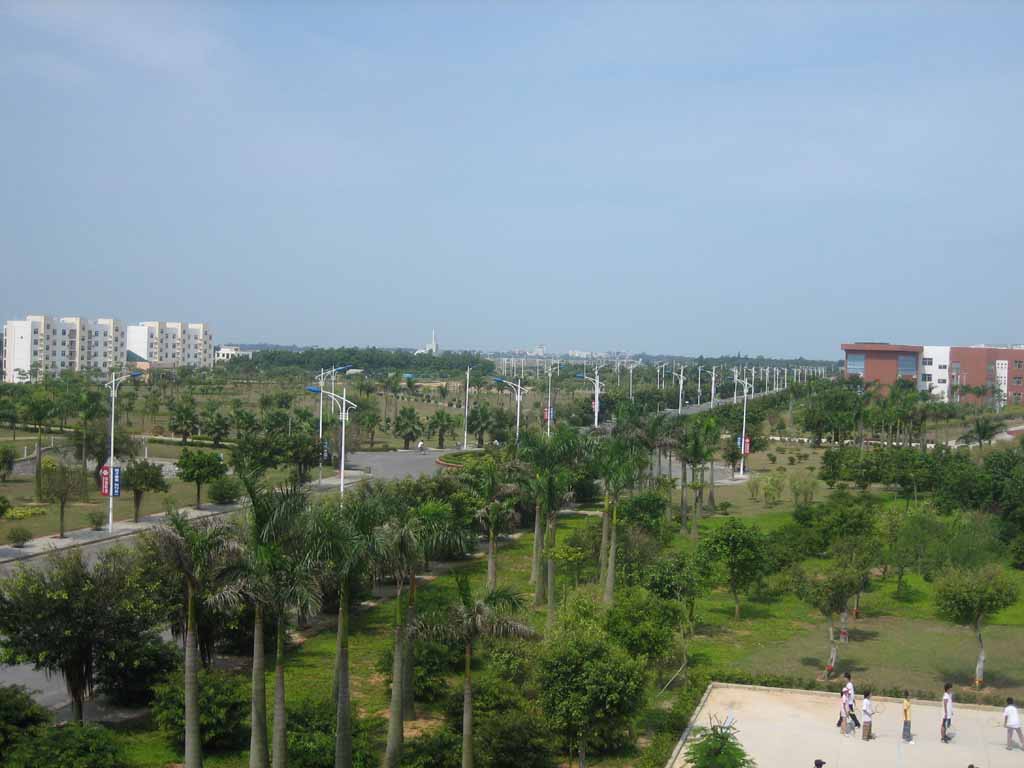 This place is really growing. This my third year here, and the students keep coming. Five hundred the first year, 1800 last year, 2800 this year, and they will probably get another 1000 students in the fall. Creates problems too. They just brought in a new bunch of teachers, so when I came down this time, they didn't have an apartment for me; stuck me in a dormitory with just a bedroom and bathroom--sorta like a hotel room. Nice, but small. Good view of the campus from up here, though.
Well, as a matter of conscience, I couldn't pretend that I cared about the space, 'cause I really don't, but I did make them bring in a washing machine, a water purifier and a little refrigerator. You really need to be able to wash clothes in this hot, sweaty climate. In Beijing I only do laundry once every two weeks. That's partly because the floor lady has two washing machines, and I can use both at the same time. But it's mainly because, for much of the year in Beijing, you don't sweat much. I have to be careful where I put my clothes when I take them off, because I can't tell the dirty ones from the clean ones. This isn't just because I am such a naturally clean person, although I'm sure that has something to do with it. Beijing is just very, very dry.
Can't get by with that here. Wear cotton, and wash it often.
Tuesday, May 27, 2008
I asked the bloke from Perth what he was doing in China.
"I'm retired."
The lady sitting next to him at the bar chided him, "Why you always say, 'I tired?' You never do any work, but you always say, 'I tired, I tired.'"
Monday, May 26, 2008
If you haven't guessed, I am back in Beihai. It's a little hot. Problem is, Beijing is pretty hot right now, too. And Beijing is terrible when it gets hot, because it is socked in, and humid, and the air just sorta hangs there like muck. That's why I have never been through a summer in Beijing. I think Beijing has the best weather in China, except for the summer. Beihai is hotter than Beijing. No question about that. But when you're sitting at an outside table at Tommy's on the Seafood Island in the cool (I use the term loosely) of the day eating a beef and mushroom casserole and feeling a breeze coming off the Gulf, it's not that bad. Evenings in Beihai are OK. I guess what I am saying is that, while I definitely prefer the cool air of North China, if it's going to be hot, then it is better to be by the water. Hot in Beijing is worse than hot in Beihai.
Saturday, May 24, 2008
This afternoon, I rode my bike to the area right south of the old Drum Tower, and Bell Tower--a group of small restaurants and coffee bars on one of the oldest streets in Beijing. This city has so much history! Sadly, much of it is being eaten up by modern development, but fortunately, there is a move to preserve some of it for generations to come. Exactly what "preserve" means remains to be seen, because the old street is not without development--people see the chance to make some money on tourism. Still, this approach is sure better than just tearing everything down.
Monday, May 19, 2008
China has really been arrested by the worst earthquake since the Tangshan quake of 1976. That earthquake was viewed as a portent of cataclysmic events, because both Mao and Zhou En-lai died shortly afterward. Many are wondering what great events this earthquake portends.
Wednesday, May 14, 2008
Tuesday, May 13, 2008
This morning, I turned on the BBC, and heard about the earthquake in Sichuan. So the little tremor felt in Beijing wasn't just a small Beijing quake, it was a very large readjustment on the other side of the country. The biggest problem in rural areas is that buildings are not earthquake proof. In Japan, they put buildings on ball bearings so that they can slide if the earth moves. I think this earthquake may effect a greater move in that direction by China. But the other thing about buildings in China is that they seem to be 100% concrete. Like the one I live in. Man, you better have solid granite bedrock to erect a building that heavy! It's all concrete. Not sure why. I do see a lot of buildings going up now that are basically steel girders with glass window walls in between. But the building I live in is just concrete stacked on concrete. I would really hate to be in that thing if the old earth under Beijing got up and shook itself off.
Sunday, May 11, 2008
Here's what I think. Jude Shao will eventually get out of prison. When he does, he will write his book. Then, the case that was not allowed to be presented in open trial will be tried again in the court of public opinion. Many questions will be addressed. Was he indeed solicited for a bribe by the very officials who were investigating him? If this turns out to be true, China's image before the world will take a hit like no other. There are other cases, of course. Like the infamous betrayal by Yahoo of one of their customers. But that case is different. That guy was trumpeted as a victim because he was sentenced for something that would not have been against the law in the United States. But he wasn't in the United States. What he did was against the law in China, and he knew it was against the law. In the case of Jude Shao, the Wall Street Journal is trying to make the case that he was framed because he refused to be involved in China's rampant corruption. And their statement is supported by the judgement of China's own top legal experts that the case is seriously flawed.
I am not quite ready to start yelling that the sky is falling just because the Wall Street Journal is making that charge. And the title of the article (China's American Prisoner) is a bit misleading. I know, a citizen is a citizen. But we cannot expect the Chinese government to treat a Chinese national who goes abroad long enough to get a passport and then comes back to China and tries to use that passport as a shield for criminal activity (if that is indeed what happened) the same way they would treat an ignorant foreigner who makes a few missteps wading through the process of operating a business in a strange country. Still, if Jude Shao is innocent, China will pay dearly. The only way they can avoid this is to be proactive, and beat him to the punch. They need to go after the auditor who solicited the bribe (if that is indeed what happened) and put him away for a long time. At least give him the same sentence that was meted out to his victim.
Wednesday, May 07, 2008
For the Chinese kids, it sounds like the school is cashing in on the tremendous demand for education in China, much like the University I teach at in Beihai. Don't have the figures for this year, but I remember a couple years ago, there were about 8 million students taking the National Entrance Exam for a chance to get one of 3 million seats. So what about the 5 million students who don't make the grade? In the past, they had to go out into the fields and work in the hot sun. But now, many of them are getting an education, because their parents are willing to pay a premium to send them to a private college. I don't know what the number is--I don't think anybody does, because obviously, among those 5 million students who did not pass the entrance exam, a large number simply would not be able to afford the private college alternative. But a lot of them are figuring out how to do it. It bothers me in a way, because it seems like the private colleges are taking advantage of students who didn't make the grade. But at the same time, they are providing opportunity. But the demand is higher than what they can fill. So it appears that schools outside of China are trying to recruit some of these students. Everybody wants to get into the act. But the approach in Fergus Falls is unique, I think, because it focuses on the cross cultural component, instead of just trying to squeeze Chinese students into an American mold. Mind you, there are plenty of Chinese students who want to be squeezed into an American mold (at least with regard to academics). But there are lots of students who would probably adapt more easily to something that accommodates their limited language proficiency. And at least a few American students are going to get a unique chance to do some immersion language learning in a school designed entirely for the purpose of cross-cultural training. This is one to watch.
Tuesday, May 06, 2008
Sunday, May 04, 2008
It is not unusual to hear Chinese people disparage their own education system. But having worked in both of them, there are some unique advantages to the Chinese system that I would not dispense with so quickly. The Chinese tend to envy the Americans' creativity. And it is true. The Americans have always been strong in that area. But again, their creativity is at the expense of competence in the sciences. Students here comment about the fact that Bill Gates, Steve Jobs and Larry Ellison all dropped out of college to found hugely successful software companies. I remind them that guys like them are able to get by with it because they hire engineers from China and India. An educational system (like the American public school system) that encourages creativity at the expense of competence will suffer from a shortage of skilled professionals.
But there is something more personal (and perhaps a bit selfish) about my concern. It is easier to teach in a situation where admission is so selective. To be sure, I deal with students in every class who are just trying to get by, but at least their ability is strong. Actually, the biggest aptitude problem has to do with language. There are some students in every class who have never taken English very seriously. What I don't have to deal with in Beijing, are students who have paid large amounts of money for a challenge that they just are not up to. Beihai is a different story. Springing up all over China are a whole bevy of schools that are employing the American "everyone should have a try" approach to higher education, and admitting students who normally would not have a chance to go to college because of their entrance scores. As in America, you can see the good and bad in it. I have students in Beihai who are exceptional scholars, but for some reason or other did not do well under the pressure of the National Entrance Exams. But I have other students who make me feel like I am teaching in an American junior high school. The young lady I spoke with this morning feels frustrated because the course of study she is in seems to easy for her. I told her that she needed a new challenge. Since she has a gift for languages, I suggested that she consider learning Japanese.
Saturday, May 03, 2008
 The May holiday has been shortened. The government opened up a couple other holidays during the year, and shortened the May golden week to 3 days. I think the idea was to cut down on the massive crowding on mass transit, especially trains. Not sure what I think about it, because I am afraid the average working people may not be able to see their families as often this way, but the crowding problem is something that had to be addressed. It's not easy, you know, when you have 1.3 billion people to keep happy.
 Thursday, Snow and Fly and I traveled to Fly's home in the country. His folks are farmers--mainly sugar cane. I like the quiet peacefulness of the South China countryside. Not sensational, really, except for the bamboo trees, I guess that's a little unusual, but mainly just peaceful and pretty.
Yesterday I went with Snow to visit with her grandmother. On the way, I saw a big billboard proclaiming Hu Jintao's statement re: development the North Coastal part of Guangxi Province. Hmmm... so all this development really is coming from the top. Orders from headquarters. Not sure what I think of it. I am always reticent about top down development. Better to create an economic environment where development can happen naturally. I can remember another top down development initiative that really worked. Shenzhen. This was Deng Xiao-ping's idea. But Shenzhen was different, because it sits right on the north side of Hong Kong. I mean right on the border. The Chinese were right next to all this wealth and not benefiting from it for no other reason than that it was against their religion. But their religion let them down, so they abandoned the faith and opened the floodgates. Manufacturers in Hong Kong were invited to open factories throughout the Pearl River Delta in a bonanza that increased their profits exponentially. They already had established markets, and had developed a business structure that was managed tightly enough to preserve some measure of profit after expenses. Now they were handed an opportunity to drastically reduce their production costs, and they didn't turn down the invitation. The Hong Kong -- Pearl River alliance became very, very competitive worldwide, and the result was phenomenal development in both Guangzhou and more sensationally, Shenzhen, a small fishing village which exploded into a metropolis of 12 million people.
But Beihai is not Shenzhen. There is no Hong Kong nearby. The development of Beihai seems to be more focused on tourism. Not quite sure if the growth of tourism encouraged by the development will eventually generate enough capital to pay for the investment. And This quiet town will probably never be the same. But I don't hear any of residents of Beihai complaining about all the development money flowing in. It is only reasonable that their wishes be considered before those of people like myself, who stop by from time to time.
Labels: Beihai

