Links
- CV
- Titles
- Topics
- Tickets
- Science
- About Eric
- Book Reviews
- Country Profile
- Modern China
- Contact Eric
- Podcast
- Vision
- Sekai
- John
Archives
RSS

Reflections on a Wandering Life.....
Wednesday, July 30, 2008
 Porters. The porters of Chongqing are a very important part of the history of this unique city. But they are not only part of the history, they are part of the present, and the foreseeable future.
 In Beijing, local deliveries are handled primarily by bicycle cart. They're everywhere. As I mentioned earlier, there are no bicycles in Chongqing. It is really quite impressive to see these porters lugging their burdens up and down the hills as they have been doing for so many decades. The more China changes, the more it remains the same.
Tuesday, July 29, 2008
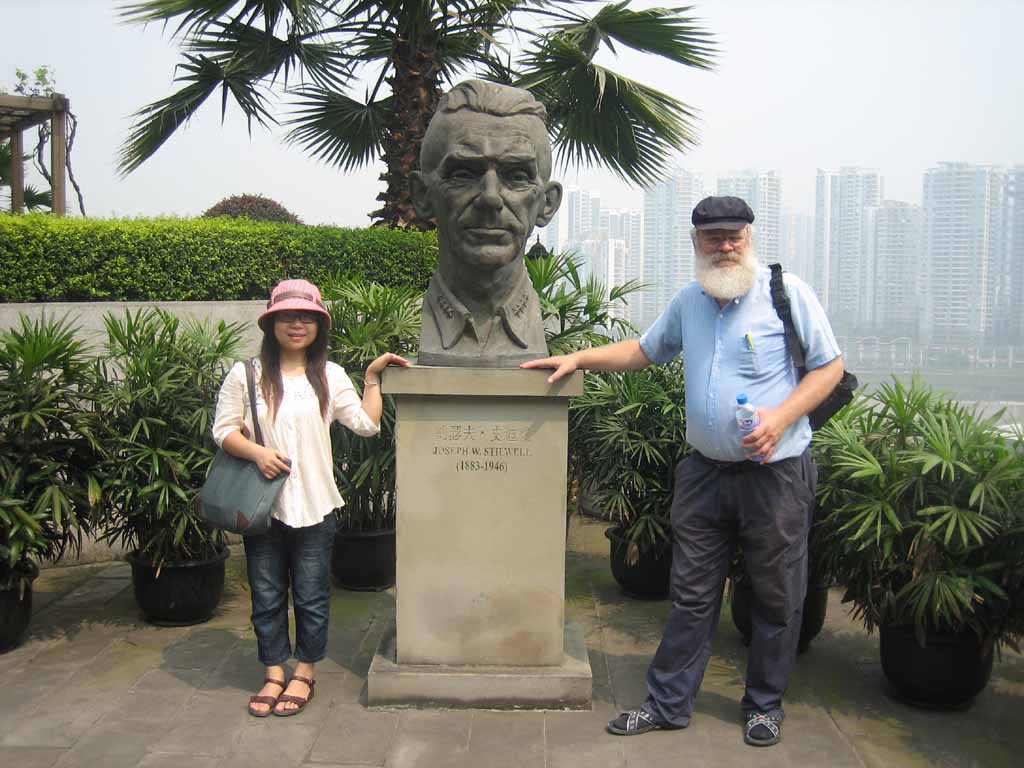
 Visited the Stilwell museum this morning. I had asked Sanni from the youth hostel to help me find it the other day, and she mentioned that she would have the day off today, so I invited her to come with me. I didn't need a translator, because the site is all in English. But it is handy to have someone along who knows the city a bit, and can save me the trouble of figuring out all the transportation routes.
 This museum is really worth seeing. But I say that because of my interest in history. If you aren't much of a history buff, perhaps you wouldn't appreciate it as much as I did. But I still think you should take a look. Most of the information at the museum appears to have been supplied by the US military. I think the main reason China allowed the US military so much latitude is because Stilwell is well known in history as a friend of China. But it's also, I think, because he couldn't stand Chiang Kai-shek, and opposed him very publicly. He wanted Chiang to fight the Japanese. Chiang, of course, wanted to spare his resources for fighting the Communists.
I hadn't realized it until we got to the museum, but there was also a display for the Flying Tigers. The Flying Tigers had their headquarters in Kunming. Not sure why they have a display here in Chongqing, but I would guess it's because Chongqing was the war time capital during the time that the Flying Tigers were fighting the Japanese in the skies over Burma.
Monday, July 28, 2008
 Visited the old SACO site today. Within a short distance of each other, are both the Baigongguan and Zhazidong prisons. Looking through these secret prisons run by the KMT, with "help" from the United States military (the extent of which is a subject of some debate), I was struck by how some issues in history keep coming back to haunt us. Of course, even the nicest prison is not going to seem like a nice place. Lovers of freedom recoil at the sight of any prison, no matter how humane. But these dingy holes were particularly depressing. I met up with some young people who spoke English, and as we were walking through the women's prison, one of them noticed how high the bunk beds were. "How do they get up there?" she wondered. No ladders. I suggested to her that maybe they helped each other, but I had to admit that it did look forbidding for prisoners who may not not be in the best health, and surely weaker than normal. When we entered the men's section, she noticed that the bunk beds there were not quite as high. "Oh, it's unfair!" To say the least. But of course, there is something about the whole situation that seems so very, very unfair. As long as there are wars and rumors of wars, there will always be places like this. But that does not excuse us from the responsibility to be diligent in making sure that prisoners are treated humanely.
 Both prisons had a torture chamber, with chairs where prisoners were forcibly restrained and tortured.
Sunday, July 27, 2008
The Amity Church list identified a church not too far from the Youth Hostel. Turned out to be a Charismatic Three Self Church. Very friendly, animated bunch of people. Better be prepared to do a lot of hand clapping.
Three-Self Churches in China are regulated by the government, but they are actually given quite a bit of latitude, as long as they don't become political. The speaker was a guest from Malaysia, who spoke in Cantonese, but it was translated. Into Mandarin.
I have previously compared Catholic and Protestant services in China. But I could also compare protestant and protestant services. What I mean by that, is that within the "Three-Self" system, there are both traditional and contemporary services, much as there are in the United States. The traditional services follow a pattern that pretty much reflects what church was like in forties and early fifties, before the Communists came to power. The contemporary services follow a worship style that probably came to China from Hong Kong, Malaysia, or Singapore. Or from Chinese folks who have lived in the United States. The worship service in this church is very, very different from what I am used to at my home church in Beijing, which is more traditional. There are one or two things that tend to be similar among Protestants in China, in spite of the differences in style. In the Protestant churches, the people sitting in the pew want to know which chapter and verse the pastor is speaking from, and follow along in their Bibles. But again, the style is very different.
Saturday, July 26, 2008
Chongqing. Took the train from Chengdu yesterday afternoon. One of the first things I noticed as I was riding the bus to the youth hostel...there are no bicycles in Chongqing. I didn't see a single one on the ride from the airport to the youth hostel. Chongqing folks just don't like to ride bikes. There are no laws against riding bikes. And as far as I know, there is not even any license requirement. People just don't want to ride them. I asked the young lady from the youth hostel about this. She said, "There are many cars in the road and it's very dangerous." She has a point.  There are no bicycle lanes in Chongqing. Riding a bike would indeed be much more dangerous in this city than in Beijing, where every road has a bicycle lane. But she is seeing the problem backwards. The reason there are no bicycles is not because there are no bicycle lanes. It's quite the other way round. There are no bicycle lanes because no one wants to ride bicycles. There are also no bicycle repair places. It would be very inconvenient to own a bicycle in Chongqing. But again, same thing. The lack of bicycle repair places is one of the effects, not the cause.
You give up? OK, I'll tell you. It's the hills. Chongqing is very hilly. And we're talking very steep hills. For example, the youth hostel I am staying at has two entrances, one on the first floor, and one on the fifth floor.
This morning, I took the bus to Red Cliff Village. Maybe it should be called "Red Bluff Village." Red Cliff Village housed the Communist Party delegation to the Guomingdang during the Mingguo period when China was ruled by the KMT. When I got there, I thought the place was closed, because there was no one in sight. I made my way to the display, and was asked for a ticket. I had not yet gotten one, because I had not seen any ticket window open. The guy took a ticket out of a desk and gave it to me. They are still going through the process of taking your ticket, but they also supply the ticket for you. I suppose the reason for this is that among modern Chinese people, there aren't that many history buffs.
 They will tell you that Chongqing has cable cars. But they're not really cable cars. They're more like cable buses. I don't even know what the official maximum capacity is, but they can easily hold 20 people. These days, there are several other ways to get across the river (actually two rivers), but it wouldn't be quite right to say that they are just there for "old times sake." There are still lots of people in this part of town who depend on them quite heavily as their way of getting across the great divide. The reason, of course, is that bicycles are impractical, and most people can't afford cars.
 There are no bicycle lanes in Chongqing. Riding a bike would indeed be much more dangerous in this city than in Beijing, where every road has a bicycle lane. But she is seeing the problem backwards. The reason there are no bicycles is not because there are no bicycle lanes. It's quite the other way round. There are no bicycle lanes because no one wants to ride bicycles. There are also no bicycle repair places. It would be very inconvenient to own a bicycle in Chongqing. But again, same thing. The lack of bicycle repair places is one of the effects, not the cause.
 You give up? OK, I'll tell you. It's the hills. Chongqing is very hilly. And we're talking very steep hills. For example, the youth hostel I am staying at has two entrances, one on the first floor, and one on the fifth floor.
This morning, I took the bus to Red Cliff Village. Maybe it should be called "Red Bluff Village." Red Cliff Village housed the Communist Party delegation to the Guomingdang during the Mingguo period when China was ruled by the KMT. When I got there, I thought the place was closed, because there was no one in sight. I made my way to the display, and was asked for a ticket. I had not yet gotten one, because I had not seen any ticket window open. The guy took a ticket out of a desk and gave it to me. They are still going through the process of taking your ticket, but they also supply the ticket for you. I suppose the reason for this is that among modern Chinese people, there aren't that many history buffs.
 They will tell you that Chongqing has cable cars. But they're not really cable cars. They're more like cable buses. I don't even know what the official maximum capacity is, but they can easily hold 20 people. These days, there are several other ways to get across the river (actually two rivers), but it wouldn't be quite right to say that they are just there for "old times sake." There are still lots of people in this part of town who depend on them quite heavily as their way of getting across the great divide. The reason, of course, is that bicycles are impractical, and most people can't afford cars.
Friday, July 25, 2008
Road to Jiuzhaigou
Got back from Jiuzhaigou late yesterday afternoon. As mentioned earlier, I had decided to go to Jiuzhaigou when my train to Chongqing was delayed for almost a day on Monday.
We left Chengdu Tuesday morning just before 9 o'clock. I had been told that the trip would take ten hours, and I was hoping for the best, but also expecting that there might be delays, because a road that has just been opened up after such a severe thing as an earthquake might be, although passable, just barely passable in some places. We did have several delays, but the turned out to be completely unrelated to the earthquake. It was the bus. And the driver. I guess I should blame it partly on the road, because I am sure the driver would if he were asked to explain why he drove into the ditch, but I'm getting ahead of myself.
The first problem was the clutch. It first became obvious when, due to traffic from the other direction on a particularly narrow section of the road, we were forced to stop while going uphill. The driver could not manage to get the bus started again. It was very frustrating, and I was about to go up front and show him how to start on a hill, but I did not know, yet, that at least part of his problem was mechanical. Eventually, he was forced to back up a little before he could finally start the bus. While we were stopped for lunch in a small town, he took the buss to a shop to get it fixed. It turned out to be a temporary job, not a real fix, but more about that later.
 After we had finished eating lunch, which in my case, was a burned ear of corn--it's not just cooked, it's burned black, but it's actually quite good after you get through the char--we got back on the bus and headed out of town. The bus had just switched drivers, and the new guy was going like gangbusters. But I'm not sure I should say that, because it makes it sound like the other drivers don't. Anyway, we came to a curve running pretty close to a sheer rock cliff where the road was particularly narrow. The driver was racing around the corner when he saw a truck coming from the other direction. He should have hit the brakes and let the other guy pass. Instead, he kept going, and then had to swerve to the right to avoid the guy. The back of the bus left the road, and I think he thought he could pull it back on, but the jagged rocks on the wall of the cliff thought differently. BANG! The back of the bus slammed into the side of the mountain. The sharp, jagged shale sticking out from the sheer rock wall tore a mean gash in the side of the bus and shattered two plexi-glass windows. The bus, of course, came to a very sudden stop, and was leaning heavily to the right. No worries about tipping over, though. The mountain wasn't going anywhere.
The drivers called the shop they had just taken the bus to, and a little while later, two guys came driving out of town in a little pickup. When I saw one of them carrying two little jacks over to the bus, I laughed. How in the world were they going to fix this situation with a couple small jacks? But believe it or not, they did. They jacked up the right rear corner of the bus, using the same kind of flat jagged rocks that broke the windows to build a little platform for the right rear tires. They drove the bus off the platform and back on to the road. The passengers boarded the bus and immediately set about the business of knocking out the rest of the glass from the two broken windows, and we were merrily on our way.
After we had finished eating lunch, which in my case, was a burned ear of corn--it's not just cooked, it's burned black, but it's actually quite good after you get through the char--we got back on the bus and headed out of town. The bus had just switched drivers, and the new guy was going like gangbusters. But I'm not sure I should say that, because it makes it sound like the other drivers don't. Anyway, we came to a curve running pretty close to a sheer rock cliff where the road was particularly narrow. The driver was racing around the corner when he saw a truck coming from the other direction. He should have hit the brakes and let the other guy pass. Instead, he kept going, and then had to swerve to the right to avoid the guy. The back of the bus left the road, and I think he thought he could pull it back on, but the jagged rocks on the wall of the cliff thought differently. BANG! The back of the bus slammed into the side of the mountain. The sharp, jagged shale sticking out from the sheer rock wall tore a mean gash in the side of the bus and shattered two plexi-glass windows. The bus, of course, came to a very sudden stop, and was leaning heavily to the right. No worries about tipping over, though. The mountain wasn't going anywhere.
The drivers called the shop they had just taken the bus to, and a little while later, two guys came driving out of town in a little pickup. When I saw one of them carrying two little jacks over to the bus, I laughed. How in the world were they going to fix this situation with a couple small jacks? But believe it or not, they did. They jacked up the right rear corner of the bus, using the same kind of flat jagged rocks that broke the windows to build a little platform for the right rear tires. They drove the bus off the platform and back on to the road. The passengers boarded the bus and immediately set about the business of knocking out the rest of the glass from the two broken windows, and we were merrily on our way.
 Did I say "merrily?" Perhaps it would be better to say, "wearily." You see, the stupid bus still had a bad clutch, and anytime we had to stop for traffic, the bus would stall, and then the driver couldn't get it started again unless it was facing downhill. Level would be OK, too, I guess. But if we were facing uphill, forget it. He had to let the bus slide back until we were on the level. What was supposed to be a ten hour trip dragged on for an extra three hours, what with the crash and everything.
Finally, we got to the bus stop in Jiuzhaigou, where I was inundated by the typical hucksters offering me a place to stay. I never go anywhere unless I already know where I am going to stay, so I just told them all a bunch of times that I wasn't interested. When I could get the hucksters out of my face, I called the lady at the hostel, and she sent her driver.
I actually like that little "Roots" Guest house. Forty kuai for a small room. That's alright. I was tired, so I went to bed. I wanted to get an early start, but I knew it wouldn't be as early as I had hoped, because the day had been so long, and nothing is gained by getting up at the crack of dawn and then being tired and cranky all day. Might as well get a good sleep.
When I made the reservation, I had asked the lady if I could get a bus from there on up to Langmusi in Gansu Province. She had told me that I could. But when I tried to make the arrangement after arriving, she talked to one of the drivers who takes people up there, and he said the police were not allowing any travelers through that area (it's a Tibetan village). Great. That means I have to go all the way back to Chengdu. I was irritated with her for not telling me that in the first place, but I suppose if she had, I would not have come, and I really did want to see Jiuzhaigou.
Jiuzhaigou is a beautiful nature preserve set in the majestic mountains of Sichuan Province. I was told that it usually gets 10,000 to 20,000 visitors a day during the summer time. The day before yesterday, when I was there, I heard there were about a thousand people visiting the park.
Generally, it's a good idea to get there as early as possible, then you can get on a bus, and when it stops, you get off, look around, and then go back and find a bus to get on. This year, since there were so few people, they were just stopping for a few minutes, and then having everyone get back on the same bus they had come on. I decided early in the day to break that rule. The problem, you see, is solitude. The last thing I want to do is just follow a group of people around all day. I wanted solitude. I wanted to be alone with God. So the first time we stopped, I deliberately got lost in the woods. I knew that if I didn't, I would not be ready for the day. I was feeling ornery and irritated, and I needed to settle my spirit. I found an isolated spot, and sat down to hear what God had to say. This is the verse that greeted me when I opened my Bible:
Did I say "merrily?" Perhaps it would be better to say, "wearily." You see, the stupid bus still had a bad clutch, and anytime we had to stop for traffic, the bus would stall, and then the driver couldn't get it started again unless it was facing downhill. Level would be OK, too, I guess. But if we were facing uphill, forget it. He had to let the bus slide back until we were on the level. What was supposed to be a ten hour trip dragged on for an extra three hours, what with the crash and everything.
Finally, we got to the bus stop in Jiuzhaigou, where I was inundated by the typical hucksters offering me a place to stay. I never go anywhere unless I already know where I am going to stay, so I just told them all a bunch of times that I wasn't interested. When I could get the hucksters out of my face, I called the lady at the hostel, and she sent her driver.
I actually like that little "Roots" Guest house. Forty kuai for a small room. That's alright. I was tired, so I went to bed. I wanted to get an early start, but I knew it wouldn't be as early as I had hoped, because the day had been so long, and nothing is gained by getting up at the crack of dawn and then being tired and cranky all day. Might as well get a good sleep.
When I made the reservation, I had asked the lady if I could get a bus from there on up to Langmusi in Gansu Province. She had told me that I could. But when I tried to make the arrangement after arriving, she talked to one of the drivers who takes people up there, and he said the police were not allowing any travelers through that area (it's a Tibetan village). Great. That means I have to go all the way back to Chengdu. I was irritated with her for not telling me that in the first place, but I suppose if she had, I would not have come, and I really did want to see Jiuzhaigou.
Jiuzhaigou is a beautiful nature preserve set in the majestic mountains of Sichuan Province. I was told that it usually gets 10,000 to 20,000 visitors a day during the summer time. The day before yesterday, when I was there, I heard there were about a thousand people visiting the park.
Generally, it's a good idea to get there as early as possible, then you can get on a bus, and when it stops, you get off, look around, and then go back and find a bus to get on. This year, since there were so few people, they were just stopping for a few minutes, and then having everyone get back on the same bus they had come on. I decided early in the day to break that rule. The problem, you see, is solitude. The last thing I want to do is just follow a group of people around all day. I wanted solitude. I wanted to be alone with God. So the first time we stopped, I deliberately got lost in the woods. I knew that if I didn't, I would not be ready for the day. I was feeling ornery and irritated, and I needed to settle my spirit. I found an isolated spot, and sat down to hear what God had to say. This is the verse that greeted me when I opened my Bible:"Did not your father eat and drink and do justice and righteousness? Then it was well with him. He judged the cause of the poor and needy; then it was well. Is this not to know me? says the LORD." (Jeremiah 22:15-16 This is Jeremiah's rebuke to the son of Josiah. Josiah was a good king, who cared for the poor. But his son only cared for making himself wealthy at the expense of the kingdom. The message is clear. You want to know God? Then judge the cause of the poor and needy. You don't want to concern yourself with the needs of the poor? Then forget about knowing God. Knowing God is not what we think. We make it complex and religious. But to God, it is simple and practical.
 But I'll leave the sermon for later. I emerged from the woods to see that my bus had left. But there was another bus with a small private tour. They allowed me to hop a ride since I was alone, and they had an extra seat.
I can't describe the scenery to you. You will just have to come here yourself. And you won't get out of it by telling me about the high prices your travel agent is quoting you for a tour to China. Remember, I don't do tours. I don't believe in them. I travel by myself and use public transportation. It's a lot cheaper, and much better, because you can follow your own schedule, not one prescribed for you. To be sure, you do need to learn a little Mandarin if you want to travel independently in Western China. And, of course, you have to put up with hucksters, wild drivers, and....oh, I don't want to start.
As I said, it's just not possible to describe, in words, the expansive natural beauty of this place. And I can't show it to you, either. The camera that could capture it has not been invented. It's almost a sacrilege to be standing there gasping at the grandeur of God's creation, and then pick up my camera and be forced to zero in on one little tiny square inch of the majestic panorama. It offended me. I felt like throwing my camera in the lake. I was filled with anger and resentment, and I decided not to take any pictures. But I just couldn't resist.
But I'll leave the sermon for later. I emerged from the woods to see that my bus had left. But there was another bus with a small private tour. They allowed me to hop a ride since I was alone, and they had an extra seat.
I can't describe the scenery to you. You will just have to come here yourself. And you won't get out of it by telling me about the high prices your travel agent is quoting you for a tour to China. Remember, I don't do tours. I don't believe in them. I travel by myself and use public transportation. It's a lot cheaper, and much better, because you can follow your own schedule, not one prescribed for you. To be sure, you do need to learn a little Mandarin if you want to travel independently in Western China. And, of course, you have to put up with hucksters, wild drivers, and....oh, I don't want to start.
As I said, it's just not possible to describe, in words, the expansive natural beauty of this place. And I can't show it to you, either. The camera that could capture it has not been invented. It's almost a sacrilege to be standing there gasping at the grandeur of God's creation, and then pick up my camera and be forced to zero in on one little tiny square inch of the majestic panorama. It offended me. I felt like throwing my camera in the lake. I was filled with anger and resentment, and I decided not to take any pictures. But I just couldn't resist.
 Fortunately, it was a very beautiful day. And the park was not crowded, because of the unusual circumstances of this summer. Still, I did hope to do a little hiking on my own at least sometime during the day. I talked with one of the tour guides, and she helped me map out a hike from a drop off point, to a pick up point further down. Solitude. What is it? Gary Kinnamon defines solitude as being alone without being lonely. It's not that easy to find in China, and many Chinese people seem to have resigned themselves to living life without it. But this is not good. Everyone needs some solitude.
Jiuzhaigou is a very pretty place. But isn't really the place to come to if you just want to get close to nature. It's much better, then, to find one of the many mountain villages in Western China, and stay for a few days. But that doesn't mean you shouldn't come here. You should see the place. If you can, try to schedule your trip right after a major earthquake, when the roads have been closed so that it's much harder for the tens of thousands of tourists from all over China to get here. And it wouldn't be a bad idea to arrange for a local uprising, so that the floods of European tourists, who generally flow down from Lanzhou, will be diverted to other places. It's an unusual combination of circumstances, and it made for a much less frenzied experience.
Fortunately, it was a very beautiful day. And the park was not crowded, because of the unusual circumstances of this summer. Still, I did hope to do a little hiking on my own at least sometime during the day. I talked with one of the tour guides, and she helped me map out a hike from a drop off point, to a pick up point further down. Solitude. What is it? Gary Kinnamon defines solitude as being alone without being lonely. It's not that easy to find in China, and many Chinese people seem to have resigned themselves to living life without it. But this is not good. Everyone needs some solitude.
Jiuzhaigou is a very pretty place. But isn't really the place to come to if you just want to get close to nature. It's much better, then, to find one of the many mountain villages in Western China, and stay for a few days. But that doesn't mean you shouldn't come here. You should see the place. If you can, try to schedule your trip right after a major earthquake, when the roads have been closed so that it's much harder for the tens of thousands of tourists from all over China to get here. And it wouldn't be a bad idea to arrange for a local uprising, so that the floods of European tourists, who generally flow down from Lanzhou, will be diverted to other places. It's an unusual combination of circumstances, and it made for a much less frenzied experience.
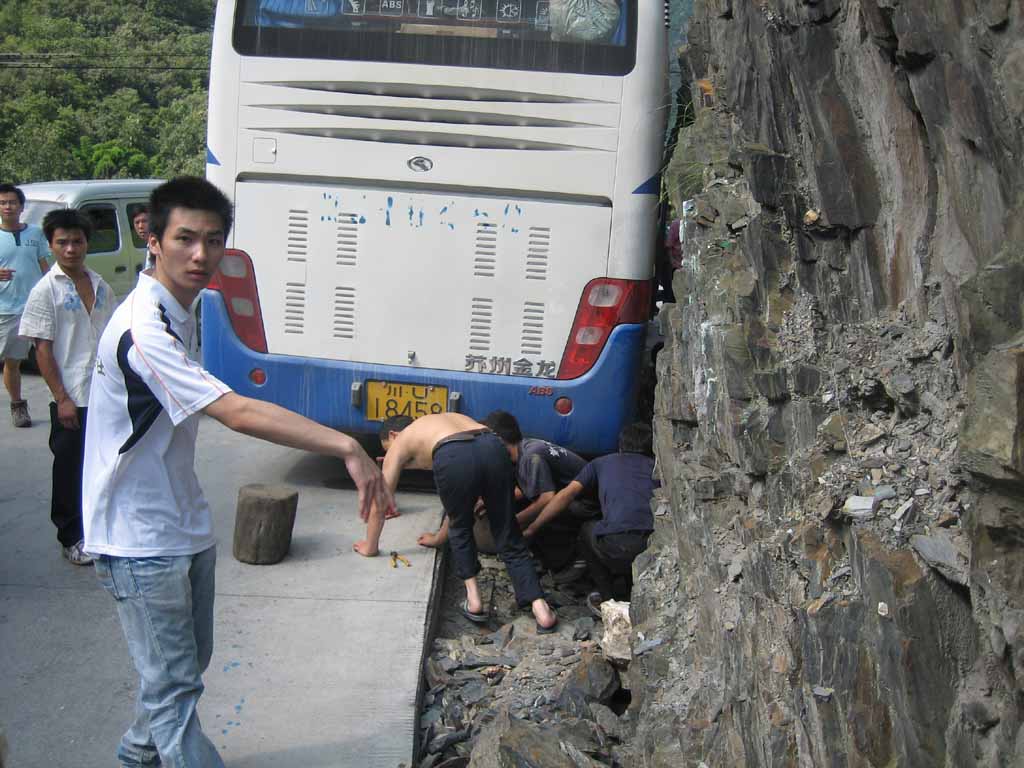 After we had finished eating lunch, which in my case, was a burned ear of corn--it's not just cooked, it's burned black, but it's actually quite good after you get through the char--we got back on the bus and headed out of town. The bus had just switched drivers, and the new guy was going like gangbusters. But I'm not sure I should say that, because it makes it sound like the other drivers don't. Anyway, we came to a curve running pretty close to a sheer rock cliff where the road was particularly narrow. The driver was racing around the corner when he saw a truck coming from the other direction. He should have hit the brakes and let the other guy pass. Instead, he kept going, and then had to swerve to the right to avoid the guy. The back of the bus left the road, and I think he thought he could pull it back on, but the jagged rocks on the wall of the cliff thought differently. BANG! The back of the bus slammed into the side of the mountain. The sharp, jagged shale sticking out from the sheer rock wall tore a mean gash in the side of the bus and shattered two plexi-glass windows. The bus, of course, came to a very sudden stop, and was leaning heavily to the right. No worries about tipping over, though. The mountain wasn't going anywhere.
The drivers called the shop they had just taken the bus to, and a little while later, two guys came driving out of town in a little pickup. When I saw one of them carrying two little jacks over to the bus, I laughed. How in the world were they going to fix this situation with a couple small jacks? But believe it or not, they did. They jacked up the right rear corner of the bus, using the same kind of flat jagged rocks that broke the windows to build a little platform for the right rear tires. They drove the bus off the platform and back on to the road. The passengers boarded the bus and immediately set about the business of knocking out the rest of the glass from the two broken windows, and we were merrily on our way.
After we had finished eating lunch, which in my case, was a burned ear of corn--it's not just cooked, it's burned black, but it's actually quite good after you get through the char--we got back on the bus and headed out of town. The bus had just switched drivers, and the new guy was going like gangbusters. But I'm not sure I should say that, because it makes it sound like the other drivers don't. Anyway, we came to a curve running pretty close to a sheer rock cliff where the road was particularly narrow. The driver was racing around the corner when he saw a truck coming from the other direction. He should have hit the brakes and let the other guy pass. Instead, he kept going, and then had to swerve to the right to avoid the guy. The back of the bus left the road, and I think he thought he could pull it back on, but the jagged rocks on the wall of the cliff thought differently. BANG! The back of the bus slammed into the side of the mountain. The sharp, jagged shale sticking out from the sheer rock wall tore a mean gash in the side of the bus and shattered two plexi-glass windows. The bus, of course, came to a very sudden stop, and was leaning heavily to the right. No worries about tipping over, though. The mountain wasn't going anywhere.
The drivers called the shop they had just taken the bus to, and a little while later, two guys came driving out of town in a little pickup. When I saw one of them carrying two little jacks over to the bus, I laughed. How in the world were they going to fix this situation with a couple small jacks? But believe it or not, they did. They jacked up the right rear corner of the bus, using the same kind of flat jagged rocks that broke the windows to build a little platform for the right rear tires. They drove the bus off the platform and back on to the road. The passengers boarded the bus and immediately set about the business of knocking out the rest of the glass from the two broken windows, and we were merrily on our way.
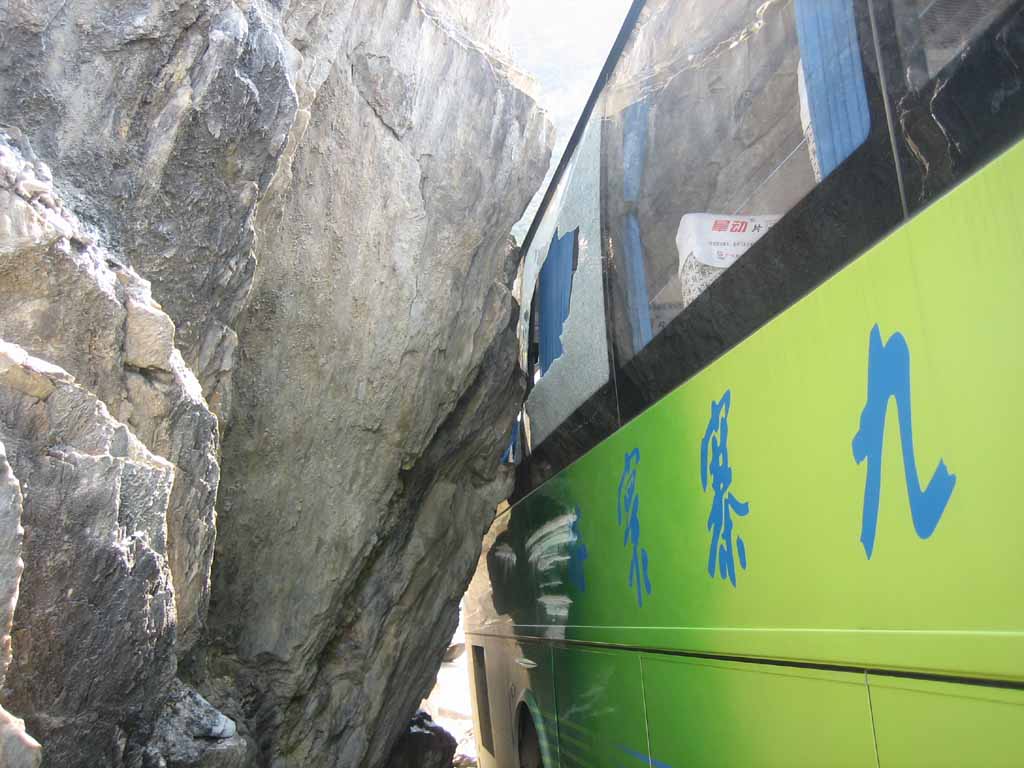 Did I say "merrily?" Perhaps it would be better to say, "wearily." You see, the stupid bus still had a bad clutch, and anytime we had to stop for traffic, the bus would stall, and then the driver couldn't get it started again unless it was facing downhill. Level would be OK, too, I guess. But if we were facing uphill, forget it. He had to let the bus slide back until we were on the level. What was supposed to be a ten hour trip dragged on for an extra three hours, what with the crash and everything.
Finally, we got to the bus stop in Jiuzhaigou, where I was inundated by the typical hucksters offering me a place to stay. I never go anywhere unless I already know where I am going to stay, so I just told them all a bunch of times that I wasn't interested. When I could get the hucksters out of my face, I called the lady at the hostel, and she sent her driver.
I actually like that little "Roots" Guest house. Forty kuai for a small room. That's alright. I was tired, so I went to bed. I wanted to get an early start, but I knew it wouldn't be as early as I had hoped, because the day had been so long, and nothing is gained by getting up at the crack of dawn and then being tired and cranky all day. Might as well get a good sleep.
When I made the reservation, I had asked the lady if I could get a bus from there on up to Langmusi in Gansu Province. She had told me that I could. But when I tried to make the arrangement after arriving, she talked to one of the drivers who takes people up there, and he said the police were not allowing any travelers through that area (it's a Tibetan village). Great. That means I have to go all the way back to Chengdu. I was irritated with her for not telling me that in the first place, but I suppose if she had, I would not have come, and I really did want to see Jiuzhaigou.
Jiuzhaigou is a beautiful nature preserve set in the majestic mountains of Sichuan Province. I was told that it usually gets 10,000 to 20,000 visitors a day during the summer time. The day before yesterday, when I was there, I heard there were about a thousand people visiting the park.
Generally, it's a good idea to get there as early as possible, then you can get on a bus, and when it stops, you get off, look around, and then go back and find a bus to get on. This year, since there were so few people, they were just stopping for a few minutes, and then having everyone get back on the same bus they had come on. I decided early in the day to break that rule. The problem, you see, is solitude. The last thing I want to do is just follow a group of people around all day. I wanted solitude. I wanted to be alone with God. So the first time we stopped, I deliberately got lost in the woods. I knew that if I didn't, I would not be ready for the day. I was feeling ornery and irritated, and I needed to settle my spirit. I found an isolated spot, and sat down to hear what God had to say. This is the verse that greeted me when I opened my Bible:
Did I say "merrily?" Perhaps it would be better to say, "wearily." You see, the stupid bus still had a bad clutch, and anytime we had to stop for traffic, the bus would stall, and then the driver couldn't get it started again unless it was facing downhill. Level would be OK, too, I guess. But if we were facing uphill, forget it. He had to let the bus slide back until we were on the level. What was supposed to be a ten hour trip dragged on for an extra three hours, what with the crash and everything.
Finally, we got to the bus stop in Jiuzhaigou, where I was inundated by the typical hucksters offering me a place to stay. I never go anywhere unless I already know where I am going to stay, so I just told them all a bunch of times that I wasn't interested. When I could get the hucksters out of my face, I called the lady at the hostel, and she sent her driver.
I actually like that little "Roots" Guest house. Forty kuai for a small room. That's alright. I was tired, so I went to bed. I wanted to get an early start, but I knew it wouldn't be as early as I had hoped, because the day had been so long, and nothing is gained by getting up at the crack of dawn and then being tired and cranky all day. Might as well get a good sleep.
When I made the reservation, I had asked the lady if I could get a bus from there on up to Langmusi in Gansu Province. She had told me that I could. But when I tried to make the arrangement after arriving, she talked to one of the drivers who takes people up there, and he said the police were not allowing any travelers through that area (it's a Tibetan village). Great. That means I have to go all the way back to Chengdu. I was irritated with her for not telling me that in the first place, but I suppose if she had, I would not have come, and I really did want to see Jiuzhaigou.
Jiuzhaigou is a beautiful nature preserve set in the majestic mountains of Sichuan Province. I was told that it usually gets 10,000 to 20,000 visitors a day during the summer time. The day before yesterday, when I was there, I heard there were about a thousand people visiting the park.
Generally, it's a good idea to get there as early as possible, then you can get on a bus, and when it stops, you get off, look around, and then go back and find a bus to get on. This year, since there were so few people, they were just stopping for a few minutes, and then having everyone get back on the same bus they had come on. I decided early in the day to break that rule. The problem, you see, is solitude. The last thing I want to do is just follow a group of people around all day. I wanted solitude. I wanted to be alone with God. So the first time we stopped, I deliberately got lost in the woods. I knew that if I didn't, I would not be ready for the day. I was feeling ornery and irritated, and I needed to settle my spirit. I found an isolated spot, and sat down to hear what God had to say. This is the verse that greeted me when I opened my Bible: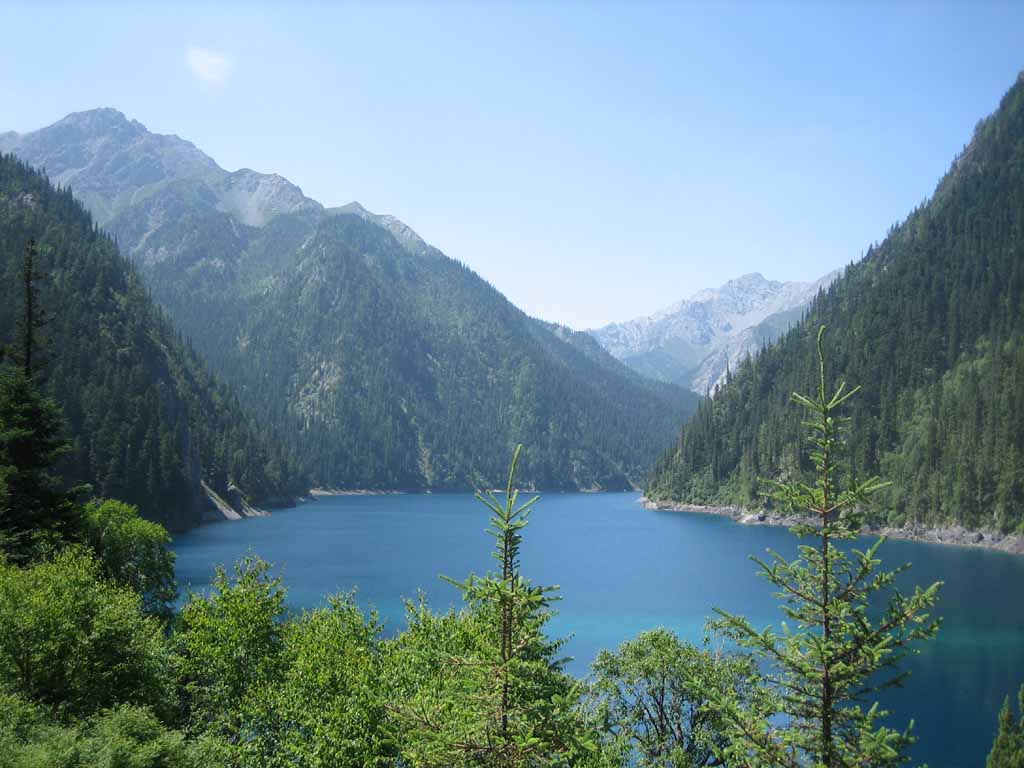 But I'll leave the sermon for later. I emerged from the woods to see that my bus had left. But there was another bus with a small private tour. They allowed me to hop a ride since I was alone, and they had an extra seat.
I can't describe the scenery to you. You will just have to come here yourself. And you won't get out of it by telling me about the high prices your travel agent is quoting you for a tour to China. Remember, I don't do tours. I don't believe in them. I travel by myself and use public transportation. It's a lot cheaper, and much better, because you can follow your own schedule, not one prescribed for you. To be sure, you do need to learn a little Mandarin if you want to travel independently in Western China. And, of course, you have to put up with hucksters, wild drivers, and....oh, I don't want to start.
As I said, it's just not possible to describe, in words, the expansive natural beauty of this place. And I can't show it to you, either. The camera that could capture it has not been invented. It's almost a sacrilege to be standing there gasping at the grandeur of God's creation, and then pick up my camera and be forced to zero in on one little tiny square inch of the majestic panorama. It offended me. I felt like throwing my camera in the lake. I was filled with anger and resentment, and I decided not to take any pictures. But I just couldn't resist.
But I'll leave the sermon for later. I emerged from the woods to see that my bus had left. But there was another bus with a small private tour. They allowed me to hop a ride since I was alone, and they had an extra seat.
I can't describe the scenery to you. You will just have to come here yourself. And you won't get out of it by telling me about the high prices your travel agent is quoting you for a tour to China. Remember, I don't do tours. I don't believe in them. I travel by myself and use public transportation. It's a lot cheaper, and much better, because you can follow your own schedule, not one prescribed for you. To be sure, you do need to learn a little Mandarin if you want to travel independently in Western China. And, of course, you have to put up with hucksters, wild drivers, and....oh, I don't want to start.
As I said, it's just not possible to describe, in words, the expansive natural beauty of this place. And I can't show it to you, either. The camera that could capture it has not been invented. It's almost a sacrilege to be standing there gasping at the grandeur of God's creation, and then pick up my camera and be forced to zero in on one little tiny square inch of the majestic panorama. It offended me. I felt like throwing my camera in the lake. I was filled with anger and resentment, and I decided not to take any pictures. But I just couldn't resist.
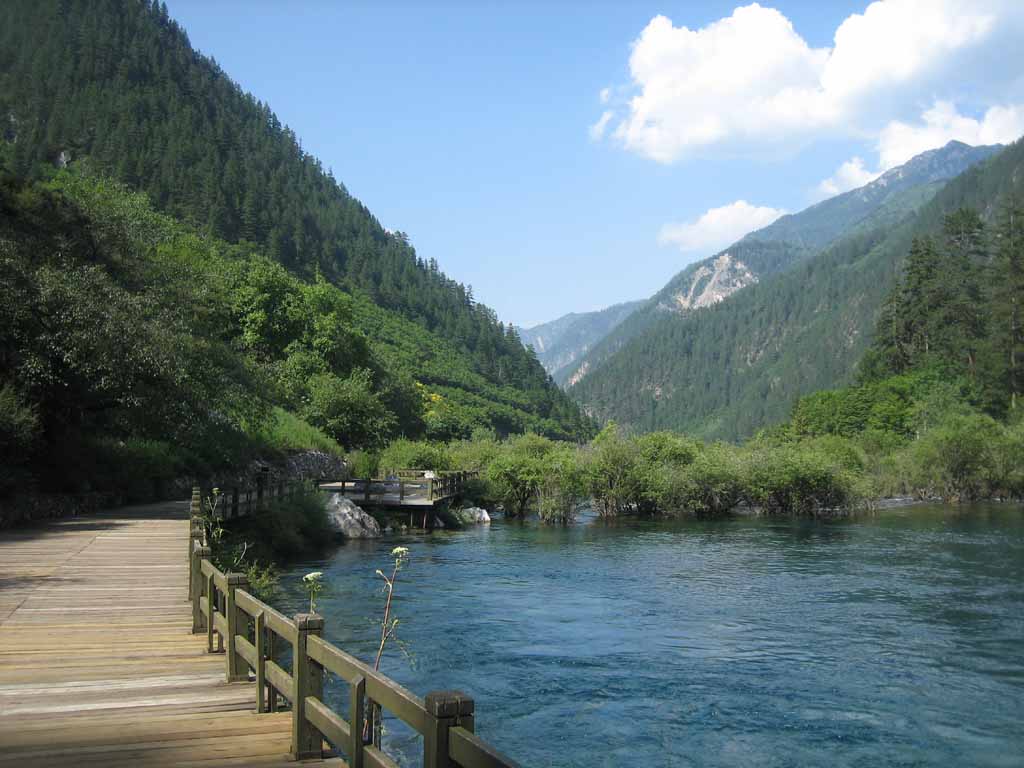 Fortunately, it was a very beautiful day. And the park was not crowded, because of the unusual circumstances of this summer. Still, I did hope to do a little hiking on my own at least sometime during the day. I talked with one of the tour guides, and she helped me map out a hike from a drop off point, to a pick up point further down. Solitude. What is it? Gary Kinnamon defines solitude as being alone without being lonely. It's not that easy to find in China, and many Chinese people seem to have resigned themselves to living life without it. But this is not good. Everyone needs some solitude.
Jiuzhaigou is a very pretty place. But isn't really the place to come to if you just want to get close to nature. It's much better, then, to find one of the many mountain villages in Western China, and stay for a few days. But that doesn't mean you shouldn't come here. You should see the place. If you can, try to schedule your trip right after a major earthquake, when the roads have been closed so that it's much harder for the tens of thousands of tourists from all over China to get here. And it wouldn't be a bad idea to arrange for a local uprising, so that the floods of European tourists, who generally flow down from Lanzhou, will be diverted to other places. It's an unusual combination of circumstances, and it made for a much less frenzied experience.
Fortunately, it was a very beautiful day. And the park was not crowded, because of the unusual circumstances of this summer. Still, I did hope to do a little hiking on my own at least sometime during the day. I talked with one of the tour guides, and she helped me map out a hike from a drop off point, to a pick up point further down. Solitude. What is it? Gary Kinnamon defines solitude as being alone without being lonely. It's not that easy to find in China, and many Chinese people seem to have resigned themselves to living life without it. But this is not good. Everyone needs some solitude.
Jiuzhaigou is a very pretty place. But isn't really the place to come to if you just want to get close to nature. It's much better, then, to find one of the many mountain villages in Western China, and stay for a few days. But that doesn't mean you shouldn't come here. You should see the place. If you can, try to schedule your trip right after a major earthquake, when the roads have been closed so that it's much harder for the tens of thousands of tourists from all over China to get here. And it wouldn't be a bad idea to arrange for a local uprising, so that the floods of European tourists, who generally flow down from Lanzhou, will be diverted to other places. It's an unusual combination of circumstances, and it made for a much less frenzied experience.Labels: Travel Sichuan
Monday, July 21, 2008
Left the youth hostel this morning to catch the morning train to Chongqing. I thought I had time to take the bus to the train station instead of the taxi, but for some reason, the bus just wouldn't come and wouldn't come. Sometimes it works that way. I could picture myself running to catch the train. Finally, I decided to take a taxi, and wouldn't you know it, I couldn't manage to catch one that didn't have passengers. I was reminded of something Clementine Churchill said about her husband: "Winston is a sporting man; he likes to give the train a chance to get away." Well, I don't. I like to be there in plenty of time. Finally, a taxi coming from the other direction spotted me, did a U turn, and pulled over. On the way to the airport, it became quite evident that I would have been late if I had taken the bus. I was glad it hadn't come. But you know what? The train was late. Seems Chonqing is experiencing a torrential downpour that has disrupted travel. That's my luck. The one time I give up and take a taxi, it turns out that I wouldn't have had to. But even though I wouldn't have missed the train if I had waited for the bus, I would have thought I had missed it, and then how would that have affected my behavior?
The time for the train departure kept being pushed back, until finally they announced that the train would be delayed until six o'clock that evening (it was originally due to depart at 11:41). It was at that point that I made a snap decision. You see, that morning I had stopped by Holly's hostel, and found out that the road to Jiuzhaigou was open. I had originally planned to go to Jiuzhaigou and then move on up into Gansu Province, to the area where I was last year. But the road to Jiuzhaigou had been closed since the earthquake, so I had given up on the idea. But now, when it was announced that the train would not be running until this evening, I decided to cancel my trip to Chongqing. Funny, isn't it, how our lives can be so profoundly affected by quick decisions made in the present moment?
I returned to the youth hostel, and got information about how to get to the bus station. I got there in time to purchase a ticket for the next morning, and decided to head down to the south side of town, where the expats hang out, and have my last dinner (in Chengdu). I had intended to go to a regular western restaurant, but I happened to walk by a Tex Mex, place. Another good decision. If you like Chimichangas, let me know, and I'll tell you how to get there.
The time for the train departure kept being pushed back, until finally they announced that the train would be delayed until six o'clock that evening (it was originally due to depart at 11:41). It was at that point that I made a snap decision. You see, that morning I had stopped by Holly's hostel, and found out that the road to Jiuzhaigou was open. I had originally planned to go to Jiuzhaigou and then move on up into Gansu Province, to the area where I was last year. But the road to Jiuzhaigou had been closed since the earthquake, so I had given up on the idea. But now, when it was announced that the train would not be running until this evening, I decided to cancel my trip to Chongqing. Funny, isn't it, how our lives can be so profoundly affected by quick decisions made in the present moment?
I returned to the youth hostel, and got information about how to get to the bus station. I got there in time to purchase a ticket for the next morning, and decided to head down to the south side of town, where the expats hang out, and have my last dinner (in Chengdu). I had intended to go to a regular western restaurant, but I happened to walk by a Tex Mex, place. Another good decision. If you like Chimichangas, let me know, and I'll tell you how to get there.
Sunday, July 20, 2008
When we had dinner last week with Leander on Jinli Street, I had told him that I wanted to meet the young lady who had been so kind to me four years ago when I came through here.
 Leander had put me in touch with her...can't remember...I think she was a classmate of his, or something. Anyway, Leander, of course, was a student in the IC Design program at the Software College in Beijing when I first came to China, so I have known him for almost five years. When he graduated, he returned to Chengdu, which is sorta his home stomping ground, and started a business with an American partner. I found out that he has also changed his English name since I saw him last. He now goes by Joel.
Anita and her husband met us near the gate of the Wuhouci Temple, and we all went to a small, traditional Chinese restaurant. Anita was laughing about the time she took me to a Chongqing hotpot four years ago, and I had told her that she couldn't find anything too spicy for me. She took me up on the deal and led me to what is perhaps the hottest meal I have ever had in my life. We even had to have a special sauce to sorta neutralize the spice a bit. That meal had taken me a couple hours to eat, and by the time I was finished, I had smoke coming out of my ears.
Well, I wasn't in the mood for anything quite so spicy this time. They gave me the menu (as Chinese people often do) and told me to order what I wanted. I had Anita do the honors, and she followed Chairman Mao's prescription (four dishes, one soup).
 Leander had put me in touch with her...can't remember...I think she was a classmate of his, or something. Anyway, Leander, of course, was a student in the IC Design program at the Software College in Beijing when I first came to China, so I have known him for almost five years. When he graduated, he returned to Chengdu, which is sorta his home stomping ground, and started a business with an American partner. I found out that he has also changed his English name since I saw him last. He now goes by Joel.
 Anita and her husband met us near the gate of the Wuhouci Temple, and we all went to a small, traditional Chinese restaurant. Anita was laughing about the time she took me to a Chongqing hotpot four years ago, and I had told her that she couldn't find anything too spicy for me. She took me up on the deal and led me to what is perhaps the hottest meal I have ever had in my life. We even had to have a special sauce to sorta neutralize the spice a bit. That meal had taken me a couple hours to eat, and by the time I was finished, I had smoke coming out of my ears.
Well, I wasn't in the mood for anything quite so spicy this time. They gave me the menu (as Chinese people often do) and told me to order what I wanted. I had Anita do the honors, and she followed Chairman Mao's prescription (four dishes, one soup).
Last night I asked the folks at the youth hostel if they knew of any churches in the neighborhood. I have the Amity Church list, but it's kinda hard to tell just where each of the churches on the list are, and whether or not they are anywhere near the hostel. One of the staff members here told me there was a church nearby, and gave me the name of the bus stop. Turned out to be a Catholic church, not "Jidujiao." I am not Catholic, but the 10 o'clock mass was just getting started, so I decided to stay.
Catholic churches in China are quite traditional, just like protestant churches. Going to church in China is a bit like entering a time warp. The church was more or less frozen in time after the 1949 revolution. American journalists writing about China tend to contrast the established Catholic church (the one that is registered with and sanctioned by the government) as supporting the party, while the underground Catholic church is loyal to the pope. But this is misleading. Although the government regulated church outwardly supports the party, it is quite clear that the laobaixing think of the pope as their "father." As I said, Catholics in China are quite traditional.
Not being Catholic, it is a bit presumptuous for me to compare mass in China with mass in America, because I have only been to mass anywhere a handful of times. But there did seem to be one or two things that were different from what I have seen in the States. Somehow I had forgotten the part where they throw the water on you--thought someone had dropped their water bottle or something. Maybe that's one of those things that is no longer done in American Catholic churches. It wasn't a problem, though, because Chengdu is pretty sultry in the summer. Felt good, actually.
It's probably better for me to focus on the difference between Protestants and Catholics in China, because that is a comparison that I have at least a hope of making. I have mentioned this before, but the Chinese term for "Protestant" is Jidujiao. But Jidujiao doesn't actually mean "Protestant," it means "Christian." So for Chinese folks, it becomes a comparison between "Catholic" and "Christian." That's why, when they express the question in English, they always say, "Are you Catholic or Christian?" American Catholics sometimes bristle at this question.
"Catholics are Christians!"
I understand their pique, but I have to say that I actually prefer the Chinese way of expressing the comparison, because I have never liked the word "protestant." In all the years I lived in America, I refused to use it to define myself. A protestant is someone who "protests." But I am not on a protest against the Catholic church. I have argued with Protestants a lot more than I have with Catholics. I always say, "I am a believer." That distinguishes me from unbelievers, a distinction I can accept. It does not distinguish me from Catholics or Protestants who are also believers, a distinction I could never accept.
That being said, there are some things one notices when attending a Catholic service after going to church every Sunday in a "Protestant" church. Since I am not from a Catholic background, my observations are just that--observations. Perhaps those of you who are Catholics can help me to understand. If nothing else, I would be interested in knowing what you think, especially if you have some familiarity with the Catholic church in China.
The first thing I noticed, was that there were no Bibles. I did see a couple elderly ladies holding some sort of prayer book that may have had scripture portions in it. But most of the people carried only a song book of some kind. No Bible. In the early years of New China, the Bible was basically contraband material. Small numbers of Bibles were smuggled in or copied by hand and passed around. Then, in 1981, Western Christians landed a million Bibles on the coast of South China in an operation that has come to be known as "Project Pearl." This incredible smuggling operation was profoundly embarrassing to the Chinese government, and after this they seemed to lose heart. Gradually, the reins were loosened and the Bible was allowed to be published. When I first came to China, Amity in Nanjing was printing a million Bibles a year. I just heard recently that they have a new press that is gearing up to print one million Bibles a month. Yet, in a congregation of hundreds of people this morning, there was not a Bible in sight. For someone who comes from a background where the Bible is considered a precious book, the impression was quite overwhelming.
In the Three-Self (Protestant) Churches I have attended in China, believers will often get into discussions about some particular Biblical text, and they will discuss the meaning of that text whether or not there is a pastor there to verify their interpretation. Catholic believers would not be able to do this, even if they were allowed to. They don't read the Bible.
The second thing is of a more personal nature. In the Catholic church in China, they don't serve you the wine when you take communion. Didn't stop me from participating, of course. I'll take what I can get. But I have to confess to feeling a little cheated. I'm a sinner; I need the blood.
I lined up with everyone else. As I was returning to my seat, I was filled with a realization of the goodness of God. I don't know what it was, exactly. Perhaps the extraordinary friendliness of these Catholic folks, who can tell that I am not familiar with everything that is going on, and are so helpful in guiding me through the process. Or maybe just the awareness that God is so high above our petty differences. I lifted my hands to God in worship and praise. Then I sat down and partook of his grace. I used that little wafer they give you for the bread, and my water bottle for the wine. Sometimes one has to make do.
Catholic churches in China are quite traditional, just like protestant churches. Going to church in China is a bit like entering a time warp. The church was more or less frozen in time after the 1949 revolution. American journalists writing about China tend to contrast the established Catholic church (the one that is registered with and sanctioned by the government) as supporting the party, while the underground Catholic church is loyal to the pope. But this is misleading. Although the government regulated church outwardly supports the party, it is quite clear that the laobaixing think of the pope as their "father." As I said, Catholics in China are quite traditional.
Not being Catholic, it is a bit presumptuous for me to compare mass in China with mass in America, because I have only been to mass anywhere a handful of times. But there did seem to be one or two things that were different from what I have seen in the States. Somehow I had forgotten the part where they throw the water on you--thought someone had dropped their water bottle or something. Maybe that's one of those things that is no longer done in American Catholic churches. It wasn't a problem, though, because Chengdu is pretty sultry in the summer. Felt good, actually.
It's probably better for me to focus on the difference between Protestants and Catholics in China, because that is a comparison that I have at least a hope of making. I have mentioned this before, but the Chinese term for "Protestant" is Jidujiao. But Jidujiao doesn't actually mean "Protestant," it means "Christian." So for Chinese folks, it becomes a comparison between "Catholic" and "Christian." That's why, when they express the question in English, they always say, "Are you Catholic or Christian?" American Catholics sometimes bristle at this question.
"Catholics are Christians!"
I understand their pique, but I have to say that I actually prefer the Chinese way of expressing the comparison, because I have never liked the word "protestant." In all the years I lived in America, I refused to use it to define myself. A protestant is someone who "protests." But I am not on a protest against the Catholic church. I have argued with Protestants a lot more than I have with Catholics. I always say, "I am a believer." That distinguishes me from unbelievers, a distinction I can accept. It does not distinguish me from Catholics or Protestants who are also believers, a distinction I could never accept.
That being said, there are some things one notices when attending a Catholic service after going to church every Sunday in a "Protestant" church. Since I am not from a Catholic background, my observations are just that--observations. Perhaps those of you who are Catholics can help me to understand. If nothing else, I would be interested in knowing what you think, especially if you have some familiarity with the Catholic church in China.
The first thing I noticed, was that there were no Bibles. I did see a couple elderly ladies holding some sort of prayer book that may have had scripture portions in it. But most of the people carried only a song book of some kind. No Bible. In the early years of New China, the Bible was basically contraband material. Small numbers of Bibles were smuggled in or copied by hand and passed around. Then, in 1981, Western Christians landed a million Bibles on the coast of South China in an operation that has come to be known as "Project Pearl." This incredible smuggling operation was profoundly embarrassing to the Chinese government, and after this they seemed to lose heart. Gradually, the reins were loosened and the Bible was allowed to be published. When I first came to China, Amity in Nanjing was printing a million Bibles a year. I just heard recently that they have a new press that is gearing up to print one million Bibles a month. Yet, in a congregation of hundreds of people this morning, there was not a Bible in sight. For someone who comes from a background where the Bible is considered a precious book, the impression was quite overwhelming.
In the Three-Self (Protestant) Churches I have attended in China, believers will often get into discussions about some particular Biblical text, and they will discuss the meaning of that text whether or not there is a pastor there to verify their interpretation. Catholic believers would not be able to do this, even if they were allowed to. They don't read the Bible.
The second thing is of a more personal nature. In the Catholic church in China, they don't serve you the wine when you take communion. Didn't stop me from participating, of course. I'll take what I can get. But I have to confess to feeling a little cheated. I'm a sinner; I need the blood.
I lined up with everyone else. As I was returning to my seat, I was filled with a realization of the goodness of God. I don't know what it was, exactly. Perhaps the extraordinary friendliness of these Catholic folks, who can tell that I am not familiar with everything that is going on, and are so helpful in guiding me through the process. Or maybe just the awareness that God is so high above our petty differences. I lifted my hands to God in worship and praise. Then I sat down and partook of his grace. I used that little wafer they give you for the bread, and my water bottle for the wine. Sometimes one has to make do.
Saturday, July 19, 2008
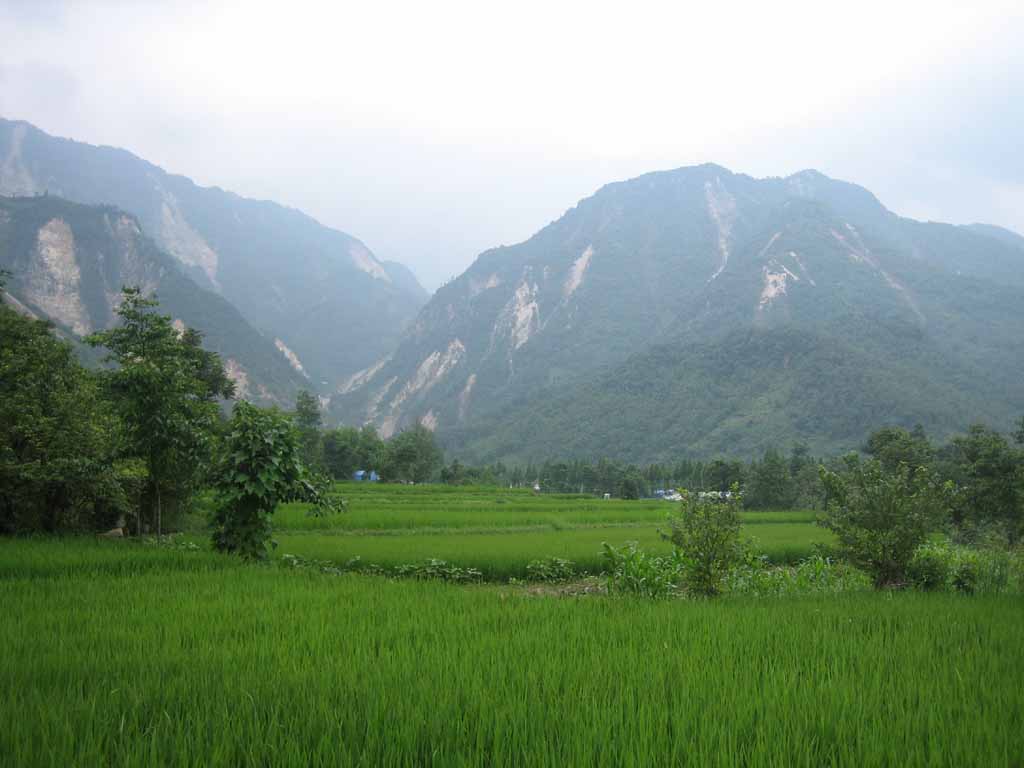 Left the farm behind today, and headed back to Chengdu. So, we trade the misty beauty of the Sichuan countryside for the cities. Hank and Andy will return to Beijing, while I move on to Chongqing.
 It's not easy for me to put all my thoughts together and come up with a simple conclusive statement about what I have seen over the past two weeks. But I do have a couple observations.
First of all, there is the matter of construction standards. I have already mentioned the contrast between the dormitory and the teaching building at Beichuan Middle School. The dormitory looked perfect, and the teaching building right next to it was a heap of rubble. No structure whatsoever. Now, I was there some time after the quake, so it's possible that there was some structure remaining that was knocked down for safety purposes. Whatever the case may be, the difference between the two buildings, and the way they were affected by the quake clearly shows a need for construction standards that give some consideration to siesmic load. Japan has shown the world that buildings can be built to greatly minimize casualty in an earthquake.
The other thing this earthquake exposed is the desperate need for a mature NGO (Non-governmental Organization) structure in this country. Right now, it is very hard to set up an NGO in China. The government seems to believe that it is "safer" (politically, of course) for them to handle everything themselves. But the group of Christians I worked with in Beichuan demonstrated how much can be accomplished by a few kind people who are willing to give of their time to help people who's lives have been horribly disrupted.
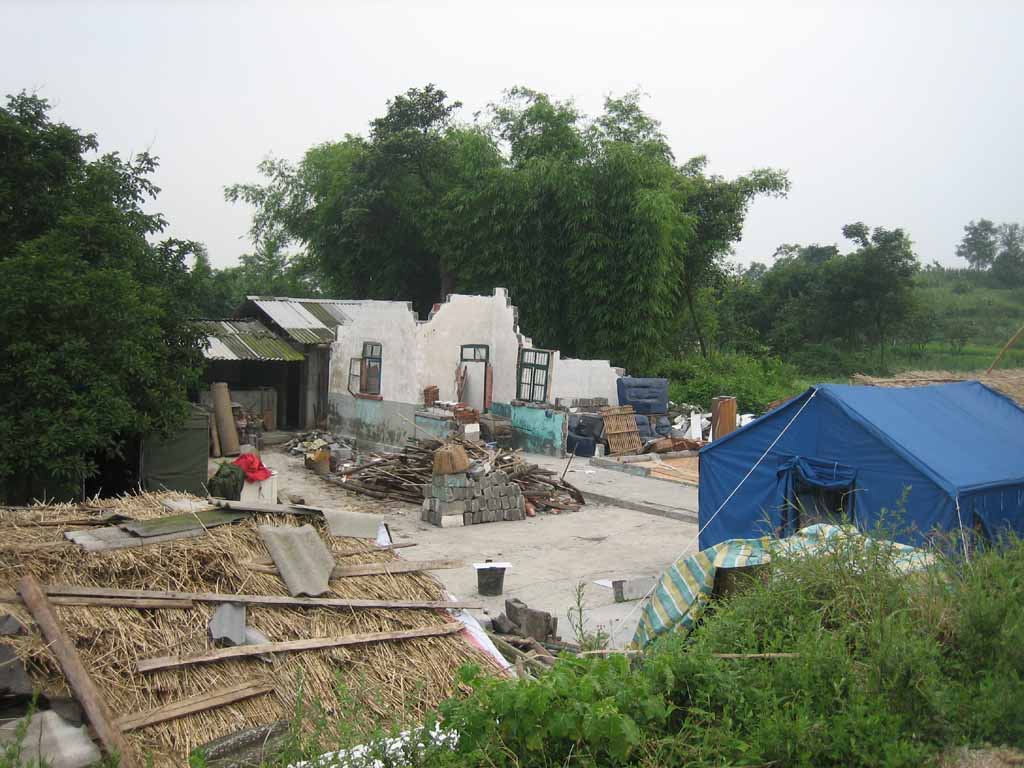 Picture a lady sitting in her living room. No walls. No roof. Just the floor. But it is her home, and she doesn't want to leave it. The government is building thousands of small, prefab houses for the earthquake victims. Nothing fancy, but I have seen these structures, and they are very good as temporary shelter. But the folks I met don't want to be moved to a prefab neighborhood. They want to stay in their homes. A more fully developed NGO structure would make this possible for at least some of them. Imagine being able to mobilize hundreds of volunteers to help local people put their houses back together.
 The day before the horrible tragedy in Beichuan, one of the teachers took these pictures of a school activity. It's hard to look at the faces of these happy young people, and know what they could never know--that 24 hours later, most of them would be dead. It's a tragedy too immense to comprehend. Many are quick to place blame. But in my opinion, this should not be the focus. Such an awesome tragedy should call all of us to consider what can be done both to prevent this kind of thing from happening again, and what can be done to harness the willingness of would-be volunteers through independent NGO's
Friday, July 18, 2008
 We returned to the tent school this morning. The students running the school had asked me to visit a couple classes I had not had a chance to speak to. I also returned to the English class. A few days ago, I had heard Andy singing "Take Me to Your Heart," a song popularized in China by an English-speaking Danish rock group. I don't know if this song is heard much in the States, but it is a big hit in China. I asked Andy to write down the words, and we taught them to the kids.
 I cannot say enough good about the energetic young people who gave up their summer to teach this school for the children of the earthquake. You know, it's a lot of work teaching these lively kids. But they are a lot of fun. When I visited a class of primary age kids, I was saying things to them in Mandarin, and asking them how to say those things in their local Sichuan dialect. Actually, I don't know whether a linguist would consider Sichuan-hua a different dialect.
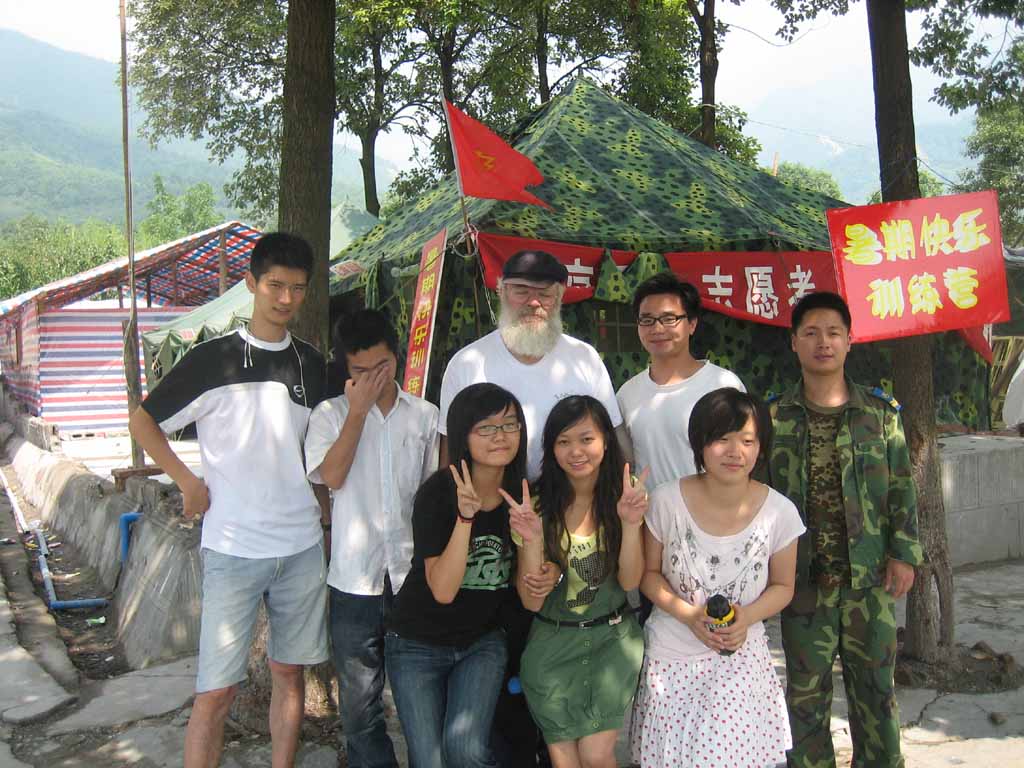 Deng Xiao-ping was from Sichuan, and he spoke with a heavy Sichuan accent, but people in the rest of China seemed to be able to understand him. Whatever the case may be, it was sure funny watching these kids trying to teach me how to speak like a native.
 We finished our work at the tent school at noon, so we decided to stop at another school. We stopped by unannounced at a location where some volunteers from Chengdu University had been running a summer school. The summer school had been disbanded, partly due to the heat, and partly due to the fact that the regular school year this year has been moved back because of the earthquake, so the kids will be back in their regular school the first of August. But when we talked with them, they asked us to stay, and they went outside and rounded up all the kids they could find. I asked one of the student volunteers to translate for me, and then presented the students with a simple question: "What is your dream?" It was interesting to listen to some of their answers.
"I want to be a doctor."
"I want to be a teacher."
"I want to be an engineer."
Toward the end of my presentation, I stopped at the desk of one young lady, and put the question to her. She said, "I want to go to Chengdu University so I can be like her (pointing to my interpreter) and understand what you are saying." I thought, "This is the smartest kid in here." It's easy to throw out the name of a profession you have heard about, or something you imagine will put you in a good position in society. But that young lady has found a practical reason to get a good education.
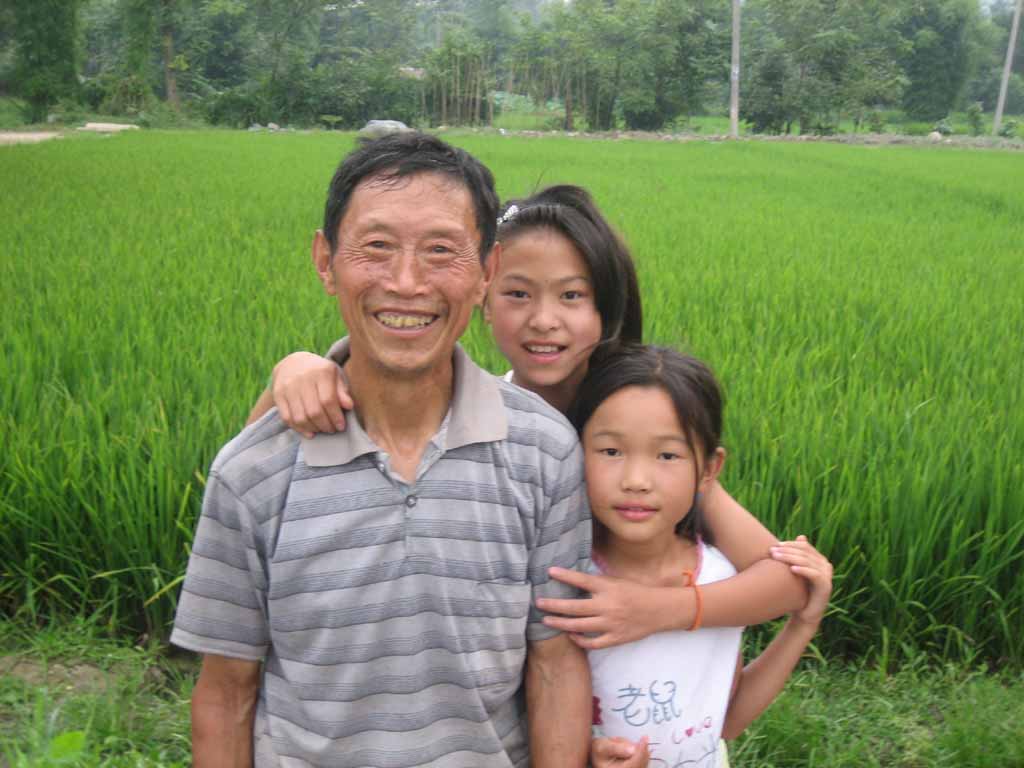 She saw me walk in as a complete stranger, and one of her teachers was able to immediately begin translating what I was saying to that everyone could understand. That kid is destined for success.
This is our last evening on the farm. Tomorrow we head back to Chengdu, and then Andy and Hank will be leaving for Beijing. The hospitality of these country people has been a huge help to us. As we were walking down the road outside the farm this evening, I heard a truck coming. It sounded like a very big truck and it sounded like it was coming very quickly. I was surprised, because I couldn't figure out why such a big vehicle would be racing toward us at that time of the evening. But Xiao Hong told me it was a landslide in the mountains. It is going to take awhile for these hills to heal, but as the seasons come and go, the vegetation will slowly cover the scars, and the mountains will stop bleeding. Nature has a way of healing her wounds, albeit ever so slowly.
Thursday, July 17, 2008
Hanwang. It's not easy to describe life in the tent city, because it's quite unlike anything you have experienced. Not really sure what kind of shower facilities they have, but it cannot be very comfortable.  Fortunately, though, the earthquake took place during a time of the year when people who have lost their homes are not going to freeze to death. It doesn't get that cold in Sichuan in the summer time, so sleeping in a tent is not life threatening in that sense. But it really is not a very convenient life. It amazes me to see how cheerful people can be in the middle of a situation that is so trying.
Life goes on. I took this picture of the beauty parlor during the lunch break, so there no customers, but this place actually keeps pretty busy. All through the earthquake zone, you will see people going on with their lives. Side walk markets are pretty common in China anyway, so when the earthquake wiped out local businesses, they just moved to the streets. Of course, in every area, there are some buildings that don't seem to be affected that much. Then there are others you would expect to be stronger, that just don't make it, such as the Bank of China in Mianzhu, which is a pile of rubble on which are standing four wreaths for the four bank employees who were unable to get out of the falling building.
The tent school in Hanwang is a pretty impressive project set up by university students and the army. The PLA officers are real gentlemen. They salute and then they shake hands. The teachers are a bunch of energetic university students who have dedicated their summers to teaching students from the earthquake zone who have had their education disrupted. The English teacher is a student from Oxford who is home for the summer. He took me in his car and showed me around the area, then invited me to come back for the afternoon English class. He wanted me to speak to the students about the importance of learning English. Students in China are required to learn English, but they display varying levels of proficiency. This is because some students learn only the minimum level of grammar needed to pass the tests, while others are very serious about communicating. When I meet students who have a high level of English proficiency, I always ask them how they learned English. Invariably, they will tell me that they started listening to the Voice of America when they were in middle school. The Voice of America has special programs for learning English. The VOA web site is blocked, but short wave radios are not expensive. I asked the English teacher when he started learning English. He told me that his father bought a subscription to HBO when he was young, so he grew up watching American movies.
After school was out, we returned to the farm to get ready for the evening meal. The peaceful countryside is such a welcome relief from the chaos that afflicts the town. But all around are reminders of the so recent disaster. A sweet neighbor lady sitting in her living room on a summer evening. No walls. No roof. Just the floor and her chair. This quiet countryside really is quite pretty. Looking out over the rice fields, you can't imagine that there was an earthquake here. But if you look up toward the mountains, you can see the massive landslides that indicate something quite drastic has happened. It will take time, but the earth will heal itself.
 Fortunately, though, the earthquake took place during a time of the year when people who have lost their homes are not going to freeze to death. It doesn't get that cold in Sichuan in the summer time, so sleeping in a tent is not life threatening in that sense. But it really is not a very convenient life. It amazes me to see how cheerful people can be in the middle of a situation that is so trying.
 Life goes on. I took this picture of the beauty parlor during the lunch break, so there no customers, but this place actually keeps pretty busy. All through the earthquake zone, you will see people going on with their lives.
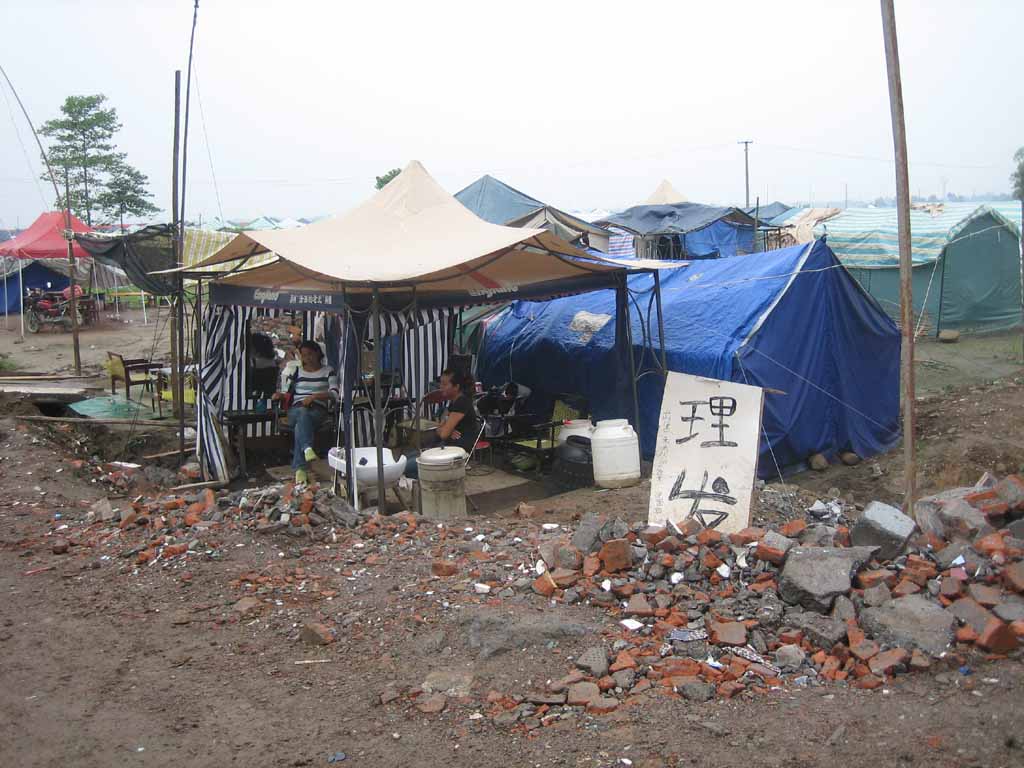 Side walk markets are pretty common in China anyway, so when the earthquake wiped out local businesses, they just moved to the streets. Of course, in every area, there are some buildings that don't seem to be affected that much. Then there are others you would expect to be stronger, that just don't make it, such as the Bank of China in Mianzhu, which is a pile of rubble on which are standing four wreaths for the four bank employees who were unable to get out of the falling building.
 The tent school in Hanwang is a pretty impressive project set up by university students and the army. The PLA officers are real gentlemen. They salute and then they shake hands. The teachers are a bunch of energetic university students who have dedicated their summers to teaching students from the earthquake zone who have had their education disrupted. The English teacher is a student from Oxford who is home for the summer.
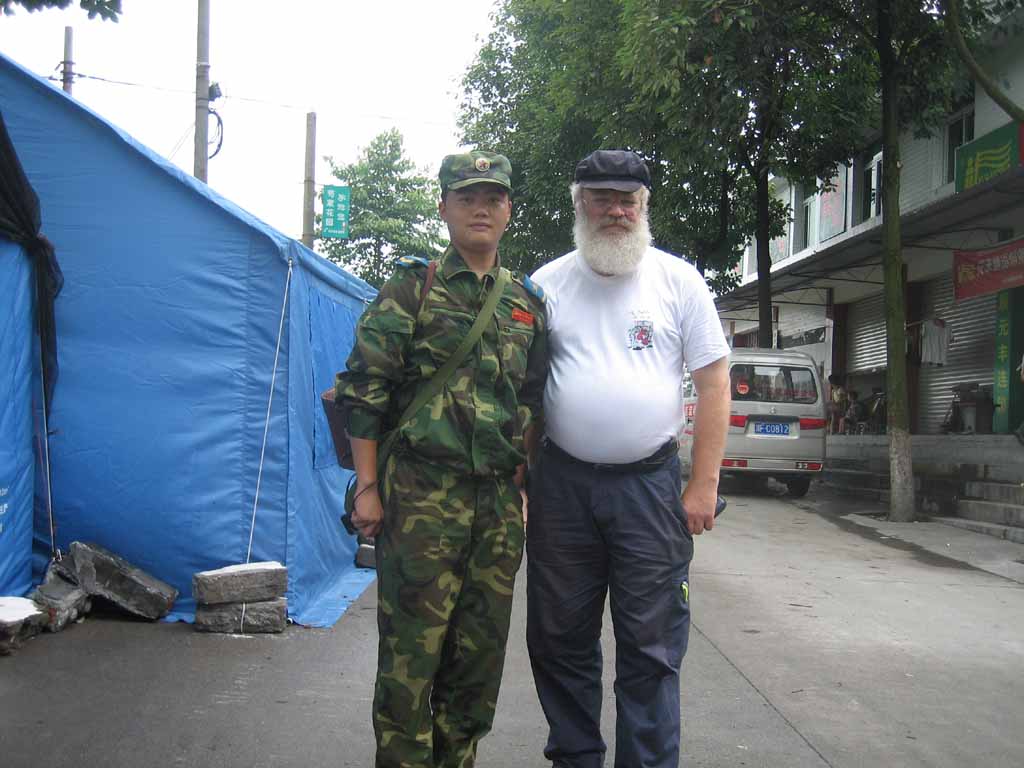 He took me in his car and showed me around the area, then invited me to come back for the afternoon English class. He wanted me to speak to the students about the importance of learning English. Students in China are required to learn English, but they display varying levels of proficiency. This is because some students learn only the minimum level of grammar needed to pass the tests, while others are very serious about communicating. When I meet students who have a high level of English proficiency, I always ask them how they learned English. Invariably, they will tell me that they started listening to the Voice of America when they were in middle school. The Voice of America has special programs for learning English. The VOA web site is blocked, but short wave radios are not expensive. I asked the English teacher when he started learning English. He told me that his father bought a subscription to HBO when he was young, so he grew up watching American movies.
 After school was out, we returned to the farm to get ready for the evening meal. The peaceful countryside is such a welcome relief from the chaos that afflicts the town. But all around are reminders of the so recent disaster.
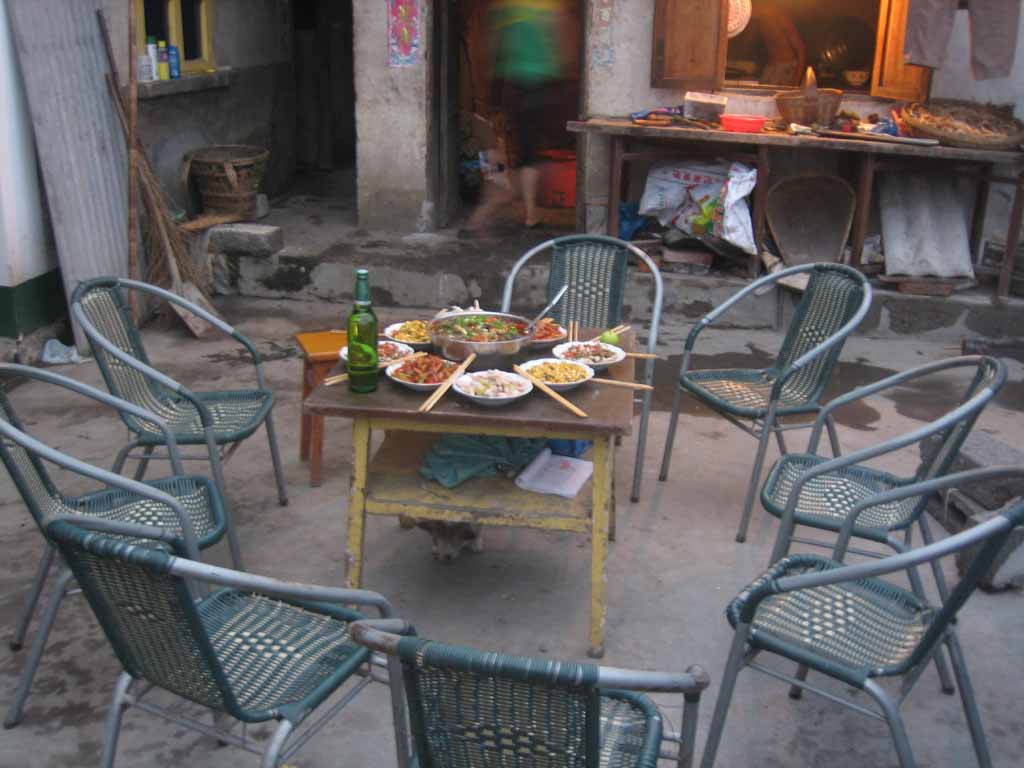 A sweet neighbor lady sitting in her living room on a summer evening. No walls. No roof. Just the floor and her chair. This quiet countryside really is quite pretty. Looking out over the rice fields, you can't imagine that there was an earthquake here. But if you look up toward the mountains, you can see the massive landslides that indicate something quite drastic has happened. It will take time, but the earth will heal itself.
Wednesday, July 16, 2008
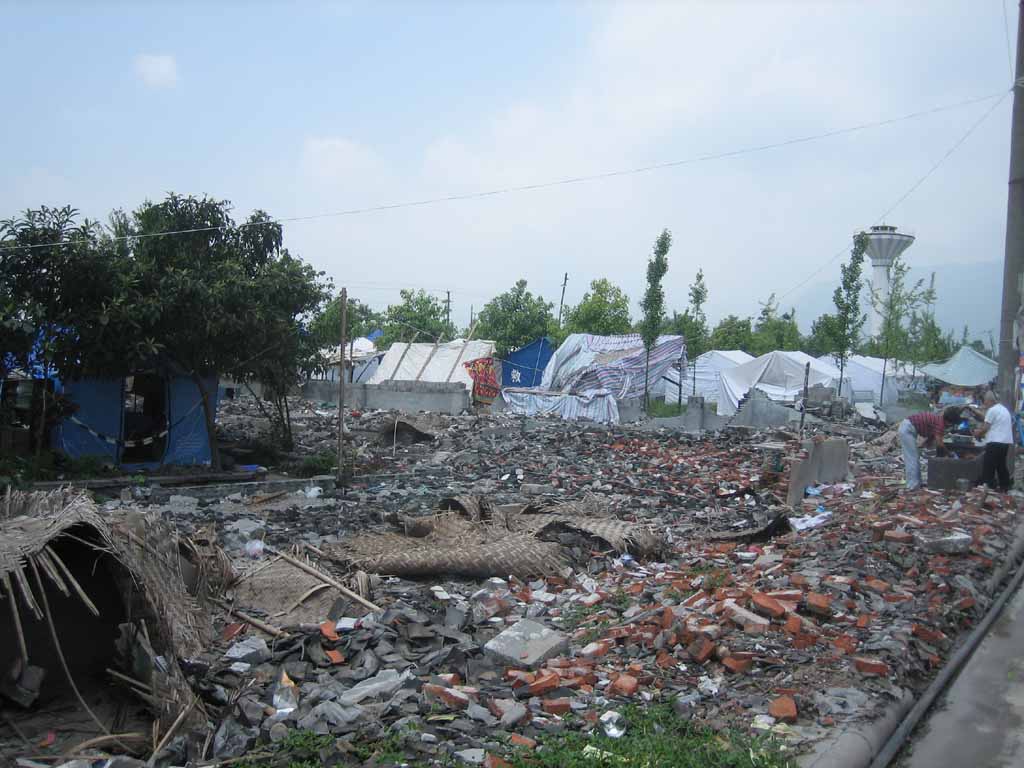 This morning we boarded the bus for Mianzhu. We arrived about noon, and Xiao Hong took us to her brother's farm, where we are going to be staying while we are here. The farmers served us a big lunch and we retired for an afternoon nap.
 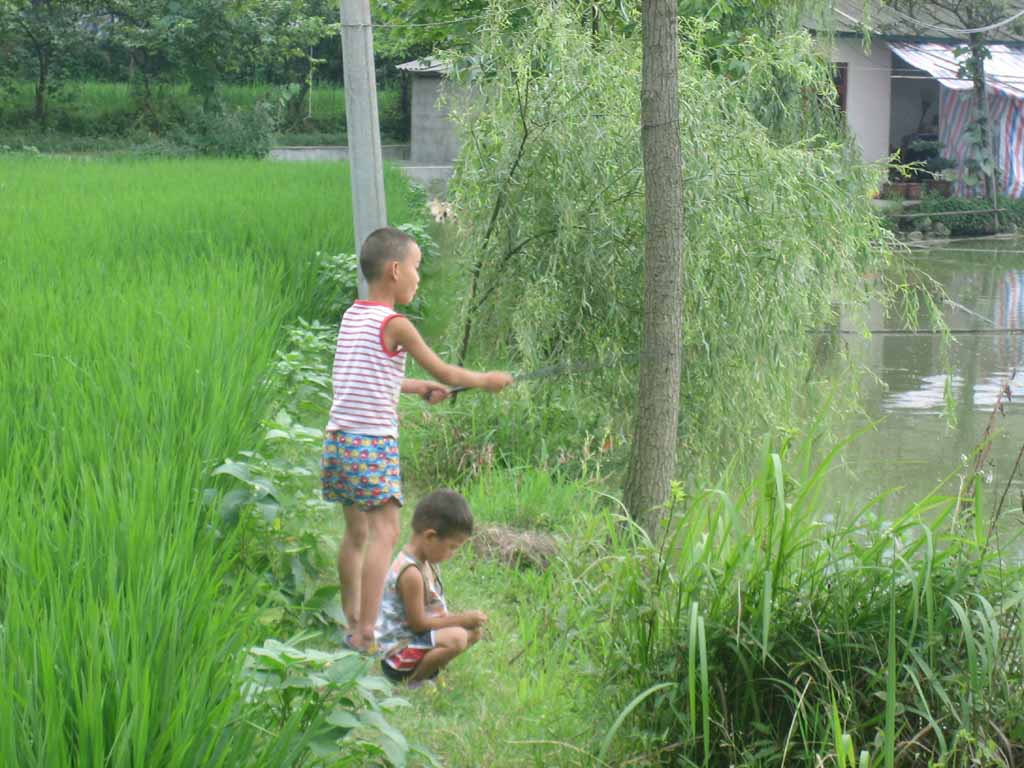 We are really lucky to be able to stay on a farm, because the only other option would be to squeeze into a tent in the tent city in Hanwang. It really is a tough, inconvenient life for many of those folks. Here on the farm, although there has been some damage, life goes on as usual. I think that's partly because most of the structures on this particular farm were either built or remodeled in the last few years. They are not "rich" buildings. But they are sturdy and well constructed.
Tuesday, July 15, 2008
We were going to leave for Mianzhu this morning, but we woke to a driving rain. Hank asked me what I thought, and I said, "Let's wait one more day. I really didn't want to go up to that devastated area in the mud. The sun came out after noon, so if we are lucky, tomorrow will be quite a bit dryer than this morning.
There remains one single duty. It is to keep one's gaze fixed on the master one has chosen and to be constantly listening so as to understand and hear and immediately obey his will. Nothing so well illustrates this condition as that of a servant whose sole duty lies in obeying instantly whatever orders his master may give him, and not employing his time on his own affairs, which he must put aside in order to be to his master all things at all times.
That's it. Immediate response to God's will for each moment. Ready to drop what we are doing to make God's irritating interruptions our top priority. I have always believed that poor planning can be costly in terms of wasted time and money spent trying to compensate for lack of preparation. But I am learning that even when we do plan thoroughly, sometimes God changes our plans. How do we respond when this happens? The mystic is saying that we should "put our own affairs aside." This implies that we each have an agenda that differs from God's purpose. One would think that the longer we walk with God, the less this should be true, but I suppose that, in one sense, it doesn't matter. What does matter is our willingness to put our agenda aside in favor of His. I think we all believe this in the larger sense. But it is the present moment that I struggle with. This is what I want to learn. To know, in each moment, what is God's highest priority.
Jinli Street. It's billed as an old street, but, of course, it is a very new street featuring an "old China" motif. Kinda nice , though, on a summer evening, to stroll through the area, grab some semi-traditional dishes, and watch the puppet show (last half of the video). Chengdu is known in China for having a "laid back" environment. Does this mean that Chengdu folks are lazy? No, I don't think so. I have seen neighborhood folks playing mahjong in the alleys in many parts of China. But this is definitely not Hong Kong. Chengdu is just not a fast-paced, trendy place. Places like Jinli Street are not really that revolutionary. They just allow Chengdu people to do what they have always been doing in a smaller area.
It's hard to give you the feel of a Chengdu summer. You sorta have to come here. And when you get tired of walking around, there will be an air conditioned Starbuck's waiting for you. Some in China decry this mixture of old and new. But Chengdu is known for the Sichuan hotpot, which everybody thinks of as a traditional dish, but which was actually developed by longshoremen in Chongqing in the first half of the 20th Century. So new ways of expressing an old lifestyle are not always bad. Sometimes a balance of old and new can be nice, as long as it doesn't get too touristy. Don't worry. There are still plenty of old neighborhoods here, too. China is changing. There are many new places and new businesses and new things being tried. But there is only one Chengdu.
Monday, July 14, 2008
We left Beichuan this morning in a driving rain. The road had been blocked or something, so we had to hike down the hill to meet the van. We walked past the dormitory, around the back end, and over the heap of rubble that used to be Beichuan Middle School. The contrast between the teaching building and the dormitory could not be more stark. The dormitory buildings seem to be in good condition. But the classroom building is literally reduced to rubble. It looks like one of those demolition projects, where they blow up the building and set the charges just right, so that everything falls into the basement. Of course it is just one example of something you see over and over again in the earthquake zone. One building standing--the building right next to it completely demolished. Generally the one that remains standing is a newer building, and the one that is demolished is old and made from cheap materials.
 It's hard to leave these precious kids behind. In spite of everything they have been through, they are quite cheerful. But what can I do for them? This is the third summer that I have taught children in the countryside. Every time I do this, I try to give kids some new things to think about--some little insight into the world outside. Really, I am trying to help them see the world through my eyes. Kids often like to try on my glasses to see what the world looks like through my eyes. But my glasses don't fit them. In truth, they can never really see the world through my eyes, because they simply do not have my perspective. But perhaps I can give them some measure of it. And I can also try to see the world through their eyes. It takes a lot of patience to see the world through another person's eyes. A lot of listening. When I first started going to the English Corner at Renmin University in Beijing, I remember feeling frustrated, because so many Chinese young people, although they may be very intelligent, have a relatively limited view of the outside world, because the news they read is filtered. But I have discovered over the years that they are frustrated too. "You're a foreigner; you don't understand." When an argument gets particularly heated, I have learned to say, "What do you think?" or "How do you feel about this?"
I came here to teach. But teaching is very educational. I have learned. I have learned that no matter how great the tragedy, people do bounce back. I have learned that sometimes the way you help people is as important as the help itself. The government is promising to have temporary shelters built for every family, and that's important. But these country folks don't want to go to some temporary shelter. They want to stay in their homes. As much as possible, we should try to help them build their unique lives so as to help them stay in these beautiful surroundings, rather than being scrunched into a sterile prefab neighborhood. Wouldn't it be wonderful if hundreds of young people could be enlisted to help these folks rebuild their own homes? I have learned that sometimes you don't have time to wait until you can put together a sophisticated organization. Just do it. That's what these Christians have done, and the local folks appreciate them so much for it.
I am back in Chengdu now. Sitting here at Starbuck's feeling clean and refreshed after a hot shower, it is easy to be philosophical. Perhaps I should not be too hasty in drawing conclusions, but I hate reading headlines like this one:
"Beichuan to be laid to rest as China moves survivors to new settlement."
And the first line really upsets me: "The town hit hardest by China’s earthquake, will never live again."
I don't believe it. Mark my word, people. Beichuan will rise again. You just watch.
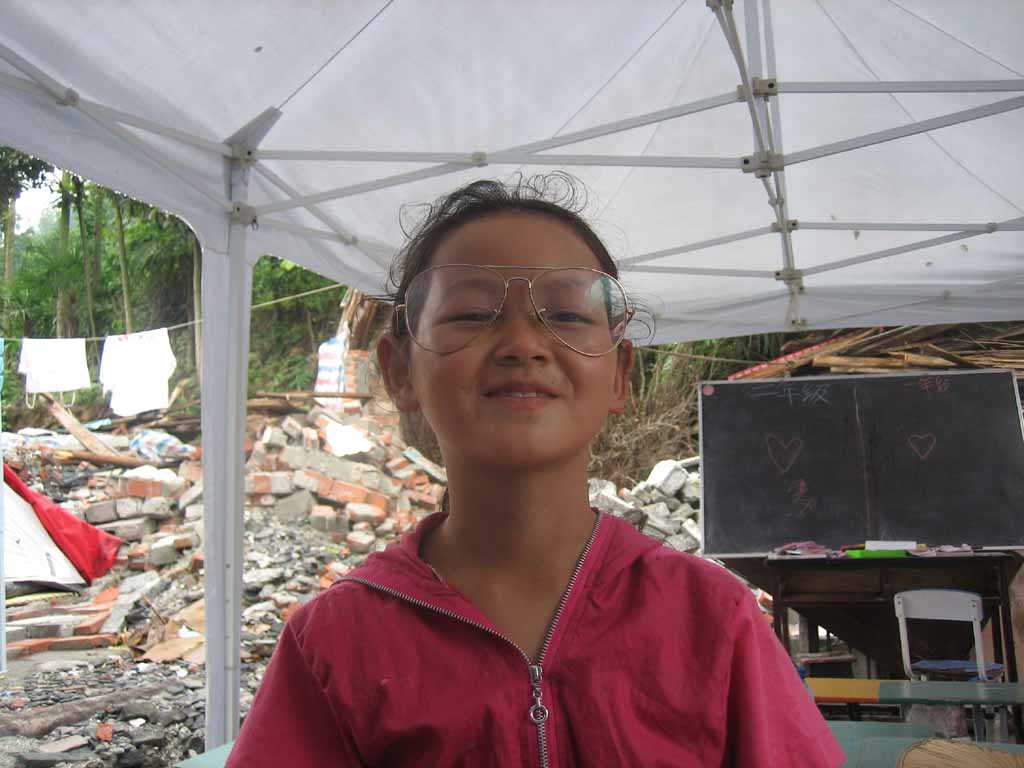 It's hard to leave these precious kids behind. In spite of everything they have been through, they are quite cheerful. But what can I do for them? This is the third summer that I have taught children in the countryside. Every time I do this, I try to give kids some new things to think about--some little insight into the world outside. Really, I am trying to help them see the world through my eyes. Kids often like to try on my glasses to see what the world looks like through my eyes. But my glasses don't fit them. In truth, they can never really see the world through my eyes, because they simply do not have my perspective. But perhaps I can give them some measure of it. And I can also try to see the world through their eyes. It takes a lot of patience to see the world through another person's eyes. A lot of listening. When I first started going to the English Corner at Renmin University in Beijing, I remember feeling frustrated, because so many Chinese young people, although they may be very intelligent, have a relatively limited view of the outside world, because the news they read is filtered. But I have discovered over the years that they are frustrated too. "You're a foreigner; you don't understand." When an argument gets particularly heated, I have learned to say, "What do you think?" or "How do you feel about this?"
 I came here to teach. But teaching is very educational. I have learned. I have learned that no matter how great the tragedy, people do bounce back. I have learned that sometimes the way you help people is as important as the help itself. The government is promising to have temporary shelters built for every family, and that's important. But these country folks don't want to go to some temporary shelter. They want to stay in their homes. As much as possible, we should try to help them build their unique lives so as to help them stay in these beautiful surroundings, rather than being scrunched into a sterile prefab neighborhood. Wouldn't it be wonderful if hundreds of young people could be enlisted to help these folks rebuild their own homes? I have learned that sometimes you don't have time to wait until you can put together a sophisticated organization. Just do it. That's what these Christians have done, and the local folks appreciate them so much for it.
I am back in Chengdu now. Sitting here at Starbuck's feeling clean and refreshed after a hot shower, it is easy to be philosophical. Perhaps I should not be too hasty in drawing conclusions, but I hate reading headlines like this one:
"Beichuan to be laid to rest as China moves survivors to new settlement."
And the first line really upsets me: "The town hit hardest by China’s earthquake, will never live again."
I don't believe it. Mark my word, people. Beichuan will rise again. You just watch.
Sunday, July 13, 2008
Sunday. The volunteers got together this morning and had a little time of fellowship. This little group of Christians is pretty impressive. You know, it's one thing for someone like me to spend a few days in a camp with no electricity and no shower, but these kind folks have been living here for several weeks, conducting a summer school program for the neighborhood children, and cooking without the benefit of refrigeration. It's pretty impressive. They are amazingly well organized. Their camp is set up on the floor of what used to be the home of one of the middle school students I talked to. Just a group of tents, and a small stove for cooking. Lots of bottled water brought in by other members of the team who shuttle back and forth from Minyang. With all the work these ladies had to do, they still insisted on doing my laundry for me.
 Perhaps the most visible evidence of their presence is the tent school they have set up for neighborhood children. The earthquake disrupted the school year for these kids, so anything that can be done to help them catch up is helpful. But just keeping them busy must be a big help to the community, because these kids have lost their homes. They live in tents, and don't really have a place to hang out during the day. Giving them a place to go and something to do is a kindness to a community that is so preoccupied with just getting by as they begin the arduous process of putting their lives back together. Beyond this, though is the fact that university entry is highly competitive in China. These kids are at a disadvantage to begin with. Anything that can be done to give them a "leg-up" is more than welcome. The presence of these kind people who are willing to live in such adverse conditions to extend a helping hand is really a gift from heaven.
 Perhaps the most visible evidence of their presence is the tent school they have set up for neighborhood children. The earthquake disrupted the school year for these kids, so anything that can be done to help them catch up is helpful. But just keeping them busy must be a big help to the community, because these kids have lost their homes. They live in tents, and don't really have a place to hang out during the day. Giving them a place to go and something to do is a kindness to a community that is so preoccupied with just getting by as they begin the arduous process of putting their lives back together. Beyond this, though is the fact that university entry is highly competitive in China. These kids are at a disadvantage to begin with. Anything that can be done to give them a "leg-up" is more than welcome. The presence of these kind people who are willing to live in such adverse conditions to extend a helping hand is really a gift from heaven.
Saturday, July 12, 2008
Driving rain last night. Hank and I lay on the platform being used as a bed and watched a movie on his iPhone. Robin Williams in some flick about a guy who is trying to be a successful businessman and take his family on vacation at the same time. I was struck by the irony of this movie in the environment I was in. But it shows that the Americans really do know that family should come first. Yet, they continue to throw their families to the wind in pursuit of their careers. I am afraid urban China is headed down the same road. So different from what family life is like here in the countryside.
Click here for larger image.
 This afternoon we went down the hill a bit to the demolished home of an elderly lady and helped her clean bricks and remove rubble from her (former) living room. The scene was pretty pathetic, because there really isn't much left of her home. But I suppose if we can manage to clean the old bricks, they an be reused, saving some on the cost of rebuilding.
When the earthquake struck, her husband was in the hospital. He was protected from falling bricks by a door that fell on him, and has since been moved to a hospital in Chongqing. He has been paralyzed for many years, so this lady has had to feed him, in addition to working in the field to make what money she could from her small farm. Even in the best of times, she was living a hard China life. And now this. But she was smiling and cheerful the entire time we were there. The relentless cheerfulness of these pleasant country people in the face of such a devastating interruption is a testimony to the power of God's creation in this beautiful valley to lift the spirits and give one the belief that life will go on. But will this lady be able to stay here? This is her life. She doesn't want to leave. But what will she do when winter comes?
Click here for larger image.
 This afternoon we went down the hill a bit to the demolished home of an elderly lady and helped her clean bricks and remove rubble from her (former) living room. The scene was pretty pathetic, because there really isn't much left of her home. But I suppose if we can manage to clean the old bricks, they an be reused, saving some on the cost of rebuilding.
 When the earthquake struck, her husband was in the hospital. He was protected from falling bricks by a door that fell on him, and has since been moved to a hospital in Chongqing. He has been paralyzed for many years, so this lady has had to feed him, in addition to working in the field to make what money she could from her small farm. Even in the best of times, she was living a hard China life. And now this. But she was smiling and cheerful the entire time we were there. The relentless cheerfulness of these pleasant country people in the face of such a devastating interruption is a testimony to the power of God's creation in this beautiful valley to lift the spirits and give one the belief that life will go on. But will this lady be able to stay here? This is her life. She doesn't want to leave. But what will she do when winter comes?
Friday, July 11, 2008
"O Divine Love, conceal yourself, leap over our suffering, make us obedient! Mystify us, arouse and confuse us. Shatter all our illusions and plans so that we lose our way, and see neither path nor light until we have found you, where you are to be found and in your true form--in the peace of solitude, in prayer, in submission, in suffering, in succour given to another, in flight from idle talk and worldly affairs."
So, according to the mystic, we find God in doing His will. But the specific emphasis of this book is on doing God's will in the present moment. This is my current preoccupation, actually. Of course I have always believed that we should be committed to God's will in the larger sense. But recently I have begun to think more and more about how to find God's perfect will in this very moment in which I find myself. I suppose it is, in part, a preoccupation that comes with the passing of the years. When I was young, I could always dismiss a poor decision or missed opportunity by saying, "there'll be another time." But as the years go by, I begin to realize how precious the moments really are, and expressions like "killing time" seem almost blasphemous. Time is precious. As Chairman Mao put it, "Ten thousand years is too long! Seize the day! Seize the hour!
Beichuan. We left Chengdu this morning. We took the bus to Mianyang and had lunch with the folks from Beichuan, and then rode with them to Beichuan in their minivan. Actually, they are not from Beichuan. They are a group of house church believers who have set up a makeshift school and relief center in Beichaun. Really nice people.
This is a very mountainous area, so it would not necessarily be a smooth ride anyway, but today there were several places where the road was blocked because of work they are doing to prepare the damage.
Beichuan is situated in a beautiful mountain valley. It was a sunny day, and when we got there, the children in the tent school set up by the house church Christians greeted us loudly. We had picked up a kindergarten teacher on the way, so she and I taught the students some basic introductions in English.
 This afternoon, after the children had gone home, I was talking with a couple middle school students. Actually, they were upper middle school students. In other words, they had just graduated from high school. They told me that, when the earthquake happened, they had jumped out the window of their third floor classroom. I was incredulous--neither of them seemed to have suffered any broken bones.
"You jumped from the third floor!?"
"By this time, the third floor had become the second floor or the first floor."
I didn't need to ask them what had happened to the students who were on the first floor, or who had run to the first floor to get out of the building. By the time they got to the first floor, they would have been in the basement, a grave from which there was no hope of escape. Nearly a thousand students are still entombed beneath the rubble that used to be Beichuan Middle School. Lives horribly disrupted, and yet,life goes on. One of the young ladies told me that the tent school is actually set up where her home used to be. Nothing is left of it but the floor.
So, according to the mystic, we find God in doing His will. But the specific emphasis of this book is on doing God's will in the present moment. This is my current preoccupation, actually. Of course I have always believed that we should be committed to God's will in the larger sense. But recently I have begun to think more and more about how to find God's perfect will in this very moment in which I find myself. I suppose it is, in part, a preoccupation that comes with the passing of the years. When I was young, I could always dismiss a poor decision or missed opportunity by saying, "there'll be another time." But as the years go by, I begin to realize how precious the moments really are, and expressions like "killing time" seem almost blasphemous. Time is precious. As Chairman Mao put it, "Ten thousand years is too long! Seize the day! Seize the hour!
Beichuan. We left Chengdu this morning. We took the bus to Mianyang and had lunch with the folks from Beichuan, and then rode with them to Beichuan in their minivan. Actually, they are not from Beichuan. They are a group of house church believers who have set up a makeshift school and relief center in Beichaun. Really nice people.
This is a very mountainous area, so it would not necessarily be a smooth ride anyway, but today there were several places where the road was blocked because of work they are doing to prepare the damage.
Beichuan is situated in a beautiful mountain valley. It was a sunny day, and when we got there, the children in the tent school set up by the house church Christians greeted us loudly. We had picked up a kindergarten teacher on the way, so she and I taught the students some basic introductions in English.
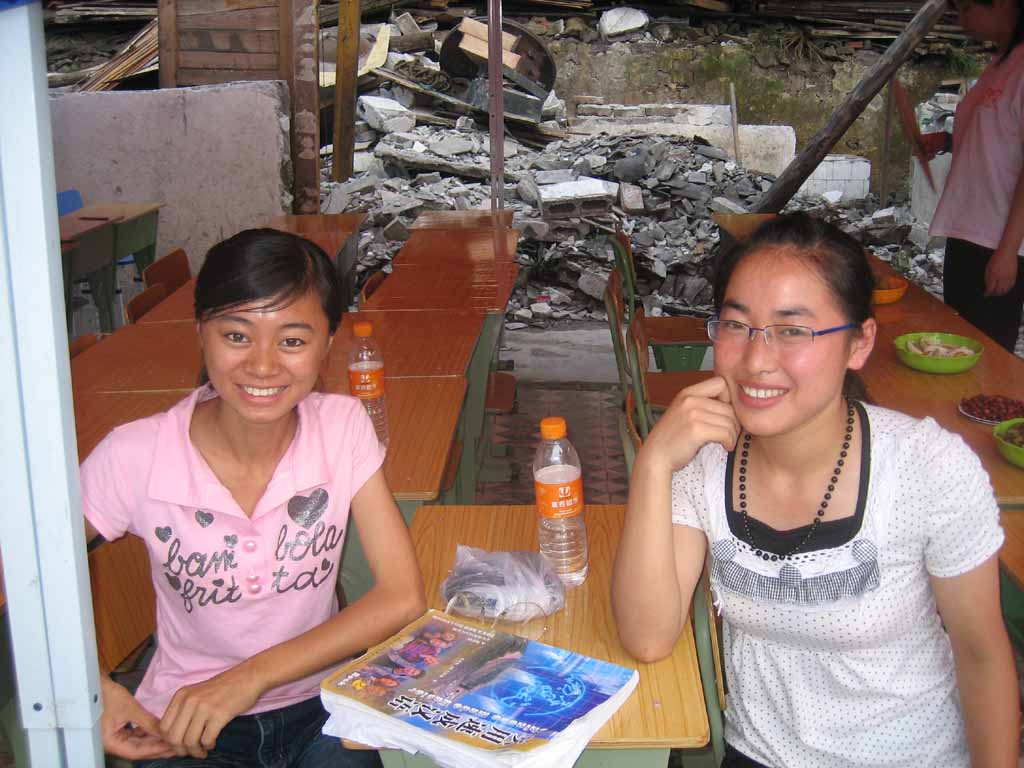 This afternoon, after the children had gone home, I was talking with a couple middle school students. Actually, they were upper middle school students. In other words, they had just graduated from high school. They told me that, when the earthquake happened, they had jumped out the window of their third floor classroom. I was incredulous--neither of them seemed to have suffered any broken bones.
 "You jumped from the third floor!?"
"By this time, the third floor had become the second floor or the first floor."
I didn't need to ask them what had happened to the students who were on the first floor, or who had run to the first floor to get out of the building. By the time they got to the first floor, they would have been in the basement, a grave from which there was no hope of escape. Nearly a thousand students are still entombed beneath the rubble that used to be Beichuan Middle School. Lives horribly disrupted, and yet,life goes on. One of the young ladies told me that the tent school is actually set up where her home used to be. Nothing is left of it but the floor.
Thursday, July 10, 2008
"...Thus, the present moment is like a desert in which simple souls see and rejoice only in God, being solely concerned to do what he asks of them. All the rest is left behind, forgotten and surrendered to him. God uses these souls to undertake and carry out his secret purpose, whether it occupies them passively within themselves or actively outside themselves. Their participation in this outward employment is voluntary and tangible yet at the same time innate and mystical. That is to say that God, satisfied that in their willingness he has found all he needs to accomplish whatever he may ordain, spares them trouble by bringing to pass for them what otherwise they would have had to achieve through their own endeavor. It is as though someone seeing a friend wishing to make a journey, were to do him a good turn by forthwith entering into him and going on a journey on his behalf; so that the friend wishing to make the journey has, at at the same time, made it by virtue of this mysterious substitution. The journey will have been free, being the result of a free decision on the part of him at whose expense it was made. It will be transcendental because it will have been accomplished without effort on the part of the friend. Finally, it will be mystical because its origin is unseen."
Hmmm... so who's taking this trip, me or God? But I think I understand what he is saying. Not sure if I would have expressed it exactly this way, but I do commend him for the effort, because the point does have to be made. It is a principle which, if lost, will result in unending frustration for the servant of God who is trying to accomplish God's purpose through human effort. We can never truly accomplish God's purpose except by God's effort. So regardless of how we might express it, there is necessarily a certain transcendence in knowing and doing God's will, because we cannot merely read a manual, follow it in our own strength, and expect to bear fruit that will please God. You can call it different things. I tend to refer to it is God's anointing. So I would say that if we move under the anointing, we will have a much more fruitful and rich experience, because we are sent by God to do the work that He ordains. But, although I pray constantly for the Lord's anointing, it is not as if I can just ask God to pour his oil of blessing on any old plan I come up with. Our prayer for God's anointing can only be honest if we are, at the same time, waiting on Him to show us His purpose. So we wait patiently for God's direction, then began to move in the way He leads, and then we can pray quite freely for His anointing, because God has no reason not to bless what He himself has ordered.
Hmmm... so who's taking this trip, me or God? But I think I understand what he is saying. Not sure if I would have expressed it exactly this way, but I do commend him for the effort, because the point does have to be made. It is a principle which, if lost, will result in unending frustration for the servant of God who is trying to accomplish God's purpose through human effort. We can never truly accomplish God's purpose except by God's effort. So regardless of how we might express it, there is necessarily a certain transcendence in knowing and doing God's will, because we cannot merely read a manual, follow it in our own strength, and expect to bear fruit that will please God. You can call it different things. I tend to refer to it is God's anointing. So I would say that if we move under the anointing, we will have a much more fruitful and rich experience, because we are sent by God to do the work that He ordains. But, although I pray constantly for the Lord's anointing, it is not as if I can just ask God to pour his oil of blessing on any old plan I come up with. Our prayer for God's anointing can only be honest if we are, at the same time, waiting on Him to show us His purpose. So we wait patiently for God's direction, then began to move in the way He leads, and then we can pray quite freely for His anointing, because God has no reason not to bless what He himself has ordered.
Wednesday, July 09, 2008
Dreams Travel International Youth Hostel. Hard to believe it has been four years since I was here last. The place is pretty much the same, but a little dead, because the cooks are gone due to the earthquake, so they are not able to staff the restaurant. But the location is very good for me, because it is quite near the university where the others are staying. They had actually booked a hotel for me, but I told them I would rather stay at the youth hostel. Cheap hotels in China are not that inviting, but most local people have never heard of youth hostels. I paid 30 RMB a night, but I met a guy who told me that he booked online and got it for 9 RMB. That's a dorm bed, of course, not a private room, but still quite comfortable, and Starbucks is right down the street.
Picked up a used book some time ago, but I just haven't gotten around to reading it. It is a translation by Kitty Muggeridge (wife of Malcum Muggeridge) of Abandonment to Divine Providence by Jean Pierre de Caussade, the 18th Century French mystic. She changed the title. She calls it The Sacrament of the Present Moment. You will know why she chose that title if you understand the mystic's belief that the present moment is a sacrament from God. So we are abandoning ourselves to God's divine will as we give ourselves to the present moment. At least I think that's what he believed. I'll let you know if I get any great insight.
Picked up a used book some time ago, but I just haven't gotten around to reading it. It is a translation by Kitty Muggeridge (wife of Malcum Muggeridge) of Abandonment to Divine Providence by Jean Pierre de Caussade, the 18th Century French mystic. She changed the title. She calls it The Sacrament of the Present Moment. You will know why she chose that title if you understand the mystic's belief that the present moment is a sacrament from God. So we are abandoning ourselves to God's divine will as we give ourselves to the present moment. At least I think that's what he believed. I'll let you know if I get any great insight.
Tuesday, July 08, 2008
Star, Raymond, Maria, Melissa and I went to Melody KTV for an evening of Karaoke. I am flying to Chengdu tomorrow, so I won't be seeing Melissa again before she leaves. Fortunately, Maria picked a really good place. You know, with Karaoke, most of the songs are in Chinese, and I don't know enough kanji to read comfortably yet, but they also have a selection of old English songs, and fortunately, I am old enough to actually know some of them. But for me, the main reason for going to Karaoke is not for singing. Its a nice way to socialize in a comfortable, non rushed environment. This one is set up so that if you order a meal, the room is free. There is a minimum charge, but if you have enough people, you're going to pay that anyway. And the food was pretty good.
Monday, July 07, 2008
Finally bought a plane ticket today. For several weeks, I have been working on putting together some kind of team to go to Sichuan Province to help out. The first thing I did was to contact Red Cross China. But I kept getting a message that their email address didn't work. Finally, I contacted Joy in Shanghai, to see if she could help me. She tried to contact them too, but didn't have any better luck. Finally, she referred me to someone in her church who had been invloved , and seemed to know sonething about it. I wrote to this lady, and she contacted the local church in one of the communities outside of Chengdu. They were invovled with relief work, but were understandably ambivalent about taking help from a clumsy foreigner who didn't speak Mandarin that well, to say nothing of the local Sichuan dialect. I told Joy that I would just wait. God has been teaching me to wait patiently for the open door, and not try to pound down closed ones. I must admit I am not always the best student, but I think I'm slowly getting better at it.
Next I contacted Cindy, who is a house church Christian, and she referred me to a group of students who were going to be going out there. i met with them, and felt very positive about what they were doing. There are some unique advantages about going with a group of students. They tend to be a little more multicultural, and are infinitely less bureaucratic. "Sure, you can go with us!"
Next I contacted Cindy, who is a house church Christian, and she referred me to a group of students who were going to be going out there. i met with them, and felt very positive about what they were doing. There are some unique advantages about going with a group of students. They tend to be a little more multicultural, and are infinitely less bureaucratic. "Sure, you can go with us!"
Wednesday, July 02, 2008
Maria, Melissa and I went to the IMAX over by People's University to see Kung Fu Panda last night. Really a hit in China right now. Last Sunday morning, I was watching Dialogue, and Yang Rui was asking some folks in the movie industry, "What can we say if Hollywood does a better job of presenting Chinese values to the world." It's a fair question, but in fact, I think the fifth generation of movie directors in China have actually done the best job presenting the best of Chinese values. The problem is that their movies were not hits. Zhang Yimou and Chen Kai-ge were clearly influenced by the success of Ang Lee's Crouching Tiger, Hidden Dragon in the States, which is unfortunate, because they both left off making good drama about life in China during difficult times, and moved to making action movies. My point is that the best movies are not always the most popular movies. I took Melissa to see Chen Kai-ge's Together at a theater in Scottsdale, Arizona before I came to China. That is a powerful film, but very few know it. There were three other people in the theater that evening.
But Kung Fu Panda is a good movie, no question about that. I am not really a fan of kung fu movies. Truth is, I really don't go much for macho flicks of any kind, because even though they are not animated in the technical sense, like this one was, they are still really cartoons in every other sense of the word. Fantasy. Real people--I mean the real hero's that are an example to us and help us (by their example) to bring the right frame of mind to difficult times--do not solve their problems by magically jumping over them. The characters in Zhang Yimou's movies (I mean the old ones) deal with the situations of life by suffering through them. There is just something so much more wholesome about a drama that shows the dynamic of suffering in difficulty, and the anguish of heart that real people feel in the face of seemingly insurmountable obstacles.
But I did like this movie. The reason, I guess, is because the movie was not a classic "macho flick" by any means. The hero was unlikely. Likeable, to be sure, but unlikely. That's real. David and Goliath. And the whole thing was presented in a setting of humor. And it was creative and original. I have become quite weary of sequels. If they come out with a Kung Fu Panda II, I won't go see it. But I might see this one again.
But Kung Fu Panda is a good movie, no question about that. I am not really a fan of kung fu movies. Truth is, I really don't go much for macho flicks of any kind, because even though they are not animated in the technical sense, like this one was, they are still really cartoons in every other sense of the word. Fantasy. Real people--I mean the real hero's that are an example to us and help us (by their example) to bring the right frame of mind to difficult times--do not solve their problems by magically jumping over them. The characters in Zhang Yimou's movies (I mean the old ones) deal with the situations of life by suffering through them. There is just something so much more wholesome about a drama that shows the dynamic of suffering in difficulty, and the anguish of heart that real people feel in the face of seemingly insurmountable obstacles.
But I did like this movie. The reason, I guess, is because the movie was not a classic "macho flick" by any means. The hero was unlikely. Likeable, to be sure, but unlikely. That's real. David and Goliath. And the whole thing was presented in a setting of humor. And it was creative and original. I have become quite weary of sequels. If they come out with a Kung Fu Panda II, I won't go see it. But I might see this one again.

